Short Story Review: Charles W. Runyon’s “First Man in a Satellite” (1958)

The following review is the 11th installment of my series searching for “SF short stories that are critical in some capacity of space agencies, astronauts, and the culture which produced them.” Some stories I’ll review in this series might not fit. And that is okay. I relish the act of literary archaeology.

Preliminary Note: I am getting a bit carried away by this project. The historian in me rears its obsessive head. I experience intense enjoyment reading any and all stories on the theme regardless of their quality. I know my readers might want me to feature some higher quality stories. Right? While I have a few average to solid stories in the docket read and waiting for reviews, I plan on tackling some harder-hitters in the near future (more Malzberg, Ballard, Sturgeon, etc.).

I had fun writing about this one! As always, feel free to join the conversation.

Previously: Roger Zelazny’s “Halfjack” (1979)

Up Next: J. G. Ballard’s “The Cage of Sand” (1962)
2.75/5 (Vaguely Average)

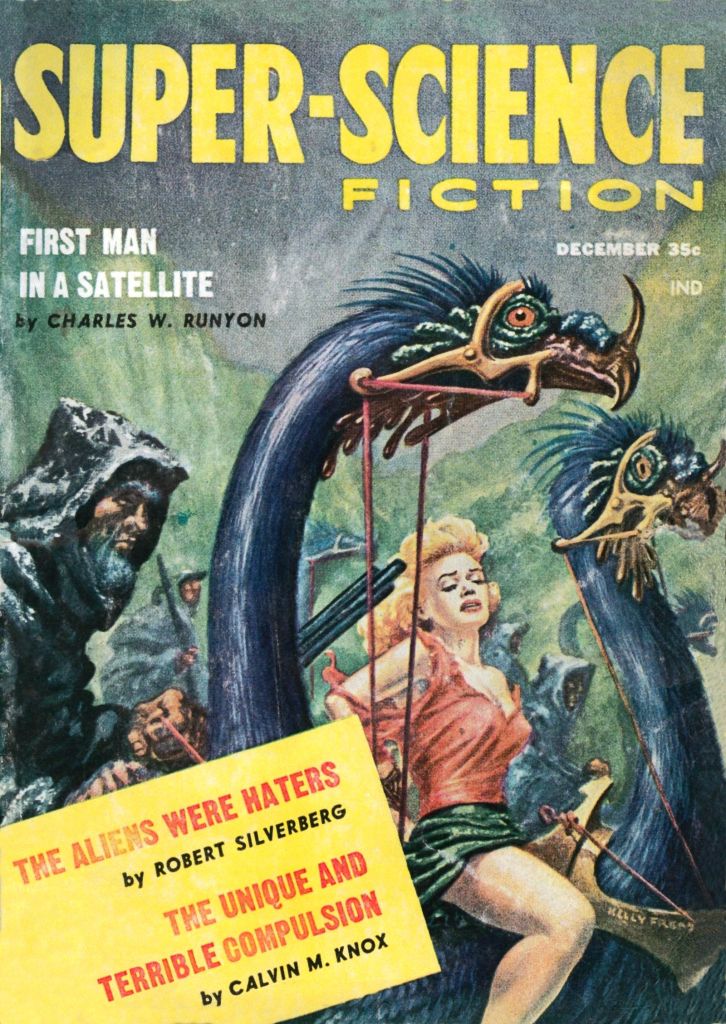
Charles W. Runyon’s “First Man in a Satellite” appeared in Super-Science Fiction (December 1958), ed. W. W. Scott. You can read it online here.

For two years of my youth in the early 1990s, I lived in Washington, D.C with the National Air and Space Museum a few blocks away from our tiny home in Dupont Circle. While I could not yet read, I knew how long it should take for my parents to read each and every exhibit label to me. And, agape at Able the monkey’s space couch and preserved body, I asked the predictable question: “did she survive the voyage into space?” “She did,” my mother would said, “she died soon after.” “And the monkeys before her?”

Continue reading

Short Story Review: Frederik Pohl’s “The Hated” (1958)

The following review is the 9th post in my series searching for “SF short stories that are critical in some capacity of space agencies, astronauts, and the culture which produced them.” Some stories I’ll review in this series might not fit. And that is okay. I relish the act of literary archaeology.

As always, feel free to join the conversation!

Previously: Philip K. Dick’s “A Little Something For Us Tempunauts” (1974)

Up next: Roger Zelazny’s “Halfjack” (1979)

3.75/5 (Good)

Frederik Pohl’s “The Hated” (1958) first appeared in the January 1958 issue of Galaxy Science Fiction, ed. H. L. Gold. He wrote it under the pseudonym Paul Flehr. You can read it online here.

“The Hated” (1958) postulates that astronauts will require psychological conditioning to survive the confines of space travel to Mars. In Pohl’s future, the Mars-craft crams six men in a space the size of a Buick (51). The continuous sounds of machine and crew, the fetid taste of the air filled with sweat, the omniscient fear of crushing your oxygen line while sleeping, the free fall, the dreams of drowning, generates an intense drive to kill your crewmates. Byron, the narrator, wants a knife for Sam, to strangle Gilvey with his bear hands, gun Chowderhead with one bullet to the belly, turn a tommy gun on Wally, and cage the captain with hungry lions. The conditioning is “like a straightjacket”–Byron elaborates: “You know how to make a baby cry? Hold his hands […] What they did to us so we couldn’t kill each other, it was like being tied up, like having out hands held so we couldn’t get free” (50).

Continue reading

Short Story Reviews: Carol Emshwiller’s “This Thing Called Love” (1955), “Love Me Again” (1956), and “The Piece Thing” (1956)

I have decided to do something I have never done before–read a contiguous chunk of an author’s work in chronological order. “Philip K. Dick? Robert A. Heinlein?” you might ask. “No! You know me….” I respond [in jest]. I have chosen to chart Carol Emshwiller’s short stories published in genre magazines and anthologies between 1955 and 1979. SF Encyclopedia conveys my fascination best: “In her hands, sf conventions became models of our deep estrangement from ourselves.” Of the two short stories of hers I’ve read–“Animal” (1968) and “Lib” (1968)–the former, an unnerving fable of the sexualized “Other” whose exclusion reinforces a community’s self-identity and cohesion, resides in my mind like a luminescent beacon. And I have finally latched on to its ever-present light.

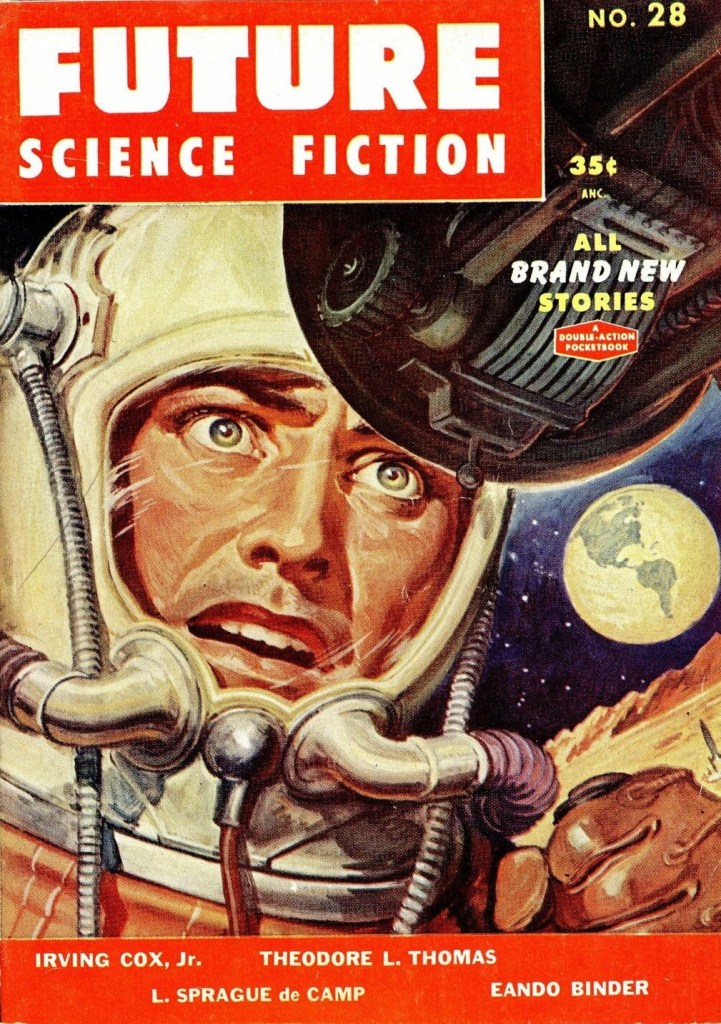
If you are interested in all of Emshwiller’s short stories, check out Nonstop Press’ 2011 (vol. 1) and 2016 (vol. 2) omnibus release which includes those in non-SFF genre magazines. Here’s an example of what I am cutting: while her first published short story “Built for Pleasure” was SF, it only appeared in Long Island Suburban (November 1954) before the omnibus. Instead, I will start with 1955’s “This Thing Called Love” in Future Science Fiction, #28, ed. Robert A. W. Lowndes.

As I’ve only scratched the surface of Emshwiller’s output and can’t adequately summarize her work (I hope to by the end of this project), here’s the blurb from the Nonstop edition:

“Crossing the boundaries between fabulist literature, science fiction, and magical realism, the stories in this collection offer a valuable glimpse into the evolution of Carol Emshwiller’s ideas and style during her more than 50-year career. Influenced by J. G. Ballard, Steven Millhauser, Philip K. Dick, and Lydia Davis, Emshwiller has a range of works that is impressive and demonstrates her refusal to be labeled or to stick to one genre. This exhilarating new collection marks the first time many of the early stories have been published in book form and is evidence of the genius of Emshwiller, one of America’s most versatile and imaginative authors.”

This series will happen concurrently with the other short story reading exploration I am conducting and other reviews I have planned. Caveat: like my attempt to watch and review Survivors (1975-1977), this series could stop after three posts or take five years. I am a reader of whim.

Her next three published short stories can be found in Part II.


“This Thing Called Love” (1955), 3.5/5 (Good). First appeared in Future Science Fiction, #28 (1955), ed. Robert A. W. Lowndes. You can read the story online here.

Continue reading

Book Review: Project Barrier, Daniel F. Galouye (1968)

3/5 (collated rating: Average)

In the early days of my site, I reviewed Daniel F. Galouye’s best-known novel Dark Universe (1961) and A Scourge of Screamers (1966). Since then I’ve attempted to read Simulacron-3 (1964), adapted into a fantastic German mini-series World on a Wire (1973) and The Thirteenth Floor (1999), three times without success. What can I say, I’m a reader of whim and in each instance I wasn’t in the mood. Maybe it was Bill Botton’s compelling/bizarre psychedelic cover for Project Barrier (1968) or perhaps Rich Horton’s comments on twitter about the title story but I decided to give Galouye’s short fiction a go.

Project Barrier (1968) contains four uneven tales with one notable standout–“Rub-a-Dub” (variant title: “Descent Into the Maestrom”) (1961)–which I highly recommend if disturbing psychological SF is up your alley. The others in the collection exude a more run-of-the-mill feel. I found it refreshing that Galouye, a veteran greatly impacted by war injuries, tends to eschew violent conflict for peaceful resolution.

Continue reading

Book Review: Survival Ship and Other Stories, Judith Merril (1974)

Derek Carter’s cover for the 1st edition

3.5/5 (collated rating: Good)

Ever since I read Judith Merril’s “Daughters of Earth” (1952), I’ve been fascinated by her subversive takes 1950s-60s gender roles and classic SF tropes. Survival Ship and Other Stories (1974) contains twelve short stories and a never-before-published poem selected by the author.

In addition to the merits of the tales within, I found Merril’s brief reflections on her early work fascinating. For example, she ruminates on the failure of her planned novel based on the generation ship launched by The Matriarchy in “Survival Ship” (1951), “Wish Upon a Star” (1958), and “The Lonely” (1963). She also describes a magazine “cover story” commission. The author would be provided with the cover art and asked to write a story containing its elements! The following three in this Continue reading

Adventures in Science Fiction Interior Art: Monday Maps and Diagrams 2/22/21: Cordwainer Smith’s Instrumentality of Mankind Timeline

Detail from Darrel K. Sweet’s cover for the 1st paperback edition of The Best from Cordwainer Smith (1975)

Today’s installment of my occasional Monday Maps and Diagrams series is a self-reminder that I must get over the poor taste left in my mouth by two forgettable Cordwainer Smith short stories and dive into the meat of his Instrumentality of Mankind sequence. Which should I have read?

I’m a sucker for future history timelines (Olaf Stapledon, Robert A. Heinlein, and Isaac Asimov come to mind). They add a sense of time and scope to what, at first glance, might seem like disparate pieces. I often wonder how much an author plans out a timeline. This one, scanned from The Best of Cordwainer Smith (1975), places each of the Instrumentality of Mankind stories into a functional timeline. I’m assuming it adds to the series’ sense of historical development and societal evolution?

Let me know what you think of the series and the timeline in the comments!

John J. Pierce’s timeline (he wrote the intro article) in the 1975 Ballantine Paperback edition

Isfdb.org note on the timeline’s publication history: “There are (at least) 2 variants of this timeline. A table version titled The Instrumentality of Mankind appears in the original July 1975 Nelson Doubleday hardcover. A reformatted graphical version titled Timeline from THE INSTRUMENTALITY OF MANKIND appears in Continue reading

Recent Science Fiction and Fantasy Purchases No. CCLXVII (Daniel F. Galouye, Gordon Eklund, Lisa Tuttle, George R. R. Martin, and Andrew Sinclair)

As always, which books/covers/authors intrigue you? Which have you read? Disliked? Enjoyed?

1. Windhaven, George R. R. Martin and Lisa Tuttle (1981)

Vincent Di Fate’s cover for the 1st edition

From the inside flap: “The planet Windhaven was settled by humans after the crash of a colony starship. Survivors discovered that people could actually fly on this world, aided by the light gravity and dense atmosphere, and using wings made from a virtually indestructible metal fabric that had once been part of the starship. On this planet of small islands, monster-infected seas Continue reading

Short Story Reviews: Theodore L. Thomas’ “Broken Tool” (1959), “The Far Look” (1956), and “The Good Work” (1959)

The following review of Theodore L. Thomas’ “Broken Tool” (1959) is the 6th post in my series on “SF short stories that are critical in some capacity of space agencies, astronauts, and the culture which produced them.” I have gone ahead and added two additional stories, including one that explores similar territory with a more positivist conclusion, by the same author.

Thank you Jennifer Jodell, “Friend of the Site,” for bringing it to my attention.

Previously: Theodore Sturgeon’s “The Man Who Lost the Sea” )1959).

Up next: Kris Neville’s “Cold War” (1949)

Martinez’s interior art for Theodore L. Thomas’ “Broken Tool” (1959)

“Broken Tool” (1959), 3.5/5 (Good): You can read the story online here.

Theodore L. Thomas speculates on an unintended consequence of training cadets for deep space exploration—the creation of a radical, unmoored from earth, who only looks outward. Our Continue reading

Updates: Recent Science Fiction Purchases No. CCLXVII (Ben Bova, Margaret O’Donnell, Dennis Schmidt, and a themed anthology on gentle invaders)

As always, which books/covers/authors intrigue you? Which have you read? Disliked? Enjoyed?

1. Millennium: A Novel About People and Politics in the Year 1999, Ben Bova (1976)

Fred Marcellino’s cover for the 1st edition

From the inside flap: “We are thrust into the terrifying world of the future in this chilling novel about people and politics in the year 1999. The Earth’s population has soared to eight billion. The two major powers are on the brink of nuclear war as they vie for control of the planet’s dwindling supply of natural resources.

Meanwhile, a few hundred kilometers above the Earth’s surface, on their respective Moon colonies, the United States Continue reading