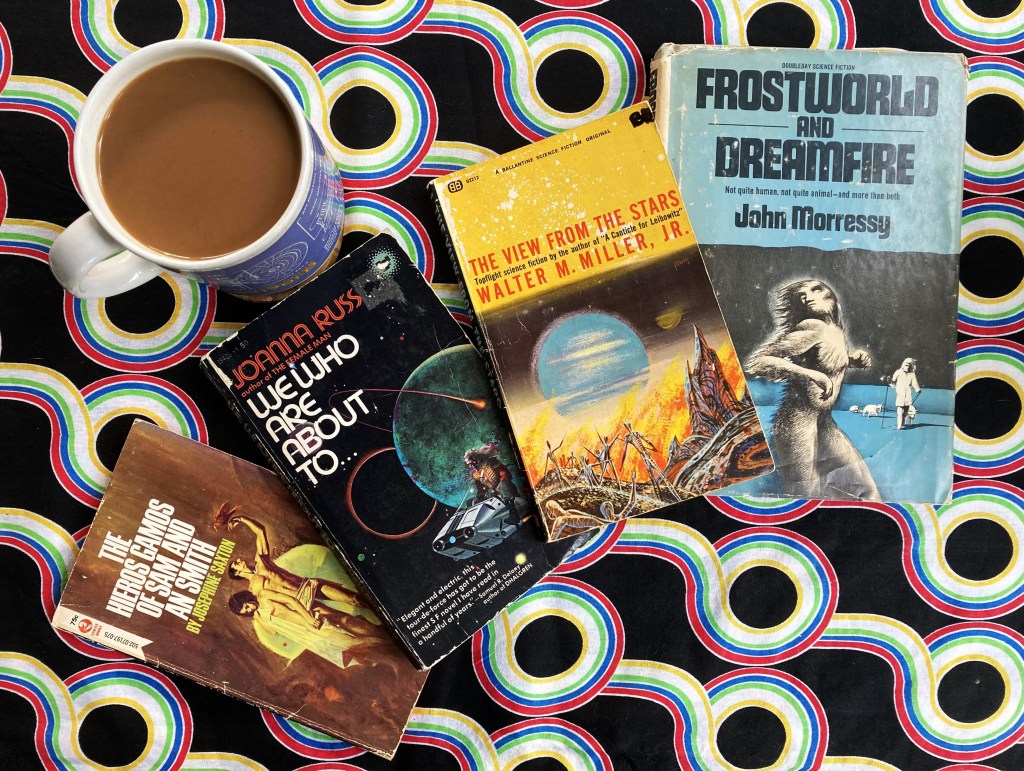
A selection of SF volumes from my shelves
What pre-1985 science fiction are you reading this weekend?
Thank you all for making this fanzine column a success! I’ve thoroughly enjoyed the conversations and connections you all have made in the comments. Make sure to check out the previous installment if you haven’t already. As before, I’ve included a bit about the books in the photograph, birthdays from the last two weeks, and brief ruminations on what I’ve been reading and writing.
Let me know what pre-1985 SF you’ve been reading!
As these posts seem to bring in new readers, if you’re curious about my rationale for the perimeters of my site, check out this recent interview and podcast.
The Photograph (with links to reviews and brief thoughts)
- Josephine Saxton’s The Hieros Gamos of Sam and An Smith (1969). I included this wonderful book as Saxton recently won the Cordwainer Smith Rediscovery Award. She joins the illustrious ranks of other underrated greats like D. G. Compton (2021 winner), Leigh Brackett (2005), R. A. Lafferty (2022), Judith Merril (2016), Wyman Guin (2013), et al. I’ve also reviewed Saxton’s first three published short fictions.
- Joanna Russ’ provocative and brilliant We Who Are About to Die… (1976). I love Russ. This is a reminder that I need to read more.
- Walter M. Miller, Jr.’s collection The View from the Stars (1965). I’ve you’ve only read the justly famous fix-up A Canticle for Leibowitz (1959) check out other short stories ASAP. I’ve more recently reviewed “Death of a Spaceman” (variant title: “Memento Homo”) (1954) and “The Hoofer” (1955).
- John Morressy’s Frostworld and Dreamfire (1977). His best novel? The plot is deceptively simple: a metamorphic alien survivor of a devastating plague attempts to track down remaining members of his species transported in the distant past off world. The effects of human intervention add to the ambiance and political background that propels the story forward. Morressy’s attention to anthropological detail and compelling characters elevates Frostworld and Dreamfire above others of its ilk.
What am I writing about?
Finally finished my review of Edgar Pangborn’s masterpiece Davy (1964). I’m a notorious note-taker (18 pages for Davy) and chew over meaty novels for weeks in order to put my thoughts in order. I have Kate Wilhelm, Edmond Hamilton, and Clark Ashton Smith short fictions up for my various series.
What am I reading?
I’m still working through Gerry Canavan’s brilliant Octavia E. Butler (2016) from the U. Illinois Modern Masters of Science Fiction series. Here’s another fascinating tidbit from the volume on the intersection of time-travel fiction and race.

A Curated List of SF Birthdays from the Last Two Weeks
July 23rd: Katharine Burdekin (1896-1963). Her bibliography. I’ve read far less pre-WWII science fiction than post-War. I need to dig out my copy of Swastika Night (1937).
July 23rd: Virgil Finlay (1914-1971). Whenever I open up a magazine and see a delicate Virgil Finlay illustration I feel a little thrill. He was also a competent cover artist. Do you have a favorite Finlay artwork?
July 23rd: Gardner Dozois (1947-2018). Best known as an editor, Dozois also wrote some wonderful science fiction. “Horse of Air” (1970) comes to mind.
July 23rd: C. M. Kornbluth (1923-1958). A Joachim Boaz favorite! Check out my recent review of the final story published in his lifetime “The Advent on Channel Twelve” (1958).
July 24th: Gordon Eklund (1945-). Here’s his bibliography. In the post-Trump world, a novel like The Eclipse of Dawn (1971) has far less impact….
July 24th: John D. MacDonald (1916-1986). Here’s his bibliography. If you’re new to his science fiction, check out my review of “Spectator Sport” (1950).
July 24th: Barry N. Malzberg (1939-). Without doubt in my top 5 science fiction authors… It’s best to go into his work with a glimpse of how he operates. I’d like to think my review of The Men Inside (1973) conveys what you’re in for!
July 25: The prolific 50s magazine author Evelyn E. Smith (1922-2000). While I own a bunch of her work, I’ve yet to explore it. Bibliography.
July 26th: Aldous Huxley (1894-1963). I hope you already know about him…
July 26th: M. John Harrison (1945-). Another Boaz favorite. Here’s one of his lesser known novels worth tracking down: The Committed Men (1971)
July 27th: Sydney J. Van Scyoc (1939-2023). As with Smith above, I’ve only explored the edges of Van Scyoc’s works. Few seem to have realized she passed away a few months ago. Bibliography.
July 28th: Artist Colin Hay (1947). A member of the Chris Foss clone legion of UK cover artists. If you adore Foss, you’ll probably like his work too.
July 28th: Jayge Carr (1940-2006). Another author mostly unknown to me… I own a copy of Leviathan’s Deep (1979) and Navigator’s Sindrome (1983). Her bibliography.
July 29th: Artist John Harris (1948-). List of covers.
July 31st: Italian author (who wrote a bunch of SF short stories) Primo Levi (1919-1987). Where do I start (SF)? I own his three-volume set of complete works.
August 2nd: Robert Holdstock (1948-2009). Here’s his bibliography. His novel Where Time Winds Blow (1981) was my best SF read of 2022.
August 3rd: Clifford D. Simak (1904-1988). Everyone knows Simak’s City (1952) and Way Station (1963). If you liked those, pick up a copy of Why Call Them Back From Heaven? (1967).
August 5th: Quebecoise/French SF author Élisabeth Vonarburg (1947-). I’ve picked up but never finished The Silent City (1981, trans. 1988). I need to give it another shot. Her bibliography includes what’s been translated.
August 5th: Per Wahlöö (1926-1975). I love Scandinavian SF in translation. If you need suggestions, let me know. As for Wahlöö, I picked up a copy of The Generals (1965, trans. 1974) but haven’t read it yet.
A Last Note
August is notoriously my least productive month of the year as my new semester starts… Teaching is a tough and time-consuming profession. I’ll try to buck the trend this year!
For book reviews consult the INDEX
For cover art posts consult the INDEX
For TV and film reviews consult the INDEX
 Science Fiction and Other Suspect Ruminations
I regret to report a lot of SF readers have no idea who Simak was and have never read or even heard of Way Station. Discovering that led me to review it in 2015.
My current read is a moderately obscure 1980 commercial fantasy novel from an author whose career seems to have come to an abrupt halt in 1995.
“moderately obscure 1980 commercial fantasy novel from an author whose career seems to have come to an abrupt halt in 1995.” — I must confess, you are not tantalizing me with that description!
I’d like to think that my website self-selects a bit for readers who might know a bit about Simak — and thus Way Station. But I could be wrong.
Well, the book is an interesting solution to the question “how do I write a LOTR pastiche that stands out from all the other LOTR pastiches that just hit the shelves?” And the end of her career came right about the time a lot of other authors suddenly stopped being published by Del Rey (although editor Owen Lock would say that’s a misleading statement).
You know you could just tell me the name of the book… hah.
Foreshadowing, the mark of quality literature.
Last week’s old book was 21-year-old Mark Geston’s 1967 Lords of the Starship, which takes the standard “noble lie that came true” trope and stands it on its head. Not an especially upbeat book.
I’ve reviewed the Geston on the site many years back. I told you about its undergrad history paper vibe (which irks me due to my profession but probably won’t bother others).
Have read ‘The Red Canary’ by Kate Wilhelm this week – and most of the other stories gathered in her ‘Infinity Box’ collection. I’ve enjoyed all of them – ‘April Fools’ Day Forever’ struck quite a chord as it cleverly played with ideas around immortality. That was considered the weakest story by your guest reviewer. Anyhow this has been my first time with Wilhelm and I will read some more of her output I’m sure.
‘The Red Canary’ is a bleak portrayal of a disentegrating society, with particular focus on its failing health system and lack of social care. A lot of what I was reading seemed not a million miles away from the UK’s wobbly health system at the moment.
I like the look of the Russ above. Unlike certain oldish SF items it looks easy to obtain as well.
Don’t judge the Russ by its cover. The contents are, well, completely different. Check out my review! https://sciencefictionruminations.com/2013/02/16/book-review-we-who-are-about-to-joanna-russ-1976/
I’ve read a ton of Wilhelm and most of the Infinity Box collection although I never reviewed it. I have reviewed the stories in The Downstairs Room and Other Speculative Fiction (1968) and Abyss (1971) and many other singleton stories and novels.
Did you see my recent review of Wilhelm’s “Ladies and Gentlemen, This Is Your Crisis” (1976)? So good! https://sciencefictionruminations.com/2023/06/05/short-story-reviews-kate-wilhelms-ladies-and-gentlemen-this-is-your-crisis-1976-and-langdon-jones-the-empathy-machine-1965/
All of this is to say, Wilhelm’s brand of SF definitely resonates with me.
Thanks – no hadn’t read the review of ‘Ladies…’.
The Russ looks like a fairly accurate account of what’s happening on planet Earth at this very moment. Looks right up my street.
Cheers.
If you have an Internet Archive link you can read the Wilhem story online (I provide a link in the review). It’s a bit more streamlined than some of her more oblique New Wavey late 60s and early 70s stories.
Let’s just hope that Wilhem never saw the UK cover for her novel… doesn’t seem like the artist (Geoff Taylor) got the vibe of the book.
Haha that’s fantastic. I bet she was really chuffed with that one.
So many SF book covers have well-endowed women on the covers – either with little on or in tight-fitting costumes. Maybe the publishers thought only teenage boys bought SF novels / thought they could lure teenage boys in that way. I dunno.
Or a bloaty interchangeable Foss spaceships. Hence my snarky comment about Foss and his clones in the post (Chris Moore, Peter Elson, Colin Hay, etc.). Of course, individual SF covers by those artists occasionally interest me…
Pageants, often with very scanty costumes, were a mainstay of SF conventions of the day. There are some amazing photos of Joe Haldeman (and his wife) with very very very little on….
Clifford Simak is without a doubt my go to science fiction author, maybe because of the “pastoral” (I love this word you use in your review of WCTBFH) nature of many of his stories. However, the dread suspense of DESTINY DOLL or random whacky imagery of his later novels is also appealing. Anyway, I’m going to revisit Why Call Them Back From Heaven a third time based on your review. Maybe I’ll finish it this time!
Most of my Simak reading happened before I started my website. What I’ve covered since then has been a bit hit and miss. Why Call Them Back from Heaven? is great but “The Birch Clump Cylinder” (1974) — umm… absolutely terrible.
Simak’s “Spacebred Generations” (variant title: “Target Generation”) (1953) was one of the earliest stories I covered for my generation ship short story review series. Solid. https://sciencefictionruminations.com/2019/11/27/generation-ship-short-story-review-clifford-d-simaks-spacebred-generations-variant-title-target-generation-1953/
Simak wrote a 1973 story called Construction Shack. It placed 3rd for the Hugo, and was anthologized in the del Rey Ace Best SF, the Arthur W. Saha & Donald A. Wollheim DAW Best SF, and other anthologies and collections. It was extremely dated and fairly dreadful. No idea what voters and editors saw in it and I have a shelf full of Simak.
I read “The Birch Clump Cylinder” and it was horrible as advertised! That’s why i come here, to find the good stuff instead. Thank you.
Unfortunately, I’ve reviewed very little of his work (3 novels and 2 short stories) — more an author of my teenage SF reading years whom I have not systematically returned to.
Which novels of Simak would you consider his best? Or, where do you think a good place to start would be? He’s someone I’m aware of but have never got around to reading. Thanks.
He’s an author more of my youth so I don’t have a ton of reviews on my site and my memories tend to be impressions more than clear thoughts. My favorite of his novels is Why Call Them Back From Heaven? (1967) which I reviewed on the site: https://sciencefictionruminations.com/2013/07/20/book-review-why-call-them-back-from-heaven-clifford-d-simak-1967/
The fix-up City (1952) and the Hugo-winning Way Station (1963) are considered his best. I have fond memories of both when I read them in my teens (half my life ago).
Cheers. On the vague subject, I enjoyed Wilhelm’s immortality story in ‘The Infinity Box’. Will keep an eye open for the above.
My dreams – well, nightmares – were haunted last night by the thought of a scantily-clad Joe Handleman.
I can always link it! I mean, I have to, you don’t have to click the link though. There’s an entire gallery near the bottom.
https://calisphere.org/item/ark:/86086/n2qr4vhn/
Well, thanks for that. Very chucklesome. I wonder if Robert Silverberg was there.
Hopefully my nightmares won’t drift into a full-blown neuroses.
I was semi-intrigued by the scrawlings on their bodies. At least he wasn’t in full Forever War kit.
Haha, that said, he was just a cosplaying fan in that photo. He hadn’t published anything yet. The photo is from 1966 and he’d be drafted for service in Vietnam the next year. His first story appeared in 1969. The short fiction “The Hero” appeared in 1972 and formed part of the 1975 The Forever War novel.
I’ve finished Leigh Brackett’s The Big Jump a few days ago and now I’m rereading Neuromancer. Next up is Karin Boye’s Kallocain.
I reviewed Brackett’s The Big Jump many many years ago on the site. Please note how old the review is — I’d like to think I’ve improved: https://sciencefictionruminations.com/2011/07/24/book-review-the-big-jump-leigh-brackett-1955/
Kallocain has been on my radar for a while. I should track down a copy.
Tempted to read anything I’ve covered recently? Maybe some of my favorite 2022 reads?
I reviewed Simak’s novella “Immigrant” for his birthday, and may have something in mind for his 120th next year.
Ah yes, Clark Ashton Smith. He’s fun, although he’s not much of a science fiction writer.
The Clark Ashton Smith one I read is straight out science fiction for my subversive accounts of space travel series.
Just posted the Smith review! I thoroughly enjoyed the story — as I mentioned to Rich below, it felt like the progenitor of many of the themes I’ve been exploring in my subversive account of space travel series.
I just finished Arthur C Clarke’s Childhood’s End and was surprised to find I didn’t like it at all – despite Adam Roberts’s approving introduction.
I have positive memories from my late teens when I read it. But the memories are far from distinct.
I also liked Childhood’s End as a teen, and on rereading it a few years ago I thought it held up well. For me, the one that didn’t was Rendezous with Rama. I still like the gimmicky ideas in it, but the plot consists entirely of the characters walking through the artifact and passively seeing these things. A few days after reading it, I couldn’t name or describe a single character, because they were all basically mannequins.
Speaking of Rama and other Big Dumb Object novels, I always trumpet James White’s far more psychologically disturbed All Judgement Fled (1968) over Rama. Although, like Childhood’s End, I loved Rama as a kid too. I dare not reread it.
Never read All Judgment Fled, but it sounds like I should. Thanks!
I wrote a short review 8 years ago: https://sciencefictionruminations.com/2015/12/19/short-book-reviews-if-all-else-fails-craig-strete-1980-my-petition-for-more-space-john-hersey-1974-and-all-judgement-fled-james-white-serialized-1967/
My favorite James White novel is still The Dream Millennium: https://sciencefictionruminations.com/2016/04/17/book-review-the-dream-millennium-james-white-serialized-1973-novel-1974/
I was the same. But time has not been kind to Clarke’s extrapolation, and there are a few bits and pieces here and there that made me really not like the Clarke revealed by the story.
Have you read a novel from your youth that has held up? I really am of the mind that unless it fits one of my major series or pet interests, I’m just not going to reread frequently. That said, I imagine that I would reaffirm my deep undying love for Brunner’s Stand if I were to reread it.
Several have done. Varley’s The Ophiuchi Hotline. Cherryh’s The Faded Sun. Van Vogt’s The Undercover Aliens. Delany’s Dhalgren.
I finished Odd John this morning and really liked it. I’m going to take a break from novels for a bit and read some old sci-fi comics, starting with the collected volumes of the French series Valerian and Laureline.
Speaking of SF comics (my knowledge is not substantial), Heavy Metal (after decades and decades) closed up shop.
I only just learned now, and how unfortunate. So many influential artists hit their big break there, like Richard Corben with his adult sword & sorcery epic “Den”, and Moebius’s experimental comics such as “The Airtight Garage”. The latter is a lot closer to new wave SF because of its completely improvised plot, right down to featuring an appearance by Jerry Cornelius.
Métal Hurlant, the original French comic, started up again a few years ago.
Good to hear that Saxton is getting some much deserved recognition. Hieros Gamos is my favorite of her novels, or at least of the ones I’ve read. I also really like Russ’ We Who are About To, but it’s the only one of hears I’ve read so far – would love to get my hands on more…
In the last couple of weeks I’ve read Ballards Hello America and Aldiss’ Who Can Replace A Man. Hello Amarica is in some ways quintessential Ballard, combining elements of his earlier dying worlds-stories with the Amarican pop culture obsesseion of The Atrocity Exhibition. At times, especially in the beginning, it seemed a bit like “Ballard going through the motions”, but it turned out to be a very satisfying read, as allways with Ballard.
Who Can Replace a Man was a mixed bag, but I found most of it very good. I’d agree with your review “Old Hundredth” is the best, but I’m a bit surprised you didn’t like “New Father Christmas” more – to me one of the very best and certainly strangest in the collection.
Rich Horton, who joins the discussion on the site frequently, is partly to thank as he’s on the committee that picked Saxton (and one of my favorites D. G. Compton two years ago).
I have a copy of Hello America but haven’t picked it up yet. I know it’ll be something I like.
To be honest, I read many of the stories in that collection have melded together a little — I reviewed it back in 2013. Maybe I’d appreciate it more after reading and covering so much more of his work.
Maybe Rich is into Doris Piserchia as well? That’s another overlooked one that I really think deserves some exposure.
I think there’s definitely a couple of stories in Replace a Man that are a less convincing – old school plot twist driven SF masquerading as experimental/more literary than the real new wave deal. “New Father Christmas” reminded me somewhat of Langdon Jones “The Hall of Machines”, which I think I recall you also liked a lot.
I was quite smitten (if that’s the word considering the terrifying story) with Doris Piserchia’s “Pale Hands” (1974). Did you see that recent review? I’ve reviewed a few more of her novels on the site. She definitely approaches SF from a unique outsider perspective. I’m not convinced all her stuff is successful but at the very least they’re different.
I recently read Paul Kincaid’s wonderful recent monograph Brian W. Aldiss (2022). It inspired me to finally get around to reading Hothouse. https://sciencefictionruminations.com/2022/11/06/book-review-hothouse-variant-title-the-long-afternoon-of-earth-brian-w-aldiss-1962/
Yes I read that review, sounds like a very good story.
I actually think I discovered your site when looking for Piserchia reviews, At her best she’s one of my all time favorites, her voice is completely unique and bizarre. Of course, plot as well as characters hardly really “work” in the traditional sense, her books read more like surreal fever dreams – absurd, at times almost comical (but not really “funny”), and often absolutely terrifying.
And now that you’re mentioning Hothouse: Pisercias Earth in Twilight is also about a future earth completely overtaken by giant plants (and bugs), with humans living like small, insignificant animals among the foilage. With Dischs Genosides that make at least three of this mini genre (but I’m sure theres more).
Ah, I don’t own a copy of Earth in Twilight yet. I’ll put it on the list. I enjoyed Disch’s The Genocides even more than Hothouse. But then again, The Genocides does a ton of things that speak to me… and it inspired probably the best review I’ve ever written.
Well, yes, Murray Leinster’s THE FORGOTTEN PLANET is another in the giant bugs/little people (relatively, anyway) genre. But don’t. Just don’t.
Lindsay Gutteridge’s Cold War in a Country Garden (1971) and its two sequels come to mind as well.
I’ve been on holiday so managed to get through a few books while away. I finished Sirius by Olaf Stapeldon and found it a really engaging read (much more so than his other efforts I have read). Finally got around to reading The Wild Shore by Kim Stanley Robinson and enjoyed it immensely, more so I think having fairly recently read Davy and found it intriguing to tease out the similarities in the two stories (post-apocalyptic societies, US cities and states de-centralised and isolated, a more feudal set up of society, fragmented technology and a simmering undercurrent of awakening sexuality).
I also read A Handmaid’s Tale and while it was a breezy enough read (and it feels somewhat flippant to describe as such) I didn’t really appreciate it in the same involved way I have enjoyed other dystopia type novels. Following that I read Dreamsnake by Vonda McIntyre and it was immeasurably better, felt I was safely back onto post-apocalyptic ground! The characterization and development of the relationships was so much more rounded and brought me right into the landscapes and situations Snake found herself in.
The Farthest Shore by Ursula Le Guin was the last part of the Earthsea trilogy I had yet to read having greatly enjoyed the previous installments and like McIntyre the world building and characterization by Le Guin is top notch to me but I found this novel lacking in comparison to the previous two in the series, particularly the last few chapters which felt, to me, a little rushed and lacking the depth I associate with her writing.
Currently I have moved into to The Hampdenshire Wonder by J.D. Beresford, an early (pastoral) Penguin SF effort set in the bucolic landscape of southern England and starting out with a lot of action based around cricket which I was not expecting. It is a little stilted as some writing from that time period is but it is growing on me as the titular character is beginning to feature and develop more (a baby born with significant but undetermined capabilities).
Hello Stephen,
I acquired The Wild Shore recently. Is it as reflective on the nature of writing as Davy? I must confess the more metafictional elements of Davy–as I hope my review makes clear–elevate it far above others of its ilk.
I read the Earthsea trilogy as a kid. Unfortunately, wasn’t a fan at the time (I must have been 12-14) as I was addicted to all things Tolkein and it wasn’t bloated enough for me at the time. Hah.
Dreamsnake is a favorite of mine for sure. One of my best reads of 2022 – -and the last pre-1990 Hugo novel winner I had to read.
As for the Atwood novel, I’ve always preferred Charnas’ earlier take Walk to the End of the World (1974). My review: https://sciencefictionruminations.com/2015/07/30/book-review-walk-to-the-end-of-the-world-suzy-mckee-charnas-1974/
I’ve never heard of The Hampdenshire Wonder. I’ll investigate. I have a review of a lesser-known English dystopia coming up by Susan Cooper.
Would that be Mandrake? I read it last year and enjoyed it, seemed to be underestimated in relation to other dystopias that were published around that time. Another that worked with the countryside almost as another character in the book.
And no The Wild Shore does not link to writing in the same way as Davy although the narrator writing their thoughts down does give it a similar approach, I would be shocked if Davy had not been an influence on Robinson when he was younger.
Yes, Mandrake. Struggling to put a review together. I enjoyed some of its elements. I might just write a short two-paragraph rumination and post it together with some other novels I’ve struggled to write about.
I acquired The Wild Shore recently. Definitely on my radar to read this year! I hope…
Hi
This week I read parts of Herbert’s Hellstrom’s Hive, a book I have read a number of times. Herbert’s creation of an insect society, and a novel where the contending groups are both awful always intrigues me. I read Gordon R. Dickson’s Dorsai! part of his Childe Cycle which I had not read in years. Ok but really marred by the misogyny at the end. I first came to he Child Cycle through the novella Soldier Ask Not which I think is a more mature and complex work. Looking at birthday’s I love Simak and am sorry he is falling by the wayside. Virgil Finlay is one of my favourite artist his work for Weird Tales was great. However I love the covers he did for A Merritt’s stories in Famous Fantastic Mysteries especially for The Snake Mother in Nov. 1940. And of course I love The Committed Men.
I am off to listen to your podcast.
All the best
Guy
Hello again Guy,
I’ve picked up Herbert’s novel but never managed to get very far (probably more an issue of my mood). It’s among a small handful of his novels that I never devoured. Herbert, like many of the famous authors who snagged Hugo Awards for their classics, was an author I religiously read before I started my site. I even consumed his very average co-written works with Bill Ransom–The Jesus Incident (1979), etc.
Feel free to link a favorite Finlay cover for others to see.
I hope you enjoyed the podcast!
Joachim
I was somewhat out of commission recently (grandkids visit, mainly) and so didn’t respond here. Grandchildren are the best — and they are also EXHAUSTING.
I have read some Doris Piserchia, a long time ago, and I remember thinking her novels didn’t quite work but her short fiction could be very good. The recently deceased Sydney J. van Scyoc fits in the same mental box for me but possibly unfairly. It’s been decades, mostly, since I read them.
Simak’s late work, such as “Birch Clump Cylinder” and “Construction Shack”, doesn’t stand with his best. (I too was quite puzzled by the latter’s appearance in BOTY collections and the Hugo ballot.) But his best work is exceptional.
I’m really trying to think of the author James is referring to — not Eleanor Arnason I trust? Her novel writing career did end abruptly, though she continues to write brilliant shorter work to this day.
I was going to say that the pre-1985 novel I am reading is DAVID COPPERFIELD — and it’s brilliant — but I actually did just finish a 1974, Rob Chilson’s AS THE CURTAIN FALLS, which is not brilliant. And I’m now also reading an obscure 1987 novel, MURDER ON USHER’S PLANET, by Atanielle Annyn Noel.
And I’m curious what you’ll make of Clark Ashton Smith. I kind of bounced off him as a teenager, but maybe he’d be better now! Amazing how some dead authors magically improve over time!
Hello Rich,
I enjoyed the Smith I read! It felt like the progenitor story of a lot of the themes I’ve been exploring in my subversive accounts of space travel series. Review posted an hour ago.
I 100% need to restart my series where I read the first three published short stories by female authors that I need to read more of. I’d include both van Scyoc and Piserchia although I’ve read novels by both.
I look forward to anything you write about lesser-known SF novels (I’m assuming Murder on Usher’s Planet is SF?)– especially by authors I’ve never heard of.
Sorry for the delayed response.