
A selection of read volumes from my shelves
What pre-1985 science fiction are you reading or planning to read this month? Here’s the March installment of this column.
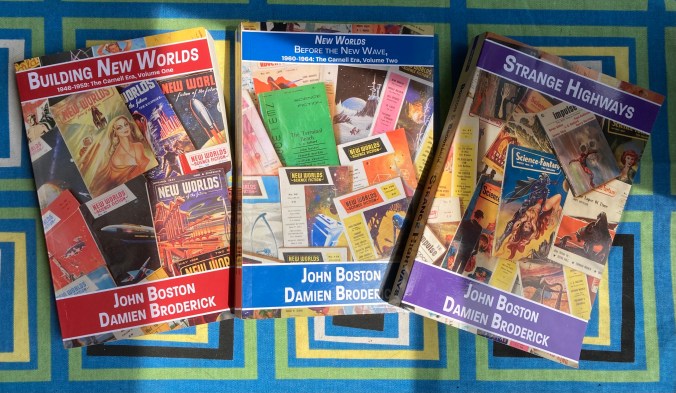
Recently I came across John Boston and Damien Broderick’s three-volume series examining each and every story and non-fiction article in the pre-Michael Moorcock New Worlds and Science Fantasy/SF Impulse magazines in the UK. John Boston is a valued member of my site’s community — frequently stopping by in the comment sections. I thought for this mini-editorial I’d list a handful of active community members with websites, books, and worthwhile SF-related fanzine articles. I, of course, could be missing a few. Community matters more than you might think. I enjoy the discussion. I enjoy reading reviews that others write — even if it’s on science fiction that might not be within my more narrow focus (the historian in me). I always want to learn and share what’s worth reading and/or historically interesting. Thank you one and all.
In no particular order…
- John Boston and Damien Broderick’s Building New Worlds: 1946-1959: The Carnell Era, Volume One (2013), New Worlds: Before the New Wave, 1960-1964: The Carnell Era, Volume Two (2013) and Strange Highways: Reading Science Fantasy, 1950-1967 (2013). Boston also writes for Galactic Journey mentioned below. Broderick encouraged Boston to gather together his read-through commentary circulated through a listserv into book form. Broderick, an Australian author and critic, recently passed away.
- Mathew Davis’ spectacular (and massive) article on Theodore Sturgeon’s life in the fanzine Seti 13. Absolutely worth the read!
- Gideon Marcus runs the immersive and varied fanzine Galactic Journey.
- Brian Collins contributes to Galactic Journey and has their own site Science Fiction & Fantasy Remembrance. Not to be missed!
- And James Davis Nicoll can be found at James Nicoll Reviews. He reviews something almost every single day. I wish I had the time to be as productive as he is.
- Antyphayes over The Sinister Science (currently more his wonderful collages but also in years past classic SF reviews).
- Richard Derus over at Expendable Mudge Muses Aloud.
- Richard Horton at Strange at Ecbatan.
- Ian Sales posts reviews at his Medium site. He’s been part of my community for almost 14 years!
- Andy Johnson over at Classic SF with Andy Johnson. His reviews can also be consumed as a podcast.
- While not a commenter on the site, Olav over at Unofficial Hugo Book Club is an enthusiastic and kind supporter on social media.
- William Emmons has a not-to-be-missed deep-dive style analysis of classic SF stories on his substack.
- Sean Guynes recently started writing long-form reviews on his website. I also find his lists of upcoming academic scholarship on science fiction (and history more broadly) indispensable.
- Rachel Cordasco’s Speculative Fiction in Translation is always worth the read.
- And Mike (Transrealfiction) has a lovely bookstore in Edinburgh, Scotland that I’ve had the pleasure of visiting twice on my European travels. The website and Google location.
The Photograph (with links to reviews and brief thoughts)
- Jean-Louis Curtis’ The Neon Halo (1956, trans. 1958). I’m a sucker for lesser-known SF in translation. Here charts the evolution of modern society between 1995-circa 2100 with an unusual focus martyrdom and persecution.
- Edgar Pangborn’s Davy (1964). One of my absolute favorites. I should have a review of another Pangborn novel posted soon. Stay tuned.
- Octavia Butler’s Mind of My Mind (1977) is the second-published and second chronological installment of her Patternist series of novels (1976-1984), that chart the dystopic and hyper-violent development (and destruction) of a telepathic society.
- Damon Knight’s Far Out (1961)–worth acquiring for “The Enemy” (1958), “You’re Another” (1955), and “Cabin Boy” (1951).
What am I writing about?
Since my last installment, I’ve posted a reviews of E. C. Tubb’s “Without Bugles” (1952), “Home is the Hero” (1952), and “Pistol Point” (1953) for my series on SF short stories that are critical of space agencies, astronauts, and the culture which produced them. All three were found due to Boston’s before-mentioned volumes. I also posted the first in what I hope will be a recurrent series on The Great Depression and SF — Frank K. Kelly’s “Famine on Mars” (1934). It’s been a hard few months on the work front. I eagerly await summer break when I hope to have more time to write.
What am I reading?
In times of stress I tend to pick up books on the history of SF or the United States in the 20th century. I consumed with glee Eric Leif Davin’s Pioneers of Wonder: Conversations with the Founders of Science Fiction (1999), Mike Ashley’s The Time Machines: The Story of the Science-Fiction Pulp Magazines from the Beginning to 1950 (2000), Mike Ashley and Robert A. W. Lowndes’ The Gernsback Days: A study of the evolution of modern science fiction from 1911-1936 (2004), John Cheg’s Astounding Wonder: Imagining Science and Science Fiction in Interwar America (2012), and Laura Browder’s Rousing the Nation: Radical Culture in Depression America (1998) for my Great Depression and SF post. A ton of reading for very few site clicks. Happens!
A Curated List of SF Birthdays from the Last Two Weeks
April 6th: Author Sonya Dorman (1924-2005). Check out Dorman’s hellish “Go, Go, Go, Said the Bird” (1967).
April 7th: Henry Kuttner (1915-1958). I recently reviewed Clash by Night and Other Stories (1980) (with C. L. Moore).
April 7th: James White (1928-1999). He wrote a lot of great stuff beyond his Sector General series! The Dream Millennium (1974) and All Judgement Fled (1968) come to mind.
April 8th: Influential UK editor John Carnell (1912-1972) — i.e. the guy at New Worlds before Michael Moorcock.
April 8th: Influential US editor Cele Goldsmith (1933-2002). She helmed Amazing and Fantastic Stories of Imagination through the era of the Great Magazine Constriction.
April 9th: Author George O. Smith (1911-1981)
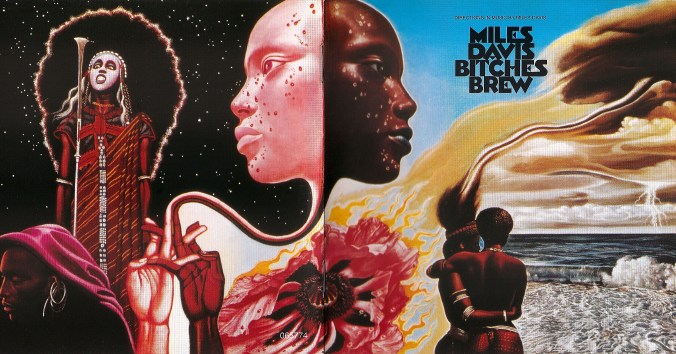
Mati Klarwein’s 1970 cover for Miles Davis’ album Bitches Brew
April 9th: Artist Mati Klarwein (1932-2002). Best known for his Miles Davis album covers. Some of his work was used for SF books as well. See my post.
April 9th: Author Barrington J. Bayley (1937-2008).
April 9th: Artist Stephen Hickman (1949-2021). I love his dragons.
April 10th: Anna Kavan (1901-1968). Check out Ice (1967)!
April 10th: Artist Henri Lievens (1920-2000).

Jim Burns’ cover for the 1986 edition
April 10th: Artist Jim Burns (1948-)
April 10th: Artist David A. Hardy (1936-)
April 10th: Author John M. Ford (1957-2006). I reviewed my first Ford work The Princes of the Air (1982) a few years back. Interesting. A bit exasperating. Opaque.
April 11th: Artist Gene Szafran (1941-2011). I call him Mr. FUZZY 70s PASTEL. Which is fine. But…
April 11th: Author James Patrick Kelly (1951-).
April 12th: Emil Petaja (1915-2000).
April 12th: Author Carol Emshwiller (1921-2019). I’ve reviewed all of her short fiction written before her early 60s break. Here’s the first post in one my favorite series I’ve started on the site.
April 13th: Author Theodore L. Thomas (1920-2005). I reviewed three of his short stories here.
April 13th: Author Jonathan Fast (1948-). On a short list of father son SF authors… Howard and Jonathan Fast. Fritz and Justin Leiber. Frank and Brian Herbert. There must be more?
April 14th: Author Bruce Sterling (1954-).

Mal Dean’s interior art for Michael Moorcock’s A Cure For Cancer (1971)
April 15th: Artist Mal Dean (1941-1974)
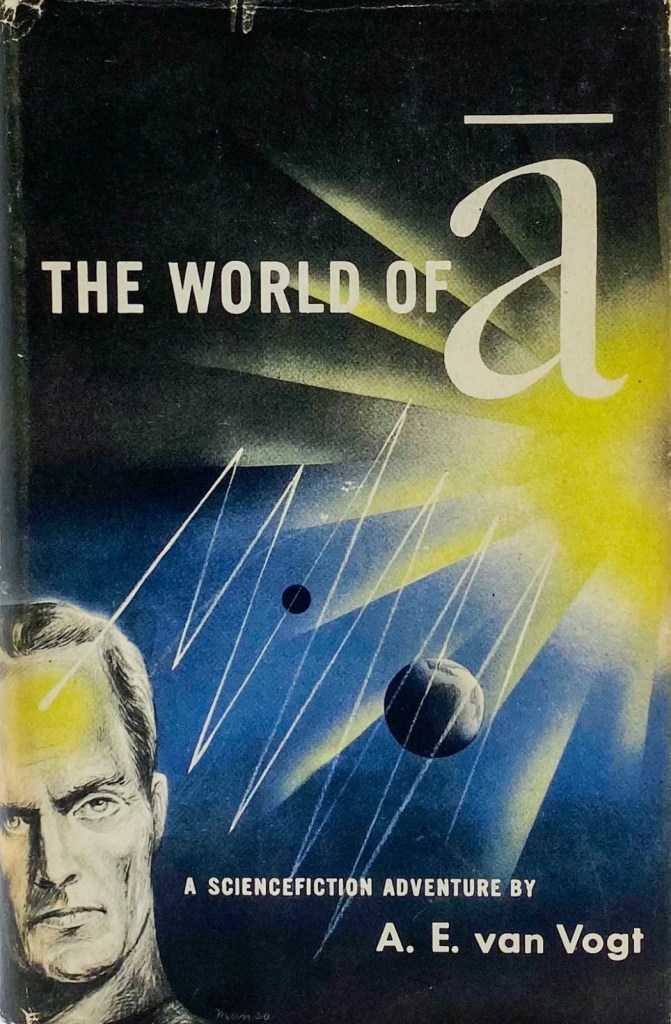
Leo Manso’s first edition cover for The World of Null-A (1948)
April 15th: Artist Leo Manso (1914-1993). His cover for A. E. van Vogt’s The World of Null-A (1948) is far superior to the book!
April 16th: Kingsley Amis (1922-1995)
April 16th: John Christopher (1922-2012). Loved the Tripod Trilogy (1967-1968) as a kid. Since then I’ve read and reviewed three of his works: A Wrinkle in the Skin (variant title: The Ragged Edge) (1965), The Death of Grass (variant title: No Blade of Grass) (1956), and The Long Winter (1962).
April 17th: Lloyd Biggle, Jr. (1923-2002). I’ve enjoyed many of Biggle’s off-kilter novels and stories, especially The Metallic Muse (1972).
April 17th: Jacques Sternberg (1923-2006). A Belgian author I’ve explored a bit over the years. Check out the collection Future Without Future (1971, trans. 1972) and Sexualis ’95 (1965, trans. 1967).
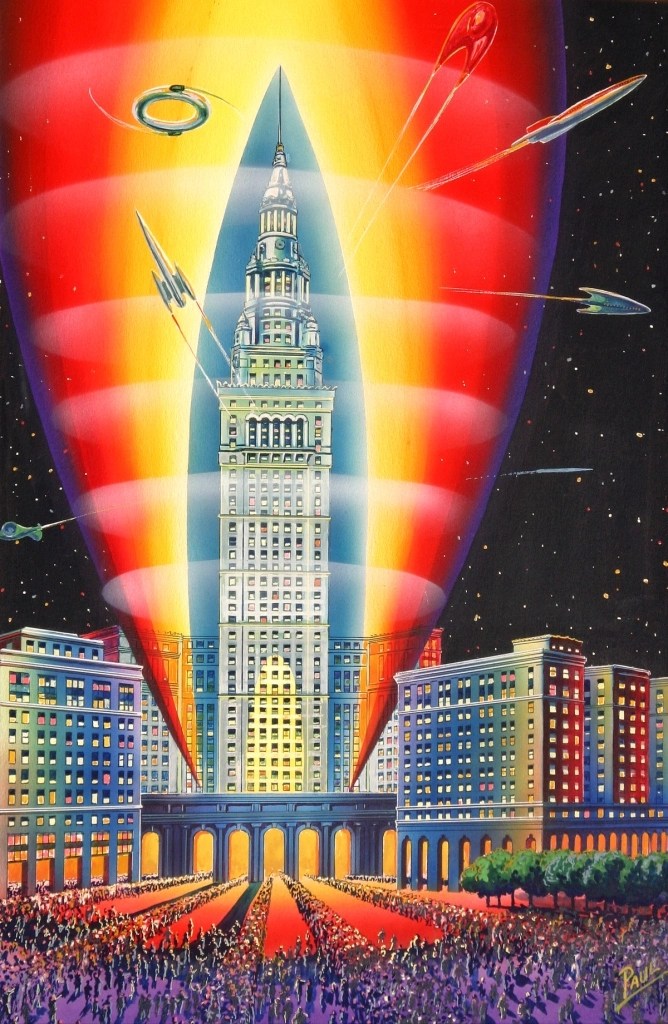
Frank R. Paul’s Worldcon Cleveland Convention Poster (1955)
April 18th: Artist Frank R. Paul (1884-1963). Iconic artist of the earliest years of magazine SF!
April 19th: Tom Purdom (1936-2024).
April 19th: Artist Chris Yates (1948-).
April 20th: Artist Karel Thole (1914-2000). Ranks amongst my top-5 SF artists of all time. His covers for the Italian Urania publication series are not to be missed.
April 20th: Donald Wandrei (1908-1987). Best known for his Weird Stories fictions I assume.
April 20th: Ian Watson (1943-). I enjoyed but never managed to review The Embedding (1973) and The Jonah Kit (1975). Check out his stories in The Very Slow Time Machine (1979). I desperately need to return to his work.
For book reviews consult the INDEX
For cover art posts consult the INDEX
For TV and film reviews consult the INDEX
 Science Fiction and Other Suspect Ruminations
Albion!Albion! and Heart Clock by Dick Morland (Reginald Hill).
Being a fan of the estimable Hill, I was curious about his foray into SF.
Of the two I’d say Albion! Albion! is the stronger, though Heart Clock contains the memorable line, ‘Let’s see if your quick thinking can save us from the results of your quick thinking’.
Both novels point to a gloomy UK, suffering the consequences of detaching itself from Europe. Both have fairly pulpy plots and both have amusingly high body counts – all helping to move the plots on. Albion! makes amusing use of football (soccer) terminology.
Apparently there’s a Dalziel and Pascoe short story of Hill’s set in the future, but I’ll probably wait until I stumble across it by chance rather than track it down.
Hello Kralin,
I’ve reviewed Albion! Albion! (1974). https://sciencefictionruminations.com/2020/12/12/book-review-albion-albion-variant-title-singletons-law-dick-morland-aka-reginald-hall-1974/
I thought it had a lot going for it (I especially enjoyed its posturing towards textual collage)– despite not being entirely successful.
Yes defintely, the Nixon lectures – including a whole section in French – all helps add more layers.
It’s by some distance the stronger of the two novels.
I might acquire Heart Clock. I have a fascination with tracking down the esoteric… just bought a random near future political thriller by politician John Lindsay (1921-2000) (Mayor New York City, Congressman, and Presidential candidate) — The Edge (1976). It’s probably complete crap. And that’s okay!
Thanks for the shout-out, old son! Also, when the heck did Jean-Louis Curtis write an SF novel?! THE FORESTS OF THE NIGHT and THE DEVIL’S DREAM were nasty, scathing takedowns of the collaborators written after WWII…and that’s all I ever knew he wrote. His writing, in 1950s translations anyway, was pretty pedestrian. I hope you’ll like NEON better.
No problem!
I enjoyed the Curtis. Albeit, probably best for people already aware of French literary tendencies of the time… My review: https://sciencefictionruminations.com/2021/12/22/book-review-the-neon-halo-jean-louis-curtis-1956-trans-1958/
I should finish Leigh Brackett’s Shadow Over Mars later tonight. This is my first read of Brackett and while not bad, reading other reviews of yours, I’m guessing it’s not her best work.
I assume you’re referencing my review of The Long Tomorrow (1955)? I enjoyed her take on the standard post-apocalyptic premise.
I haven’t read “Shadow Over Mars” (1952), yet. I have read her Mars stories in The Coming of the Terrans (1967). Although I never managed to review it. Here’s the listing: https://www.isfdb.org/cgi-bin/pl.cgi?37379
Actually, it was The Big Jump, but I went and looked at The Long Tomorrow review, which looks far more interesting. I should definitely check that out. Thanks!
Ah, my review for The Big Jump is quite old (in the first years of my site — ’twas barely in my twenties). I doubt I’d enjoy it much if I were to reread it. I’ve become a bit more discerning.
Understandable on the earlier blog. I’m going to afford Brackett the same consideration as well, noting that Shadow over Mars came out in 1944(?), ~a decade before The Long Tomorrow, which I just downloaded on Kindle.
I gave the date 1951 as that’s when it was novelized vs. the 1944 Startling Stories publication. I assumed that’s what you read. Sorry!
I’ve been on a real SETI kick lately, reading a lot on the subject. This includes Sagan’s Contact (not a fan), James Gunn’s The Listeners and Gift from the Stars, and His Master’s Voice by Stanislaw Lem. Also some non-fiction books and a ton of articles. I must say, Gunn’s The Listener’s might be my favorite take on the subject. I know him mostly for his non-fiction and scholarly work on SF, but now I’m more inclined to seek out his fiction work.
I enjoyed The Listeners. Unfortunately, I never managed to write a review. And His Master’s Voice is one of my favorite Lem novels! (read before I started my site).
I’ve reviewed a range of Gunn’s novels on my site — albeit in its earliest years (2010-2012). Haven’t returned to him in a long while. He even stopped by at one point and left a comment about the cover for Station in Space (1958). https://sciencefictionruminations.com/2012/05/30/book-review-station-in-space-james-gunn-1958/
Good to know! His non-fiction book, “Inside Science Fiction” is IMO one of the best introductory books on the history and development of American SF. It doesn’t cover everything, but for a beginner SF enthusiast who wants to learn more about the field, this is THE book to start with.
Yeah, he’s a super important voice in the history of academic SF criticism. And a solid author — I think The Immortals (1962) and The Joy Makers (1961) are my favorite of his works. Albeit, as I mentioned, the reviews are really old. Not sure what I would think now.
Another informative and engaging post – enjoying the wide-ranging format!
That three volume series on the Ted Carnell era of New Worlds sounds fascinating. I’ve just been reading about the support he gave to Irene Shubik, producer of the Out of this World and Out of the Unknown television anthology aeries back in the sixties. Apparently it was Carnell who suggested several of the stories to be adapted, included gems which are now little discussed (such as John Rankine’s ‘Six Cubed Plus One’ and Colin Kapp’s ‘Lambda 1’).
Great to see the acknowledgements for the likes of Mal Dean too – who always contributed eye catching illustrations for the likes of New Worlds under Moorcock’s editorship.
I saw the reference to Lloyd Biggle Jnr there by the way – an author I’ve never encountered before, so I’m about to embark on his novelette ‘Tunesmith’ (I see you’ve reviewed a collection of his work entitled ‘The Metal Muse’, so I’ll have to check out your review of this story when I’ve finished 🙂
Thank you for your kind words. The series is a issue-by-issue readthrough of informal reviews. A great way to understand the range of stories and identify some authors utterly worth avoiding unless you have a larger historical interest. I love Mal Dean’s work. He died far too young.
Let me know what you think of the Biggle stories. He feels like an outsider in many ways. The male version of Doris Piserchia perhaps, hah.
Thank you for the incredibly useful links to other reviewers/writers.
The link to #2 (the Sturgeon article) is mangled. I managed to tease out the correct info though.
Thanks for stopping by! I’ll fix the link when I get home. I copied and pasted from his comment but should have checked it… alas.
What pre-1985 SF have you been reading recently? or plan to read?
I really did not like Davy.
Not reading any old sf at the moment, but I did recently finish Michael Coney’s Cat Karina. To be honest, I prefer his near-future sf, perhaps because it’s so English. Before that, I read Little Fuzzy. Wasn’t impressed with that either.
Yeah, I don’t get that Ian — haha.
My passionate and detailed defense of the novel:
I disagree pretty much with all of your review 🙂 I found the world-building unconvincing, and the structure badly unbalanced. Also, neither Tom Sawyer nor Huckleberry Finn are cultural touchstones for me as I’m British, so all that left me cold.
Not interested in “world building.” It’s a kid experiencing a world that’s lived in, not a lecture about said world. SF overrates “world building.” I’m interested in operations of narrative and storytelling, vivaciousness, its democratic and inclusive sensibilities, etc. It’s brilliant in the latter.
Sf needs to be set in worlds that do not ruin the reading experience. And Davy’s did for me. Also, it’s a memoir written by an adult, so even though he’s a kid when it opens he’s looking back on it from adulthood.
And it’s unbalanced because of the operations of Davy’s memory. Why dwell on the sadness? Dwell on the love and moments of connection. As I said, the novel is in itself a thereupetic practice vs. an immersive experience of the post-apocalyptic. I’m interested in Davy and how he lives in his world. Not the world separated from Davy.
It’s unbalanced because it opens hinting at a life of adventure, and mentions a few events in passing, and then spends 80% of its length on the weeks after Davy escaped, then a short run through the years he was with the travellers… and then it finishes. How did he end up in a coup? Or getting overthrown? It reads like it was going to be a much longer book, or the first of many, but Pangborn decided not to bother and just had Davy sail off into the sunset.
I found the end far more disturbing. When he’s writing that portion about the coup it’s not a moment of celebration. His lover is dying. He has no progeny. The possibility of a brighter future feels different. He doesn’t want to dwell on the failure of the past. He’s consumed with the failure of the present. It’s fucking horrifying in its implications. How he writes about his life changes as the life he is currently living evolves. No other novel I have encountered in genre takes on with such gusto a rumination on the act of writing and its role in processing the complexities, nostalgia, solace, and trauma of memory as Davy does.
(Note: I am about to level a similar critique to your view of Davy’s structure to Pangborn’s last novel in the same sequence — The Company of Glory (1975). Which is illogically rushed in parts and does not really provide an explanatory frame story to make sense of the fragments.)
As for the references to Tom Sawyer and Huckleberry Finn, I don’t buy that they’re really what anchors the novel. But neither of those iconic characters are searching for a father-figure like Davy, or creating a community of radical acceptance (Maybe H. Finn as it was conceived as an anti-racist novel despite its inability to overcome stereotypes).
There, I plead ignorance. I’ve never read any Twain, and if I know the characters it’s probably from the Disney films seen when I was a kid. It’s not that they “anchor2 Davy but more like Davy felt to me like a post-apocalyptic Huckleberry Finn. But then I’m basing that on faint memories that are probably wrong anyway.
My comments are all in the spirit of debate. I’m passionate about this book. It really represents what I adore in SF — historically (pre-New Wave narrative experimentation with progressivism) and literarily (reflection on memory, meta-interjections and textual pairing — comments in the present pairing with things in the past, events in the present pairing with events in the past, etc.).
Granted about the ending. But when I encounter child labour, slavery, sexual abuse and religious intolerance in the first chapter of a book, it will need to work *really* hard to get me to like it 🙂
Yeah, it’s a dystopic world for sure — that’s what he’s escaping. That’s why he’s desperate to create a far more equitable, democratic and free world. That’s why the end is so darn sad. Not only has the revolution failed but the last gasp attempt to create anew crumbles away. The idealism gives way to the reality of the irradiated world. And yet Davy still tries to go on. It’s gut-wrenching.
I get that it’s dystopian, and I can’t fault the narrator’s plans to create a more just society. I just question the artistic choices that always seem to result in US sf authors creating worlds featuring chattel slavery, child labour and so on. I know “communism”, and even “socialism”, is a dirty word in the US, but cooperative communities are far more likely to survive than one that embody all the worst excesses of US history. Having said that, I’m a European and I live in a Nordic country 🙂
“But cooperative communities are far more likely to survive than one that embody all the worst excesses of US history.” — I mean, Pangborn is all about yearning to make cooperative communities… His heroes actually aspire to that. Admirable to be honest. And I’m sorry, I’ve read PLENTY of European apocalyptic novels (Scandinavian ones for example) and they are seldom if ever about making cooperative communities. Your attempt to create some bifurcation between the continents does not play out in the fiction. The post-apocalyptic more often than not becomes an arena of authoritarian despair or pseudo-medieval return. And here Pangborn is an exception in the ideology of his characters.
A short list created in a few minutes of reflecting. It could be far longer and still cover stuff I’ve read:
Sven Holms’ Termush (1967, trans. 1969) (Denmark)
P. C. Jersild’s After the Flood (1982, trans. 1986) (Sweden)
John CHristopher’s A Wrinkle in the Skin (variant title: The Ragged Edge) (1965) (UK)
The Death of Grass (variant title: No Blade of Grass) (1956) (UK)
The Long Winter (1962) (UK)
Richard Cowper’s The Road to Corlay (1978) (UK)
Bennett’s The Long Way Back (1954) (UK) — and she was even involved in Communist politics (and served in the Spanish Revolution) and still doesn’t really posit the existence of a non-dystopic socialist society.
Thanks for sharing a lot of links! You made me happy, but I’m afraid not my employer 🙂
Hello again, glad you enjoyed perusing them!
I finished Nova by Samuel Delany over the long weekend. I loved it, it was a nice mix of his earlier and later books.
Nova is actually one of the few SF novels I’ve reread for pleasure rather than for a writing project. I read it before my site and for a SF reading group as a graduate student. Unfortunately, I never managed to review it (the reread must have been 2012 or so).
I much prefer Empire Star and Dhalgren. The former is, I think, a brilliant space opera with a cleverly recursive plot; the latter is a novel I’ve reread several times and each time it strikes me as just as powerful.
Never managed to finish Dhalgren. One of those “I really need to give it another shot” novels…
Dhalgren is one of my favourite ever books 🙂
I will read Empire Star next!
I read Empire Star a long long time ago. Let me know how it is!
I’m reading Graybeard By Brian Aldiss. I’m not far enough to come to a real idea of how I feel about it. I am enjoying it.
I just finished Arslan by MJ Engh which I found harrowing and fascinating and sat with me for a long time especially the opening.
I really enjoyed Graybeard. Unfortunately, I could not put my thoughts to paper and never managed to review it. As for Arslan, I’ve tried to read that novel two or three times. At some point I read a very critical take on the novel (mostly its depiction of rape and homosexuality) that has poisoned my will to return to it. I should try again.
Its an uncomfortable book, the rapes happen as a means of control and dominance, there is then a continued depiction of how victims continue to be abused and manipulated to become dependant on their abusers, its a chilling book, not a comfortable read at all.
Yeah, I assume something similar to Stockholm Syndrome occurs with one of the victims.
Greybeard is Aldiss at his best, although it took me awhile to finish it and I didnt really fully appreciate it until the payoff of the last few pages. He can be a frustrating novelist. I have a copy of Frankenstein Unbound on my to-read pile that I am looking forward to, it sounds like it features the type of narrative hijinks I tend to enjoy.
I enjoyed his focus on non-traditional subjects of SF — older protagonists. But yes, I agree that he can be frustrating and often a bit too willing to slip into parody when he has some serious ideas that need fleshing out. If you haven’t read “Appearance of Life” (1976), you really should! Perhaps my favorite of his short works (so far).
Greybears is great, one of the better Aldiss novels I’ve read (and he can be a frustrating novelist). It took me awhile to finish but the payoff, for me anyway, really turned out to be in the last few pages. I have a copy of Frankenstein Unbound in my to-read pile that I’m looking forward to.
I’ve gone all the way back to pre-1885 haha. The collected works of Poe, including his proto-sf pieces. The prose is purple and often overwrought but it is enjoyable, not least because of my historical interest. I havent gotten to the longest, possibly most significant sf story yet (the narrative of Arthur Gordon Pym).
While I certainly know and have read about Poe and his influence on SF, I have not read any of his proto-SF works.
I’m about to finish PKDs The Penultimate Truth. I read it many years ago, as it’s the case with most of the PKD I’ve read, and I would like to revisit not just the obvious ones but also the less celebrated, like this. Not one of his most coheret, or best, but as always his deluge of paranoid invention is a wild ride.
Prior to that I read M K Jospehs The Hole in the Zero, which didn’t really live up to its potential for me. It did contain some great sequences, but not a convincing depiction of “non-space” – rather than using the idea of going beyond time, space and causality to create something truly strange, it seemed more like an arbitrary setting for a much more standard allegorical mind/fantasy journey.
I’ve read and reviewed both on my site. I agree on both counts (my rating of The Hole in the Zero is probably too high but it was quiet a long while ago…).
Dick’s The Penultimate Truth (1964)
Joseph’s The Hole in the Zero (1967)
Even if the Hole in the Zero doesn’t live up to that review that sounds like it ticks more than enough boxes to go on my want list
It’s certainly worth reading, I would agree with the rating in Joachims rating in his old review.
Lot’s of very enjoyable parts, they just don’t combine into a convincing whole, let alone deliver on the potential af the main idea.
I don’t know if you’ve gotten around to reading it, but I loved Kingsley Amis’s New Maps of Hell. It was so much fun to read a writer of literary fiction’s assessment of science fiction up to the early ’60’s. His affection for the genre was obvious, but he was also forthright about its flaws. Plus, he was such a witty writer.
I recently finished “The Red Peril” by SP Meek. It’s from 1929 and about a Soviet invasion. There’s plenty of Cold War science fiction featuring the Soviets, but there isn’t much from that interwar period. What’s interesting is that the portrayal of the Soviets is not that far off of reality.
I’m now reading Stanton Coblentz’s “The Golden Planetoid”. I don’t remember how I first found out about Coblentz, but he should be better known! He’s a good stylist and an accomplished satirist. I really like satire and as far as I’m concerned, satire works really well in science fiction. I haven’t gotten very far in the story, so I’m not sure if it’s going to be satirical or not.
I have skimmed through it and read substantially about New Maps of Hell. I assume you also know that he wrote some SF and alternate history? I’ve been meaning to read The Alteration (1976).
I’m intrigued by the Meek. I mean there was a Red Scare in 1917 (and later) due to Lenin’s takeover. By the Great Depression Communists, at least in the US, were increasingly allowed into the “mainstream” political dialogue — as long as they supported the New Deal.
The Alteration has been on my to read list for a couple of years.
The Meek story was interesting. The author was clearly not a fan of the Soviet Union and he saw it as a rival to the US when it came to technical prowess. It’s also a bit ahead of its time in that it also features biological warfare.
Here’s where I found a copy of Red Peril https://archive.org/details/Amazing_Stories_v04n06_1929-09_jvh-sas/page/n7/mode/2up?view=theater
I’ve been meaning to read Amis’ The Alteration for a long while as well. I received a review copy from NYRB and never managed to read it! After that I decided to always decline proffered copies…
Gosh. Thanks.
Recently read Warren Miller’s “Looking for the General” (1964 –not unconnectedly same year as “Dr Strangelove).
It’s tangently sci-fi as it’s about a satirical roadtrip across America in search of Fortean and extraterrestrial phenomena. It also presages The X-Files as the pursuit of the truth about aliens is accompanied by paranoia of being under surveillance, which is partly true as participants are in Military Intelligence and scientific research. The middle-aged protagonists are suffering mid-life crisis in the wake of dissipated youth, energy and purpose of WW2. Their acute mordant perceptions of decadence in stagnant contemporary America fuel their True Believer hopes of Close Encounters of Third Kind salvation. The conclusion however is an ambiguous Heaven’s Gate cult immolation, which given assorted refs to Melville throughout, is probably an allusion to the Pequod’s end.
I can’t help wondering if it was a book Disch and Sladek read. The actual prose itself is very good (a diary like Camp Concentration) where teeming observations batten on scientific laws as metaphor for societal breakdown, but also a particular kind of crackpottism where science and alchemy collide in the military mind. The Sladek taste is a ripe enjoyment enumerating the study of Fortean rains, pyramids, etheric anti-gravity forces, and the whole Van Daniken potpourri from flying saucers to Atlantis. There are some Nabokovian touches, and multiple reference to Chichikov and “Dead Souls” as precursors to his roadtrip – and by association “Diary of a Mad Man”.
A big thumbs up from me. Warren Miller died almost 60 years ago so I suspect the book has fallen into estate limbo, otherwise I’m sure it would have been reprinted a couple of times since.
No problem.
The only Warren Miller I’ve read is his near-future novel The Siege of Harlem (1964). Which I did not care for…. at all…. “Looking for the General” (1964) sounds far more interesting.
I haven’t been reading quite so voraciously recently but have started reading Dhalgren by Delany. In isolation each section I’ve read so far has been fairly enjoyable (I was apprehensive from online reviews suggesting it is fairly dense) but am only tackling it in short bursts at the moment and am about half way through. I’ve read quite a few other of his works (Nova, Einstein Interection, Triton) so felt it was time to move onto this one.
My great shame, despite my adoration of the New Wave, is that I have not managed to finish Dhalgren. I’ve abandoned it two or three times. Alas.