What pre-1985 science fiction are you reading or planning to read next month? Here’s the October installment of this column.

A selection of read volumes from my shelves
If I’m feeling a bit unmotivated to write about science fiction, I always end up on Fanac or another online repository of fanzines/newspapers exploring all the old historical fannish debates. I especially enjoy their reports on various conventions and the community (from accepting to reactionary) that emerges. For example, the details I uncovered about a lost Philip José Farmer speech titled “SF and the Kinsey Report at the 11th World Science Fiction Convention (Philcon 2) in Philadelphia (September 1953) and Pat M. Kuras and Rob Schmieder’s article “When It Changed: Lesbians, Gay Men, and Science Fiction Fandom” (1980) on the first Worldcon panel with an openly LGBTQ topic: “The Closed Open Mind: Homophobia in Science Fiction Fantasy Stories” moderated by Jerry Jacks, one of the “early openly gay fans.” I recently edited a friend’s article for academic publication on the role of conventions in forming feminist and political activism. Conventions sound like fascinating places, at least from my historically-minded vantage point and lens.
However, as visitors to the site probably know, I’ve never attended a science fiction specific con (I’ve attended Gencon twice as its in my current hometown and tons of academic conferences earlier in my career). For fear of revealing too much of my psychological profile (muahaha), I enjoy the self-created illusion of being an outsider. The scholar who writes from the shadows. I often tell myself “I’m a historian, not a fan.” Of course, both can be true… I know cons cover a vast variety of topics beyond contemporary science fiction (which does not interest me in the slightest, alas). There are frequently panels on all the topics, authors, and themes I enjoy. And of course, all the friendships with fans with similar interests… As meeting authors? Not my thing, sorry. Well-meaning readers of my website often attempt to invite me to participate on panels on historical topics. Thank you! Maybe at one point I will. I really should.
I’d love to know why you, lovely readers, enjoy attending cons.
Also, before we get to the photograph above and the curated birthdays, let me know what pre-1985 SF you’re currently reading or planning to read!
The Photograph (with links to reviews and brief thoughts)
- I suspect I’ve featured Langdon Jones’ wonderful collection The Eye of the Lens (1972) before. It’s an example of the exuberant (and successful) elements of the New Wave movement. “The Hall of the Machines” (1968) represents what I enjoy most lates 60s SF.
- Algis Budrys’ Rogue Moon (1960). A good one! I wish I managed to write a full-length review.
- Joanna Russ’ We Who Are About To…. (1976). Remains my favorite Russ novel.
- John Christopher’s A Wrinkle in the Skin (variant title: The Ragged Edge) (1965). I preferred this post-apocalyptic nightmare to The Death of Grass (1956). The scene with the tanker stranded in the dried-out English Channel, top notch…
What am I writing about?
I recently restarted my series on translated SF short fiction—after a lull on my part–with Rachel S. Cordasco over at Speculative Fiction in Translation. We thoroughly enjoyed Izumi Suzuki’s “Terminal Boredom” (1984). Up next– a story from Germany!
Despite a slow writing month, I did manage to put together my first full-length review of Octavia E. Butler’s Clay’s Ark (1984). My favorite of her novels so far! There’s some solid early 80s SF out there.
What am I reading?
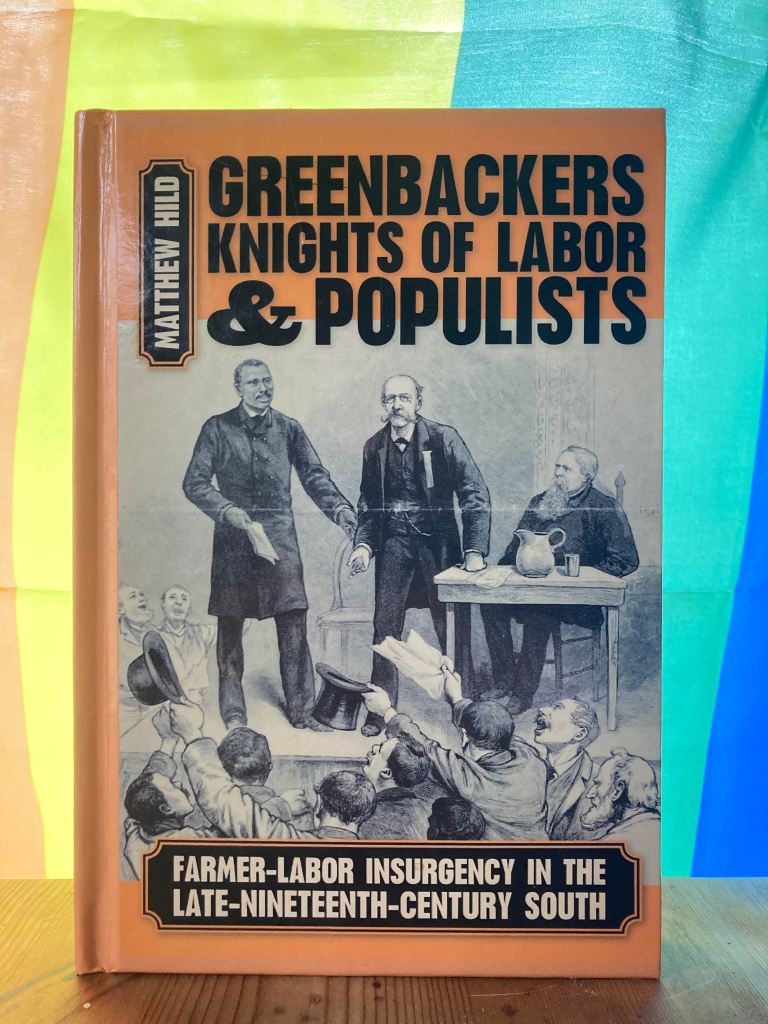
My reading of various forms of American leftist politics continues. Finished Mathew Hild’s Greenbackers, Knight of Labor, and Populist: Farmer-Labor Insurgency in the Late-Nineteenth-Century South (2007). There’s a larger incubatory SF-related writing project looming that will connect to late 19th century attempts to challenge Southern Democrats. Simultaneously, as I teach college-level American History courses I felt that that portion of my classes needed some work. Stay tuned!
Most of my reading has been related to the scholarship related to my unnamed writing project. However, I finally finished my Kim Stanley Robinson novel and should (I know, I promised the same thing a while back) have a review up soon(ish). A vampiric cloud of despair–generated by American politics, the challenges of my job, etc.–continues to consume my energy.
A Curated List of SF Birthdays from the Last Two Weeks [names link to The Internet Speculative Fiction Database for bibliographical info]
November 15th: William Hope Hodgson (1877-1918). I recently acquired a copy of The House on the Borderland (1908).
November 15th: J. G. Ballard (1930-2009). A favorite of mine.
November 16th: Candas Jane Dorsey (1952-). There’s a copy of Machine Sex and Other Stories (1988) judging me from the shelves.
Diane and Leo Dillon’s cover for the 1971 1st edition
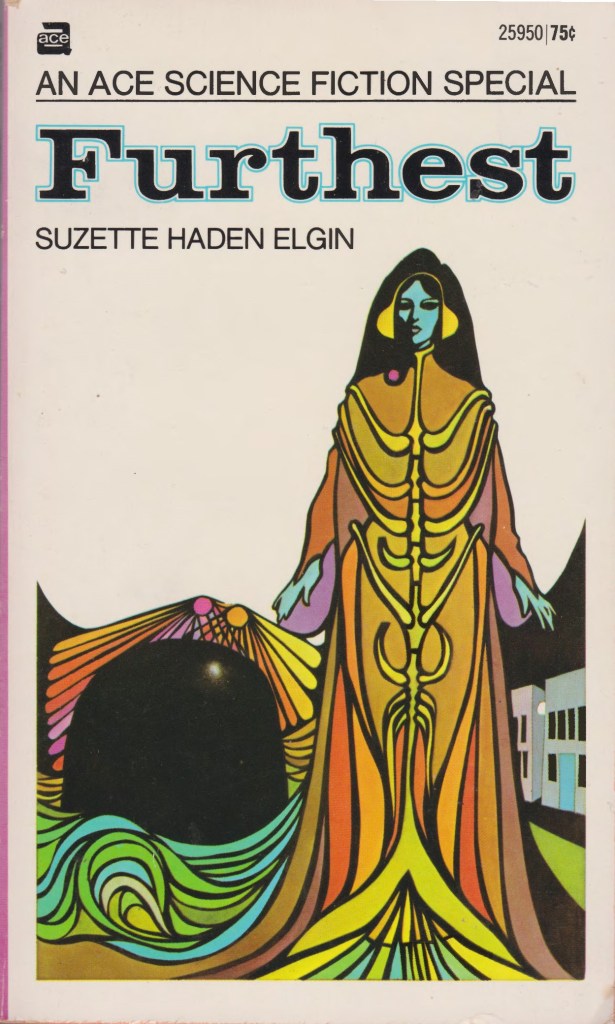
November 18th: Suzette Haden Elgin (1936-2015). I’ve reviewed At the Seventh Level (1972) and Furthest (1971).
November 18th: Margaret Atwood (1939-).
November 18th: Frederick Turner (1943).
November 18th: Alan Dean Foster (1946-).
November 18th: Graham Charnock (1946-). One of the British voices of the New Wave movement. I’ve only read “The Chinese Boxes” (1970).

Mark Salwowski’s cover for the 1989 edition
November 18th: Michael Swanwick (1950-). I read my first Swanwick novel last year–In the Drift (1985).
November 19th: Wolfgang Jeschke (1936-2015). A Czech-born German SF author whom I really should read… I own his translated novel The Last Day of Creation (1981, trans. 1982).
November 20th: Molly Gloss (1944-). The Dazzle of the Day (1997) is supposed to be a really great take on the generation ship premise (outside of my date range, alas).
November 21st: Artist Vincent Di Fate (1945-).
Ken Laidlaw’s cover for the 1977 edition
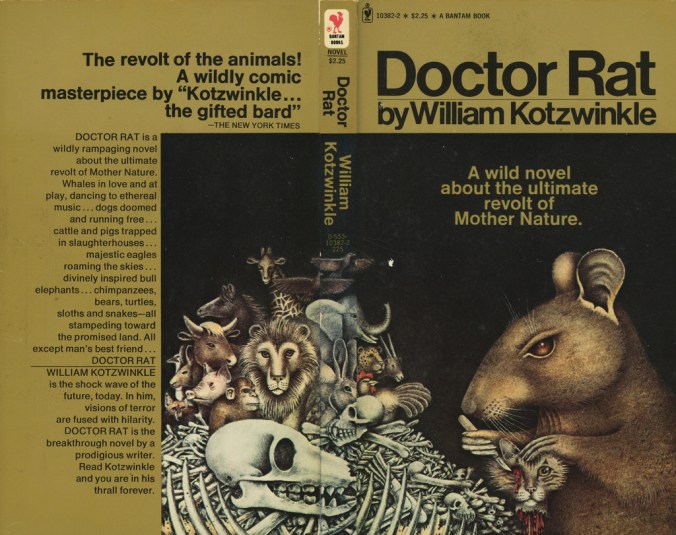
November 22nd: William Kotzwinkle (1938-). Doctor Rat (1976) still unsettles me.
November 23rd: Wilson Tucker (1914-2006). Huge fan of The Long Loud Silence (1952, rev. 1969) — one of the better nuclear-war themed 50s novels. I must get to more of his work in 2026…
November 24th: Editor T. O’Conor Sloane, Ph.D. (1851-1940). The editor of Amazing between 1929-1938.
November 24th: Spider Robinson (1948-).
November 25th: Amelia Reynolds Long (1904-1978). An earlier female SF pioneer, I’ve only read Long’s “Omega” (1932). Unfortunately, my dislike of 30s SF informs my comments — regardless, she’s a historically important figure.
November 25th: Poul Anderson (1926-2001). One of the authors of the first years of my website. I’ve covered eleven novels and twenty-six of his short stories. Most recently I featured “The Troublemakers” (1953) in my generation ship review series.
November 26th: Leonard Tushnet (1908-1973)
November 26th: Artist Victoria Poyser (1949-).
November 27th: L. Sprague de Camp (1907-2000).
November 27th: C. C. MacApp (1917-1971)

Uncredited cover for the 1965 edition
November 27th: Dave Wallis (1917-1990). I thoroughly enjoyed his sole SF novel Only Lovers Left Alive (1964).
November 27th: Artist Josh Kirby (1928-2001). Perhaps best known for his Discworld covers, Kirby was a prolific contributor of art for a vast variety of authors.
November 28th: Richard R. Smith (1930-). A prolific contributor to the magazines in the 1950s, I’ve yet to read his work.
November 28th: Artist Walter Velez (1939-2018).

MacGowan’s interior art for Gregory Benford’s “Nobody Lives Around There” in Vertex: The Magazine of Science Fiction (February 1974)
November 28th: Editor and author Donald J. Pfeil (1937-1989). Best known for editing Vertex (1973-1975).
November 29th: C. S. Lewis (1898-1963).
November 29th: Madeleine L’Engle (1918-2007). If you haven’t read about the L’Engle great cover mystery, you should!
November 29th: Kevin O’Donnell, Jr. (1950-2012).
November 29th: Artist Doug Beekman (1952-).
For book reviews consult the INDEX
For cover art posts consult the INDEX
For TV and film reviews consult the INDEX
 Science Fiction and Other Suspect Ruminations
Is the Knights of Labor worth reading and is it restricted to events in the South?
The Hild book is spectacular. But yes, his lens is restricted to the south in part to untangle an often reductive take in scholarship on Populism about the role of various labor organizations like the Knights of Labor (and The Grange, Farmers’ Alliance, Colored Farmers’ Alliance, The Brotherhood, etc.) in providing the organizing groundwork and political positions that appeared in the People’s Party (Populism) (which was most “successful,” at least in southern states, — caveats spelled out at length in the book — in Texas, Alabama, Georgia, Arkansas, and North Carolina). I recommend Robert C. McGrath, Jr.’s American Populism: A Social History, 1877-1898 (1993) for a general take on the Populist movement. I also have Postel’s newer book The Populist Vision (2009) (haven’t read yet) but I don’t know how much it focuses on the role of the Knights of Labor in their local advocacy of bi-racial farmer-labor coalition.
I just discovered that this book exists: Gerald H. Gaither’s Blacks and the Populist Movement: Ballots and Bigotry in the New South (2005). Immediate purchase.
Thanks for the recommendations.
I’d probably track down the Postel volume. Seems to be the most recent general survey. I have two more books coming on the Fusion government (bi-racial coalition organized by the Knights of Labor of Populists and Republicans) in North Carolina, brutally overthrown in a literal coup by Southern Democrats. One of them will be released in January, the other is a few years older. I’ll see if they have a more recent survey cited.
The North Carolina-specific environment is what I’m focusing on for my SF-related writing project on Edward A. Johnson’s semi-utopian SF novel Light Ahead for the Negro (1904).
My vague impression, based on little knowledge, is all the populist movements, left or right, never managed broad national appeal and were limited in political geography. That may be based on my knowledge of the Non-Partisan League.
Of course, that wasn’t just a matter of public opinion but actions on the parts of their various enemies.
Yes, the Populists were mostly successful in the West and South. They carried multiple states in the West (22 electoral votes) in the 1892 election. They sent multiple senators as populists and fusion candidates (with Republicans), house members, etc. to the national government. But southern Redeemer Democrats acted with violence, assassination, and fraud to overturn elections. And then pushed through the final disenfranchisement of black voters which prevented a rebirth of an effective third party or possibility of challenge to restored Democratic domination. They also prevented investigation of many an illegally doctored election. And, as I mentioned, an actual bona fide coup against an elected Fusion government in North Carolina. https://en.wikipedia.org/wiki/Wilmington_massacre
Currently reading “The Alternate Asimovs” – which contains the early versions of “Pebble in the Sky” and “The End of Eternity” and two versions of “Belief.” The early version of Pebble has pretty much the same plot, but the character work is only sketched in. The obnoxious Imperial Guard is absent, Pola and Bel fall in love almost instantly, and weirdly, Asimov breaks the fourth wall to comment on the structure of the story periodically. Wow.
Conventions are enormous fun for me – I went to my first one in 1998, and aside from the pandemic, I haven’t gone a year with a con attendance since then (with some years, getting to three). You can usually find panels on older SF as well as newer stuff, science talks (a sin I have committed!), trivia contests (I’m rather competitive!), and dealers’ rooms with lots of used books. I’m fortunate that my wife enjoys them as much as I do (or more!)
Is The Alternate Asimovs volume a collection of the serialized versions of the novels that were changed later? Or earlier drafts? I assume the later as the two you mentioned weren’t serialized. I read Pebble too long ago (there’s a review on the site) to remember the plot or to understand the changes you reference.
Rejected forms of Pebble (a novella called “Grow Old Along With Me”) and Eternity (a novelette of the same name) and both the rejected and revised forms of Belief
I do think it’s a bit odd they’d even print those. I assume every author has a pile. I know Octavia E. Butler was notorious in the quantity of drafts and revisions. Some novels you’d never assume are linked were at one point linked — like Kindred was part of the Patternist sequence!
Asimov’s co-anthologist Charles Waugh found the works in Boston University’s vault of Asimovania, and helped persuade a publisher to give it a try
Well, all the Butlers exist in an archive that you can go consult. I don’t know if her executors would allow them to see print. I think it would be cool if they were digitized so scholars could analyze them. But as a way to get money off of drafts, it’s just a bit weird…
JB: …it would be cool if they were digitized so scholars could analyze them. But as a way to get money off of drafts, it’s just a bit weird…
It’s not great. Writers should be judged on their best work, not their least. Especially Butler, who labored so long and hard to get it good.
Asimov was the master of publishing any and everything he wrote — not surprised on his account.
I hope there’s a lot of researchers digging into the Butler archives.
I only know this from a really good book that you should track down if you haven’t already — he was the first one to systematically look at the drafts and rewrites: Gerry Canavan’s Octavia E. Butler (2016). I just acquired a brand new monograph — Susana M. Morris’ Positive Obsession: The Life and Times of Octavia E. Butler (2025)– but I haven’t looked yet to see how much it uses her archives. I assume it does.
Thanks!
Returning to the earlier comment about conventions. One of the problems with the WorldCon scheduling is that it falls right at the beginning of the school year — right after summer break. It’s hard to take off time from work that early in the semester. I’m a long way off from retiring!
But yes, I imagine that the meeting up with online friends and the panels on older SF would be what I enjoy the most (and any used book sales that might occur). As you know, I have little interest in meeting authors or panels on newer SF (TV shows, films, or books).
Worldcon is by no means the whole show – local and regional conventions happen at various times of the year (I don’t know where you live, but there’s probably a convention not too far from you)
Yeah, I know there are many more. I brought up Worldcon as that is what I had been invited to for a panel (and one in the North East — I think it’s ReaderCon). I live in Indianapolis, IN (the location of Gencon). I was also thinking Worldcon as I would be more likely to meet people in person whom I’ve met through my site.
Ah – understood.
Apparently it’s the most requested item at the Huntington Library!
That’s good to hear!
Clicking through his link from the birthdays you listed, I checked Kotzwinkle’s work to see if there was anything new (which I knew was unlikely). No such luck but it has put me in mind to read his very Seasonal “Christmas at Fontaine’s” again this month.
And at present I’ve fallen into re-reading Abercrombie Station (1952) by Jack Vance (which became the first half of Monsters in Orbit (itself half an Ace Double 1965). I wouldn’t be surprised if I go on to read the 2nd half, Cholwell’s Chickens (1952) as well! Why some rich people might want to live in space, and problems/benefits of cloning.
Ah, I haven’t heard of that Vance. I just can’t get myself intrigued by Vance. I’ve tried in the past but I never feel like returning to his work. I’m glad you’re enjoying it!
Did you have a chance to read any of the Izumi Suzuki collections? (they were released recently. I covered one of the stories with Rachel S. Cordasco).
The Vance is of its time, as they say. It wouldn’t get written without major revisions today. It was one of the first of his books I read, quite some time ago now! 😄
I haven’t read any Suzuki, but I still have a couple of Soviet collections lying about for when I finally get round to commenting on the Strugatsky story you both reviewed…
I brought up the Suzuki as her work was translated and published in the last five years by Verso books. I thought, perhaps, they made an appearance in your store. Although, I can’t imagine translated SF sells well, alas.
Strugatsky and Lem mainly, Cixen Liu and low numbers of a range of others inc. various Korean & Japanese authors writing books set in cozy tea-shops & bookshops… I’ve sold hundreds of a little Italo Calvino sampler…
A Calvino sampler? Weird. Rather have a full work! I own a nice 1st edition of Invisible Cities. It’s my favorite of his works.
I love that edition; it was the first book of his I bought/read. (The 1978 hbj softcover, not a h/c) The layout and numbering of the contents pages highlighting the connections between sets of cities described appeals too.
The sampler (maybe the wrong term) is this little book, with several stories from Cosmicomics. https://www.isfdb.org/cgi-bin/pl.cgi?719150 It was issued to celebrate some round number of years Penguin had been publishers. They did a whole series of them, including a similar one for Lem, which I’ve also sold hundreds of. https://www.isfdb.org/cgi-bin/pl.cgi?655811
None of the others were particularly sf/f, although I did try stocking a few of the others.
Ah, that makes sense. I still don’t get why they wouldn’t just print all the stories from Cosmicomics.
Well, it was only £1 when it came out and smaller than most other books around so it was an easy impulse purchase. The full Cosmicomics, although 3 times the length, would probably have been 7 or 8 times the price.
Yeah, my comments definitely have more to do with the press’ sketchy idea of cutting down the original vs. a business choice that clearly was the correct one to make on your part!
Back when Penguin were 60 y.o., they released a set of 60 similar little books covering their whole range, priced at 60p each. Or you could buy a box set of all of them! I have 8 or 9 of them, they’re quite nice little samplers of an auther’s work.
The current ones are only about 6.5″ by 4.5″ and 50 odd pages and act as nice little promos for the authors.
@ JB —
[1] Are you familiar with FOUNDATION: THE INTERNATIONAL REVIEW OF SCIENCE FICTION, which began publishing in 1972 and is a still-extant UK‑based academic journal devoted to critical analysis of SF? The back issues are all here —
https://fanac.org/fanzines/Foundation/
And I bring them up because while FOUNDATION was and is supposedly scholarly, there was nothing dry about it at all when the meat of it during the last century was, firstly, actual writers and critics then — the likes of Ballard, Budrys, Blish, Wolfe, Holdstock, Aldiss, M. John Harrison, Pohl, Jack Williamson, you name them– writing or being interviewed at length about just what they thought they were doing, and what their reactions were to their times and other writers; and, secondly, reviews of many of the books you’ve written about here as they came out, so that one can see reviewers at the time, like Ian Watson or Brian Stableford, made of a range of books, from the likes of, e.g. LeGuin pre-canonization or Wolfe, to other names we barely recall these days.
So that stuff is something I’ve been enjoying dipping into.
[2] Also, for once I have been (re) reading SF in your pre-1985 era of concern.
Firstly, on the positive side, D.G. Compton’s Synthajoy and The Continuous Katherine Mortenhoe/The Unsleeping Eye, which I hadn’t read before.
Well, everybody is right. Compton wasn’t just a great SF writer, but a great writer period. I’ll probably go through the rest of the best of his SF, then a couple of his detective novels.
Secondly, on the negative side, I picked up cheap ebook anthologies of everything Kate Wilhelm wrote for husband Damon Knight’s Orbit and of Brian Aldiss: The Sixties, the latter being every piece of short-form SF that Aldiss wrote in the 1960s (or approximately a hundred stories) for the bargain price of $0.99.
And both were … disheartening. I liked them a lot less this time than back in the day.
I thought Wilhelm had a couple of great/semi-great stories when she began writing for Orbit, ‘Baby, You Were Great’ and ‘The Planners.’ Subsequently, it seemed clear (to me, anyway) that she’d started a story with no idea of where she was going and then made it up as she went along. Unfortunately, while she could write people, character, setting, and such, in order to hash her way through to the stories’ ends she fell back in story after story upon then-current popular cliches about psionics, the patriarchy, the military-industrial complex to give a semblance of plot architecture and closure. The results in most cases, I thought, were a mess.
Just my two cents’ worth. Still, Wilhelm in a way reminds me of another really good writer, Donald Westlake, who was a great writer who began in SF but fell out of it earlier in their career (than Wilhelm) into, mostly, crime novels — great crime novels– to his and everybody else’s benefit (as also was the case with Wilhelm, eventually). My theory is that you can be a really good writer and make it up as you go along, but you’re likely to fail at SF because good SF also depends on great ideas — not cliches — and maybe only the likes of H.G. Wells and Philip K. Dick can improvise great ideas as they go along (if that’s in fact what those guys were doing).
Same deal with Brian Aldiss: The Sixties, to some extent.
The pattern seemed to be one great Aldiss story like ‘Old Hundredth’ and ‘Man In His Time’ preceded and followed by about three or stories where Aldiss was clearly pulling it out of his fundament ,knowing he’d get it published in John Carnell’s ‘New Worlds’ or, later, Moorcock’s New Worlds. Now, I know that Aldiss was a good enough writer qua writer than he could publish mainstream lit novels in 1980s which I’ve read and admired. But after about a half-dozen of his 1960s SF shorts being pretty awful — sorry! — I decided life is too damned short to duty-read stuff like that.
And why should I, when I could read Compton instead?
For some idea of the range of the stuff in Foundation, I just looked at the contents page of a 1984 issue that’s got an autobiographical piece by British Marxist standup comedian Alexai Sayle called ‘Why I Should Have Been The New Doctor Who’–
https://en.wikipedia.org/wiki/Alexei_Sayle
followed by a piece called ‘Jean Baudrillard and the Current State of SF’ and preceded by once called ‘Pilgrim of Hope: William Morris On the Way To Utopia.’
Barrington Bayley wrote a couple of the book reviews, meanwhile, and poor old Brian Stableford has one of his deeply scholarly essays (as he did in most issues).
Yup, definitely know Foundation. It would be hard to read a scholarly article or book on the genre and not find articles that were originally published in its pages. That said, I have not looked systematically through entire issues. Thank you for the reminder that it’s on Fanac. The article “Pilgrim of Hope: William Morris On the Way To Utopia” was on my radar for reasons that might become apparent soon-ish although I won’t do much more along those lines than mention Morris’ name…
I used to really like Foundation and still have.loads of the early issues from issue 7/8 up to #54, I think, which would have been the early 1990s sometime. I renewed my subscription in 2005 for a couple of years but the tone had changed and become more academic and less fun, it seemed to me, so I dropped it again… not sure I’ve seen a copy since. Maybe at a con!
The other, more fanzine, magazine I used to love was sthe quarterly Science Fiction Review by Richard E Geis, which would arrive from the US by mail, usually at breakfast time, and made my day reading the reviews and letters, etc. Much more cynical and tongue in cheek than most of the other magazines of the time. Sadly, I gave away all but one of my copies years ago.
Wasn’t Geis the SF shouldn’t be “high brow” and traditionalist SF is the way main mouthpiece? The reactionary to all things New Wave? I don’t think there would be someone I’d argue with more back in the day. But yes, I’ve looked through his various fanzines.
Yes, that’s him! Very opinionated but fun and not to be taken too seriously.
transrealfiction: .…in 2005 … the tone had changed and become more academic and less fun, it seemed to me, so I dropped it again…
You are correct, sir. The recent 21st century iteration of FOUNDATION is considerably less clever and fun.
transrealfiction: The other, more fanzine, magazine I used to love was the quarterly Science Fiction Review by Richard E Geis
Ride again through yesteryear, kids, with every single issue of Geis’s SFR in both its early and late iterations, and Geis’s ALIEN CRITIC in between. Well, I’m not going to, but you can here–
https://fanac.org/fanzines/SF_Review/
Forex, here’s the November 1976 issue that had the 10,000 word interview with Philip K. Dick , for instance —
https://fanac.org/fanzines/SF_Review/SF_Review719.pdf
There are others with wacking great interviews with the likes of Sturgeon, Bradbury, Budrys, Pohl, Vance, Van Vogt, Leigh Brackett and Edmond Hamilton, Le Guin, Brunner, Moorcock, Wollheim (the most successful Marxist in American publishing history!), and regular columns by the likes of Malzberg and Brunner.
Thanks for the link. Not sure that they’ll be as much fun 40 years on though. For a start, half the reviewed books will have been almost completely forgotten by now!
(except by readers here! 😄 )
That makes it all more fun!
You mention a ton in your comment. I’ll engage with it in a piecemeal fashion.
Compton has long been one of my favorites. I do think Synthajoy and The Unsleeping Eye are his best. I place Farewell, Earth’s Bliss (1966) a close third. He has some clunkers but, as you imply, his prose is very solid.
That Russ is great indeed, I should read The Female Man, it has been on my TBR for ages. Currently reading PKDs Time Out of Joint – great so far.
As for leftist history, have you read Achieving Our Country: Leftist Thought in 20th Century America by Richard Rorty? It’s short, and most editions include an easy about literature too. Either way, it’s brilliant, very insightful. I’m reading his final work, Pragmatism as Anti-Authoritarianism, too atm.
I’ve read both The Female Man and Time Out of Joint (which I don’t remember clearly). The Female Man was one of my reads for a short-lived SF group I helped found in graduate school. I never managed to put together a review so it has faded a bit. I’m more likely to read “When It Changed” (1972) that was later adapted into a section of The Female Man vs. conduct a reread.
I have not read Rorty’s Achieving Our Country: Leftist Thought in 20th Century America (1999) yet. Looks like a nice survey. I certainly have books about each of the main subjects it covers (Old Left, Vietnam, New Left, etc.).
It gained some notoriety as it more or less predicted the current political predicament, and pointed out the role of the left in it.
I’ll have to read it to know what you mean and whether I agree. I am suspicious upfront because those type of causal arguments suggest a monolithic conception of “The Left,” if that is what he does…
Don’t worry: the fact the Left is divided is one of his main arguments.
I would suggest that the Cold War mentality — even a president on the left was still a Cold War warrior — prevented real progress on social reform that were started and then abandoned (LBJ’s The Great Society plans for example). The US federal government viewed so much of the Civil Rights movement through the lens of the Cold War. And thus Vietnam became the new lens and global way the US was viewed vs worries that our Cold War allies (and potential allies) viewed the US negatively due to injustice at home. In many ways, the large overlap between left and right on issues of the Cold War prevented real reform.
I’m riffing of the spectacular book that charts how the US government reacted to the Civil Rights movement based on international views of the US (what was hot in the news): Mary L. Dudziak’s Cold War Civil Rights: Race and the Image of American Democracy (2011).
Interesting, thanks, will check it out.
If you get to it, I’d love to hear your thoughts.
In the last month, I’ve read The Sirian Experiments, the third book in Doris Lessing’s Canopus in Argos: Archives quintet, The Long Arm of Gil Hamilton by Larry Niven, The White Dragon by Anne McCaffrey, Brightness Falls from the Air by James Tiptree Jr and Wave without a Shore by CJ Cherryh, all published in or before 1985.
So far, the second book of Lessing’s quintet has proven the most enjoyable. The Niven should be avoided. The Pern books are a lot better, and lot more fun, than I’d expected. I liked the Tiptree, although the teen porn actors leave a bad taste. The Cherryh spends too long on the philosophy underpinning the story – solipsism, basically – and is probably one for completists only (among which I count myself).
As you might know, the Pern books were an important bridge between my childhood fantasy obsession and science fiction (late teens). I read them all, including some written with her son, religiously. I can’t say I am eager to return. They are very nostalgic. And sometimes nostalgia is good nostalgia as I know how inspiration they were to my childhood.
On conventions: I’ve been attending UK cons since 1989, but started going to Nordic cons in 2013. And then I moved to Sweden, so it’s been exclusively Nordic cons since then – in Sweden Denmark, Norway and Åland. I prefer Nordic cons – they’re smaller, the fans are stil interested in the genre and not in networking, and the cities in which they take place are way nicer than many of the shit-hole towns and cities used by UK conventions.
Yeah, there’s nothing about the UK (for me) that could be classified as “shit-hole towns and cities.” There’s always something amazing and medieval to explore. Haha. I live in the city with the 6th highest murder rate in the US. And that’s astronomically higher than anything in Europe… Yet we get the biggest Cons — Gencon.
You’ve obviously never been to Hull. Or Rotherham 🙂
UK cons aren’t big enough to have the money to afford good hotels with suitable function space, so they often end up using run-down shitty hotels that haven’t been renovated since the 1980s. Like the Britannia Hotel in Nottingham, Royal Albion Hotel in Brighton, Grand Hotel in Scarborough or Majestic Hotel in Harrogate.
Hull homicide rate 1.1 per 100k in 2024. My city has 24 times the murder rate in the same year. You aren’t going to convince me Ian. I wish I lived in your lovely European bubble 😉
There was book published several years ago called Shit Towns. Hull came top. Of course, the UK doesn’t have guns….
And things are even better here in Sweden 🙂
Re-guns — yeah, 45% of households in my state own guns. My neighbor’s acquaintance or family member pulled a gun on him and shot him a few months back. One of two gun-related murders that night. Montana is the highest with 66%.
I remember picking up up a Savoy Books edition of the Langdon Jones collection back in the day (wish I’d kept it too!). Some very strong imagery in those stories as I recall, with The Great Clock probably being the most linear narrative.
As for the others, Budry’s ‘Rogue Moon’ is certainly high on my list of reads for early next year.
Over this last month the highlights for this reader have been Priest’s ‘Inverted World’, Pohl’s ‘The Metchants of Venus’, one of Ballard’s
Vermillion Sands tales (The Thousand Dreams of Stellavista). Oh and an astonishingly evocative (and beautifully understated) Ray Bradbury short story entitled ‘The last night of the World’, which I thought was perfect.
Currently embarking on Wyndham’s ‘Midwich Cuckoos’ (and much anticipated too :))
That Savoy edition had an abomination for a cover…
But yes, I enjoyed the collection thoroughly. My full review if you didn’t see it yet: The Eye of the Lens (1972).
I also reviewed Jones’ “The Empathy Machine” (1965) more recently.
And “I Remember, Anita…” (1964).
The Inverted World ranks as one of my top SF novels of the 70s. Never managed to review it. Alas! That’s one I would reread for an eye to review, but, too many projects.
I reviewed my first Wyndham recently. I also read David Seeds brand new monograph. I wanted to interview him about his book but he didn’t return my query. Regardless, I highly recommend tracking down a copy! https://www.liverpooluniversitypress.co.uk/doi/book/10.3828/9781836243540
I’ll certainly be tracking down David Seeds monograph – a fascinating author, and it seems a very private individual despite of his rapid and widespread fame.
And yes, likewise Inverted World was well received here too – easily in my top 5 reads of the year to date.
Covering Langdon Jones- I believe that is how I discovered your blog. ” The Hall of Machines ” is one of my favorite short stories of all time. Readers often have a story that just speaks to them on an emotional level-and that is mine. I first heard it via Mindwebs.
Hello Echo, it’s been a long while since I saw you last. Yeah, the Jones stories are really top notch for the New Wave fan. What pre-1985 SF are you planning or currently reading?
I haven’t read much serious SF of late. I’ve been on a binge of collecting tie-in novels for Alien Nation, Blake’s 7, and old Trek. Fascinating by how writing styles have changed.
I plan to do a re-read of the Butler’s Patternist series. And tackle God Emporer of Dune- I never made it that far in the Dune universe. I have more of an interest in short stories and recently found the original short story (“Farewell to the Master/Harry Bates) that the classic film The Day The Earth Stood Still was based on. Mainly out of curiosity.
Speaking of the Patternist series, did you see my recent review of Clay’s Ark (1984)? Really good.
https://sciencefictionruminations.com/2025/10/18/book-review-octavia-e-butlers-clays-ark-1984/
I just finished “The Birthgrave” by Tanith Lee. Lee’s superb prose bolsters a novel that should probably have been shorter based on the premise. The maturity of the prose and the contents make it feel like it can’t have been published in the 70s but more like a 2000s fantasy. Very well done, if a bit overlong.
Ah, I have a copy on the shelf. One of many many many many books I’ve been meaning to read.
I have never been to a SF convention. I’m not really thinking of myself as a science fiction “fan”, it’s just that a lot of the litterature that I find most interesting happens to be SF.
I recently read Charlotte Perkins Gilmans Herland, which I enjoyed a lot despite some badly dated elements.
I assign non-fiction by Gilman in my US History college-credit course! I’ve never read Herland. I’ve certainly read scholarship about it.
I don’t place as much importance on going to conventions as I did when I was very young. And lately I only tend to be interested in Worldcon if it’s in an exciting city with lots to do, or better yet, overseas (and they accept me as a panelist). And then I usually spend more time doing touristy things around town than attending programming.
But I do still enjoy the experience of going to them, if only to see friends that I see once a year at best. And I think cons can still serve the function of building a community. But compared to social media, they’re far less valuable in that regard these days, particularly among younger fans. Con culture in general seems to cater to a graying demographic. Several friends of mine who are early 30s Millennials decided to attend Chicago in 2022 for their first Worldcon, and I was equally amused/bemused by their common refrain: “Everybody was so old!” And I understand the divide. Boomers and Gen Xers (my gen) still had to rely on cons, fan groups, and similar real-world events to find fellow fans to befriend. Millennials and Gen Z have TikTok, Instagram, Discord and the like, to find literally thousands of fellow travelers in fandom.
Just got a big stack of books (Swanwick, Wilhelm, Holdstock, Murphy, some others) from my annual visit to the biggest bookstore on the west coast, but before I get to those I was trying to make my way through:
1) Jack Vance “Tales of the Dying Earth” – I only made it through the first handful of stories before I had to return this to the library, which is a bit unfortunate as I was actually enjoying it more than I expected. I will probably hunt down a copy. The combination of florid imagery, ironic plot twists, and mixture of fantasy and post-technological elements were oddly charming, it’s easy to see how hugely influential this was on stuff like Wolfe’s New Sun books.
2) Joshua Glenn (ed.) “More Tales of the Radium Age” – Really enjoying this MIT imprint that’s focused on neglected works from the early 20th century (generally post Wells/Verne but pre-Campbell). This is a second edition collecting various short works, mostly from people I have never heard of, with a few exceptions like Algernon Blackwood and Wells and a couple others. Stories range from ridiculous to fascinating, there’s one that pre-dates Zamyatin’s “We” about a plague of insanity that overtakes a soviet-style utopian city at the south pole (Valery Bryusov’s “The Republic of the Southern Cross” (1907).
This might interest some here —
The once New Worlds of Charles Platt
In 2011, someone interviewed Charles Platt about being 22 in 1967 and putting together the visual magazine design of every issue of Moorcock’s New Worlds, despite having no professional magazine experience whatsoever. Lots of anecdotes about familiar names like Ballard, and Moorcock signs in in the comments to say ,yes, this was how it was.
https://pedromarquesdg.wordpress.com/2011/11/02/the-new-worlds-of-charles-platt/
I’m reading Harold Mead’s The Bright Phoenix, which I think you’ve reviewed. I picked it up in a used book store because the back cover compared it to Childhood’s End and The Day of the Triffids, both of which I liked but I’d never heard of Mead. I was so curious as to whether the comparisons were hyperbole or if it was good and he only had one or two novels in him. I’m not very far into it so I’m not sure which way it’s going to go.
I recently finished reading the Strugatskys’ Monday Begins on Saturday. It was an entertaining read, more fantasy than science fiction. I suspect a lot of it went over my head because I didn’t live in the Soviet Union and it’s a satire of the absurdities of the Soviet Union. Still worth reading but I much preferred the Doomed City.
I read A Wrinkle in Time as a kid and one of the things I remember about it is that it was one of the few science fiction novels that wasn’t a letdown. It really was as good as I expected from the first few pages. I might go back and reread it as an adult to see if I still agree with that assessment.
A Sour Apple Tree (1958) by John Blackburn. A novel of malign telepathy. I picked this one up – nice green Penguin edition – then hastily donated it after reading to a charity shop. I had a dim memory of enjoying a book or two of his many moons ago but this was a dud. One of those strange reading experiences where a short novel suddenly seems much longer.
On a happier note I also reread The Course of the Heart recently. Nice new edition with a beautiful cover. I’d forgotten how fix-uppy it is. At least one of his pre 1985 short stories is included pretty much verbatim. I’d also forgotten the great novels referenced within it and which are very direct influences – Love for Lydia, The Last of Cheri and so on. A much more satisfying read than the Blackburn. The 1980s was a good decade for MJH.
Merry Christmas.
Ah, I’ve only heard about Blackburn, I’ve never read his work. I’ve always enjoyed the 1968 Bruce Pennington cover for A Scent of New-Mown Hay (1958)
As you obviously have seen, my most recent pre-1985 SF novel was Christopher Priest’s Inverted World. I am also hoping to get to the rest of the anthology New Writings in SF-22, in which Priest published a sort of alpha version of Inverted World, “The Inverted World”.
I don’t think I realized that there was an earlier short version. Cool. Tempted to read it.
Just started “The Embedding” by Ian Watson.
I read that one a decade or more ago. Never managed to write a review unfortunately.
Just finished Spinrad’s the Iron Dream. Read Rogue Moon earlier this year. Both are rereads of books that I first read decades ago. I love both books. I think I need to read more Spinrad.
I reviewed The Iron Dream a while back. I also enjoyed it. I’m all for meta-commentaries on genre, and goodness me, he levels a substantial one.
I also need to read more of Spinrad’s work beyond the handful of short stories and three of his novels.
I’ve read The Iron Dream Bug Jack Barron and several short stories. Do you have a recommendation of another novel? Preferably something else that’s been condemned somewhere at some time. 🙂
I read but never reviewed The Solarians (1966) and Agent of Chaos (1967). Neither were that great.
I just started “The Orphan” by Robert Stallman (1980 Nebula nominee).
Ah, I don’t know Stallman. I look forward to your thoughts.
I finished tonight. It is… really bad.
Alas.
It was a great premise- a werebeast and the human form observing but not being fully aware of the other. But the execution was fail and it involved some really awful scenes. Not recommended.
I just wrote 20 pages (a more academic article that I’ll post eventually on my site) about an unsuccessful novel because it was historically/thematically transfixing. Not saying I’ll do the same thing with Stallman. Haha.