First update post of 2026! What pre-1985 science fiction adventures have you started this year? Any great reads? Disappointing ones? Intriguing discoveries? Here’s the November 2025 installment of this column.
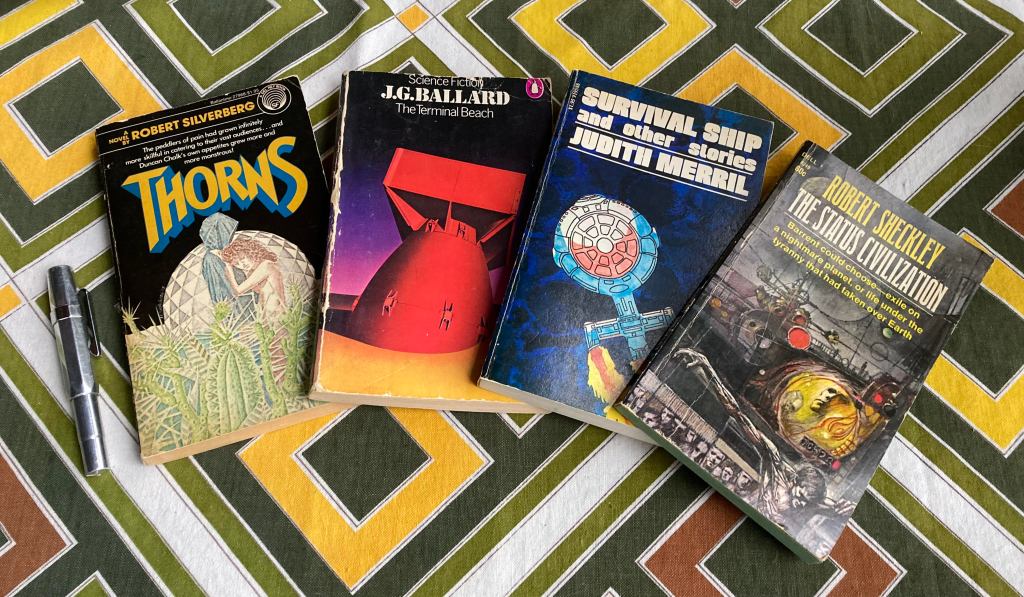
A selection of read volumes from my shelf
Exciting news! Rachel S. Cordasco, who occasionally joins me to review older SF short stories in translation, will soon launch Small Planet: The SF in Translation Magazine. As the announcement on File 770 states, “the magazine will come out 4 times per year (February, May, August, and November) and include columns on such topics as: interesting upcoming books and notable reviews, interviews with authors, translators, editors, translators talking about books they’d like to see in English, essays on Anglophone awards, databases, and publishers that should recognize translators/SFT, essays on Anglophone awards, databases, and publishers that should recognize translators/SFT, pieces on interesting translation conundrums, notes on what’s happening in other countries in SF. It will be available for free on Cordasco’s Speculative Fiction in Translation website.”
Missing from the list will be my reviews of vintage SF in translation! The plan is to have one review in each issue for at least the next year or for as long as I can keep up a schedule (schedules and I do not mesh). I’ve already tracked down some lesser known gems from German, Norway, and Italy.
The Photograph (with links to reviews and brief thoughts)
- Robert Silverberg’s Thorns (1967). Generally considered one of his first great novels — I thoroughly his rumination on two psychologically devastated characters who are set up to fall in love for the entertainment of the world. Harrowing stuff. Recommended.
- J. G. Ballard’s The Terminal Beach (1964). Never managed to review this top-notch Ballard collection. I should just reread it… Coincidentally, I wrote a short story as a college student with a very similar premise to Ballard’s “The Drowned Giant” (1964).
- Judith Merril’s Survival Ship and Other Stories (1974). Notably contains the three short stories that Merril planned to transform into a generation ship novel — “Survival Ship” (1951), “Wish Upon a Star” (1958), and “The Lonely” (1963). If she had, it would have been the first gen ship novel by a woman. According to my index, the first solo-written generation ship novel by a woman is Pamela Sargent’s YA novel Earthseed (1983).
- Robert Sheckley’s The Status Civilization (1960). I found his short novel an interesting intersection of pulp narrative and “artfully constructed satire.”
What am I writing about?
While I have not had the most productive 2026, here are few notable reviews I’ve written recently in case you missed them: two interesting 50s short stories on race in America, Alan E. Nourse’s “Marley’s Chain” (1952) and Edward W. Ludwig’s “The Rocket Man” (1951); Fritz Leiber, Jr.’s Gather, Darkness! (1943, novelized 1950) and Gillian Freeman’s The Leader (1965); William Tenn’s collection Time in Advance (1958); and another installment on my survey of all pre-1985 generation ship stories available in English, Mari Wolf’s “The First Day of Spring” (1954) and Francis G. Rayer’s “Continuity Man” (1959).
As I mentioned earlier, I am writing reviews for Rachel’s online magazine on SF in translation. When they go live I’ll double-post them on the site and link the other goodies that are sure to grace the pages.
What am I reading?
I recently finished Matthew I. Thompson’s fascinating monograph On Life Support: Eco-Dystopian Cinema in the Long 1970s (2026). He explores the intersection of popular science works by Rachel Carson and Paul R. Ehrlich and dystopia SF film with ecological themes. If you missed my interview with Thompson, I highly recommend you check it out. The interview surveys the main theoretical premises of the work and the main films he covers. I should rewatch Soylent Green (1972), David Cronenberg’s Shivers (1975), and Douglas Trumbull’s Silent Running (1972).
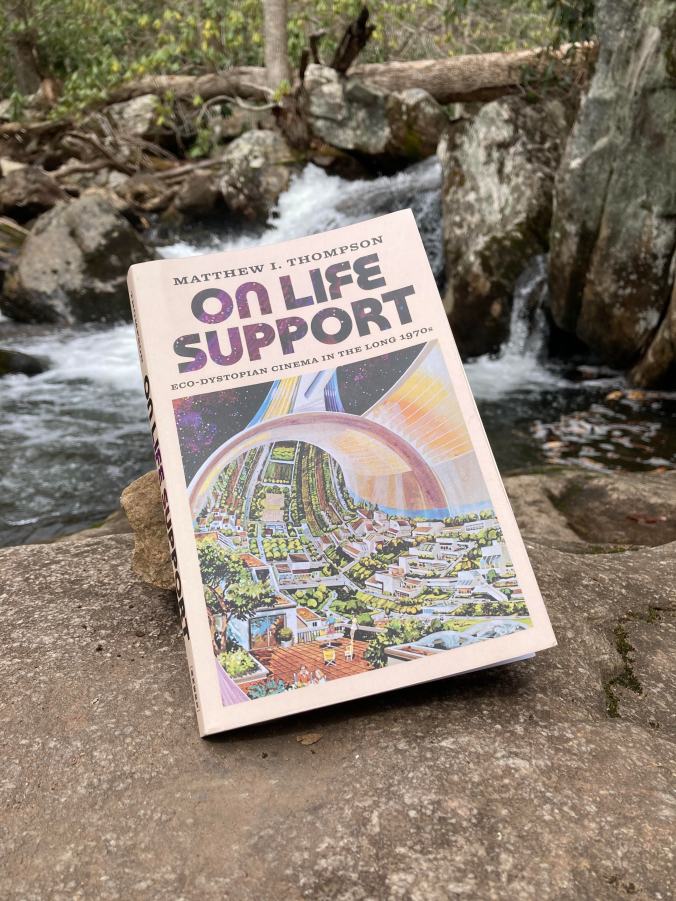
Matthew I. Thompson’s On Life Support: Eco-Dystopian Cinema in the Long 1970s (2026). Photographed by me on a hike in Pembroke, VA.
A Curated List of SF Birthdays from the Last Two Weeks [names link to The Internet Speculative Fiction Database for bibliographical info]
March 22nd: Raymond Z. Gallun (1911-1994).
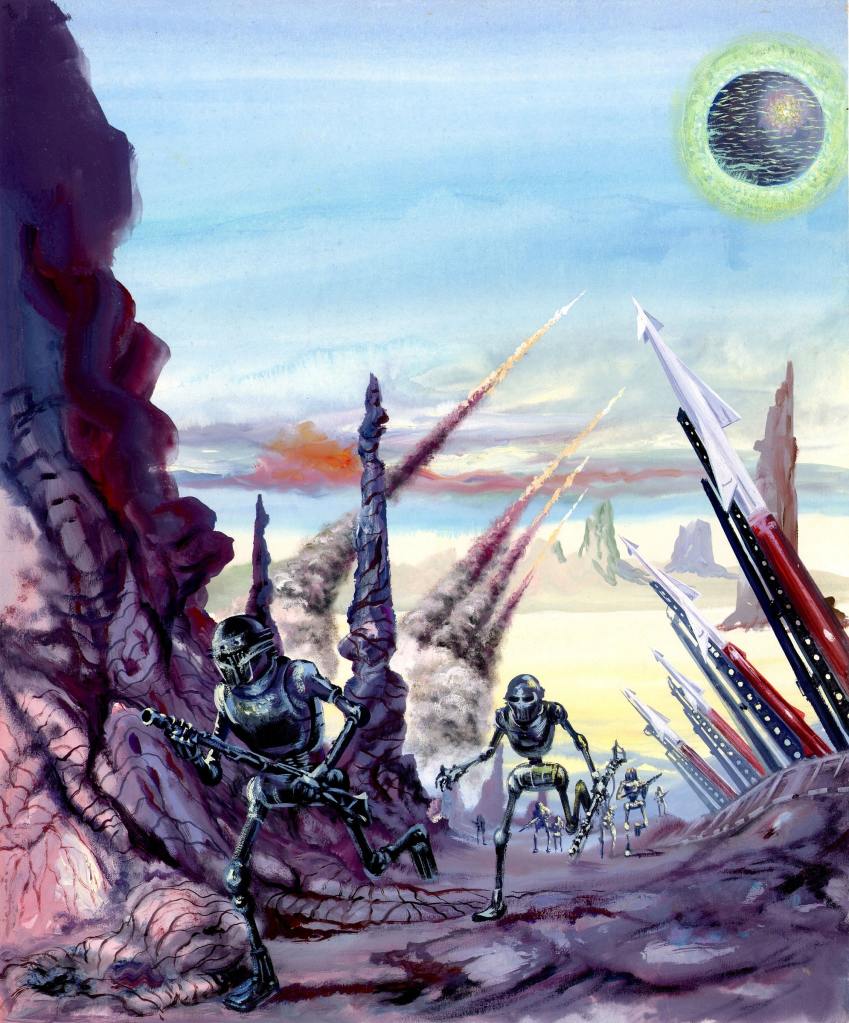
Johnny Bruck’s canvas for Perry Rhodan, #270: Ultimatum an Unbekannt (1966)
March 22nd: German cover artist Johnny Bruck (1921-1995). He’s easily one of the most prolific German cover artists.
March 22nd: Rudy Rucker (1946-).
March 23nd: H. Beam Piper (1904-1964). I recently (sort of) covered my first Piper story on the site: H. Beam Piper and John J. McGuire’s “Hunter Patrol” (1959). I have another one planned this year.
March 23nd: Sheila MacLeod (1939-).
March 23nd: Elizabeth Ann Scarborough (1947-). I enjoyed her Acorna sequence books (written with Anne McCaffrey) was a child. Most of her published solo work is outside my area of focus. I placed her novel The Healer’s War (1988-) on my Vietnam War-inspired SFF list.
March 23rd: Kim Stanley Robinson (1952-). I recently reviewed Icehenge (1984). I really enjoyed it. Perhaps more than his Mars Trilogy, albeit, they are very different books…
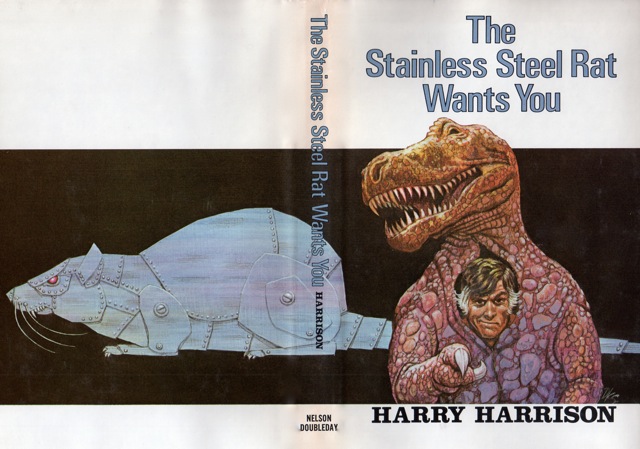
David K. Stone’s cover for the 1978 edition of The Stainless Steel Rat Wants You (1978)
March 24th: Cover artist David K. Stone (1922-2001).
March 24th: Peter George (1924-1966).
March 25th: Jacqueline Lichtenberg (1942-)
March 26th: Edward Bellamy (1850-1898). Author of Looking Backward: 2000–1887 (1888), the highly influential utopian SF novel that inspired countless sequels and prequels and rebuttals by other authors.
March 26th: David J. Lake (1929-2016)
March 26th: K. W. Jeter (1950-)
March 27th: Artist Stanley Meltzoff (1917-2006)
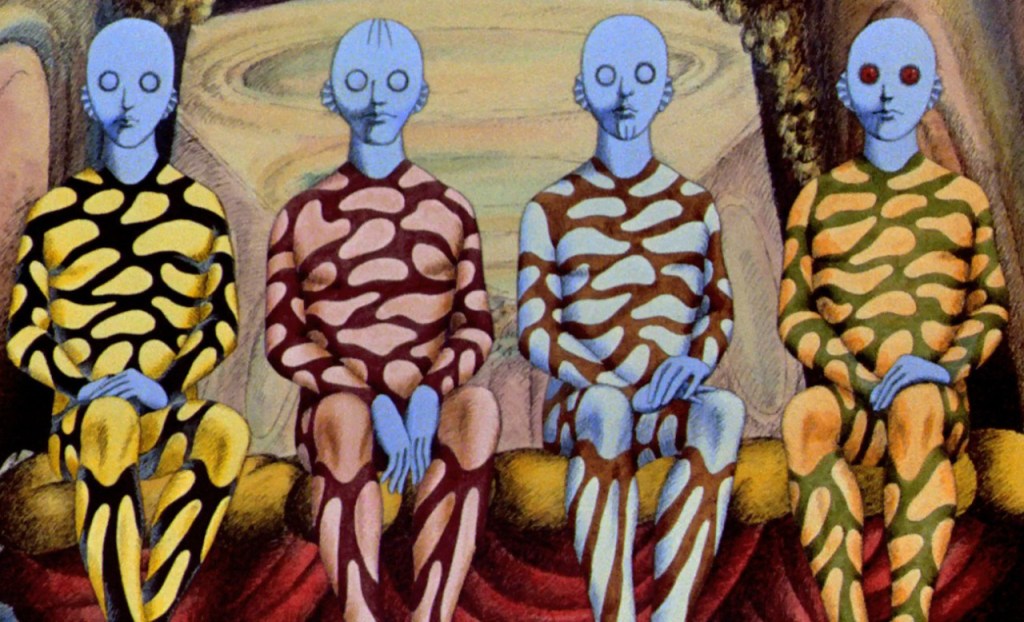
Still from René Laloux’s Fantastic Planet (1973)
March 27th: Stefan Wul (1922-2003). A French SF author best known for writing Oms en série (1957), the source material for Fantastic Planet (1973).
March 27th: Helmut Wenske (1940-).
March 28th: A. Bertram Chandler (1912-1984)
March 28th: Cover artist George Ziel (1914-1982)
March 29th: Lino Aldani (1926-2009). I adored Aldani’s “Good Night, Sophie” (1963, trans. 1973). He represents one of the many reasons why Rachel’s magazine to promote SF in translation is such a great idea. Despite his ability to craft a masterpiece, only ONE additional short story exists in English translation.
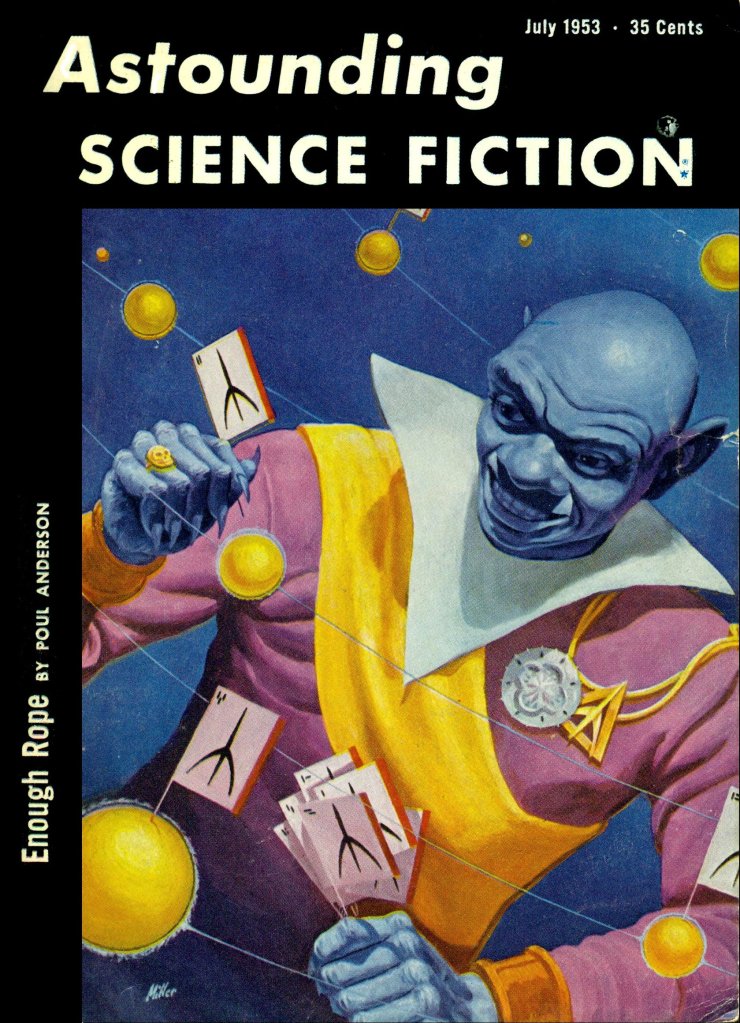
Walt Miller’s cover for the July 1953 issue of Astounding Science Fiction
March 29th: Artist Walt Miller (1928-2015).
March 29th: Artist Johann Peter Reuter (1949-).
March 29th: Mary Gentle (1956-).
March 30th: Artist Curt Caesar (1906-1974).
March 30th: Alice Eleanor Jones (1916-1981). While she only published five science fiction short stories, “Created He Them” (1955) is a 50s masterpiece.
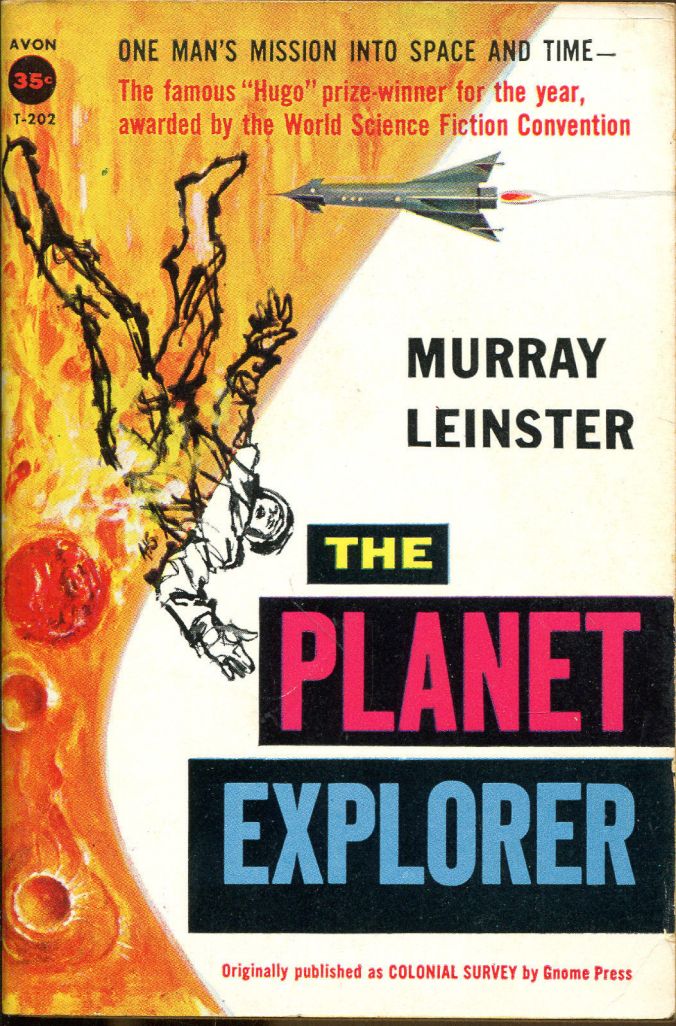
Art Sussman’s cover for the 1957 edition of Murray Leinster’s The Planet Explorer (variant title: Colonial Survey) (1956)
March 30th: Artist Art Sussman (1927-2008). Another underrated SF artist with a beguiling surrealist streat– I put together a post on his work in 2017.
March 30th: Chad Oliver (1928-1993). Most recently I covered his two generation ship stories: “Stardust” (1952) and “The Wind Blows Free” (1957).
March 31st: Marge Piercy (1936-). Dance the Eagle To Sleep (1970) is not to be missed!
April 1st: Anne McCaffrey (1926-2011). I adored her work as a kid. I read everything I could get my hands on–even from the lowest points in her career i.e. the Acorna Universe sequence and co-written Dragonriders of Pern novels with her son.
April 1st: Samuel R. Delany (1942-).
April 2nd: Artist Mitchell Hooks (1923-2013). One of the underrated SF artists of the 50s-70s in my view. For a lovely example, check out my recent review of William Tenn’s Time in Advance (1958).

Murray Tinkelman’s cover for the 1978 edition of John Brunner’s The Squares of the City (1965)
April 2nd: Artist Murray Tinkelman (1933-2016). Another underrated SF artist… How can your forget his iconic cover for Brunner’s The Sheep Look Up?
April 2nd: Joan D. Vinge (1948-)
April 3nd: Noel Loomis (1905-1969).
April 3rd: Colin Kapp (1928-2007). As I’ve said before, “want to push my buttons? Recommend stories for me to read like Kapp’s “Hunger Over Sweet Waters” (1965). You’ll have to read my review (an exercise in snark) to find out why.”
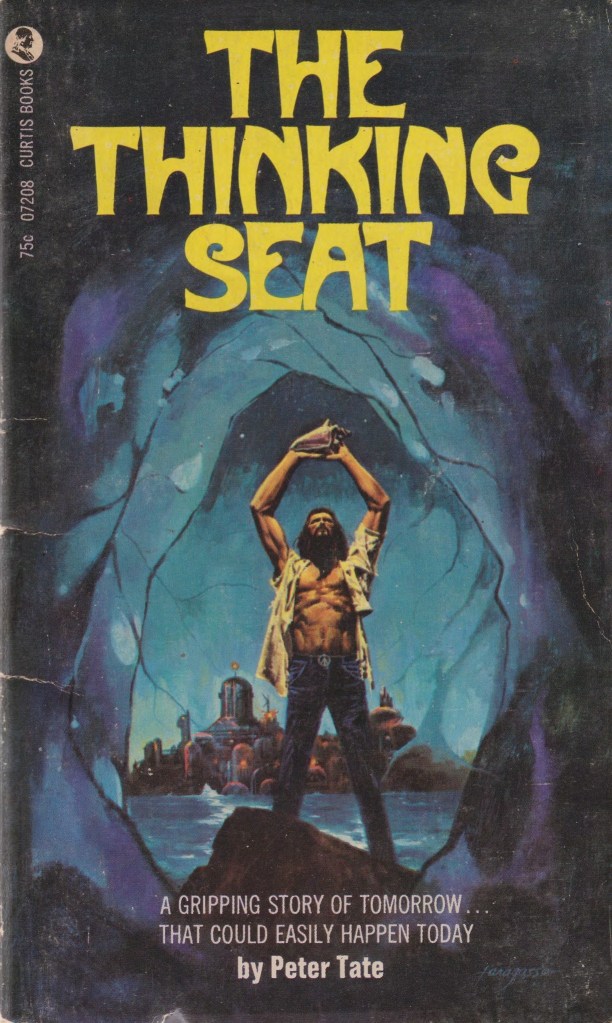
Jack Faragasso’s cover for the 1972 edition of The Thinking Seat (1969)
April 3rd: Peter Tate (1940-). One of those British New Wave authors I should read more of… Tate’s The Thinking Seat (1969) is on the burner for later this year.
April 4th: Stanley G. Weinbaum (1902-1935). Best known for his early classic “A Martian Odyssey” (1934).
April 4th: Artist Tim White (1952-2020).
For book reviews consult the INDEX
For cover art posts consult the INDEX
For TV and film reviews consult the INDEX
 Science Fiction and Other Suspect Ruminations
I finally read “Thorns” around Christmas last year. I wasn’t sure of it for the first 50 or so pages, but it finally grew on me–like a rash! I love Silverberg.
The Terminal Beach. Ballard finally achieving the Ballardian!
Judith Merril–I need to read more of her (I stalled about halfway through the NESFA collected short stories).
I haven’t read Sheckley’s The Status Civilisation, amazingly, considering I’ve read a lot of his 50s and 60s shorts and novels. I should just do it!
I’ve finally got back into SF over the last three months or so. Maybe it was Silverberg that got me back in!
I’ve picked up my read through of short SF c. 1970. I finished the final Terry Car, Donald Wolheim collection “World’s Best Science Fiction 1971”. The surprise stand out for me was Gordon Eklund’s ‘Dear Aunt Annie’.
I also finally read Christopher Priest’s “An Infinite Summer–excellent, particularly ‘An Infinite Summer’, ‘Palely Loitering’ and ‘The Watched’. This sent me down a C. Priest hole. I’m also reading both his collection “Real-Time World” and a more recent one “Episodes”.
Finally, I read Brunner’s “The Squares of the City”. Interesting. I’m not sure I liked it as much as you. It had a lot of promise I don’t feel that it exploited. But there were some great bits in it (the subliminal TV stuff entwined with a sort of critical theory of the city for one!).
Hello Anthony,
Excited that you’re back reading SF. I agree on the Brunner. I liked the concept, I enjoyed the intersection of subliminal TV and as you say a “critical theory of the city,” but the plot was a bit labyrinthine—in part due to his structural need to follow an existing chess game…
Gordon Eklund — > I imagine that somewhere in his substantial short story ouvre there are some gems. I apparently called his short story in Universe 2 “Stalking the Sun” “surprisingly good” and his novel The Eclipse of Dawn (1971) had its moments. Haven’t read too much more — beyond a short story here and there.
Still working my way through the collected stories of J.G. Ballard – currently up to 1962, so on the cusp of many of the tales collected in The Terminal Beach (which I recollect as being his strongest collection).
Oh, and I recently acquired Sheckley’s ‘The Status Civilisation’ too – it’s on the TBR shelf as it were!
As for what I’ve been reading – I’m currently on a short story binge for a week or two – just finished Priest’s ‘An Infinite Summer’ and Keith Roberts’s ‘Weihnachtabend’ (having acquired the collections ‘Episodes’ and ‘The Grain Kings’ respectively). The latter is easily one of the best short stories I’ve had the pleasure to discover – ‘Pavane’ set a high bar, but this was in a league of its own.
And next? Well I’m just about to embark on Sheckley’s ‘Specialist’ from his collection ‘Untouched by Human Hands’ – happy days.
Re-Roberts: I also was impressed with “Weihnachtabend” and others in The Grain Kings (1976). I am normally uninterested in Nazi alternate histories, but this one worked…
You’re reading a lot of things I’ve covered so I can’t help but link the reviews! Here’s my review of Priest’s collection An Infinite Summer (1979). I was quite blown away by it.
In the early years of my site, Sheckley was a staple. I’ve covered 34 short stories and 4 novels.
Checked out your review of The Grain Kings & I’d wholeheartedly agree with your ratings for ‘Weihnachtasbend’ & ‘The White Boat’. Will be getting to the others in due course! Such a fabulous writer.
I’ve enjoyed most of what I’ve read of his work so far.
I read “The Status Civilization” in 2017.
Currently reading Clarke’s “A Fall of Moondust” which is very good, and just started a reread of “The Stars My Destination”
I read both the Bester and Clarke as an older teen. I can say I was transfixed by either — but that was my life ago… I imagine I would appreciate the Bester more and the Clarke less if I were to reread them.
Are you looking forward to SF in translation magazine I mentioned in the beginning of the post?
I read Citizen in Space (Ciudadano del espacio), I’m currently reading Store of Infinity (La tienda de los mundos) and next up is Notions: Unlimited (Paraíso II). Robert Sheckley x3.
Hello, thanks for stopping by. Do you enjoy his work?
I’ve reviewed the first two you mentioned on my site. Here’s the index if you wanted to check out my thoughts.
I’ve been on a Silverberg kick for the last few years, but somehow never read Thorns. It sounds like I’ll have to read it. I’m pretty sure I’ve read The Status Civilization, but my old brain seems to have no memory of it. Maybe time to check it out again.
Recently reread Spinrad’s Bug Jack Barron, which I first read as a teenager. I liked it a lot then, and still did this time.
With John Varley’s passing in December, I went back and reread his first two books, the novel The Ophiuchi Hotline and the short story collection The Persistence of Vision. The novel is good, and the collection is excellent.
Hello John! Here’s to more good reading in 2026. As I know I’ve said multiple times in various venues, Thorns is one of his first really competent novels. There are some solid earlier short stories for sure. Still have not tackled Bug Jack Barron…. a glaring hole in my New Wave obsession. The few Varley shorts I’ve read have been really great. Ian Sales, a longtime friend of site, has tried to get me to read The Ophiuchi Hotline for more than a decade. I really should!
If you only read one Varley (i,e, have to be “pushed” to it 🙂 ) I’d go with the collection. Hotline lays out the universe that most of the shorts are set in, but it’s not really important for understanding or appreciating them.
I also I read the stories in his collection The Barbie Murders but never reviewed it. I do enjoy his work. https://www.isfdb.org/cgi-bin/title.cgi?25557
I just started reading “The Princes of the Air” by John M. Ford, and I am reading a few selections from “Edges” by Ursula K. Le Guin and Virginia Kidd. In “Edges” I’m reading the story “The Oracle” by M.J. Engh. I have the complete short stories of J.G. Ballard and I think I’m going to have a go at it too.
Ford’s The Princes of the Air was an unusual read. I assume you’ve seen my review? I found it oblique in a not entirely substantial way… Not sure what to make of it!
I’ve tried to read Engh’s Arslan many times. I think I acquired Edges to read that short story. Only three fall within my timeframe — and perfect for my series on the first three published short stories by female authors I need to know more about.
Recently read a few things (at least partly based on your reviews/recommendations):
Robert Holdstock’s “Where the Time Winds Blow” – never read him before, was a bit taken aback by how skillful the psychological characterizations were handled, and wondered more than once if the planet’s bizarrely absorbing nature was meant as a metaphor for the sf genre itself. Found the ending/resolution a little disappointing and nonsensically pat but really enjoyed it overall, will seek out more of his work.
Christopher Priest’s “Infinite Summer” – Havent finished yet but in general he does not disappoint when it comes to the Dream Archipelago material, and having read later works this has been interesting to dip into to see the origins of its peculiar milieu.
George Alec Effinger’s “Irrational Numbers” – Idiosyncratic but engaging, even if I found my mind wandering a bit through some of the extended athletic action scenes. Not sure if anything topped the opening story (“Lydectes”) although “Hard Times” also stuck out. I confess I picked this up because I havent been able to get my hands on a copy of “What Entropy Means to Me” yet.
Also read Michael Swanwick’s “Stations of the Tide” (incredible and dense, but outside your timeframe) and currently am on Moorcock’s “The Eternal Champion” (pulpy nonsense).
I apologize for the delayed response — rough week at work.
Glad you enjoyed the Holdstock. It certainly was the surprise of the year I read it it. He’s best known for Mythago Wood, apparently to the detriment of his other more overtly SF novels. I am struggling to remember the exact details of the ending.
I agree with you on the Priest and Effinger. I look forward to your thoughts on What Entropy Means to Me when you acquire a copy.
Always good to hear from you. Sorry again for the delay.
Used the long Easter weekend to finish a few books, and from the SF side, read Vonda McIntyre’s Dreamsnake, which I enjoyed. Like you, in your review from a few years ago, one of last couple pre-1990 Hugos for me to read (the other being LeGuin’s The Dispossessed).
You saved a good one for last! Although, my memories of The Dispossessed are hazy at best. After you read it, I recommend you take a look at this interesting article on translating Le Guin for East German audiences. https://sciencefictionruminations.com/2022/11/11/exploration-log-1-sonja-fritzsches-publishing-ursula-k-le-guin-in-east-germany-2006/
I just finished Philip K Dick’s Ubik. I enjoyed it. It was weird, as expected. There were also details like the main character complaining about how he wants more salacious celebrity gossip or how he has to pay the door to leave his apartment that weren’t necessary for the plot, but were nice touches.
I stumbled across the IF magazlne list of winners in their college writing contest and have decided to read some of them. I’ve finished the second place winner, which isn’t to my taste but it’s not bad.
I just started Robert Wade’s Zero A.D. The premise is that a professor discovers that history is only 100 years old and everything prior to that is made up. It’s an interesting enough premise that I’ll finish the novel even if it’s poorly executed.
I read Ubik before I started writing about SF — It’s certainly one of those novels that I’ve though about rereading. My memories are positive. I enjoy his unusual somewhat surreal touches. I’ve been enjoying working through some of his SF short stories over the last few years.
Can you link the IF list?
I’ve never heard of Wade. Time to go look him up!
I stumbled on the list while reading the issue where they announced the winner.
This is the issue where they announced the winners. https://archive.org/details/If_Worlds_Of_Science_Fiction_v04n03_1954-11.Quinn_AKv1.0/page/n7/mode/2up
I haven’t been able to find much about the winners and the contest aside from a few lines on Wikipedia, though only two went on to publish anything else, so maybe that’s part of it. The others were STEM majors so I guess they got jobs and didn’t have the time or inclination to try to get anything else published. I don’t think any of the entries have been republished.
I recently read a collection of DIck’s short stories and they were a lot of fun.
Thanks for the list. I assume the two you mean are:
Andrew J. Offutt — > became a “well-known” writer of fantasy porn, etc. and a few more straight laced SF novels and short stories. https://www.isfdb.org/cgi-bin/ea.cgi?264
And Leo P. Kelly: published quite a few SF novels, etc. https://www.isfdb.org/cgi-bin/ea.cgi?10953
Yes, those are the two. I’ve read Kelly’s story, which is fine, though I wasn’t impressed enough that I’ll actively seek out his other work. I started Offutt’s story, which is better. It’s somewhat ridiculous the way that works for science fiction. Offutt sounds like a real character.
The last SF book I read was PKDs Flow My Tears the Policeman Said. Definitely not among his best, though as always there’s at least a couple of wild scenes, as well as some of those odd details that he’s so good at.
Before that I did a couple of rereads:
Aldiss’ Non-Stop, which was as good as I remembered it, maybe even a bit better, though still also with a couple of minor flaws.
Burroughs Naked Lunch, which I guess is only tangentially SF, even though it had more SF elements than I remembered.
I read Non-stop way back in 2010 — it certainly inspired my fascination with the generation ship. As I’ve probably mentioned, Paul Kincaid’s monograph on Aldiss is not to be missed! https://www.press.uillinois.edu/books/?id=44xma6ms9780252044489
He puts Non-stop in dialogue with his military service in British Burma in WWII, etc.
I received “Sword of Rhiannon” in the mail the other day. I’m still reading Ford’s word “Princes of the Air,” I write daily so it impedes reading progress sometimes. But it’s tempting to drop “Princes” and read “Sword” but I feel obligated and I’ve got to see it through. I also got a copy of “Dreamsnake,” and I’m looking forward to finally reading it. I just have too many choices.
Dreamsnake is great!
” I just have too many choices.” — I know the feeling. As you know, close to 2k unread SF books at this point…
Listening not reading.
“The Earth Book of Stormgate” by Poul Anderson.
About the Ythrians, an intelligent bird-like predator species and their interaction with humans. Anderson does a fairly nuanced job with these. Their slang for humans: mudfeet.
A Slow Saturday Night by Michael Moorcock.
Jehovah himself visits a bar and talks. Rather inane.
“An Ape About the House” by Arthur C. Clarke
Good old A.C.C.
There’s an enormous amount of Spec-Fic on audio on the net.
Hello William, I’ve read the earlier The People of the Wind (1973) novel in the same Avalon universe. I had not realized he wrote a later story. I was on an Anderson kick at the time (there’s a review of novel from the first few years of the website). I’ve soured a bit on his work since then.