Book Review: We All Died at Breakaway Station, Richard C. Meredith (1969)

WLLDDBKYS1969

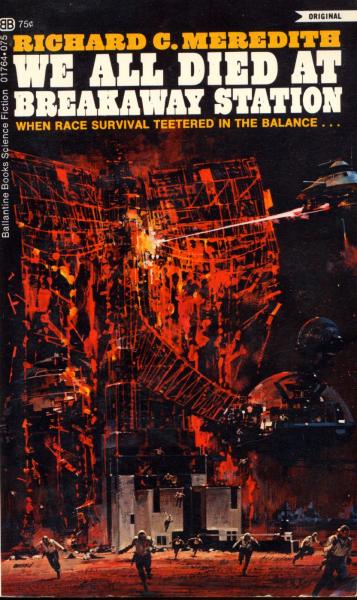
(John Berkey’s cover for the 1969 edition)

3/5 (Average)

Automated machines rummage through the wreckage of a spaceship—after a battle with the Jillies—gathering the human dead and placing them into cold storage, to be stitched together again for another fight.   Absolom Bracer is one of the casualties of Earth and its colonies’ war with the a vaguely known alien foe (the before mentioned Jillies) doing their “damnedest” to “eat up every crumb” of the “apple pie” (as sophisticated as a Richard C. Meredith gets)  (192).  Captain (eventually Admiral) Bracer of the warship Iwo Jima after his death becomes one the resurrected—“a shiny meter-tall cylinder of metal supporting what was left of the upper torso of a man” (9).  What remains are a “few bones, a little living flesh and muscle” and most importantly, “a collection of tangled Continue reading

Updates: Recent Science Fiction Acquisitions No. CXXVIII (Roberts + Cherryh + Blish + Knight + Pangborn)

Finally, a famous (“Joachim Boaz you will adore it”) fix-up novel by Keith Roberts enters my collection….

Overpopulation SF never gets old—even if I have low expectations about this one.

More Pangborn and a singleton Cherryh novel I had never heard of….

Thoughts?

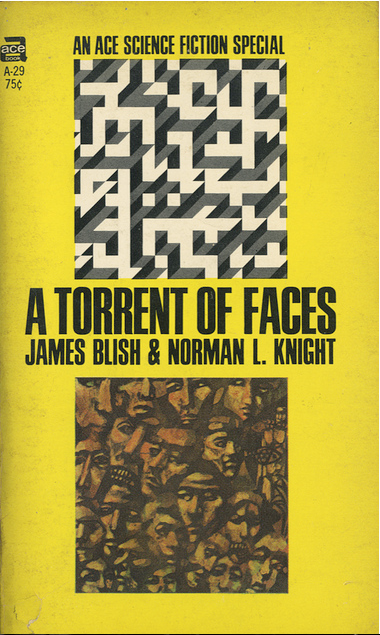
1. A Torrent of Faces, James Blish & Norman L. Knight (1967)

screen-shot-2013-02-09-at-12-16-53-am

(Diane and Leo Dillon’s cover for the 1968 edition) Continue reading

Guest Post: The Killer Thing, Kate Wilhelm (1967)

The sixth in my Kate Wilhelm’s SF Guest Post Series (original announcement and post list) comes via 2theD (twitter) over at Potpourri of Science Fiction Literature and Tongues of Speculation. He is a prolific blogger of vintage, translated, and newer science fiction.  Unfortunately, and much to my frustration (he knows!), he is on something of a hiatus (other than short story summaries and ratings).  Thus, when I approached him about participating in this series he volunteered one of his older reviews.  As I remembered it fondly, I agreed.

Thanks so much for contributing!

~

THKLLNGTHN1972

(Patrick Goodfellow’s (?) cover for the 1972 edition)

Kate Wilhelm is among a handful of female science fiction writers who need no introduction. She’s authored scores of short stories, about thirty-six genre novels, and eleven collections. She’s probably more prolific than many common and respectable male authors, yet she receives very little of the limelight that’s due to her (outside of SFMistress’s occasional posting on her work). Of her novels, I read her most popular work Where Late the Sweet Birds Sang (1976) and the much lesser popular Let the Fire Fall (1969), their respective popularity very much reflecting their quality. The two-story collection in Abyss (1971) had some Continue reading

Updates: Recent Science Fiction Acquisitions No. CXXVII (Malzberg + Silverberg + Biggle, Jr. + Zelazny)

One of Robert Silverberg’s most famous 70s novels…

Barry N. Malzberg’s first published novel (more speculative fiction than SF)…

Lloyd Biggle, Jr.’s best known novel…

And Roger Zelazny’s first published collection of SF shorts…

And some great covers!

1. The Book of Skulls, Robert Silverberg (1971)

BKFSKLLS1972B

(Dean Ellis’ cover for the 1971 edition) Continue reading

Book Review: Starswarm, Brian W. Aldiss (1964)

STRSWRMPSJ1964

(William Hofmann’s cover for the 1964 edition)

4/5 (collated rating: Good)

Filth.  Decay.  Mud.  Transmutation.  Brian W. Aldiss’ SF is filled with such images:  Men—with limbs removed—who are slowly (and artificially) transmuted into fish, writhe around in the mud of their tanks grasping at the last shards of their humanity;  A powerful matriarch lords over a planet where her pets transform at will;  A tall tale about a planet filled with strange life and a human hero who cannot get over the fact that everything smells like garbage…. Aldiss’ novel The Dark Light-Years (1964), despite its poor delivery, is the best example of these themes—humans encounter sentient aliens who spend their days copulating, laying around, and eating in their own fifth.  And they are happy with their lot.

Starswarm (1964) is comprised of three novelettes and five short stories with conjoining explanatory material that links the previously published short fiction into a cohesive collection.  The modus operandi of such a conjoining concerns the “Theory of Multigrade Superannuation” where “the universe is similar to the cosmic clock; the civilizations of man are not mere cogs but infinitely smaller clocks, ticking in their own right” (7).  Thus, the inhabited solar systems of Starswarm—our galaxy—will exhibit all the characteristics through which a civilization can Continue reading

Updates: Recent Science Fiction Acquisitions No. CXXVI (Lessing, Silverberg, Sheckley, Dickson)

I have yet to read anything by the Nobel Prize for Literature-winning author Doris Lessing…  And she wrote numerous SF novels—I’m very excited that I found one in a clearance section for 2$.  I also found one of the very few 1970s works by Silverberg not in my collection.  Dickson’s supposedly most mature novel (which I doubt is very good) also joins my collection.  So far the only Dickson I can tolerate are a handful of his short stories. And finally, my last acquisition is one of Robert Sheckley’s best-loved novels.

Thoughts?

1. The Memoirs of a Survivor, Doris Lessing (1974)

0394757599.01.LZZZZZZZ

(Brad Holland’s cover for the 1988 edition) Continue reading

Book Review: Bettyann, Kris Neville (1970)

BTTNNWXZBT1970

(W. Thut’s cover for the 1970 edition)

4/5 (Good)

So the Amio were deficient, from the very beginning, and were born weaklings, untested, and had gone their own solitary way. […] [Bettyann] would reinfuse in them the vitality that their own development had ultimately denied them and contravene the defeat that was foreshadowed in the limited dreams and ambitions of their father’s father’s father’s father’s father, backward to the time when myth told little that one might truly believe, except that the Amio were always, from the beginning, one” (78).

Since the beginning of the year MPorcius, who presides over MPorcius’ Fiction Log, has reviewed a handful of Kris Neville’s short stories (here and here).  Because the name was on my mind and I had not read any of his work in the past, I eagerly picked up a copy of his fix-up novel Bettyann (1970)— which contains contains two previously published stories “Bettyann” (1951), which appeared in New Tales of Space and Time, and “Ouverture” (1954) which appeared in 9 Tales of Space and Time, both edited by Raymond J. Healey.  The novel is hard to find as it was only published by Tower Books.

Neville is praised by Barry N. Malzberg as an author, if he had not abandoned the field for the sciences, who could have been among the “ten most honored science fiction writers of his generation” (Malzburg’s intro to Neville’s “Ballenger’s People” in the 1979 Doubleday collection Neglected Visions). Continue reading

Updates: Recent Acquisitions No. CXXV (M. John Harrison + Coney 3x + Anthology + Cooper)

M. John Harrison’s collection The Machine in Shaft Tent (1975) contains one of the more humorous inside flap advertisements I have encountered:

P1050232

Don’t worry, I certainly intend to “see tomorrow today!”  I’ll be disappointed if I can’t!

The others are a strange blend…  From Edmund Cooper’s apparently anti-Free Love/60s culture Kronk (1970) to a delightful collection of another one of my favorite years of SF.

Also, I seldom accept advanced reader copies due to my limited time/limited interest in newer SF/and incredible mental block when it comes to, how shall I say it, outside forces guiding my central hobby which tends to take me in a variety of directions solely on whim.  But, Gollancz was nice enough to send me their new omnibus collection of 1970s Michael G. Coney novels (amazon link: US, UK).  Not only did I enjoy Hello Summer, Goodbye (1975) but I recently reviewed and loved Coney’s bizarre and original Friends Come in Boxes (1973).  With two out of two successes it’s hardly like I wouldn’t buy his work on sight anyway (another one of my requirements when accepting AVCs)….  I will review two or three of the novels in the omnibus one at a time over the next few months.

Thoughts?

1. The Machine in Shaft Ten, M. John Harrison (1975)

THMCSTRS071975

(Chris Foss’ cover for the 1975 edition) Continue reading

Update: Kate Wilhelm Guest Post Series Announcement

Kate Wilhelm is most widely known for her Hugo- and Locus-winning,  Nebula-nominated, fix-up novel masterpiece Where Late The Sweet Birds Sang (1976).  However, this linked series of novellas (her favorite form) was already the product of a long and fruitful career starting with somewhat standard pulp in the late 1950s.  By the late 1960s and early 1970s her SF took on psychologically heavy and often devastatingly effective themes with great success: for example, in 1972 she was nominated for an astounding four Nebulas (winning none of them).

Most of her critical success focused on shorter forms which might be the reason why other than Where Late the Sweet Birds Sang (1976) little of her work has remained firmly entrenched in the SF canon.  Which is a crying shame as she is easily one of the most regularly brilliant writers I have encountered.

Thus I have rounded up my normal suspects from across the vintage SF blog sphere for my second guest post series! The first covered the work of Michael Bishop.  As always, I have no idea whether they like her work or not but the purpose is to expose my readers to the range of her amazing visions.  I will place links to their twitter accounts (if they have them) and Continue reading