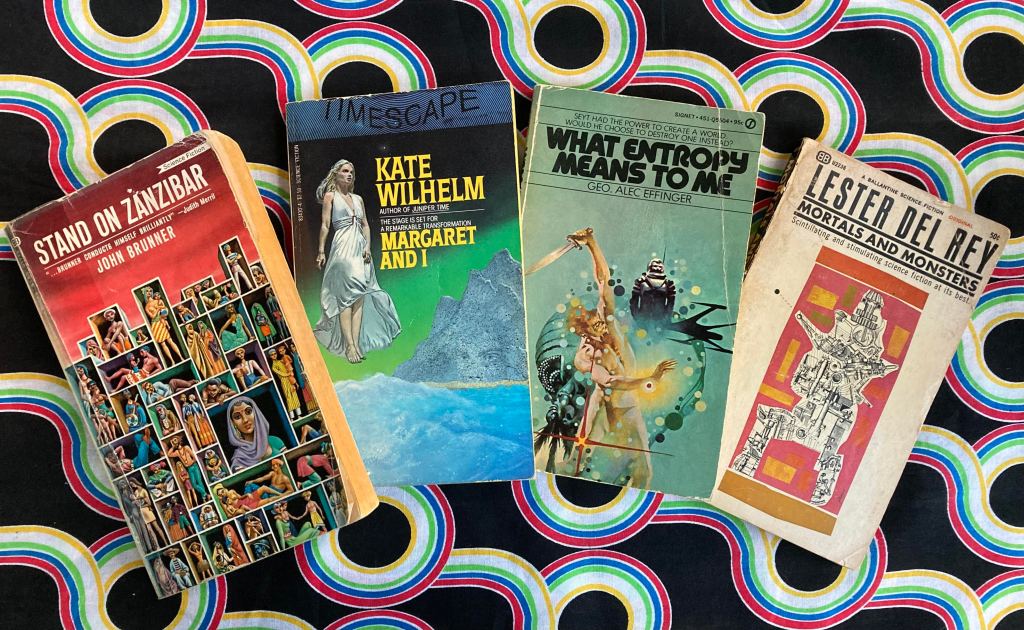
A selection of SF volumes from my shelves
What pre-1985 science fiction are you reading this weekend?
After the success of the previous installment, I’ve decided to make this a bimonthly post (“column”) for my site (“fanzine”). As before, I’ve included a bit about the books in the photograph, birthdays from the last two weeks, and brief ruminations on what I’ve been reading and writing.
Let me know what pre-1985 SF you’ve been reading! If you’re new and curious about my rationale for the perimeters of my site, check out this recent interview and podcast.
The Photograph (with links to reviews and brief thoughts)
- John Brunner’s Stand on Zanzibar (1968): This was the novel that hooked me on the New Wave. While I read it before I started my site, I remember the novel’s attempt at conveying information overload and the fascinating immersion of contemporary historical events like the 1966 University of Texas shooting from the top of the Main Building tower. I read tons of Brunner while attending UT (and read sections in a quiet nook in the Main Building’s Life Science Library) for my undergraduate degree (2004-2009) so the Stand reference jumped out at me.
- Kate Wilhelm’s Margaret and I (1971): One of many Kate Wilhelm novels I’ve reviewed on my site. I’ve returned to her fiction recently with the brilliant “Ladies and Gentlemen, This Is Your Crisis” (1976) and have another story lined up for a review series.
- George Alec Effinger’s What Entropy Means to Me (1972): One of the touchstone New Wave novels in my view–and what an underrated author.
- Lester Del Rey’s Mortals and Monsters (1965): There are some surprisingly good short stories in this collection” “The Years Draw Nigh” (1951), “The Dwindling Years” (1956), and “Lady of Space” (1958) were the highlights. Looking through my review I discovered a generation ship short story that I had forgotten–“Recessional” (1965)–and apparently, for good reason!
What am I writing about?
Still working on my new installment of my generation ship reviews series–Poul Anderson’s “The Troublemakers” (1953) is on the chopping block–and writing a review of Edgar Pangborn’s Davy (1964) (lips sealed on this one until the review is posted!)…
What am I reading?
I’m currently reading Phillip Mann’s The Eye of the Queen (1982).
Tempted by some fascinating scholarship about SF? I finished David Seed’s solid Ray Bradbury (2015) a few days ago and started Gerry Canavan’s brilliant Octavia E. Butler (2016) — both are in the U. Illinois Modern Masters of Science Fiction series. Let me know in the comments if you want any interesting factoids about Butler. Here’s one about Butler and how often she rewrote and rewrote and rewrote: “there were at least three Kindreds, two or three Dawns, at least four Sowers…”
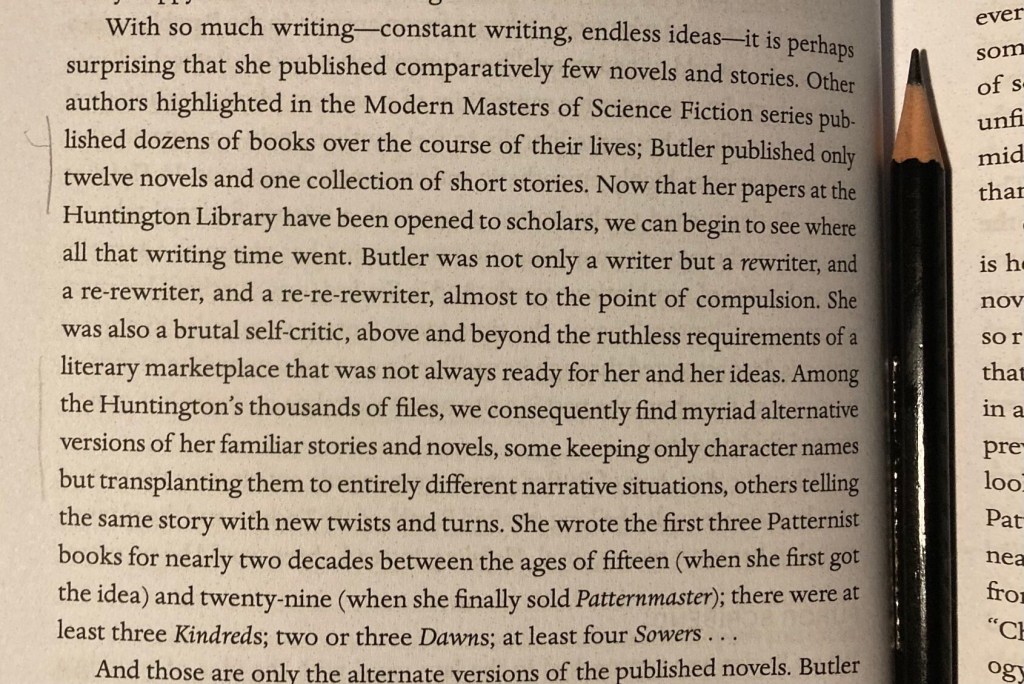
A selection from Gerry Canavan’s brilliant Octavia E. Butler (2016)
A Curated List of SF Birthdays from the Last Two Weeks
July 9th: Dean R. Koontz (1945-): Best known for his non-SF work, I’ve yet to explore any of his early science fiction. Here’s his bibliography.
July 9th: Mervyn Peake (1911-1968) was born on this day. I’ve only read, and thoroughly enjoyed, the first installment–Titus Groan (1946)–of his Gormenghast sequence. He also created fascinating cover art! Here’s his bibliography which includes images of his covers.
July 9th: Glen Cook (1944-): I’ve only read and reviewed The Heirs of Babylon (1972). Here’s his bibliography.
July 10th: Jack Coggins (1911-2006): I’d classify him as a vastly underrated SF artist of the 50s. If you’ve ever perused 50s SF magazines like Galaxy and Thrilling Wonder Stories, you’ve probably seen his work before.
July 10th: Julian May (1931-2017): I’ve only read one of her earliest 50s short stories for my generation ship short stories review series. On this list as a reminder that I need to read more… Here’s her bibliography.
July 10th: John Wyndham (1903-1969) was born on this day. I’ve only read and reviewed The Chrysalids (variant title: Re-Birth) (1955). Yes, I need to read more.
July 11th: Cordwainer Smith (1913-1966). I know. As with Wyndham, a blindspot in my reading although I’ve read quite a bit about his unusual science fiction.
July 12th: Charles R. Saunders (1946-2020): A pioneer of the “sword and soul” fantasy novel. While outside of the main SFictional purview of this sight, I’d love to track down the original DAW volumes of Imaro (1981), The Quest for Cush, and The Trail of Bohu (1985).
July 12th: James E. Gunn (1923-2020): A favorite from the early days of my site. Check out my reviews of The Immortals (1962) and The Joy Makers (1961) in particular if you haven’t already. I also read but never managed to review his best-known novel The Listeners (1972). He’s also important as a pioneer in the academic study of science fiction. Here’s his bibliography.
July 13th: Monique Wittig (1935-2003): A French author, philosopher, and feminist theorist, Wittig wrote a handful of novels that could be classified as SF. I’m interested in Les Guérillères (1969), which I snagged a few years ago.
July 14th: Christopher Priest (1943-): A Joachim Boaz favorite! I wish I managed to write a review of Inverted World (1974), which ranks in my top 10 SF novels of the 70s. Here’s his illustrious bibliography.
July 16th: Robert Sheckley (1928-2005): Another Joachim Boaz favorite! Heavily reviewed on the site. Here’s his massive bibliography.
July 16th: Sheri S. Tepper (1929-2016). Little of her work fits within the perimeters of my current reading interests but… I have a few of her books on the shelf.
July 21st: Italian SF author and editor Ugo Malaguti (1945-2021). I wish I knew more about the Italian SF scene… I’ve read an article here and there and reviewed a few translated works but that’s it. Bibliography.
July 22nd: Vaughn Bodé (1941-1975). A great artist who died too young. Check out their bibliography.
A Last Note
For years I have puttered around with the idea of making a podcast. That said, I listen to very few. What SF podcasts do you listen to? Why?
For book reviews consult the INDEX
For cover art posts consult the INDEX
For TV and film reviews consult the INDEX
 Science Fiction and Other Suspect Ruminations
I have sinned – this weekend I’m reading 1987’s book “Vacuum Flowers” by Michael Swanwick.
I do recommend Julian May’s 1950s “Dune Roller” and her early 1980s series, The Pliocene Exile.
Read what you want to read! haha.
I can’t remember if I have a copy of the Swanwick or not. At one point (like so many authors), I bought a bunch of his work as he’s mostly unknown to me but never got around to them. Alas.
Yeah, “Dune Roller” has been percolating my consciousness. I’ve been quite wedded to my reviews series as of late and haven’t dabbled around as much as I have in previous years.
Swanwick is mostly good, and sometimes world-class good. I even read his fantasy, though I usually hold genre fantasy in supreme contempt. (I don’t always finish his fantasies, mind you.)
What are your favorite early Swanwick works?
What falls within your remit are a few early Swanwick short stories (he doesn’t start getting it together novel-wise till his second, VACUUM FLOWERS, in 1987).
His very first, ‘Ginungagap’, got much anthologized, and was indeed noteworthy and novel — with somewhat of a Bruce Sterling ‘Schismatrix’ solar opera vibe, except Swanwick got there two years before Sterling published his first story in that vein.
‘Ginungagap’ (1980)
https://www.isfdb.org/cgi-bin/title.cgi?41372
‘The Feast of Saint Janis’ (1980).
This was the first novella in IN THE DRIFT, Swanwick’s first novel, a semi-fixup set in a post-Collapse U.S. where the nuclear disaster at Three Mile Island has wreaked environmental, civil, and genetic damage, and, IIRC, Janis Joplin, the 1960s rock star, has a semi-Wickerman-like cultural afterlife as a kind of fertility goddess. Or something — after forty-three years I forget. Certainly, some poor unfortunate gets trapped as a Janis Joplin cover singer touring the post-Collapse hinterlands and is consumed by the role, as the original was.
With all the 1960s-rock culture nostalgia, this one is definitely an artifact of its time, like one of the contemporaneous George R.R. Martin stories that do similar things (e.g. THE ARMAGEDDON RAG). This is better than Martin, of course, but even at the time I had limited tolerance for this sort of thing. Still, YMMV; as a historian, for instance, if you wanted an SF story about 1960s rock culture written in the 1980s, this would be the one, and is arguably good within its quaint cultural parameters.
https://www.isfdb.org/cgi-bin/title.cgi?41409
‘The Man Who Met Picasso ‘ (1982)
Succinct, poignant, well-written fantasy.
https://www.isfdb.org/cgi-bin/title.cgi?51000
‘Ice Age’ (1984)
A couple finds a tiny, accelerated civilization al la Sturgeon’s ‘Microcosmic God’ growing in their fridge. A trifle, but of its kind good enough to get picked up four decades later as an episode of LOVE, DEATH + ROBOTS. Hell, you could stick it in a classic 1950s issue of GALAXY next to a Sheckley or publish it in the next issue of CLARKESWORLD in 2023, and it would work.
https://www.isfdb.org/cgi-bin/title.cgi?56528
‘Trojan Horse’ (1984)
More space fiction, slower and more obvious than ‘Ginungagap,’ but much anthologized at the time, including in both the Carr and Dozois ‘Years Best’ collections for that year.
https://www.isfdb.org/cgi-bin/title.cgi?408
To my taste Swanwick’s “A Midwinter’s Tale” (IASFM Dec ’88 ) is as good as he got, though it is slightly outside your catchment area. It would make a nice contrast to Emshwiller’s “Pelt.” (And a risible contrast to “Black Destroyer”!
Thank you for the list Mark.
Hi Just finished The Warlock in Spite of Himself (1969) by Christopher Stasheff. I found it dated, sexist and the main character never engaged me. He started writing them again in the 1980’s. I picked up four lovely SFBC omnibus editions of his Warlock novels at Value Village so hopefully the latter ones are better. I followed that up with Stableford’s Mythos tale The Womb of Time but that is 2011 and not Sf. But I enjoyed it a lot more. I am planning to start The Long Afternoon of Earth by Aldiss and I have the David Seed plus a ton of Ray Bradbury’s short stories on my Kindle so that should be fun. You may know this but The Outlaw Bookseller does a ton of stuff about Christopher Priest including interviews.
All the best
Guy
Hello Guy,
It’s good to hear from you. I’ve had the first Stasheff volume on my to acquire list for a bit.
Which version of the Aldiss do you plan on reading? I talk a bit about its confusing publication history in my review of Hothouse from last year. Only US editions published after 1976 are complete. They were abridged under the name The Long Afternoon of Earth. I accidentally bought the abridged version and finally tracked down a complete US edition: https://sciencefictionruminations.com/2022/11/06/book-review-hothouse-variant-title-the-long-afternoon-of-earth-brian-w-aldiss-1962/
Thank you for the interview. I’ll check it out. What’s the subject of the interview?
Hi
Mine is a Signet book from New American Library /Times Mirror The New American Library of Canada, Signet Printing 1962. As for the Priest interview the two men are friends so a lot of reminisancing about the New Wave, authors they know Priest’s books etc.
Regards
Guy
So yeah, that’s abridged against his wishes and different than the UK version. I highly recommend tracking down a post-1976 US edition or UK edition under the title Hothouse.
Reminiscing about the New Wave is topic I can get behind! Thank you.
Just finished A Time of Changes (1972) by Robert Silverberg, published one year before his Dying Inside novel appeared.
Speaking of, you were right, Dying Inside was much better than Asimov’s The Gods Themselves that year. Further, you were correct in the rationale. Silverberg says as much in his March 2008 preface, speaking of his own book, “It did get nominated for both the Hugo and Nebula awards, although it lost both trophies to Isaac Asimov’s The Gods Themselves, which was very far from his best book but a sentimental favorite among the voters because it was his first novel in fifteen years.”
Thanks for the recommendation (you’re 2 for 2 with these, the other being Tevis’ Mockingbird)!
John
Hello John, glad you enjoyed it!
I’ve read but never managed to review A Time of Changes. I’d place it in my top 5 or Silverberg novels along with Dying Inside. He’s definitely a favorite of mine.
Dying Inside should have blown the competition out of the water. Unfortunately, the novel was perceived by some fans as anti-SF in its formulation (and far to overtly literary etc.).
Hello John, I posted a review of another novel—Edgar Pangborn’s Davy (1964)–that I’d argue should have won the Hugo…. His work is seriously under-read. Maybe I can go three for three? Haha. Again, Davy might be more my cup of tea due to my various pet interests…
Thanks for the recommendation and I will definitely pick it up! As I may have mentioned on Twitter, I’m a sucker for post-apocalyptic fiction, so I’ll probably have a starting bias in its favor. It looks like it was up against Fritz Leiber’s The Wanderer that year, which I have not read yet.
The Wanderer is terrible. I love Leiber. I can’t tolerate The Wanderer.
I second this. I love Leiber and The Wanderer is dreadful.
In the discussion section of my recent review of Davy, John Boston explains why Davy probably lost. The paperback editions weren’t released with enough time for the voters to read them. Fewer people bought its hardback first edition (which was also “graced” with miserable art).
Awards in retrospect feel so monumental. In reality, who wins what can be entirely up to how something was published and who could read it when. These fan awards have such a small body of voters.
Joachim,
Your take on how Davy could have been hurt by publication timing is pretty plausible. But how the heck was The Wanderer even nominated? In the mid-60’s? Just how?
John Boston explains that Leiber was a recognized name and the novel was designed in some ways to appeal to the old guard of SF readers of the time — with an epigraph to E. E. Smith etc.
Definitely check out John Boston’s full comment in the review discussion! He explains his reaction as a teen picking it up and how his views have shifted completely towards the Davy camp of things…. https://sciencefictionruminations.com/2023/07/29/book-review-davy-edgar-pangborn-1964/
I generally like Leiber but The Wanderer was too long and too many POVs and the feline evolved alien was just one too many. I especially liked “Gonna Roll the Bones”, “The Moon is Green”, “The Big Time”, “The Night of the Long Knives” and “The Girl With the Hungry Eyes”.
I’m reading PHAID THE GAMBLER, by Mick Farren (1986, but actually the first half of the 1981 UK publication THE SONG OF PHAID THE GAMBLER, so it’s truly “pre-1985”.) Pretty disappointing so far — shabbily written, full of cliches, bog-standard “SF set on a world where people have forgotten their history” stuff.
I’ve only read one Farren novel and it was quite poor as well.
The Texts of Festival (1973) https://sciencefictionruminations.com/2019/11/30/book-review-the-texts-of-festival-mick-farren-1973/
I was astonished to discover Charles R. Saunders ended in an unmarked grave, although I believe that has been addressed. I reviewed his Imaro some years ago. As I recall, his career was inadvertently nobbled by his publisher, who attracted the ire of the notoriously litigious Burroughs estate by slapping “the Black Tarzan” on Imaro, which is in every respect utterly unlike Tarzan. First print with that copy got pulped.
Gene Wolfe is on the to-do list but not Shadow of the Torturer… So is Mark Geston, exactly for the book one would expect.
I have finally finished the Cija portion of the Atlan books. Now I want to find the book written from the POV of her daughter, who is said to be much brighter than Cija. Granted, not a high bar.
The Geston was fine. It has the undergrad history major vibe though (which I know too well…). Reviewed on my site.
I’d love to get a copy of Gaskell’s SF novel A Sweet Sweet Summer (1969).
It seems to be very sincerely out of print.
And very very very expensive…
The Merril has a copy available to read in the Merril.
https://www.torontopubliclibrary.ca/detail.jsp?Entt=RDM554483&R=554483
That’s not exactly helpful for me.
I just finished Edgar Pangborn’s ‘A Mirror for Observers’ (1954):
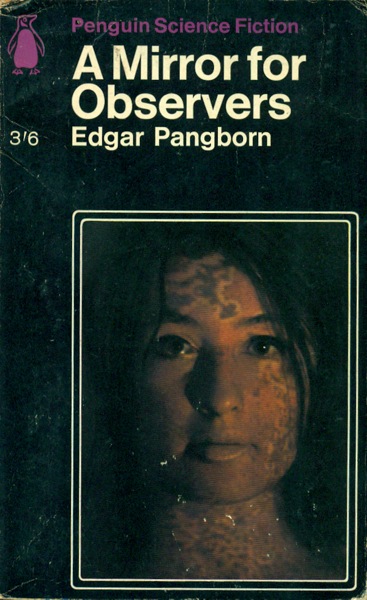
(bad cove)
Definitely worth a read. Different to ‘Davy’ though, but just as good–perhaps better?
And am about to embark on a reread of Brunner’s ‘The Jagged Orbit’ (1969):
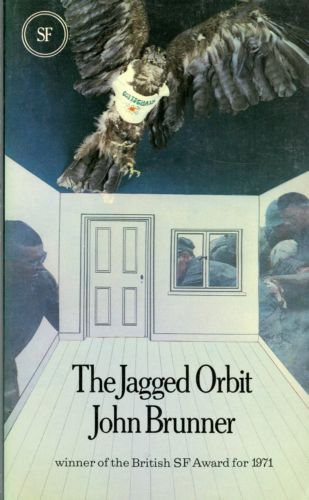
(another bad cover… my luck…).
This I am really looking forward to.
That jagged Orbit cover… goodness. I’ve always thought Chris Yates’ bizarre covers for Arrow Books were surreal in a rather amateur way.
I’ve only heard good things about Mirror. I have a copy somewhere on the shelf. I think I’m more likely to read Pangborn’s The Judgement of Eve and the rest of the short stories in the Tales of a Darkening World sequence first.
So, the question with A Darkening World is do you read in publication order or in internal order? The first is Davy, The Judgment of Eve, The Company of Glory, and Still I Persist in Wondering. The second is Eve, Glory, Persist, and Davy. The first documents Pangborn’s increasing pessimism as each book is bleaker than the last, the second lets you end with what I think was the best book, although I am also fond of Persist.
James, you know me and plans. I do not make plans. I am a reader of whim and fancy. There will probably be no easily discernable logic (unless you had a map of my mysterious compulsion) in the order any reviews come out. Haha.
Finally posted my review of Davy! Now I can think about what other stories in the same world I’ll read next.
I fell down a large, Pangborn shaped hole when I read ‘Davy’ and loved it. I read all of the stories collected in ‘Tales of a Darkening World’ and liked them, some quite a bit, but none as much as Davy. But this still wasn’t enough! I also recommend ‘The Music Master of Babylon’ (1954) which is a story that plays out only a few years after the catastrophe that is the historical backstory to Davy. I also tracked down another Darkening World story that appears only in the Roger Elwood edited ‘Continuum 4’: ‘Mam Sola’s House’ (1975), though I can’t remember it at all. I read ‘The Company of Glory’ about a year or so ago and found that despite a few nice touches it doesn’t reach the heights of Davy—barely the slopes far below. I haven’t read ‘The Judgement of Eve’ yet, but probably will do this soon on the back of all this Pangborn talk.
And yeah, the buzz about ‘A Mirror for Observers’ is all true. A stand out, to my thinking, of 50s sf novels.
The ground is set for a Pangborn extravaganza as I own Continuum 4 and have access to all the stories in that larger sequence. If only I could get this review of Davy together…. I’m trying to make it a hefty cornerstone-type review of the year. But sometimes that’s harder said than done.
I’d go with MIRROR. Here’s my take on THE JUDGMENT OF EVE:
http://galacticjourney.org/july-14-1966-octobers-judgment-july-galactoscope/
On the other hand, if you’re actually going to read it, maybe you should not read the review first, except for these bottom-line sentences:
“It’s unusual to see a writer so gifted get in his own way so conclusively.”
and
“Pangborn’s failure is more worthwhile than many writers’ successes. “
I always read reviews, scholarship, etc. about books I haven’t read. It’s how I know if it might be something that interests me — even if the reviewer doesn’t care for it. Part of the fun! I wish I could buckle down and write my review of Davy as it would demonstrate some of the elements that appeal to me that do appear to also crop up in Judgement according to your review. We shall see!
I too advocate for A MIRROR FOR OBSERVERS, as I think I’ve said before. Here’s a link to my review (which many of you have seen before probably!): http://rrhorton.blogspot.com/2018/09/a-great-and-somewhat-neglected-sf-novel.html
Still struggling with this Davy review… took 18 pages of typed notes. Trying at the moment to corral them into something sensical. For all I know, the analysis will all come together at 3 am in a 2-hour writing rush.
I seem to remember your review but it’s always good for a reminder! Thank you for linking it.
@Rich and John, finally posted my Davy review!
Working my way through Sirius by Olaf Stapledon at the moment. I was reticent to dive into this as I found both First and Last Men and Starmaker pretty hard going with how they are written – almost as an academic narration. However I have actually really enjoyed Sirius so far (I’m about 2/3s of the way through). Next up will be the short story With The Night Mail by Rudyard Kipling which I have no reference point for so going in with a completely open mind.
Following on from that I am going on holiday and am taking The Handmaid’s Tale by Margaret Atwood and Wild Shore by Kim Stanley Robinson – I’ve never read anything by either author so looking forward to getting stuck in with some time to really focus on them.
Stephen
Hello Stephen,
I’ve read Atwood. To be honest, I preferred Suzy McKee Charnas’ earlier novel which has many similarities: Walk to the End of the World (1974) https://sciencefictionruminations.com/2015/07/30/book-review-walk-to-the-end-of-the-world-suzy-mckee-charnas-1974/
Inspired to track down anything I’ve been covering recently? Did you see my 2022 in review list?
Hi Joachim. Yes I have Dreamsnake by Vonda McIntyre in my to read pile but have a few things sitting before it. I am also wanting to pick up Hothouse by Brian Aldiss and dip into some more Robert Silverberg from what I’ve read on your site over the last few months (actively looking to pick up Dying Inside and Downwards to the Earth).
That’s definitely a list of hard hitters! Let me know what you think when you get to any of those!
Started Odd John by Olaf Stapledon, which is one of the earliest examples of the modern superman concept. I already loved Sirius, which I recommend you check out.
I do own a copy but it’s not on the docket at the moment.
Odd John is my favorite Stapledon. His main idea(s) presented in a much more concise, understated and engaging form than Last Men or Starmaker.
One of the advantages of having a book record is that I can check to see that I read “Odd John,” “Last and First Men”, “Sirius,” “The Flames,” and “Starmaker” in August of 1985 (I found an omnibus with all of them in my college library). It was a good couple of weeks. The “Odd John” reading was particularly fortunate, because the book “Odd John” plays a role in Julian May’s “Intervention” which I was to read a few years later.
One of the reasons for my site! It’s a wonderful mnemonic device.
I recently read Silverberg’s Across a Billion Years and one of Asimov’s Lucky Starr books. Currently reading Algis Budrys’ collection Budrys’ Inferno. The Silverberg is recommended. The Asimov is what it is, and what I knew it would be going in… The Budrys is very good so far.
Hello John,
I enjoyed most of the Budrys collection as well. Here are my thoughts from a few years ago: https://sciencefictionruminations.com/2017/03/06/book-review-budrys-inferno-variant-title-the-furious-future-algis-budrys-1963/
I’m a huge fan of Silverberg but have dodged that one so far as I assumed it was more for younger readers? But yes, I’m a huge Silverberg fan. I’ve covered a ton of his work on the site (I’ve also read but never reviewed the stories in Capricorn Games, A Time of Changes, and Tower of Class).
Just looked at your review of the Budrys. My thoughts tracked closely to yours, for the stories I’ve read so far.
I don’t think the Silverberg is for younger readers. Among other things, it includes a non-graphic rape-ish scene. Maybe you meant the Asimov, which definitely is? 🙂
Ah, it’s tagged as YA on isfdb.org — maybe someone was comparing it to other works from the same period that are even more “mature”… https://www.isfdb.org/cgi-bin/title.cgi?8734
I’ll put it on the list.
ACROSS A BILLION YEARS is a Silverberg I haven’t read … which often means it was YA! I’m not sure about this one, based on reviews I’ve seen. It certainly doesn’t seem to have got the notice of most of his novels of that era — he published four (!) others in 1969: DOWNWARD TO THE EARTH (book form 1970), TO LIVE AGAIN, UP THE LINE, and THE MAN IN THE MAZE.
ACROSS was from Dial Press, not a usual outlet for him, and not commonly a publisher of SF (nor of YA, as far as I know.)
If it is YA, it was his last YA novel unless you count his very last novel, THE LONGEST WAY HOME.
I was wrong about Dial and YA — they apparently did publish children’s books and YA.
Two of the 1969 novels are really really good — Downward and The Man in the Maze. I haven’t had the best luck with his more comedic SF works so I haven’t read Up the Line yet. To Live Again struck me as even more sexist than Silverberg’s normal works….
‘The Electric Ant’ by PKD, from the collection ‘Human Is?’
Though familiar with a lot of Philip K Dick’s novels I have read barely any of his short fiction. So I’m in a nice position in that I have a lot of good unread material ahead of me.
‘The Electric Ant’ (spoilers galore to follow) gives us overlapping realities a-plenty. The story’s main character discovers early on he is not a human but a robot. He reacts to this with remarkable sang-froid and thence proceeds to fiddle round with his inner circuitry, leading to some startling perceptual changes.
As ever with Dick the little details – there’s a lovely exchange with some repairmen early on in the story – all anchor the story in the believable and relatable to and make the mind-bending material at the end all the more gripping.
Am looking forward to reading more of his shorter work.
Did you see my PKD review from just a few days ago? “Precious Artifact” (1964) — definitely worth reading. https://sciencefictionruminations.com/2023/07/18/short-story-reviews-philip-k-dicks-the-precious-artifact-1964-and-henry-slesars-mr-loneliness-1957/
I’m also a big fan of “Imposter” (1953): https://sciencefictionruminations.com/2012/03/20/book-review-the-end-of-the-world-1956-ed-donald-wollheim/
And “A Little Something For Us Tempunauts” (1974) https://sciencefictionruminations.com/2021/03/26/short-story-review-philip-k-dicks-a-little-something-for-us-tempunauts-1974/
I know I read “The Electric Ant” in my PKD-heavy reading days before I created my site. Your comments sound super familiar.
I did read your review and it whetted my appetite for some PKD. ‘Precious…’ isn’t in ‘Human Is?’, alas, so I settled on ‘Ant’ for some reason.
‘Imposter’ is a startling and memorable short and it took me aback the first time I read it. If memory serves it distills the Dickian is-this-person-who-we-think-he-is (or more to the point who he thinks he is) to (literally) devastating effect. He probably got paid about $25 for it.
Happily ‘…Tempunauts’ is in the collection so I’ll check that out soonish (hopefully).
Happy reading.
Glad I could be of assistance. I tend to temper my PKD excitement as I struggle mightily writing about him as he is one of the most studied authors…. Most of what I’ve read of his (20+ novels and tons of short stories) happened before I started my site.
Re-“Precious Artifact” — > I made sure to link an online copy of story in the reivew (my older reviews don’t have links but those in the last two years or so tend to). I know, it’s much more enjoyable probably reading it in a physical book.
In the 50s you could at least make a living writing short SF if you were prolific. Not always the case later on!
Just finished Doris Lessings Canopus series. I can imagine the form – eclectic and sprawling, yet dry with much more telling than showing – would not be everyones cup of tea, and there were parts that got a bit too repetetive and preachy for my taste, but overall I really enjoyed it – fascinating and pretty unique. There’s some similarities with Le Guin and Stapledon, and the main theme is probably more related to the Strugatskys “Hard to Be a God” than to anything else, but the feel is very different from all these.
And speaking of the Strugatkys, I also read Lame Fate/Ugly Swans. Ugly Swans held up, perhaps even better than I remembered it, but the interweaving with Lame Fate is not an improvement. Not that they’ don’t “fit”, but Lame Fate is just a much weaker and less focused work, and Uglys Swans works better on its own IMO.
Glad you enjoyed it!
I have thought about reading Hard to Be a God many many times… But due to my training as a medievalist (PhD), I have am massive mental hurdle to get over with pseudo-medieval futures. Of course, there are exceptions — especially post-apocalyptic return to the primitive style narratives. primitive-style
You sir, are a bad influence of the very best kind. After having left the world of science fiction years and years ago I stumbled upon one of your posts You reopened the door to a lost world. I am going back to visit all my old friends in that world. The very first science fiction I read was a ACE paperback of The Quest of Three Worlds. I got sick on out family vacation at the shore so when we went to the pharmacy Mom said I could buy any book I wanted. I am now going to go back and read the lot lot of Cordwainer Smith. After that I think a little Hal Clement. I saw him speak at a convention where he said he wasn’t good at character development. I had to stop him and tell him I thought his aliens had very well developed characters. I saw Julian May on the list. I just downloaded Dune Roller from the Internet Archive for bedtime reading. First time I read it I was up late with a flashlight in a thunderstorm and it left an indelible memory
Glad I could be of service! Cordwainer Smith is an author I need to read more of.
If you’re curious about my more recent reading adventures, definitely check out my 2022 in review. I tend to read far more short stories than novels as of late. I have a section with my top 20 of 2022 in addition to the various reading initiatives I’ve been conducting (near the bottom of the post): https://sciencefictionruminations.com/2023/01/01/updates-my-2022-in-review-best-sf-novels-best-sf-short-fiction-and-bonus-categories/
Believe me I have been reading your posts. I really enjoy them and I will be sure to visit your suggestions. I did read Dune Roller this evening and just as the tramp was about to get caught in the rainstorm an enormous gust of wind blew into the tree by my window and a big thunderstorm started. Just like when I read it years ago. Kind of spooky.