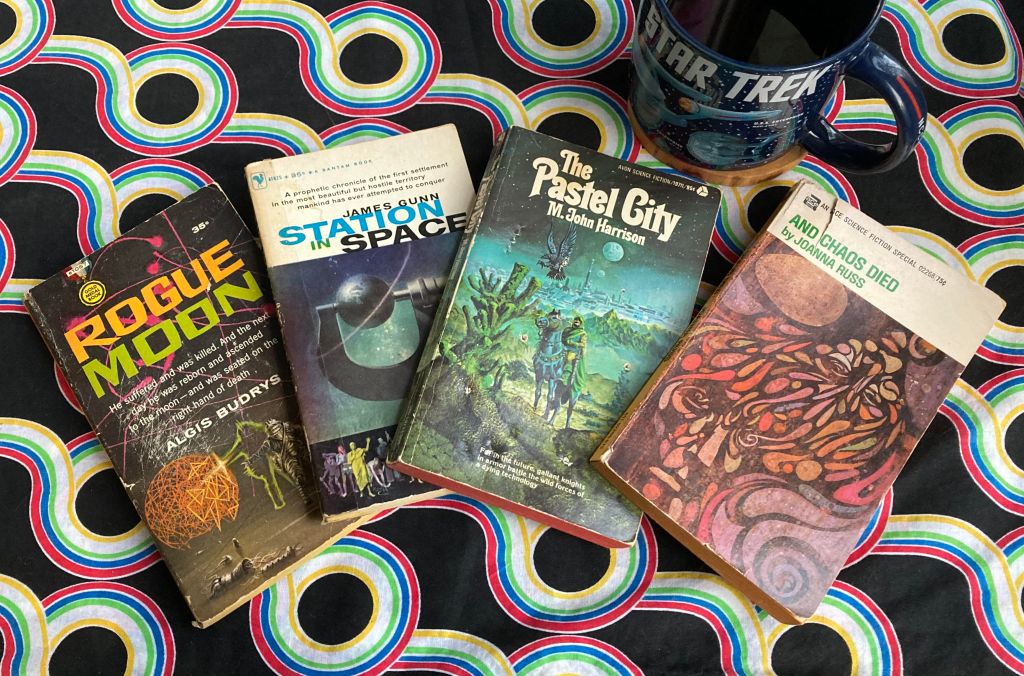
A selection of SF volumes from my shelves
What pre-1985 science fiction are you reading this week?
I’ve thoroughly enjoyed the conversations and connections you all have made in the comments over the last two months of this column. Make sure to check out the previous installment if you haven’t already. As before, I’ve included a bit about the books in the photograph, birthdays from the last two weeks, and brief ruminations on what I’ve been reading and writing.
Let me know what pre-1985 SF you’ve been reading!
As these posts seem to bring in new readers, if you’re curious about my rationale for the perimeters of my site, check out this recent interview and podcast.
The Photograph (with links to reviews and brief thoughts)
- Algis Budrys’ Rogue Moon (1960) is the most successful of his novels I’ve covered so far. If Cold War inspired paranoid SF is your thing, check this one out.
- James E. Gunn’s Station in Space (1958) is a fascinating collection of interconnected series of stories with a distinct blue-collar focus that form a cohesive chronologically organized whole tracking the development of human exploration into space. Gunn even stopped by!
- M. John Harrison’s The Pastel City (1971). One of the previous owners of my copy of M. John Harrison’s The Pastel City (1971) must have harbored a pernicious grudge against corroded landscapes and nebulous morals. So much in fact that they propped up the first volume of the Viriconium sequence against a tree and used it for BB gun target practice.
- Joanna Russ’ And Chaos Died (1970). This seems to be her least-known SF novel. I suspect my praise was a bit too effusive–a fascinating experiment nevertheless.
What am I writing about?
I’ve been plagued by a bit of reviewer’s block recently which is why I delayed this post. At least I managed to finish my promised reviews of Kate Wilhelm’s “Planet Story” (1975) and Clark Ashton Smith’s “Master of the Asteroid” (1932) yesterday.
What am I reading?
Inspired by Gerry Canavan’s brilliant Octavia E. Butler (2016), I’ve acquired and started reading some of her novels in her Patternist series. As with Dawn (1987), I’m struggling to put my thoughts together on what I’ve read so far.
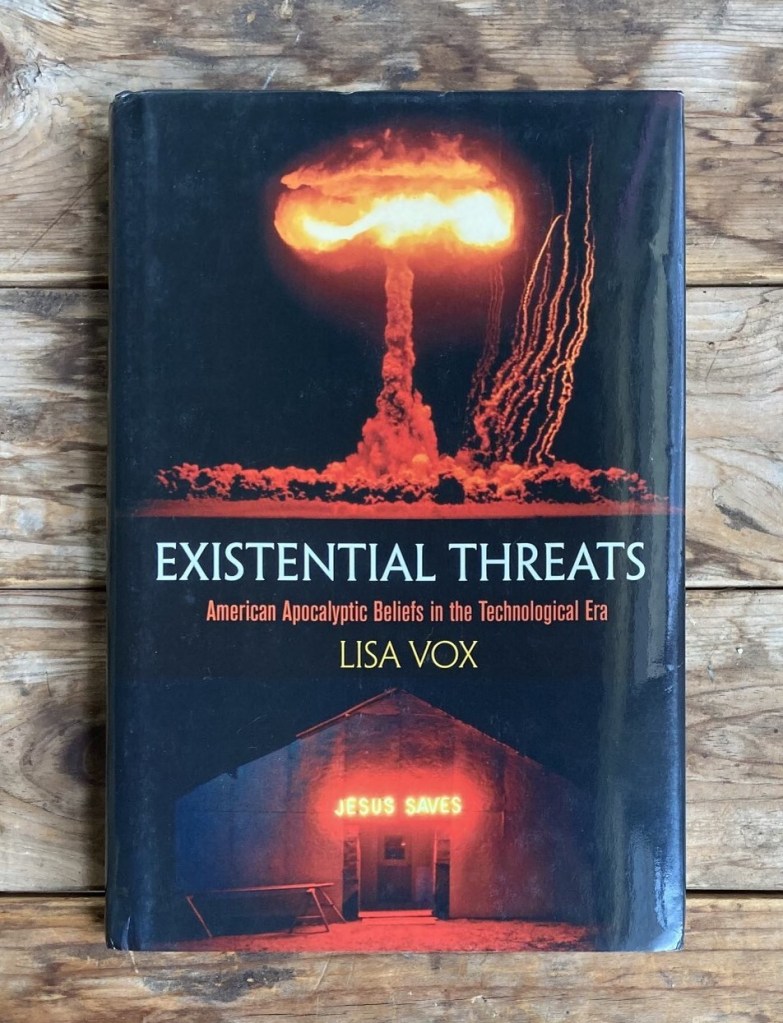
Here’s a new history purchase that intersects with science fiction:
A Curated List of SF Birthdays from the Last Two Weeks
August 6th: Piers Anthony (1934-). His prodigious output never seems to go over well with newer fans. I have a copies of Chthon (1967) and Rings of Ice (1974).
August 7th: Phillip Mann (1942-2022). Bibliography.
August 7th: David R. Bunch (1925-2000). Along with R. A. Lafferty and Doris Piserchia, Bunch manifests the outsider artist. I adored but never managed to review his short story collection Moderan (1971). It was recently republished by NYRB.
August 9th: Daniel Keyes (1927-2014). One of the side effects of gathering birthdays is the reminder of the projects that I developed but never came to fruition. I plan on reviewing his pre-“Flowers for Algernon” (1959) SF short stories.
August 9th: Artist Mike Hinge (1931-2003). One of my favorite 70s SF artists–his covers seem to channel the decade. Cover index.
August 9th: John Varley (1947-). Bibliography.
August 9th: Frank M. Robinson (1926-2014). What I’ve read so far of his SF author and gay rights activist (he wrote speeches for Harvey Milk) fascinates me. I reviewed his generation ship short story “The Oceans Are Wide” (1954) most recently.
August 10th: Ward Moore (1903-1978) was born on this day. I recently reviewed Moore’s disturbing “Lot” (1953) for my 1950s sex and sexuality review series.
August 12th: Chan Davis (1926-2022). I need to read his work. I have three of his early nuclear war stories on my radar.
August 13th: Author and editor Martin Bax (1933-). I reviewed his only (unfortunately) SF experiment–The Hospital Ship (1976). If you enjoy Ballard at his most experimental, Bax might be worth tracking down.
August 13th: Artist John Berkey (1932-2008). Another iconic image smith of the highest caliber. I love his use of blues.
August 14th: Alexei Panshin (1940-2022). I’ve only read a handful of Panshin’s short fiction. I recently acquired a copy of his best-known novel Rite of Passage (1968). Bibliography.
August 15th: Artist Darrell K. Sweet (1934-2011). List of covers.
August 16th: Artist Paul Lehr (1930-1998). If you own any older SF books, you probably have seen his majestic covers. His listing on The Internet Speculative Fiction Database is a must browse.
August 17th: Rachel Pollack (1945-2023) was born on this day. She passed away recently. Her obit in The New York Times. I’ve only reviewed Alqua Dreams (1987). On Facebook she called my review “fair.”
August 18th: Brian W. Aldiss (1925-2017). Another Joachim Boaz favorite. Check out my review of Hothouse (variant title: The Long Afternoon of Earth) (1962) if you haven’t already.
August 19th: Joachim Boaz favorite D. G. Compton (1930-) crafted a fascinating range of SF novels — I recommend The Unsleeping Eye (variant title: The Continuous Katherine Mortenhoe) (1973), Synthajoy (1968), and Farewell, Earth’s Bliss (1966) in particular. The 2021 winner of the Cordwainer Smith Rediscovery Award.
August 19th: Artist H. W. Wesso (1894-1948) was one of the iconic Astounding Stories artists. Check out his work here.
August 20th: Artist H. R. Van Dongen (1920-2010) was born on this day. Check out his cover list!
August 20th: Greg Bear (1951-2022). In my more expansive SF-reading days, I consumed Bear’s Darwin’s Radio (1999), Blood Music (1985), and Eon (1985).
August 20th: H. P. Lovecraft (1890-1937). Bibliography. If his work tickles your fancy, definitely check out Bobby D.’s wonderful website Deep Cuts in a Lovecraftian Vein.
For book reviews consult the INDEX
For cover art posts consult the INDEX
For TV and film reviews consult the INDEX
 Science Fiction and Other Suspect Ruminations
I am about to finish A Secret History of Time to Come, which is very 1970s and less interesting than the author’s actual life.
Ah, I’ve had that one on my radar for a bit.
I bumped the Macauley a week for reasons that don’t matter, replacing it with Wilhelm’s Juniper Time. Might be a fit for “stories hostile to space programs”: one side effect of the bold plan to promote humans in space is a brush with WWIII.
I remember enjoying it — it seems like you found my review!
But for anyone else perusing by: https://sciencefictionruminations.com/2014/04/11/book-review-juniper-time-kate-wilhelm-1979/
I’m currently reading Samuel Delaney’s “Nova.”
I thoroughly enjoyed that one. I never managed to write a review. It’s also one of the few SF novels I’ve read twice as I had a SF reading group in college.
I’m going to review it for Galactic Journey when I’m done reading it.
Good good.
This makes me want to reread Nova; it’s got to be 50 years or more since I last read it. Hope to see a review of it in the near future.
Hello Jeff,
From me or Tonya? If you’re talking about me, I tend not to reread so it’s definitely not in the plans at this moment. I read Nova for a second time circa 2010 (in grad school). The first was in my late teens (2005 maybe).
I recently finished The Day the Machines Stopped (Monarch, 1964) by Christopher Anvil. I knew it would be somewhat similar in theme to The Year When Stardust Fell (Winston, 1958) by Raymond F. Jones. So I am reading the earlier Stardust again to see how they compare.
In Machines it is electricity that has failed. In Stardust the act of sliding metal leads to a molecular bonding. Both have examples of the decay of civilized society as many fill with fear about how to cope with their new reality.
I suppose these would fall under the post-apocalyptic category though I don’t normally have an interest in that theme.
Is the Anvil worthwhile? I’ve bounced off what I’ve read his short fiction. Not big on his brand of comic humans-always-win-in-the-end style. But it might be due to limited exposure on my part vs. his quality.
At about 160 pages of paperback, this was a fairly short story. Perhaps it would be classed as a novella. For what it was trying to achieve, I think it was a solid attempt. I don’t know that it was revolutionary but it was worth the time.
Well, if you ever write a review, link it here. I religiously read about SF even if I never end up reading it. Which I suspect will probably be the case with most Anvil.
I have only ever read Pandora’s Planet by that author
Hello David,
And what did you think of it?
Hi
Just read “Weihnachtabend” by Keith Roberts which I liked. II have read your review as part of Jame’s entry at Classics of Science Fiction.
I will have to reread The Summer Isles by Ian R. MacLeod another alternate history of Brian (pub. 1998) which I loved but it is too recent for this post. I am reading Starswarm by Aldiss which looks good. But I am also reading his memoir Bury My Heart at W.H. Smith’s A Writing Life which may be my read of the year but it was published in 1990.
Happy Reading
Guy
Hello Guy,
Glad you enjoyed the Roberts. I’m normally not a huge fan of alternate histories but that one not only had a far more sinister jonbar point (the British détente with Nazi Germany) that created a fascinating extrapolation. What resonated with you?
I gave Starswarm a high collated rating: https://sciencefictionruminations.com/2015/05/06/book-review-starswarm-brian-w-aldiss-1964/
Hi
The Christmas party theme complete with children made it seem more like horror than military SF which a lot of alternate history tends to be. Ii gave the piece a very spooky atmosphere.
Guy
Yeah, military SF and me rarely see eye-to-eye.
Not reading any SF right now, but I am in the middle of Wonder’s Child, Jack Williamson’s autobiography. Also still waiting for Fred Pohl’s The Way the Future Was to come in the mail.
Let me know if you find any cool observations, stories, etc. in the Williamson. An author I haven’t read since the first few years of the site… what a long career!
I’ve said before that “With Folded Hands” is amazing. Tbh I’m relictant to read “…And Searching Mind,” aka the rest of The Humanoids, but I know it’ll undermine the eeriness of that first story. I also thought The Legion of Time to be a lot of fun, although you would find it too pulpy. Soon I’ll be starting The Reign of Wizardry, which Williamson says surprisingly little about in his book.
There’s just so much to read. I’ll write down “With Folded Hands” to keep it in mind.
“With Folded Hands” is one of the great mythically resonant pieces of early genre SF, up there with “Nightfall,” “Who Goes There?” and “Mimsy Were the Borogoves.” It is not to be missed (though sometimes it’s a little hard to read).
That seems right — one of the great “mythically resonant” stories. And all of those qualify. I have come to the view recently that the 1940s story — the “Golden Age” story, if you will — that truly lasts and is a great now as it seemed then, is “Vintage Season”.
A Golden Age story that I think fits that phrase is a little known story by an even lesser known author, that being “Robot’s Return” by Robert Moore Williams. A mythical little tale that’s far more tapped into the dream sensation than Asimov’s robot stories.
Just started Blind Voices by Tom Reamy. The plot seems not dissimilar to Bradbury’s Something Wicked This Way Comes, which I absolutely hated. Writing seems a great deal better, though.
I thoroughly enjoyed the Reamy. Please note, as the first publisher — Arnie Fenner — of a portion in Shayol points out in the comment section, that you are essentially reading a draft after a few revisions as Reamy died before it could be completed: https://sciencefictionruminations.com/2016/06/25/book-review-blind-voices-tom-reamy-1978/
By coincidence, I started Reamy’s “Blind Voices” just yesterday – a mere 30 or so years after I purchased it! I suspect I delayed reading it because I’d read pretty much all his shorter fiction back in the ‘70s and knew that after BV, that would be it; however the recent publication of the Subterranean Press collection of his complete short fiction, including a previously unpublished novella, has prompted me to finally read the novel. I’m about a quarter of the way in and greatly enjoying it – I know that it’s often claimed to be a bit unpolished, due to Reamy’s death before its publication, but so far I haven’t had any such feeling.
Hello,
When I read and reviewed it in 2016, I found all the unpolished moments occurred near the end. And, as I lay out there, it was less “unpolished” and more that part of the storyline was missing. https://sciencefictionruminations.com/2016/06/25/book-review-blind-voices-tom-reamy-1978/
I have a collection of his short stories but I have not dived into them yet.
Well, I ‘ve not been reading any, but went to an M. John Harrison event last night and, coincidentally, when I spoke to him afterwards, he signed my 1974 NEL copy of The Pastel City (with the Pennington cover, not the one you have.) so I guess my copy has been defaced as well now! 😉
Nice! My old review that I linked above shows the damage in more detail. Some of the BB pellets went through the cover and quite a few layers of paper.
I’m reading a non-SF story by an SF writer — BLACK AURA, a mystery by John Sladek, from 1974. I just finished Atanielle Annyn Noel’s MURDER ON USHER’S PLANET, from 1987; and before that THE SONG OF PHAID THE GAMBLER by Mick Farren (1981). Reviews of both of those will appear at Black Gate in a month or so. And I also recently reviewed Rob Chilson’s AS THE CURTAIN FALLS (1974) and C. J. Cherryh’s SUNFALL (1981). Of all those books, the only truly positive review is of SUNFALL!
https://rrhorton.blogspot.com/2023/08/review-sunfall-by-c-j-cherryh.html
https://rrhorton.blogspot.com/2023/08/review-as-curtain-falls-by-robert.html
I’ll check out the reviews as they come out. I procured a copy of Sunfall a few years ago and really should read it.
I recently posted my paired review of Wilhelm’s wonderful “Planet Story” (1975) and Clark Ashton Smith’s rather straightlaced and wonderful SF story (that feels like a progenitor of so many tropes of the astronaut going insane) “The Master of the Asteroid” (1932).
And Chilson is not someone I know much about so I’ll check that review out too…
As for the books pictured — ROGUE MOON and THE PASTEL CITY are personal favorites. I should probably reread AND CHAOS DIED — I love most Russ but that didn’t really work for me. (I’m not that big a fan of telepathy as a trope, for one thing.)
I’m also not the biggest fan of telepathy — although there are exceptions. The Octavia E. Butler novel I’m reading — Mind of My Mind (1977)–for example lays out the true toll of such a power: insanity, enslavement, manipulation, and extreme violence.
Speaking of ROGUE MOON–is your comment about it in the introductory spiel mixing it up with WHO?
No. Both are influenced by the paranoia of the Cold War — Who? more overtly is about he Cold War geopolitics of the day but Rogue Moon is still a product of that moment.
Mentioning Mike Hinge, I’d love to see a decent quality book on his artwork. I’ve never seen a copy of the sole collection published in his lifetime, but I believe it was only B&W.
I agree. But yes, no art book that covered his career was published. The Mike Hinge Experience (1973) seems to be the B&W volume you mentioned. I recently interviewed Adam Rowe who published a book on 70s SF art this year. Hinge is given a small section but yes, I still want something devoted to him. https://sciencefictionruminations.com/2023/08/06/exploration-log-3-interview-with-adam-rowe-author-of-worlds-beyond-time-sci-fi-art-of-the-1970s-2023/
After reading your review, I just got a copy of ROGUE MOON. I’m not very familiar with Budrys – I think I read MICHAELMAS as a teenager, but I don’t recall a thing about it.
I hope it’s enjoyable! I am all for a good dose of paranoia in my SF.
I’ve also enjoyed some of his short stories. Didn’t care a ton for Michaelmas.
I started reading the Pastel City this weekend, too 🙂 since it’s always good to shake things up a bit and read some fantasy (and I know it’s a new wave sci-fi novel, but fantasy is also a good descriptor)
Since Pastel is a short read, I’ll probably dig into Echo Round His Bones next by Thomas M. Disch.
After reading Disch’s The Genocides, I am eager to explore the rest of his early novels — Echo Round His Bones included.
I was a huge fan of The Pastel City, as I hope my review makes clear. Anything that punctured my youthful preconceptions about fantasy (I was a HUGE fantasy reader as a kid and I thought the closer to Tolkein the better)….
I haven’t read any SF the last 2-3 weeks, as I’ve been going through Clarice Lispectors Complete Stories (which I liked a lot).
Now I’ve just started Brunners The Long Result.
I think I abandoned The Long Result after the first 50 pages. One of my oldest blog friends wrote a very positive review, which is why I picked it up.
https://sfpotpourri.blogspot.com/2011/12/1965-long-result-brunner-john.html
Yes, that reveiw also made me quite interested in it. Not that I have actively sought it out, I just happened to find it very cheaply.
So far it’s quite a bit more traditional/”hard” SF than what I’m usually associating Brunner with, but there’s also some recogniseable touches. We’ll see, his more pulpy stuff can be at bit hit and miss it seems.
I’ve read all of the featured books in the photo except the Russ one. Russ is one of those writers I’ve found intriguing–e.g. the great short ‘When It Changed’. I really should read more of her.
I’m still slogging my way through ‘The Jagged Orbit’, but I’m finding the reread hard, even though there are great sequences in it. I wonder to what extent the ‘stoolpigeon’ character Mathew Flamen is a less than subtle repost to Norman Spinrad’s truly awful ‘Bug Jack Baron’ (surely the latter is the most overrated New Wave novel of them all!?).
For some reason I’ve found myself slowly reading through Charles R. Tanner’s ‘Tumithak of the Corridors’ (1932). A patently influential story, but sadly like many of those that helped establish the genre’s conventions it is badly written. Still, there is enough there to keep me going.
I had no idea that you disliked the Spinrad! It’s one of the main New Wave SF novels that I have yet to read… I should. As a result, I doubt I understood Brunner’s reference when I read The Jagged Orbit (but never managed to review it) a few years ago.
I read the Spinrad with an eye to writing on it. I hoped to find something akin to Brunner’s masterworks, but instead found a mess of sub-avant-garde noodling with laughable sex scenes all tied up in a fairly gross but inevitably sexist 60s sexual revolution-ese. This work has dated badly. I find it hard to believe it was even lauded at the time. Spinrad is capable of better than this (at least based on some of his shorts from the 60s). Barron is an awful character, and Spinrad understands this in part, but nonetheless is unable to make much of it, critically speaking. I suppose you will have to read it just for its place in the New Wave canon. Believe me, it’s reputation is overrated and pales in comparison to Brunner’s contemporaneous works.
I couldn’t say it as well but I basically agree. Seemed like Spinrad trying to give what he perceived as his then audience just what they wanted.
Yeah, that the sense I got from the book–i.e., that Spinrad was trying to shock the censor. Mission accomplished! Unfortunately it undermines the sf-nal aspects of the book so that it just seems like a pastiche of the 1960s displaced into an imaginary and all to familiar 1990s.
There are so many better, and edgier SF works from the same time (Delany immediately leaps to mind).
I love Spinrad. I had high hopes for Bug Jack Barron (I even have a signed copy — although, I did not know it at the time and the bookstore certainly didn’t as it cost $1. His signature looks like a child scrawl). Still going to read it!
Have to agree about Bug Jack Barron, I was shocked at how bad it was, from the clumsy plot mechanics to the egregious and poorly handled sexual shenanigans. It’s just not well-written, its almost comical how badly he attempts “edgy” material. There’s other New Wave stuff that aggressively crosses various lines, but this just had no redeeming qualities.
Still curious about his Hitler book, though I possibly shouldnt be.
My review of The Iron Dream (1972) https://sciencefictionruminations.com/2013/05/18/book-review-the-iron-dream-norman-spinrad-1972/
The Iron Dream is a better book than Bug Jack Baron. However, it is “better” insofar as it executes its central idea in a more consistent and effective way, i.e., what if Adolf Hitler had become a pulp sf writer rather than the leader of the Nazi party. Nonetheless, this Hitler recapitulates in lurid, sf-nal terms, the actual life of the Nazi Hitler, and what’s more, this Hitler wins. A truly horrifying outcome that does, nonetheless, skewer the sub-fascist dreams of many who swell in the sf ghetto.
I’m not sure, though, if I share Joachim’s and other’s enthusiasm for this work. In an excellent article on the book Ursula Le Guin poses that such parodies are ‘self-doomed. You cannot exaggerate what is already witlessly exaggerated; you cannot distort for comic effect something that is already distorted out of all reality.’ (https://www.depauw.edu/sfs/backissues/1/leguin1art.htm).
Despite this she still finds something redeeming in the work. Interestingly, Spinrad felt the need to append a fictional academic afterward by an equally fictional academic in order to forestall his work’s use and enjoyment by actual fascists. Unfortunately he failed. The book made it’s way on the recommended reading list of the American Nazi Party, apparently. More fool them perhaps, but the point is that such parodies, even if delivered in the nudge nudge wink wink code of those in the know, have a life beyond what is intended. And, indeed, I feel that if you write a book that implicitly parodies the barely repressed fascist prose of much of the Golden Age of SF, without making this criticism explicit, you run the risk of just adding to the mess.
I just finished Alfred Bester’s “The Computer Connection”. From what I’ve heard, this is considered one of his lesser works and many contemporary reviewers seem to have been disappointed with it. I happened to pick it up at a thrift store on a whim.
Honestly, I thought it was pretty fun. Not incredible, but worthwhile. I approached it from the perspective of “this is what people in the early 1970s imagined the future could be like” and that extra level of connecting the concerns of the novel to what little I know of the time period (I was born in ’78 so I missed most of it) made it interesting.
Thinking I should probably find a copy of “The Stars My Destination” now since I haven’t read that one…
I read THE COMPUTER CONNECTION when it came out, or actually before it came out: I read the Analog serialization as “The Indian Giver”. And your description — “pretty fun. Not incredible but worthwhile” — seems dead on.
I think people dunk on it because there’s a notion that all late Bester was terrible. But for a few years after his return to the field in 1972 or so, he did some quite nice stuff. None that matched his ’50s work, but “fun, not incredible” stuff. Then he started declining — the ’80s novels (GOLEM 100 and THE DECEIVERS) are terrible. (Not sure about PSYCHOSHOP, the Zelazny collaboration, as I haven’t read it.)
But do read THE STARS MY DESTINATION. It’s wonderful.
I was going to ask if you knew of any good C.L. Moore novels, but I found DOOMSDAY MORNING on the Hoopla app. There is a very positive pull quote from your site on the book page, so never mind. I’ll take that as a recommendation.
It’s a fascinating novel — and feels quite a bit different than her earlier novels. A great shame she did not continue writing. Here’s the review: https://sciencefictionruminations.com/2013/10/17/book-review-doomsday-morning-c-l-moore-1957/
My review index: https://sciencefictionruminations.com/science-fiction-book-reviews-by-author/
Judgment Night is an excellent space opera. See https://sfmistressworks.wordpress.com/2014/07/29/judgment-night-cl-moore-2/
Thank you Ian and Joachim for the links to your excellent reviews of C.L. Moore novels. I can’t wait to dive into both of them.
No problem.
…I definitely wish Ian continued SF Mistressworks!
Just finished reading Last Men In London by Olaf Stapledon. It was a bit too flowery and long winded for me, lots of pontificating on the nature of man and evolution.
Needing some respite from the heavy going nature of that I’ve decided to forgo adult literature and carry on with a trilogy of YA fiction that I started a while ago but just got hold of the remaining books – the Weathermonger series by Peter Dickinson on Puffin. Maybe labelling it science fiction is a slight stretch but it is about an England where people have turned against machines and returned to a world more reminiscent of the medieval period (with witch burnings and other such religious based mania). I enjoyed reading the first (last?) in the series (first chronologically but last published I believe) so now working my way forwards.
I just finished reading Enemies of the System by Brian Aldiss, and I still haven’t decided what I think of it…
Hello Phil!
Not one I’ve read yet. I recently read, as you might know from my various tweets, Aldiss’ wonderful Hothouse (1962): https://sciencefictionruminations.com/2022/11/06/book-review-hothouse-variant-title-the-long-afternoon-of-earth-brian-w-aldiss-1962/
Yes, Hothouse is one of my favorites of his as well. Maybe my very favorite. This one… was diferent.
For some reason I decided to reread Stranger in a Strange Land by Heinlein recently. I had originally read it around 1980 but it might have been earlier. I was 33 in 1980 and I don’t know if my memory was bad or I was just a very different person 40+ years ago. This time what would have originally seemed to be unique way to get people of the early 60’s to reassess religion and sexuality just felt clumsy. I now find everyone in the book annoying especially Jubal and the endless sermons had me hurrying to get to the end. I had actually forgotten the “blow-off” at the end but this time it just felt wrong.
I’ve always assumed that I would like it even less if I were to read it now. I don’t deny its historical importance but the allure that Heinlein once had on me as a teen has long since faded.
Dipping into “We,Robots Artificial Intelligence in 100 Stories.I love Golem stories but find it hard to enjoy pre-Asimov or even pre-Chatgpt now.”The Golem runs Amuck” was written in 1914…prescient?..and the Williamson “With Folded Hands” in 1947.
I’ve wanted to read the Williamson for a bit. Let me know your thoughts when you get to it.
It goes on a bit!And brought up,so to speak,on the Three Rules of Robotics,kept huffing “they can’t do that,they can’t do that”..
I read a lot of Asimov in my late teens. But, as someone almost religiously opposed to rereading, nothing about those books are imprinted in my mind as the way things should be.
Same..but one of the laws is to do no harm to humans and the Black Mechanicals were doing a great deal of that!