
A selection of SF volumes from my shelves
What pre-1985 science fiction are you reading this week?
Thanks again for all the great conversation. Make sure to check out the previous installment if you haven’t already. As before, I’ve included a bit about the books in the photograph, birthdays from the last two weeks, and brief ruminations on what I’ve been reading and writing.
Let me know what pre-1985 SF you’ve been reading!
As these posts seem to bring in new readers, if you’re curious about my rationale for the perimeters of my site, check out this recent interview and podcast.
The Photograph (with links to reviews and brief thoughts)
- Irene Schram’s Ashes, Ashes, We All Fall Down (1972) is not a great book. But it’s a first novel that was so destroyed by critics in The New York Times that I suspect she decided to not publish another… I wonder what would have happened if she had published in a SF-specific press and been given some time to refine her craft. In my review I reconstructed what I could figure out about her life and activism.
- Silverberg’s most underrated novel? My 2012 review.
- I read Bester’s masterpiece The Stars My Destination (1956) before I started my site. At the time I proclaimed The Demolished Man (1952) as the superior novel. I wonder what I would think now.
- Daniel F. Galouye’s best work Dark Universe (1961)–a the nuclear bunker story unlike any other. One of the first novels I reviewed on the site.
What am I writing about?
August ended. Thank goodness. I’ve been more in the writing groove as of late. I recently finished an Octavia E. Butler novel in her Patternist series. I should have a short review up this week.
What am I reading?
As always, I have multiple vague reading paths I’m contemplating. I’m puttering around with a few of Pohl’s Star anthologies and reading for another post in my 1st three published SF short stories by female authors series whom I should know better (which will also intersect with my media series).
Here’s a new history purchase–and my reading companion Cyrus–relevant to my obsession with the impact of radical social movements on SF of the day: Michael Hardt’s The Subversive Seventies (2023).

A Curated List of SF Birthdays from the Last Two Weeks
August 21st: Miriam Allen deFord (1888-1975) strikes a fascinating figure–she was a left-wing activist who campaigned for birth control and women’s suffrage and was a member of the Socialist Part of America between 1919-2022. Some of her short fiction also fascinates: “The Ajeri Diary” (1968), “Gathi” (1958), and “The Transit of Venus” (1962) come to mind. They can be found in her collection Xenogenesis (1969).
August 21st: Anthony Boucher (1911-1968).
August 21st: Lucius Shepard (1943-2014). A hole in my SF reading landscape….
August 22nd: Ray Bradbury (1920-2012). A Joachim Boaz favorite I’ve been slowly rereading since my early youthful explorations.
August 22nd: Ron Turner (1922-1998). One of the most distinctive of the pulp artists. He took on the most schlocky themes with extreme abandon! See one of many over-the-top examples below.
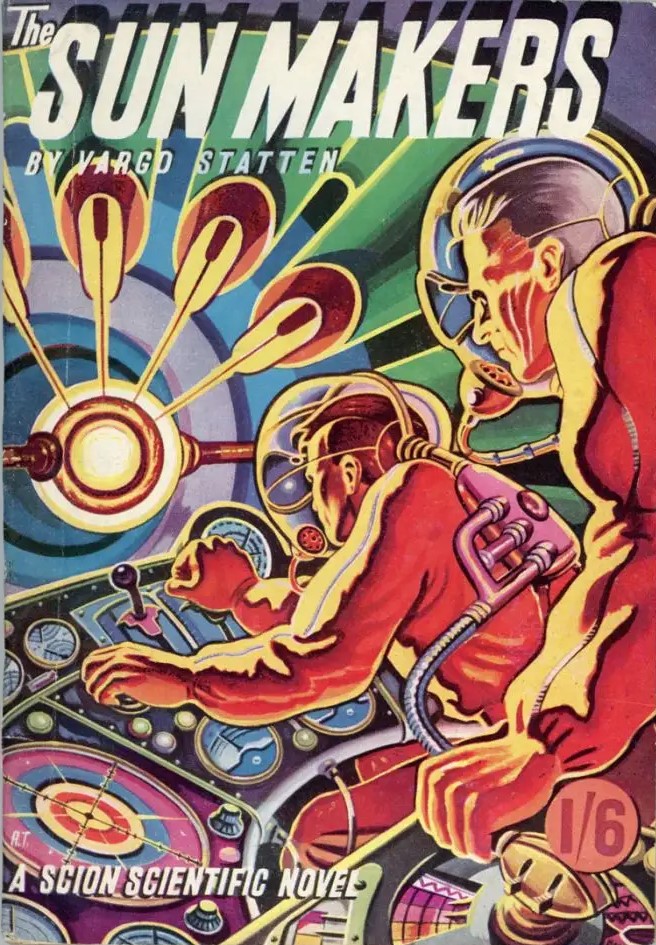
Ron Turner’s cover for the 1st edition of Vargo Statten’s The Sun Makers (1950)
August 24th: James Tiptree, Jr. (1915-1987). “Love Is the Plan the Plan Is Death” (1973) still incubates, sinister, within my mind.
August 24th: Bea Mahaffey (1926-1987). One of a handful of influential female SF editors in the 50s and 60s. She was often the actual editor behind various Raymond A. Palmer magazine projects.
August 25th: Jeffrey A. Carver (1949-). Included as carver remains a complete unknown to me. I have a copy of Star Rigger’s Way (1978). The presence of a cat-like alien prevents me from picking it up… hah.
August 27th: Artist Frank Kelly Freas (1922-2005).
August 27th: Mari Wolf (1927-). I wish it was possible to track down her contact information. To the best of my knowledge, she is one of the few SF authors born in the 20s that’s still alive and would be a fascinating person to interview (if possible).
August 28th: Bernard Wolfe (1915-1985). I need to read Limbo (1952).
August 28th: Jack Vance (1916-2013).
August 28th: Vonda N. McIntyre (1948-2019). A Joachim Boaz favorite! If you’re new to her work, check out the Hugo and Nebula-winning Dreamsnake (1979).
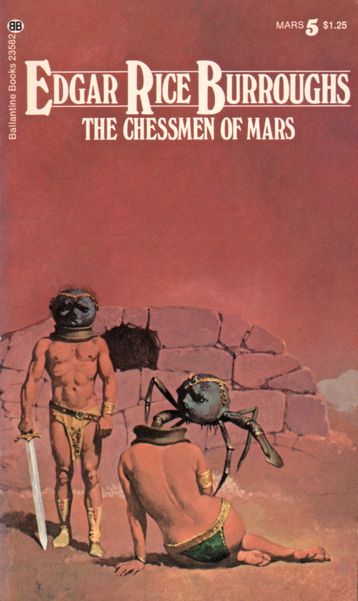
August 29th: Edgar Rice Burroughs (1875-1950). An author of my youth. I’ve slowly given away most of my Barsoom novels. I kept my copy of the 1973 Ballantine edition of The Chessmen of Mars (1973) as the Gino D’Achille cover horrified/transfixed me as a kid.
August 29th: C. J. Cherryh (1942-) another favorite of my late teens.
September 3rd: Cherry Wilder (1930-2002). Placed here as a reminder that I need to read Second Nature (1982).
September 3rd: Artist Paul Alexander (1937-2021) is one of the few primarily descriptive (vs. surreal or metaphorical) SF artists I frequently find myself caught up in. Click the link for a list of his covers.
September 7th: Felix C. Gotschalk (1929-2002). Placed here is a reminder that his fix-up of New Wave stories Growing Up In Tier 3000 (1976) still judges me from the shelf.
September 8th: Michael Frayn (1933-). Mainstream lit author who wrote a few SF(ish) novels. I own two: The Tin Men (1965) and A Very Private Life (1968).
September 8th: Artist Don Punchatz (1936-2009)
September 10th: Leo P. Kelley (1928-2002).
For book reviews consult the INDEX
For cover art posts consult the INDEX
For TV and film reviews consult the INDEX
 Science Fiction and Other Suspect Ruminations
Born with the Dead by Robert Silverberg
The word that seems most frequently used with Silverberg’s work is ‘intense’, maybe due to the driven characters caught in highly stressful situations that lie within the pages of his work. In this novella the main character is in the peculiar situation of having lost his wife at a relatively young age only to see her ‘rekindled’, e.g. brought back to life, but now completely isolated from, and indifferent to him and living with an entourage of fellow rekindleds (‘colds’) within a completely closed gated community. The entourage occasionally leave the community and travel together around the world and so sometimes are in contact – albeit at a distance – with normal society.
One of the novella’s strengths is that it is told in the third person, so the perspective switches between the main character and his (ex) wife. This allows us to get the ‘cold’ angle on things.
The intensity derives from his being unable to reconcile himself to not being able to make any form of contact with her at all – and his attempts to do so.
I’m not overly familiar with the zombie genre – apart from this, I think the only other fiction I’ve read is Whitehead’s entertaining ‘Zone One’, but that one follows a Romero like trajectory of zombies being evil flesh chomping baddies, overwhelming the good guys by sheer volume. In ‘Born with the Dead’ the colds move about us in a peaceful way (though generally silence rooms when they walk in, give everyone they meet the creeps etc). Peaceful to humans, that is, as the main group of colds in the story derive pleasure from slaughtering (formerly extinct) animals held within game reserves.
The colds certainly don’t seem to be struggling on the breadline. They appear, in fact, to have pretty much limitless amounts of dosh and swan around the world in the leisured manner of upper-class characters from novels of the 1920s or 30s. There are hints that the taxman is trying to get on their case but that side of things lies within the margins of the text. Maybe the novella is an oblique sideswipe at the very rich.
I read a fair amount of Silverberg a while ago (his novels, not his shorter work) and was trying to work out why I stopped then and haven’t picked up his work again until now. I think perhaps that things can get well, pretty intense when reading his work. There’s not much humour / lighter touches to break things up (though they are there, if you dig a bit deeper) – so perhaps that makes it hard to go on a sustained reading spell with his work. That seems a very minor quibble though. This story – plus the other two in the collection – are so fluently written and gripping that you are completely swept along by the narrative, wondering how it’s all going to develop.
Highly recommended.
Silverberg has long been a favorite of mine. I’ve reviewed 45 of his short stories and 12 of his novels over the history of the site. I’ve also read but never managed to review (as I listened to them as audiobooks) A Time of Changes and Tower of Glass. https://sciencefictionruminations.com/science-fiction-book-reviews-by-author/
I have not tackled Born with the Dead, yet.
As for worthwhile zombie stories (I’m also not super familiar, nor want to be, with the subgenre), I mean, one can’t go wrong with Matheson’s I Am Legend (1954): https://sciencefictionruminations.com/2022/07/06/book-review-i-am-legend-richard-matheson-1954/
Of the short stories I’ve devoured, I appreciated the following the most:
“Passengers” (1968) https://sciencefictionruminations.com/2017/02/03/book-review-orbit-4-ed-damon-knight-1968-wilhelm-silverberg-vinge-ellison-lafferty-et-al/
“When We Went to See the End of the World” (1972) https://sciencefictionruminations.com/2016/09/12/short-book-reviews-robert-silverbergs-dying-inside-1972-universe-2-ed-terry-carr-1972-and-avram-davidsons-the-enemy-of-my-enemy-1966/
“By the Seawall” (1967): https://sciencefictionruminations.com/2023/04/16/book-review-dimension-thirteen-robert-silverberg-1969/
“Good News from the Vatican” (1971) https://sciencefictionruminations.com/2016/01/06/book-review-universe-1-ed-terry-carr-1971/
“How It Was When the Past Went Away” (1969) https://sciencefictionruminations.com/2012/09/02/book-review-three-for-tomorrow-novellas-by-robert-silverberg-roger-zelazny-and-james-blish-1969/
“The Pain Peddlers” (1963) https://sciencefictionruminations.com/2012/12/18/book-review-needle-in-a-timestack-robert-silverberg-1966/
Thanks very much for the tips. The Vatican story is in a collection of his I picked up recently called ‘Unfamiliar Territory’. I also got very lucky (hopefully) at a secondhand bookshop the other day where a couple of his novels appeared ‘A Time of Changes’ and one I’d never heard of, ‘Those Who Watch’. The latter is from his golden period (though I appreciate that some books may be more golden than others.)
Not everything of Silverberg’s is that easy to come by but the sheer volume of work means there’s enough around.
(Given the content of some of his stuff I’d hasted to add that ‘Those Who Watch’ isn’t some sort of Malzbergian dwelling on voyeurism – as far as I’m aware anyway.)
‘hasten’
I went ahead and snagged a copy! Will feature soon in a purchase post.
I posted my review of Those Who Watch!
I reread a hefty horror novel from 1979, which may lead to me tracking down my copy of Powers’ The Stress of Her Regard. I do not name the novel, as the review should go up in a week.
Well, horror ain’t SF James! So no need to talk about such genres here… muahaha. I jest of course.
I’m reading Stranger in a Strange Land by Heinlein this week. I couldn’t settle into anything this summer so I re-read about 4 or 5 of his juveniles which I discovered at the local library when I was 10 or 12 one boring summer vacation. Reading Red Planet reminded me that Heinlien used it as the basis for Stranger, so here I am rereading it once more. I still grok his message!
Hey, if you want to break free from the Heinlein embrace, here’s my 2022 in review. Lost of great stuff to track down that you might not have read: https://sciencefictionruminations.com/2023/01/01/updates-my-2022-in-review-best-sf-novels-best-sf-short-fiction-and-bonus-categories/
In a bit of a reading drought, but I just finished “Don’t Bite the Sun” by Tanith Lee. (1976) The plot kind of wanders around, echoing the unnamed main character’s sense of purposelessness. I love Lee’s worldbuilding, and she’s certainly ahead of the curve in many ways in her approach toward gender. I’m looking forward to reading the sequel, “Drinking Sapphire Wine” to see where she goes with it.
Yeah, I found it far less satisfying than her later ELectric Forest (1979). Which remains my favorite of her novels.
I think you’ve seen both reviews before, but just in case some other visitors haven’t.
Don’t Bite the Sun (1976)
Electric Forest (1979)
Just finished Damon Knight’s “The Earth Quarter,” a superb novella. My review of that will be going up VERY soon. Otherwise it’s gonna be mostly fantasy reading until… November.
Despite reading a bunch more of Knight’s short stories recently, I haven’t read that one, yet. I look forward to your review.
“The Earth Quarter” is legitimately great. I’m looking forward to Brian’s review, as well. And Joachim — I really think you’ll love it!
When I said very soon I did mean bvery lol. Also, Rich, I see you classified it as a novelette. I thought at first it might be too, being only 40 magazine pages. But running the Gutenberg text through a word processor shows it’s indeed a novella. It’s a dense work and one of my favorite reads of the year unquestionably.
I’ll put it on the list. I wonder if I should read the original magazine or the expanded 1970 version…
Brian, you’re right! Almost 20,000 words! That’s 25% more than I counted. Strange. I have the original magazine, I’ll look through it again.
Joachim — expanded version is actually from 1961, when it was published in an Ace Double as THE SUN SABOTEURS. It is possible that Knight did some clean up of that version for the later reprints in his collection, but I’m fairly sure that the text is substantially the same.
I think, actually, I ought to do a rigorous textual comparison!
Ah, I misread what it said on the isfdb.org entry.
I’ll be starting The Door Into Summer by Robert Heinlein, even though the seasons coming to a close. Just seems like the cooler weather will make for a nice cosy read as fall approaches.
Definitely an author of my youth that I’ve moved away from over the years. I certainly read enough of his stuff…
I’m planning on reading Sheffield’s “Vectors” (a collection) shortly.
I snagged that one a few years ago. I’ve only read (and reviewed) Sheffield’s average at best Sight of Proteus (1978).
Last week’s reading was mostly a 2021 novel, Machinehood, for our book club. (Review here: ) Also I was reading an advance copy of Being Michael Swanwick, a collection of interviews/conversations with Alvaro Zinos-Amaro about Swanwick’s entire career, going back to 1980. Swanwick is an outstanding writer, and his recollections, anecdotes, insight into his methods of composition, etc. are fascinating. The book is due from Fairwood Press in November, and I’ll have a review in Black Gate, presumably around the time of the book’s release.
Currently I’m rereading Pnin, not SF but from 1957, and from a writer (Vladimir Nabokov) who wrote a lot of SF. Someday I hope to be on a panel discussing Nabokov’s SF, or perhaps even a single novel, like his brilliant, beautiful and infuriation Ada.
And up soon will be a 1976 novel by Rob Chilson (The Shores of Kansas) or a 1975 novel from Arthur Tofte (Crash Landing on Iduna.) So there’s that! (Though a 2023 novel or two, Terrace Story by Hilary Leichter and The Fraud by Zadie Smith, also await!)
I meant to post a link to my review of MACHINEHOOD, in case anyone is interested in something so new. 🙂 https://rrhorton.blogspot.com/2023/09/review-machinehood-by-s-b-divya.html
Alos I meant “infuriating” as my comment about Nabokov’s ADA, not “infuriation”.
I was fascinated by Nabokov in my early 20s. One of the ones I read was his dystopian SF novel Bend Sinister (1947) — his first in English.
To nitpick, Nabokov’s first novel in English was THE REAL LIFE OF SEBASTIAN KNIGHT (1941) — which was written in Paris. BEND SINISTER was his first novel written after moving to the US. My review of those two books is here: https://rrhorton.blogspot.com/2015/10/nabokovs-first-two-english-language.html
(One can also make a case for LAUGHTER IN THE DARK, his retranslation of his Russian novel CAMERA OBSCURA. Nabokov so disliked the first English translation that he did his own version, and made significant changes to the original novel.)
I have read almost every thing Nabokov wrote, save for a few of the Russian novels.
Ah, you’re right. It’s been a while.
You are correct that you need to read Bernard Wolfe’s LIMBO. Perhaps more urgently, if you haven’t, you need to read his related story “Self Portrait” (GALAXY 1951), a brilliant early SF Cold War/McCarthyism story, and also an SF story of character in a way I can’t describe without spoiling it.
It’s more likely that I’ll read “Self Portrait” in the near future. I’ve heard good things about that one and it’s on my massive list of McCarthy-inspired short fiction I’ve been collating over the last few years.
I was hoping to find Vonda N. McIntyre’s DREAMSNAKE on my shelf after reading your review again, but I only have THE EXILE WAITING and BARBARY. I think I’m going to try out the first one as my next read.
Before she passed away I spoke to her briefly about The Exile Waiting. She always had a soft place for it in her heart as it was her first novel.
Thank you both. I can’t believe I lucked into Vonda N. McIntyre’s first novel.
Let me know what you think!
I like THE EXILE WAITING a lot (more than DREAMSNAKE, actually.) We reread it a couple of years ago for our book club. https://rrhorton.blogspot.com/2022/04/review-exile-waiting-by-vonda-n-mcintyre.html
I remember your review Rich. I also apparently left a comment! 🙂
Thank for offering this list! I hadn’t heard of many of these writers, so it’s great to learn a little about them. I’m reading “The Forever War” and enjoying it, particularly that it does not fit a groove of the hero blasts everyone away and never makes mistakes.
No problem. I enjoyed The Forever War (and its various sequels) in my late teens. I’ve been meaning to return to his 70s short fiction.
I just finished reading Haldeman’s “A Separate War and Other Stories,” which collects his short fiction from a 30-year span, and most of the stories were really enjoyable.
I own a few collections: Infinite Dreams (1978), Dealing in Futures (1968), and Vietnam and Other Alien Worlds (1993). I just haven’t read them yet…. which can also be said about tons of other authors. Alas. Life with 1.5-2 thousand unread SF books!
Wow! Happy reading with all those books!
Just finished Potockis Saragossa Manuscript, which isn’t SF, and it will probably be some time before I get back to SF as most of what I have lined up doesn’t really fall into that category.
But I did finish Brunners The Long Result first, as mentioned last time. Obviously not as complex as his more famous New Wave classics, and not among my favorites of his more pulpy stuff (not that I’ve read much of that), but I nevertheless quite liked it.
I’ve got THE SARAGOSSA MANUSCRIPT and plan to read it soon! I read the first chapter and found it intriguing, but other books took priority.
I’ve read, and loved, the Saragossa Manuscript and watched the fascinating 1965 film adaptation. https://www.imdb.com/title/tt0059643/
All of Has’ ventures into the Fantastic are wonderful — see also his adaptations of Bruno Schulz https://www.imdb.com/title/tt0070628/ and James Hogg https://www.imdb.com/title/tt0091697/
I enjoyed The Hourglass Sanatorium but haven’t seen Memoirs of a Sinner yet.
I’m reading two concurrently, one in e-form and one in audio. The Forge of God by Greg Bear and The Cassiopeia Affair by Chloe Zerwick and Harrison Brown (available at the Internet Archive https://archive.org/details/cassiopeiaaffair0000zerw). The two books are oddly similar and, at the halfway point, seem to be tracking each other. Both are about the present-day reaction to discovery of extraterrestrial life, especially that of the US President. Both have casts of characters consisting mainly of scientists and politicians. So far, both are pretty good.
Liked your review of The Man in the Maze. It has similarities to Budrys’ Rogue Moon, including the fact that the mysteries of the alien artifacts are never explained, but the two have very different, and engaging, character stories.
I also agree that The Demolished Man is the better Bester, although both are good.
I haven’t heard of The Cassiopeia Affair.
Re-Bester: I’m not sure I agree with myself John. I read them only a few years into my SF reading adventures in my late late teens. My memories are foggy at best.
The Cassiopeia Affair is pretty obscure. I looked it up because it was recommended at the Galactic Journey website. (http://galacticjourney.org/, an interesting site that every other day reviews SF and news from exactly 55 years ago. The site is worth a look if you’re not familiar with it.) The book starts well, but now that I’ve finished it I thought it ended abruptly without resolving what it started. Mildly recommended, I guess.
As for the Bester, I guess I agree with one of you…
Yes, I am definitely aware of Galactic Journey. He came to me for advice (I’ve had this site since 2011) when he started his site. haha.
Apropos of recent Pohl discussion, picked up “Midas World” randomly and the opening piece is amusingly mordant. Rest of the collection spans decades. Pohl’s greatest virtue was as a sardonic craftsman – even when he’s not great he’s at least competent and (usually) funny.
If you haven’t already, I highly recommend Michael R. Page’s monograph Frederik Pohl (2015). It was a fascinating look into his fiction and editorial practices. It made me think about his work again and read The Gold at the Starbow’s End that I assume you’re referencing (“recent Pohl discussion”).
I have not read that monograph, although I did recently read Pohl’s autobiography “The Way The Future Was” (1979) which covered some of that territory from his personal perspective. Naturally it has a career-retrospective tone to it, but he was in the middle of something of a late career rennaissance at that time – “Jem”, which I consider a personal favorite and one of his most fully realized works, came out the same year, and he was in the middle of all the Heechee stuff.
And then he had another career renaissance with his wonderful website!
I just reread “The Voices of Time” by JG Ballard. I first read it in the mid-1960s (in my dad’s copy of The Voices of Time and Other Stories). It remains one of my favorite Ballard stories.
It’s a good one. I rank it highly in his oeuvre as well. https://sciencefictionruminations.com/2014/08/08/book-review-the-voices-of-time-and-other-stories-j-g-ballard-1962/
I think I have all of Silverberg’s major novels from that period between 1967 to 1976. Of those I have read, “Thorns”, “A Time of Changes”, “Downward to The Earth”, and “To Open The Sky”. I would have to say that “Thorns” is my favorite but that’s mostly because it is the only one that I have read multiple times. I think there’s an explanation for Silverberg writing women in such a sexual way. He, before he went into his major artistic period, wrote somewhere near two hundred porno novels, so that may have rubbed off of him. The only other explanation is that he was trying his best to be considered “mature” for the mainstream.
And I’ve read (and reviewed on the site) the vast majority of his novels between those years! Missing Shadrach in the Furnace and The Stochastic Man and maybe two others. I’ve read but never reviewed A Time of Changes and Tower of Glass.
I read Stochastic Man in 1985 or so and enjoyed it