A selection of SF volumes acquired over winter break!
Which books/covers/authors intrigue you? Which have you read? Disliked? Enjoyed?
1. Flesh, Philip José Farmer (1960)

Gerald McConnell’s cover for the 1st edition
From the back cover: “Spaceman by DAY… MONSTER by night!
Peter Stagg was caught in the vilest trap ever devised–his own lust-driven body! For FLESH is the pulse-stirring story of a space explorer’s return from the strangest voyage man had ever made–to the strangest world the universe had ever seen–his own Earth!
This was an Earth that worshipped the lusts of FLESH–where a maiden’s most pious hope was to be chosen for a perverse mass orgy–where the temples were houses of carnal rites–where science was devoted to generating uncontrollable sexual passions. Into this FLESH-adoring world Peter Stagg was plunged, to find himself changed by this queer new science into something part man, part beast, part god. His FLESH was stronger than ten men’s, his desires were driven by alien hormones in his blood, and each morning his tortured mind recoiled from the memory of what his body had done the night before!
Initial Thoughts: I need to read more of Farmer’s early fiction (his glory period in my view). My reviews of Strange Relations (1960) and “The Lovers” (1952). And the cover on this volume… how could I not acquire a first edition?
2. Rogue Queen, L. Sprague de Camp (1951)
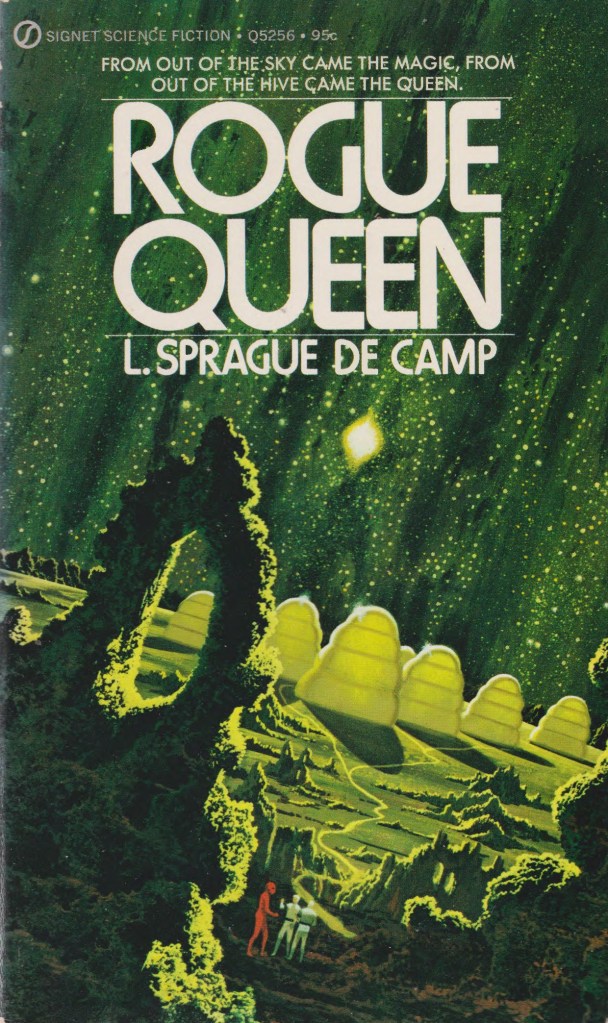
Uncredited (Dean Ellis?) cover for the 1972 edition
From the back cover: “‘When the Rogue Queen wears a crown of light / The Golden Couch shall be over thrown; When the gods descend from heaven’s height / Shall the seed be sown.’
Worker Iroedh was confused. Though she was a lover of antiquity, she really could put no faith in the Oracle’s prophecy. It was true that strange human beings, Terrans, had come from beyond the heavens. But these ‘men’ were no gods. Had not she seen them making fools of themselves over a silly think called ‘love’? Was this the action of the gods?
Certainly no god of the Avtini would carry on like this. Avtini gods would ‘love’ only a Community, with self-respecting groups of workers and drones and its highly productive Queen.
And as for Queens, why no Avtini Queen would go rogue. Only a few mad drones had ever been known to desert the Community. And their lives were the price of this antisocial action.
No, Iroedh could not understand the prophecy and so it must be false.
But Iroedh was soon to learn that prophecy has a way of coming true, and that even the most unassuming, antiquarian Worker might be born to rule.”
Initial Thoughts: L. Sprague de Camp is a complete hole in my SFF knowledge. I’ve seen Rogue Queen (1951) described as exploring similar issues to Farmer’s “The Lovers” (1952). Although, I suspect in a less revolutionary way.
3. Idle Pleasures, George Alec Effinger (1983)
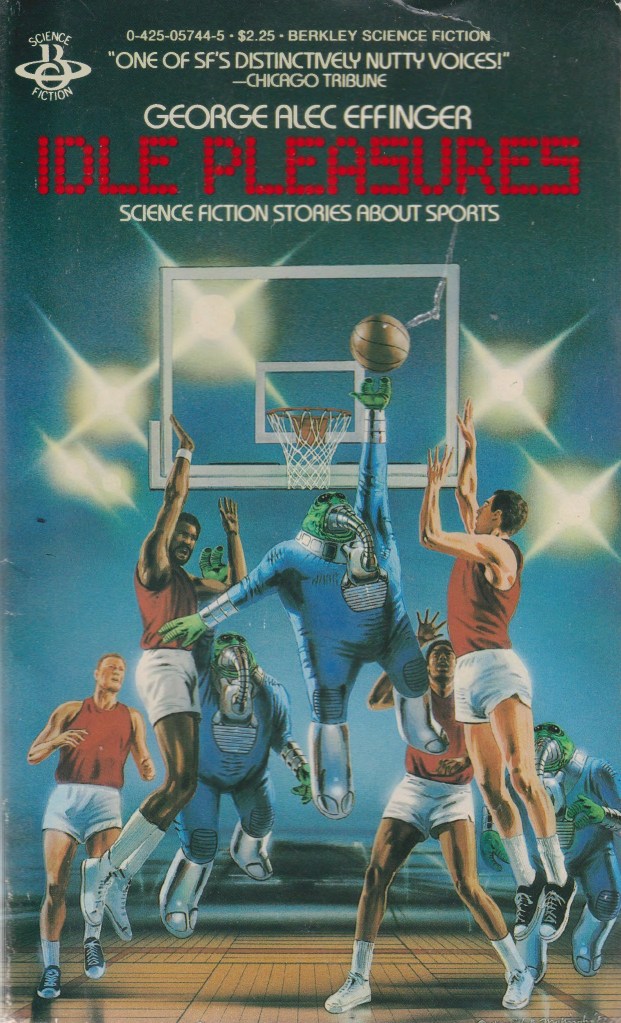
David Mattingly’s cover for the 1st edition
From the back cover: “THE ALIENS’ FIRST WORDS WERE ‘LET’S PLAY BAL!’
Ice hockey with an entire planet for a rink.
A chess competition where the rules change with every move.
No-holds-barred basketball with the blue Cobae.
And other stories from the Wide Universe of Sports by one of today’s most astonishing Masters of Imaginative fiction.”
Contents: “Naked to the Invisible Eye” (1973), “From Downtown at the Buzzer” (1977), “The Exempt” (1977), “25 Crunch Split Right on Two” (1975), “The Pinch Hitters’ (1979), “Breakaway” (1981), “The Horse with One Leg” (1974), “Heartstop” (1974).
Initial Thoughts: As I’ve mentioned in various reviews in the past, “I am (generally) not a fan of sports [other than soccer]. I am a fan of science fiction about sports. More specifically, I’m a proponent of sports as a SF vehicle for social commentary on commercialism, trauma, alienation, and violence.” Effinger’s “25 Crunch Split Right on Two” (1975) is a great example of what these stories can do. I look forward to exploring his other stories on the intersection of sports and SF ruminations on heady issues.
4. Cassandra Rising, ed. Alice Laurance (1978)
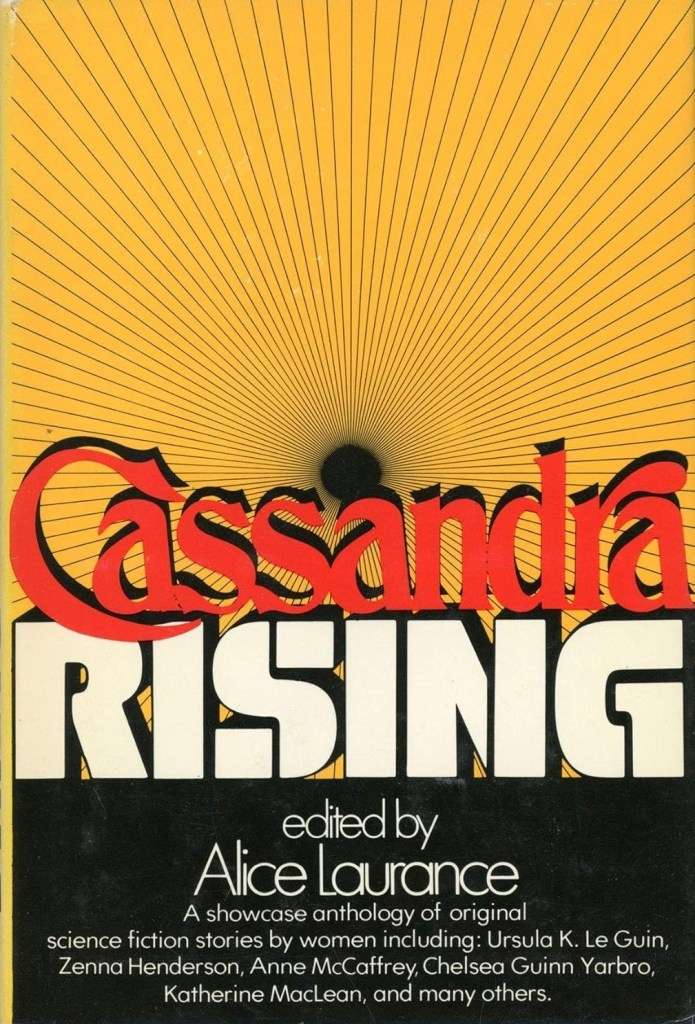
One Plus One Studio’s cover for the 1st edition
From the inside flap: “The world of science fiction–long dominated by male writers who created male heroes always ready to rescue a damsel in distress–is feeling the influence of top-notch women writers. This anthology contains nineteen original stories by some of the most exciting talents in science fiction today–who happen to be women.
Here are unusual and stimulating visions of politics, time travel, motherhood, nature, war and peace, courage, survival of the fittest–and a few choice examples of the heroine in action.”
Contents: Ursula K. Le Guin’s “SQ” (1978), Kay Rogers’ “Flirtation Walk” (1978), Joan Bernott’s “Troll Road” (1978), Zenna Henderson’s “There Was a Garden” (1978), Katherine MacLean’s “Night-Rise” (1978), Kathleen Sky’s “Motherbeast” (1978), Rachel Cosgrove Payes’ “Escape to the Suburbs” (1978), Josephine Saxton’s “Alien Sensation” (1978), Grania Davis’ “Last One in Is a Rotten Egg” (1978), Raylyn Moore’s “The Way Back” (1978), Alice Laurance’s “Schlossie” (1978), Anne McCaffrey’s “Lady in Waiting” (1978), Steve Barnes’ “Impact” (1978), Barbara Paul’s “The Slow and Gentle Progress of trainee Bell-Ringers” (1978), Sydney J. Van Scyoc’s “Nightfire” (1978), Beverly Goldberg’s “Selena” (1978), Juanita Coulson and Miriam Allen deFord’s “Uraguayen and I” (1978), Jacqueline Lichtenberg’s “The Vanillamind Tapestry” (1978), Chelsea Quinn Yarbro’s “Space/Time Arabesque” (1978).
Initial Thoughts: This anthology contains multiple authors that are unknowns to me–Joan Bernott, Steve Barnes, Alice Laurance, Beverly Goldberg, etc. I look forward to this one. And I still have not read a story by Zenna Henderson.
For book reviews consult the INDEX
For cover art posts consult the INDEX
For TV and film reviews consult the INDEX
 Science Fiction and Other Suspect Ruminations
Flesh – I read this last year as I’m approaching a milestone birthday and I have too many books accumulated over the last couple of decades still unread. So many accusations of neglect.
There’s a lot of ingenious detail to “Flesh”, but PJFarmer has a default where his novels just turn into typical adventure trek and it happens here too. Beside the obvious sexual anthropology as basis for sf-culture aspect to the novel there are several elements which merit comparison with other themes in sf.
1) In this future Philadelphia really is the city of Brotherly Love, where all the homosexuals have been hived off, though my recollection is this is nothing more than a little flirty bitchiness.
2) It leans very heavily into the idealisation of astronauts, that they are supermen to be fetishised and how that’s applicable to Golden Bough-type rituals. A heightening of their glamour in opposition to Malzberg’s treatments of the astronaut myth.
And there’s a lengthy diversion about a murderous variation on baseball as sublimation.
If nothing else, for a book of its era, it does deliver the deathless line: “Bend over, and I’ll massage your prostate for a specimen”
Sounds like a fascinating range of elements. As you know, I love Malzberg, SF about sex and sexuality, and various odd takes on astronauts. As I’ll mention in an upcoming “What pre-1985 science fiction are you reading?” post, Philip José Farmer gave a speech titled “SF and the Kinsey Report” at the 11th World Science Fiction Convention (Philcon 2), Philadelphia, September 1953. Unfortunately, a copy of his speech is lost. I’ll include the few fragments I’ve uncovered about the speech in my later post. I can’t help but wonder that giving the speech on the Kinsey report in Philadelphia inspired some elements of Flesh!
I wish a copy existed!
As early as 1949 (or is it even late 1948, American “winter” issues confuse me) Theodore Sturgeon was proselytising that Kinsey was an essential part of a SF writer’s library. Though Sturgeon was placing him beside Charles Fort and Alfred Korzybski (when was the last time anyone mentioned him?). Unfortunately Sturgeon doesn’t have too much to say specifically about Kinsey:
https://archive.org/details/the-arkham-sampler-05-v-02n-01-1949-winter-beb/The%20Arkham%20Sampler%20%2305%20v02n01%20%5B1949-Winter%5D%20%28beb%29/page/26/mode/2up?q=%22theodore+sturgeon%22+kinsey&view=theater
Thank you for the link! I am also very interested in Sturgeon’s early work that touches on sex and sexuality.
Zenna Henderson was a school teacher in Arizona and New Mexico. During the 50s and 60s she also wrote science fictions stories, mostly published in F&SF. They focus on people, just outside the edges of society and had a profound love of nature. I would say that she is Clifford D. Simak transplanted into the American Southwest.
She didn’t write a lot. NESFA Press (a very underrated publisher) has collected her work into two volumes. Ingathering: The Complete People Stories is her best known, a series of stories about psychically gifted descendants of an alien spaceship that crashed in the Southwest in the 19th century. Her other stories and poems are collected in Believing: The Other Stories of Zenna Henderson. Both books are very reasonable priced and are great for dipping into.
Hello Paul,
Oh, I know a lot about her and own multiple collections (The Anything Box and Holding Wonder), I just haven’t read one of her stories (yet!). I read almost as much scholarship of SF as I read SF. In this instance, Lisa Yaszek’s Galactic Suburbia: Recovering Women’s Science Fiction (2008) and Eric Leif Davin’s Partners in Wonder: Women and the Birth of Science Fiction, 1926-1965 (2005) come to mind for their discussions of her work.
In her instance I probably shouldn’t have said “unknowns” — haha. Some of the others in that collections actual complete unknowns — Joan Bernott, Steve Barnes, Alice Laurance, Beverly Goldberg, etc. I know about but have not read Henderson. I’ll modify the post for clarity’s sake. Oops. Sorry.
No problem. Zenna Henderson is something of a trigger for me. She is so much an unknown author who really deserves better. Whenever the subject comes up I start evangelizing without meaning too.
No no no, don’t apologize. I was far from clear. I have a series on the first three published short stories by female authors I should know more about. I’ve covered so far: Alice Eleanor Jones (1916-1981), Phyllis Gotlieb (1926-2009), Sydney J. Van Scyoc (1939-2023), Josephine Saxton (1935-), Carol Emshwiller (1921-2019), Wilmar H. Shiras (1908-1990), Nancy Kress (1948-), Melisa Michaels (1946-2019), Lee Killough (1942-), Betsy Curtis (1917-2002), Leigh Kennedy (1951-), and Eleanor Arnason (1942-).
She should be the next person I include in the series!
I was going to say that Steve Barnes isn’t unknown, and in fact, I’ve met him in person and reprinted his work. But then I looked farther, and saw that THIS Steve Barnes is really named Margaret Barnes, and would indeed qualify as unknown!
Learn something new every day!
I also thought it was strange that one male author would appear in the anthology (assuming it was the Steve Barnes you mentioned). Then I read the editors intro to the story and realize it wasn’t the same person.
Rogue Queen is one of the more unusual of L. Sprague de Camp’s novels. I haven’t read it in a number of years, but it concerns an alien species who live in communities that are made up of workers, females that have never sexually matured, male drones, and a reproducing queen. Then a worker gets involved with people from Earth who are studying the species and discovers that the hive structure is artificial. She has been cut off from supplies and has been forced to eat the drone’s diet and develops sexuality and a relationship with a particular drone. Revolution, of course, ensues. I quite enjoyed the story when I read it. Of course, I was in the process of falling in love at the time, which might have colored my opinion. Reading more of de Camp might be worthwhile, though.
If you (JB) have read nothing by L. Sprague de Camp, the best starting place might be LEST DARKNESS FALL, in which a guy is propelled back to shortly before the fall of the Roman Empire, and just happens to be a scholar who knows enough history to figure out where and when he is, and enough languages to figure out how to communicate. He decides the fall of the Roman Empire was probably not such a great thing, and undertakes to prevent it. As an historian you will probably be able to shoot it full of holes, but that will be part of the entertainment. There’s a good argument that it’s the best single illustration of what Campbell was trying to do with SF in ASTOUNDING, even though it first appeared in UNKNOWN and is fantasy, some would say, because the protagonist is flung back in time arbitrarily rather than by pushing a button or pulling a switch. (Others might say it’s less fantastic than Doc Smith’s inertialess drive, but let’s not start that one back up.) The Panshins, by the way, say that Campbell said that de Camp was the model of what he was looking for in an SF writer.
I agree with Paul that ROGUE QUEEN is a very enjoyable book.
If you want a first edition of FLESH, there are copies on Abebooks at plausible prices, to my surprise.
That’s a scan of my copy of Flesh! It’s a first edition. I always scan my copies for these purchase posts unless mine is damaged or missing a dustjacket — in that case I try to find an equivalent image. But in this instance I have a flawless 1st edition copy.
John Boston: … a guy is propelled back to shortly before the fall of the Roman Empire
Meh. What fall of the Roman Empire? I get tired of this.
The historical reality is that the Roman Empire lasted till 1453, which is a record of civilizational continuity that isn’t equaled by even any Chinese dynasty you care to name, AFAIK.
And it went out with integrity. On the night before Constantinople fell to the Ottomans in 1453 AD, the Emperor Constantine XI Palaiologos arrayed himself in the very same regalia the first Roman emperors had worn more than eleven centuries before, took communion from Byzantine Cardinal Isidore of Kiev, and the next day led his men onto the field, into a battle he fully understood they would lose, then removed his imperial insignia to lead a final charge against the enemy and died fighting.
In fact, when I visited the boondocks of Greece during the 1980s I ran into old people there who claimed in absolute seriousness that, as descendants of Byzantium, they were Romans. I don’t think you’d find those people there now, but still.
Mark, he obviously means the fate of the Western Empire. That said, there probably is no more debated historical moment (medieval historian with a secondary focus on Late Antiquity — and medieval views of Rome — speaking) than the prolonged collapse and transformation of Rome. I imagine that the de Camp is interesting as a window into popular views of Rome and its “fall” at the time. I am not reading SF or any fiction to learn history else you’ll endlessly get peeved. I am reading SF that touches on those topics only to learn what they thought of history. I used to be super dismissive of SF and fiction with historical errors etc. It took me forever to simply understand that fiction interprets and reflects the era. Haha.
I quite agree with John Boston that you will probably like Lest Darkness Fall. Also, I think you will find that the book follows what was known about the period when it was written in 1939. Besides writing SF and fantasy, de Camp wrote a number of popular non-fiction books like Lost Continents: the Atlantis Theme in History, Science, and Literature, which is grand debunking of Atlantis pop-culture. Another one I like is The Ancient Engineers, a account of practical science through the ages. He points out, looking at art from the Persian Empire, that the legs on the Emperor’s throne meant the lathe had been invented by then, and that such proof did not exist from before that time. He was not a formal historian, but he was pretty sharp. His Wikipedia page is pretty comprehensive.
”Lest Darkness Fall” is indeed a very entertaining novel. For a modern reader, though, there’s a kicker at the end where the time-displaced Martinus suggests that an expedition to the Americas might result in a supply of a harmless weed of which he is fond – tobacco. Oh, great – an additional 1,000 years of smoking-related diseases……
JB: It took me forever to simply understand that fiction interprets and reflects the era.
Oh, of course not. Nor was I actually ticked off. It was just an opportunity to sound off and remind people that this rote popular view of ‘The Fall of Rome’ writes into invisibility what is, alongside Chinese history, one of the two most impressive, longest enduring civilizational achievements in human history.
I am far more interested in what happens after Rome collapses in the West personally. As for China, I’ve attempted over the years to expand my knowledge. For example, I went through a few months of reading everything about the Shang I could get my hands on — pretty obsessed with oracle bones. Keightley’s The Ancestral Landscape: Time, Space, and Community in Late Shang China (ca. 1200-1045 B.C) was a brilliant utilization of oracle bones to reconstruct Shang conceptions of the world.
Havent read any of these. That blandly literal Effinger cover is hilarious.
re: Sturgeon and sexuality, I just finished Venus Plus X, which was pretty fascinating but ultimately ended up pulling some punches in an unsatisfying way (for me, at least). I’m assume you’re familiar with that one.
There’s a review from ages back of Venus Plus X. I enjoyed but did not know what to make of it — as a result, I only could put together a short blurb review. Here’s my general review index: https://sciencefictionruminations.com/science-fiction-book-reviews-by-author/
I have a signed copy of Cassandra Rising, but it’s in storage and I can remember who signed it. Flesh is original to the series Beacon Books published for Galaxy magazine, and while I have a copy I’ve not read it. See https://iansales.com/2009/06/22/sexy-sci-fi/
Yup, I made sure to buy a first edition. Maybe I’ll slowly acquire the rest in the series.
I’d be very interested in the Effinger volume on sports. And that Rogue Queen book would have captured my teenaged self very easily. Looks cool. Flesh could not be more a “no” from me. I admit I haven’t really enjoyed his books and that premise makes me think misogyny city.
I’ve already reviewed one of the stories in the Effinger collection — it’s terrific. “25 Crunch Split Right on Two” (1975): https://sciencefictionruminations.com/2016/01/26/book-review-irrational-numbers-george-alec-effinger-1976/
As for the Farmer, I love his short fiction and have been less impressed with his novels. I’m all for pre-New Wave examples of SF pushing boundaries. Farmer even gave a talk at a convention in 1953 on SF and the Kinsey report! Do I expect Flesh to be a “good” novel? I highly doubt it. But looking for the good stuff is only a small part of why I read SF.