Which books/covers/authors intrigue you? Which have you read? Disliked? Enjoyed?
The first purchases of 2026!
1. A Mirror For Observers, Edgar Pangborn (1954)
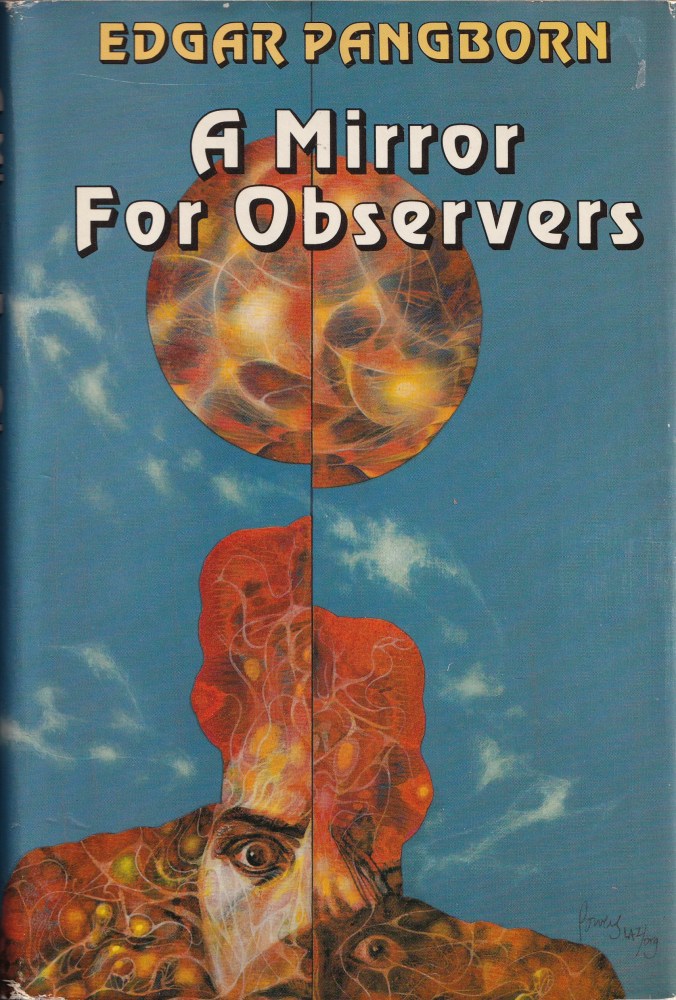
Richard Powers’ cover for the 1985 edition
From the back cover: “We would call them Martians, though they refer to themselves as Salvayans. Refugees from their dying planet, they arrived on our world almost 30,000 years ago to make new lives for themselves. From their vast underground cities, hidden from discovery, the Salvayans have ben observing us with care and concern, waiting for the day when humans will be ready to meet them. The Salvayans are not many, but they are long-lived and patient….
…Most of them, that is. for some have already tired of waiting. They call themselves Abdicators, setting themselves apart from the more passive Observers; they’d like to rid the Earth once and for all of the greedy, petty race that populates its surface. And with a little help from the Abdicators, perhaps the humans will destroy themselves.
In the small town of Latimer, Massachusetts, dwells a 12-year-old boy named Angelo Pontevicchio. Angelo is no ordinary human child, though he often wishes he would be. The handicap of his polioed leg and his unassuming gentleness are more than compensated for by his soaring mind. To Namir the Abdicator, Angelo is the human tool he needs. Angelo’s genius, his read-to-mold-personality, give him the potential of a Ghandi–or a Hitler. For Namir, it is but a matter of careful manipulation…
Learning of Namir’s plans, the Observers send in their own agent, poet-historian Elmis. Alone in the field, disguised as a mild, middle-aged ex-school teacher, Elmis must reach Angelo and somehow counteract the influence of the renegade Namir, whose resources and determination will stop at nothing–including murder. Elmis’ weapons: only the power of love and truth… and an ancient bronze mirror from the last civilization of Crete, a mirror that can show what one really is–or could be.
Following Elmis, Namir and Angelo over nine years–years in which the boy will be drawn into corruption, violence and, ultimately, a Nazi-like cult that threatens to fulfill Namir’s sinister wishes for human catastrophe–A Mirror for Observers showcases the captivating talents of of one of the SF’s most brilliant, most human and most innovative writers.”
Initial Thoughts: I love Pangborn. This is actually a second copy as my 1st edition paperback crumbled as I attempted to read it.
2. The 57th Franz Kafka, Rudy Rucker (1983)
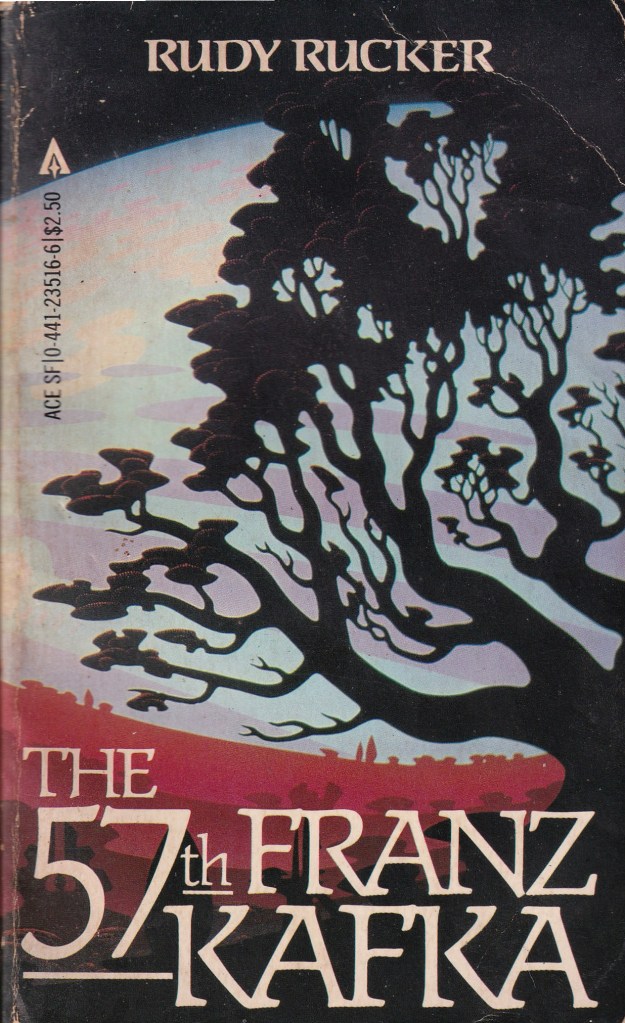
Uncredited cover for the 1st edition
From the back cover: “Mathematical philosopher, former unground cartoonist, aruthor of three wild sf novels and two works of mathematical non-fiction, great-great-great-grandson of G. W. F. Hegel and father of three, Rudolf von Bitter Rucker has a mind and a wit all of his own. Come enter his bizarre and delightful world in this collection of fact, fancy, and mangled history.”
Contents: “The 57th Franz Kafka” (1982), “Schrödinger’s Cat” (1981), “A New Golden Age” (1981), “Jumpin’ Jack Flash” (1983), “Sufferin’ Succotash” (1983), “Faraway Eyes” (1980), “Hyperspherical Space and Beyond” (1980), “The Indian Rope Trick Explained” (1983), “A New Experiment with Time” (1982), “The Man Who Age Himself” (1982), “The Facts of Life” (1983), “Tales of Houdini” (1981), “Buzz” (1981), “The Last Einstein-Rosen Bridge” (1983), “Pac-Man” (1982), “Pi in the Sky” (1983), “Inertia” (1983), “Message Found in a Copy of Flatland” (1983), “The Jack Kerouac Disembodied School of Poetics” (1982).
Initial Thoughts: Rudy Rucker remains a complete unknown to me. I’ve read a few reviews here and there and picked up a copy of Software (1982) (which remains unread). I’ve heard good things about White Light (1980) in particular.
3. Wanderground: Stories of the Hill Women, Sally Miller Gearhart (1978)

Jim Hanlon’s cover for the 1984 edition
From the back cover: No summary provided. See my quote from SF Encyclopedia below.
Initial Thoughts: According to SF Encyclopedia, Gearhart’s first sf book, one of the most extreme of those that envisage men and women as effectively different races, is The Wanderground: Stories of the Hill Women (coll of linked stories 1978). It is set in the outlaw, all-women, Utopian hill communities of a future when men are restricted to the Cities and dependent on Technology, while women (in a somewhat New Age manner) have developed Psi Powers through harmony with Nature. Even the Gentles, men no longer driven by violence, know that “maleness touched women only with the accumulated hatred of centuries.” She’s an author I’ve frequently encounter in scholarship of feminist SF but hadn’t picked up a copy, until now.
4. Science-Fiction Carnival, ed. Fredric Brown and Mack Reynolds (1953)
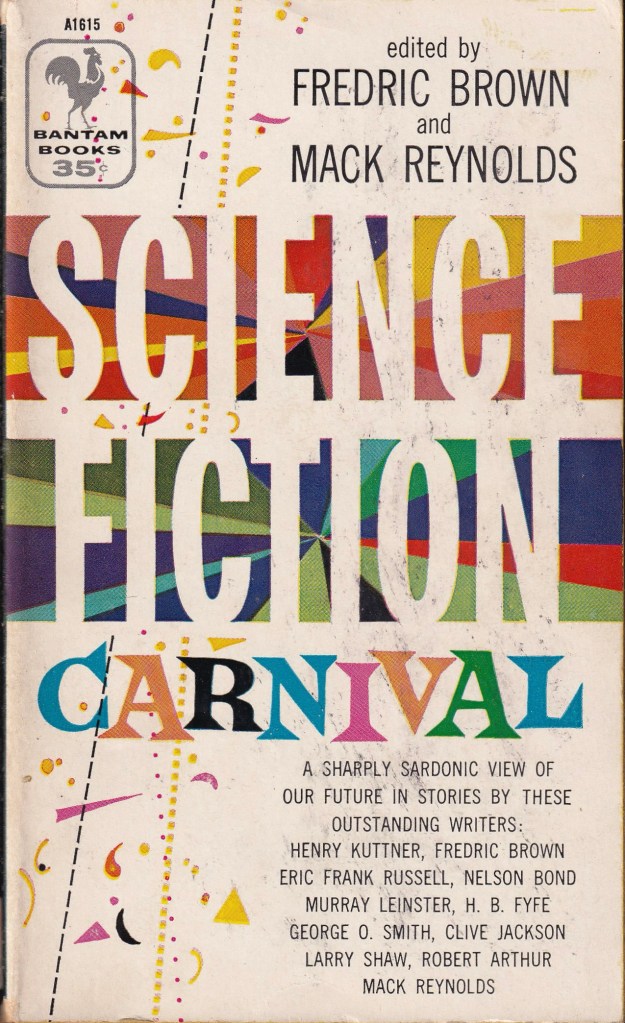
Uncredited cover for the 1957 edition
From the back cover: “….in science fiction carnival you’ll find out how a screenwriter traded personalities with Ivan the Terrible in THE EGO MACHINE.
What happens when thinking machines can give the answers to any question in A LOGIC NAMED JOE.
When a hillbilly finds a Martian is easier to handle than a “revenoer” in THE MARTIANS AND THE COYS.
How a glorified slot machine solved the problem of interplanetary travel in THE COSMIC JACKPOT.
What Jeremiah Jupiter, “mad scientist” deluxe, thought in THE WHEEL OF TIME.
And six other yarns of the fabulous future collected for your enjoyment.”
Contents: Robert Arthur’s “The Wheel of Time” (1950), Murray Leinster’s “A Logic Named Joe” (1946), Larry T. Shaw’s “Simworthy’s Circus” (1950), H. B. Fyfe’s “The Well-Oiled Machine” (1950), Clive Jackson’s “The Swordsmen of Varnis” (1950), Fredric Brown’s “Paradox Lost” (1943), Eric Frank Russell’s “Muten” (1948), Mack Reynolds’ “The Martians and the Coys” (1951), Henry Kuttner and C. L. Moore’s “The Ego Machine” (1952), George O. Smith’s “The Cosmic Jackpot” (1948), Nelson S. Bond’s “The Abduction of Abner Greer” (1941).
Initial Thoughts: Sometimes I cast my eyes on anthologies as a way to finally read SF authors that have escaped my focus. In this instance, I haven’t read anything by Robert Arthur, H. B. Fyfe, Larry T. Shaw, George O. Smith, or Nelson S. Bond.
For book reviews consult the INDEX
For cover art posts consult the INDEX
For TV and film reviews consult the INDEX
 Science Fiction and Other Suspect Ruminations
I loved the stories in The 57th Franz Kafka! I first read Rucker in the late 1970s when Unearth magazine published 2/3rds of his very fun novel Spacetime Donuts before they folded.
I read most of what he had published back then, although White Light was hard to come by- when I did get a copy, I’m afraid I didn’t like it as much as his Ware books, etc.
And I think I’ve said before that I named my shop after a term he invented for his style of fiction!
I think the apparent (from the titles) presence of higher level math concepts scared me off reading his SF in the past. If you know me there is literally nothing I despise more in this world than math…. Obviously a good author can write a story that uses math ideas AND spins an engaging story.
And for anyone stopping by who doesn’t know — this is Mike’s bookstore (if you’re in Edinburgh, Scotland). I’ve stopped by twice on my travels.
I’ve been there too and second the recommendation.
Reminds me that I need to make another trip to Scotland!
Did you have a favorite story in the collection?
Well, it’s a long time since I last looked at the book, but I’d say A New Golden Age or Pac-Man are both fun. And your dislike of maths might allow you to appreciate A New Golden Age more!
Thanks! In the US (I dunno about Europe), we could take an Advance Placement test and test out of college requirements — I received the bare minimum score to test out of taking a math class in college. A top five happy moment. Muahaha. That’s how much I despised math classes.
I wouldn’t be too scared of Rucker and his maths. I’m not the most numerate guy myself but I could follow along, because: –
[1] Rucker’s takes on maths in his SF are so far-out theoretical and always go straight for the most wigged-out stoner’s take on things that you can just go ‘Sure, Rudy, for the purposes of this story Cantor’s transfinite infinities like Aleph-Null, Aleph-One, Aleph-Two, etc. could lead exactly where you say they do.’
[2] Also, he explains the ideas he’s riffing off well because he’s a good maths theory popularizer. I’ve read his non-fiction book The Fourth Dimension, for example (I hesitated to call it fact), and it’s good.
I actually prefer Rucker in this mode to his SF, which I tend to find tedious and too shambolic for my taste, and quite a bit of which was written when he was stoned. As he admits.
Now I think about it, I recall meeting him around about 2005-2006 when I drove down with a couple of friends from the East Bay and had dinner with him and his wife in Santa Cruz.
Appropriately enough, I can’t remember a thing about the evening other than that he was a very nice guy.
The Pangborn is solid, read it last year. It felt like one part low-ley character study and one part Pohl/Kornbluth social commentary, in my memory. Wanderground sounds interesting (never heard of it), but oy that cover/font arent doing it any favors.
As you know, I will eventually make my way through all of his fiction. Mirror is my goal for this year, and maybe The Judgment of Eve (1966).
I reviewed The Wanderground on sfmistressworks back in 2012. I remember liking it.
Thank you for the link. While I read all the Mistressworks reviews when they were posted, I had forgotten that you wrote a review of the Gearhart.
Joachim,
I read A Mirror For Observers in 1976; reread it in 2014 and didn’t think so highly of it. The only Rucker for me was Software in 1987; haven’t sought him out since, but some of his story titles sound intriguing. Since Gearhard is unknown to me I Googled her: She’s described as a radical feminist in Wikipedia so that put the kibosh on reading Wanderground, since I’ve never been keen on authors with extremist agendas. That leaves S-F Carnival. The “sharply sardonic view of our future” blurb on the cover appeals to me so I downloaded a pdf at readitfree, as accessed under luminist.org/archives, which is great place to find older books.
Andrew Pineo
Hello Andrew,
Make sure you check out my 2025 in review if you haven’t already, maybe you’ll encounter some stories/novels that I actually recommend. As you know, these are just things I’ve recently acquired. https://sciencefictionruminations.com/2026/01/02/my-2025-in-review-best-science-fiction-novels-and-short-fiction-reading-initiatives-and-bonus-categories/
As for radical voices, well, that’s the major difference with how I read SF: “I am fascinated by the ways authors responded to the advent of nuclear weapons, the rise of 50s suburbia and commercialism, the Civil Rights movement, the Counterculture and radical student politics, the Vietnam War, and the 1970s political backlash. I chart what’s produced in a specific time and territory to understand the people who dwelled at that moment—their dreams for the future, their fears of the present, and all the manifestations of estrangement and elation generated by a rapidly transforming world. Science fiction is a fantastic way to get at the zeitgeist of an era.”
And that includes the entire range of responses — radical or not. The historian in me…
Joachim,
I understand your reading direction (what I called “esoteric eddies” some years ago); my reasons are mostly for enjoyment and to explore the really early stories.
I did check your 2025 year in review post! I’ve read Haldeman’s All My Sins Remembered in 1977; my favorite of his is All My Sins Remembered; Pangborn’s The Company of Glory in 1976. I’ve added Robinson’s Icehenge to my want list and Fairbairn’s Benefits with a question mark. I may have read a few of the 20 shorter pieces, but I’d have to dig through my reading log (53 years and counting) to figure out which ones.
I’m still going working on my much older S-F list from de Grainville’s The Last Man, 1805, to Dent’s Emperor of the If, 1926, with either Griffith’s The Angel of the Revolution or Wells’ A Modern Utopia next. I might throw in a few S-F magazines from the 50s since luminist.org has a fantastic selection.
Andrew
Joachim,
I just finished Science-Fiction Carnival last night. It took quite an effort not to skim some of the “yarns,” as Fredric Brown often wrote in his introductions. I’ve come to the conclusion that other than Arena, Fredric is way over rated, and the selection seems more to his stylistic choices, rather than his co conspiritor, Mack Reynolds. The best for me were Leinster’s A Logic Named Joe and Russell’s Muten.. The latter is surprising because I think his most famous, the Hugo awarded Allamagoosa, never did much for me. Overall, I found the anthology dated, predictable and evidently too subtle to register on my humor meter. I hope you find something of interest here!
Andrew Pineo
I read A Mirror for Observers just a few years ago and I loved it. I think it’s an underrated novel. It probably should have won the Hugo that They’d Rather Be Right won, and I wonder how that might have affected Pangborn’s career or reputation.
I have a copy of Science Fiction Carnival, but haven’t gotten to it yet.
I hope to get to it this year!
I’ve read a little bit of Fyfe (he’s got a bunch of things on Project Gutenberg). The one that sticks out in my mind at the moment is “The Manners of the Age” which shares some features with “The Naked Sun.”
As you know, almost every issue of early SF magazines are available online — you can track down every Fyfe story you might want regardless of whether it is on Gutenberg. But yes, I really should read some of his work — he’s an unknown to me.