Book Review: New Dimensions 3, ed. Robert Silverberg (1973) (Le Guin + Tiptree, Jr. + Lafferty + Malzberg + Effinger + et al.)


(Dennis Anderson’s cover for the 1973 edition)

4/5 (Collated rating: Good)

For an anthology, bound to contain a filler story or two, this one is spectacular. Robert Silverberg’s New Dimensions 3 (1973) lives up to his claim to contain “stories that demonstrate vigorous and original ways [often experimental] of approaching the body of ideas, images, and concepts that is science fiction” yet do not sacrifice “emotional vitality, or clarity of insight.” Ursula K. Le Guin, with her rumination on utopias, and James T. Tipree, Jr.’s proto-cyberpunk tale of commercialism and performing gender, deliver some of their best work.

Continue reading

Book Review: Mindship, Gerard F. Conway (1974)

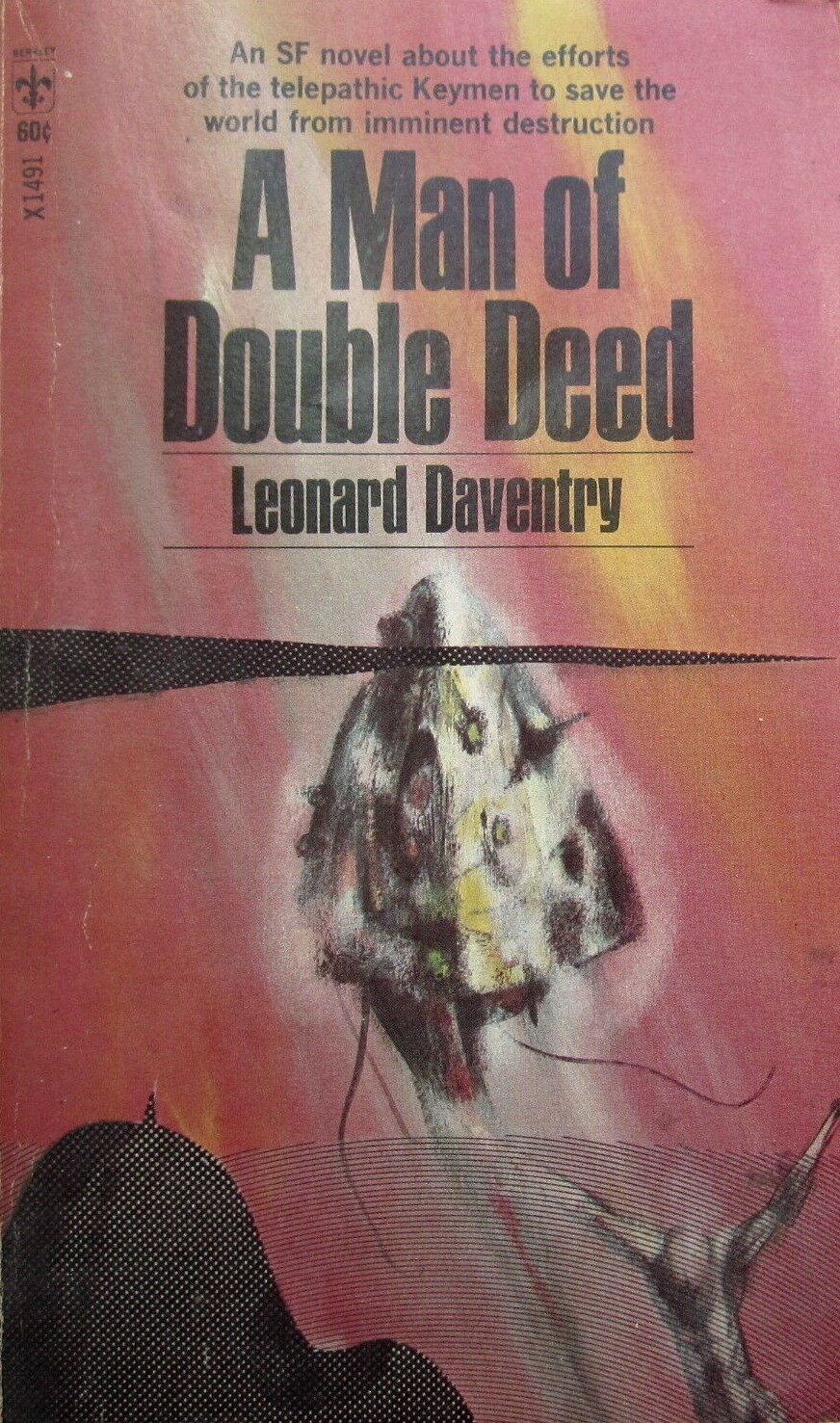
mindship conway(Kelly Freas’ cover for the 1974 edition)
3/5 (Average)

“The only truth is what happens, in plain and simple reality. I’ve seen the inside of too many minds to think any man’s intentions can be good. We’re evil inside ourselves Kilgarin. We’re sick and foul and filthy. The only ones who come close to being pure are those too stupid to be anything else” (72).

Back in 2016 I read Universe 1, ed. Terry Carr (1971) and was pleasantly surprised by Gerard F. Conway’s short story “Mindship” (1971) about telepathic (“sensitive”) “corks” who calm the minds of the spaceship crews whose psychic powers run interstellar “engines.” This story forms the prologue of Conway’s novel continuation. In an odd way, the novel reinterprets the original short story and adds an additional level of mystery (it wasn’t an accidental death, it was a murder!) to its straightforward plot.

Continue reading

Book Review: Emphyrio, Jack Vance (1969)


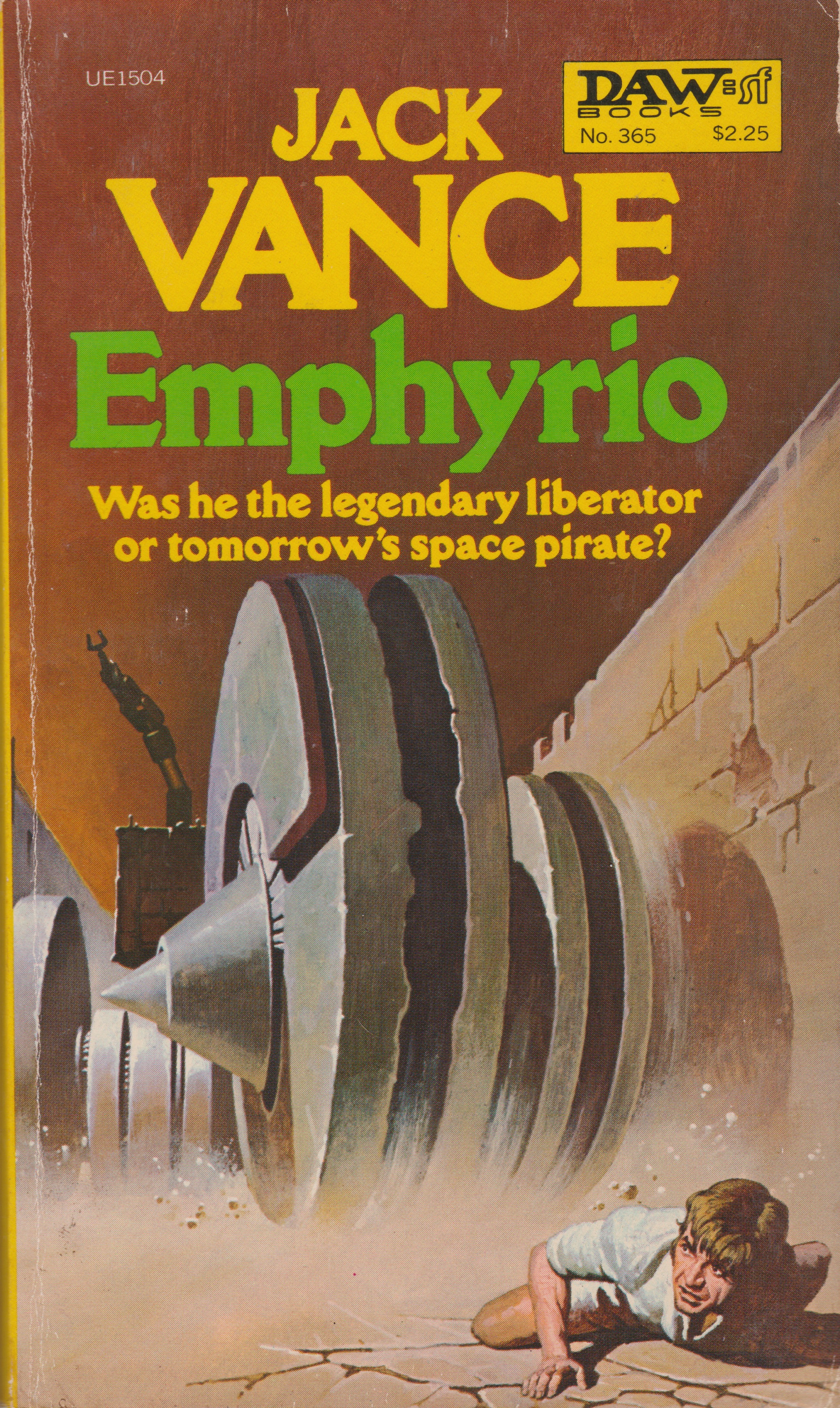
(Gino D’Achille’s cover for the 1979 edition)

3.5/5 (Good)

Jack Vance’s Emphyrio (1969) is a story about how a story can create change and heighten our own yearning for escape. Although a pulp coming-of-age adventure at heart, Vance reigns in his baroque descriptive tendencies to spin a narrative that tries (successfully) to say something meaningful about the impact of storytelling.
Continue reading

Book Review: Killerbowl, Gary K. Wolf (1975)

4.75/5 (Very Good)

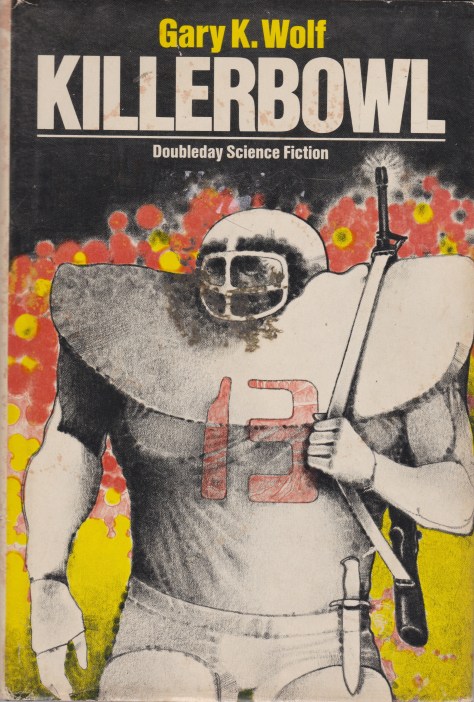
“The Minutemen’s hidden safety, crouching on the fifteenth floor of the Fontana West apartments, puts cross hairs on Gradington’s Adam’s apple, now even so slightly exposed just below the bottom of his bulletproof helmet and mask, just above the top of his body armor, and squeezes the trigger (5).”

In some ways SF comparisons between modern sports and Roman arenas, where blood and guts are spilled in obligatory fashion, might come off as a soft target. Imagine if the football players had knives! Pass. Imagine if one of the players had a gun! Double pass. Yes, we know sports can be violent and taxing on the mind and body. A quick browse through the current NFL injury list and articles such as The Boston Globe‘s six-part series on Aaron Hernandez makes grim and disturbing reading (researched only for this post). And adding levels of violence and trauma to an already splattered playing field is a predictable avenue of SF speculation. Predictable yet relentlessly fascinating in the hands of a talented author….

Continue reading

Novella Review (Italian SF in translation): “Cancerqueen” (1950), Tommaso Landolfi

DkVqsjsUwAEDHqm[1].jpg(Colin Hay’s cover for the 1984 Italian edition of Cancerqueen (1950), Tommaso Landolfi)

4.75/5 (Near Masterpiece)

The fiction of Tommaso Landolfi—an Italian author, translator, and critic—dabbled at speculative edges. Those far more knowledgeable about Italian SF consider Landolfi’s novella “Cancerqueen” (1950), translated in 1971 by Raymond Rosenthal, an important work in the history of Italian SF as it resonated with later “New Wave sensibilities” and “went against the realist grain of Italian high culture” (Salvatore Proietti, “The Field of Italian Science Fiction,” Science Fiction Studies, July 2015).

Redolent with gothic overtones, “Cancerqueen” tells the transfixing tale of a possibly insane narrator (N) relating his voyage into space, and into the womb of a manipulative spaceship. Writing as an act of self-delusion—“perhaps I should pretend I have a reader, I shall be less alone, and that is enough” (50)—N relates how, in a disconsolate state of mind, he agreed to an outrageous proposition put forth by Filano, an escapee from a nearby asylum.  The proposition: Deep in the mountains Filano has a spaceship named Cancerqueen and he wants to take N to the moon! For N, “she was my liberator, whose wings (wholly metaphorical) would transport me (not metaphorically) beyond my  disagreeable Continue reading

Book Review: A Rose for Armageddon, Hilbert Schenck (1982)

(Don Maitz’s cover for the 1982 edition)

2.75/5 (Vaguely Average)

Hilbert Schenck’s A Rose for Armageddon (1982) postulates that in the near future a complex computer program (“Archmorph”) will be able to predict political and social trends as “conflict was [and will be] pattern-determined” (26). Filled with references to the turbulent 1970s (Vietnam protests, campus unrest, the 1979 energy crisis) and the fear the decade generated, Schenck suggests that a cataclysmic possibility looms.

A Rose for Armageddon treads intriguing grounds in part because it centers on two non-standard individuals (it’s rare to have elderly main characters!): Dr. Elsa Adams, the Louis Agassiz Professor of Analytic Zoology and Dr. Jake Stinson Continue reading

Book Review: The 1972 Annual World’s Best SF, ed. Donald A. Wollheim (1972)

(John Schoenherr’s cover for the 1972 edition)

3.5/5 (collated rating: Good)

The 1972 Annual World’s Best SF, ed. Donald A. Wollheim (1972) doesn’t feel like a “best of” collection. The majority of the contents are unspectacular space operas and hard SF in the Analog vein. Amongst the chaff, a few more inventive visions shined through—in particular, Joanna Russ’ mysteriously gauzy and stylized experiment replete with twins and dream machines; Michael G. Coney’s evocative overpopulation story about tourist robots; Christopher Priest’s “factual” recounting of human experimental subjects that isn’t factual at all; and Barry Malzberg’s brief almost flash piece about differing perspectives all tied together by the New York metro.

On the whole, I give it a solid recommendation although the best can be found in single-author collections.

Brief Analysis/Summary

“The Fourth Profession” (1971), novelette by Larry Niven, 3/5 (Average): Nominated for the 1972 Continue reading

Book Review: The Halcyon Drift, Brian Stableford (1972)

(Angus McKie’s cover for the 1976 edition)

2.75/5 (Vaguely Average)

I have not had the best luck with Brian Stableford’s science fiction (albeit, I’m not sure I’ve read a single short story of his). Jesse over at Speculiction… swears (and I believe him!) that Stableford is occasionally capable of intelligent and sustained SF — consult his wonderful review of Man in a Cage (1975). Jesse barely dignifies The Halcyon Drift (1972) with a review. I’m in the same boat (or spaceship?). It took weeks of staring at my battered copy in a pile of other superior “to review” novels to convince myself to put finger to keyboard. How does one approach a bare by the numbers outline of a space opera?

By starting with the plot?

The Prologue forms the most evocative and moody Continue reading

Short Story Review: Marcel Schwob’s “The Death of Odjigh” (1892)

(John Yang’s cover for the 2017 edition)

4.25/5 (Very Good)

Marcel Schwob’s short stories (and invented biographies) inspired the likes of Jorge Luis Borges, Roberto Bolaño, and other proponents of “intertextual” and “encyclopedic” literature. Due to this intellectual genealogy which speaks to my very fiber, I purchased a copy of Wakefield Press’ gorgeous 2017 edition of The King in the Golden Mask (1892), which contains a kaleidoscope of fascinating fictions  filled with evocative imagery and metafictional delights. I eagerly await a new edition of Schwob’s pseudo-historical biographies Imaginary Lives Continue reading