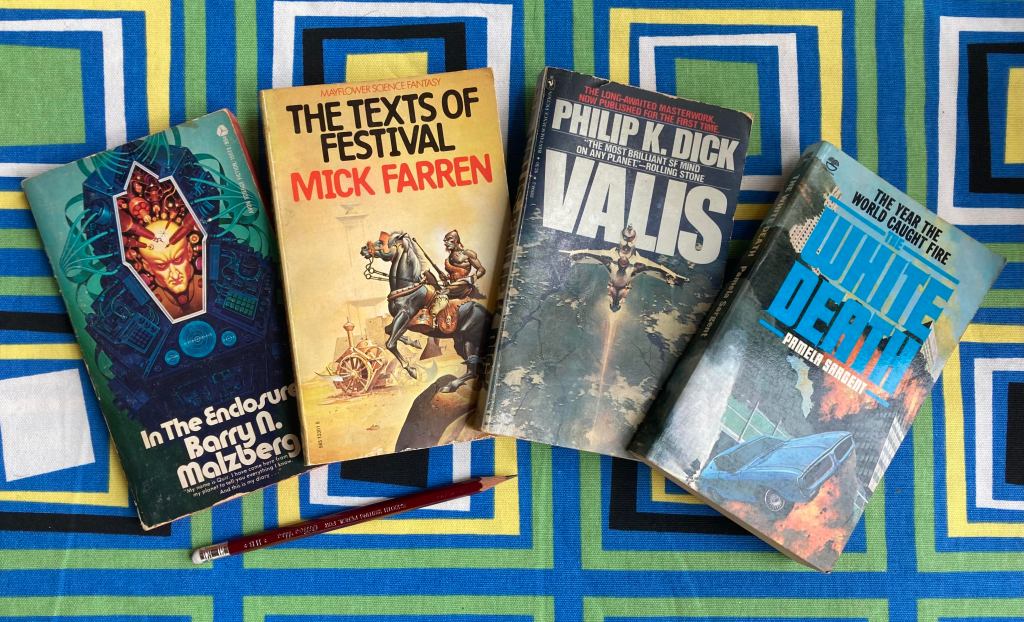
Updates: Recent Science Fiction Purchases No. CCCXXXVI (Clare Winger Harris, Frederik Pohl, Barrington J. Bayley, and Robert Asprin)

Which books/covers/authors in the post intrigue you? Which have you read? Disliked? Enjoyed?

1. Away From the Here and Now, Clare Winger Harris (1947)

From the inside flap: “In this age of atomic bombs and radar to the moon, Mrs. Harris’ stories may prove closer to the “here and now” than the title would indicate. Mrs. Harris Proudly claims the distinction of being the first woman science-fiction writer in the country. Each of her stories is based upon a sound scientific fact, carried so plausibly to the nth degree that at no time does it overstain credulity. The stories possess the qualities of dealing with ideas of big importance to the human race, of presenting those ideas in a plausible form, and of appealing to emotions that exist deep within the heart of every human being whether he be scientific or not.

Continue reading

What pre-1985 science fiction are you reading? + Update No. XIV

What pre-1985 science fiction are you reading or planning to read this month?

Here’s June’s installment of this column.

I’m periodically plagued by the virulent Esoterica virus, the relentless desire to catalogue and write about the less known, and even better, the completely unknown. While attending a Medieval English literature graduate class, I remember a conversation I had with the professor, Robert D. Fulk, during office hours about the sheer quantity of scholarship on Beowulf (here’s his edition of the iconic text). I pointed out the panic I experience if I’m unable to read ALL the scholarship on a popular text.

Continue reading

Exploration Log 4: Six Interviews with Clifford D. Simak (1904-1988)

Clifford D. Simak (1904-1988) published science fiction steadily between 1931 and his death in the late 80s. His work–from City (1952) to the Hugo-winning Way Station (1963)–often demonstrates a fascination with the rural environment and the lives of “ordinary” people confronted with the alien. As I am currently working on a mini-project related to Simak,1 I thought I’d give a rundown of six of the seven interviews I’ve found reference to. I’ll also provide quotes of interesting passages, and a scanned version of one that isn’t available online. In the interviews, Simak comes across as an author deeply suspicious of rigorous generic distinctions, passionate about all life, and open to science fiction as an ever-changing and evolving entity.

The Internet Speculative Fiction Database lists five interviews on science fiction conducted with Clifford D. Simak–all published between 1975-1980. Muriel R. Becker’s indispensable Clifford D. Simak: A Primary and Secondary Bibliography (1980) includes two more: a video interview from 1971 and another from 1976 in the Minneapolis Tribune.2 I cannot find a copy of the latter. I provide links to the others in the post.

Obviously, which interview you want to read depends on your interests or questions you have about Simak. That said, I found Paul Walker’s the most fascinating (and frequently references in the little scholarship on the grandmaster).

Continue reading

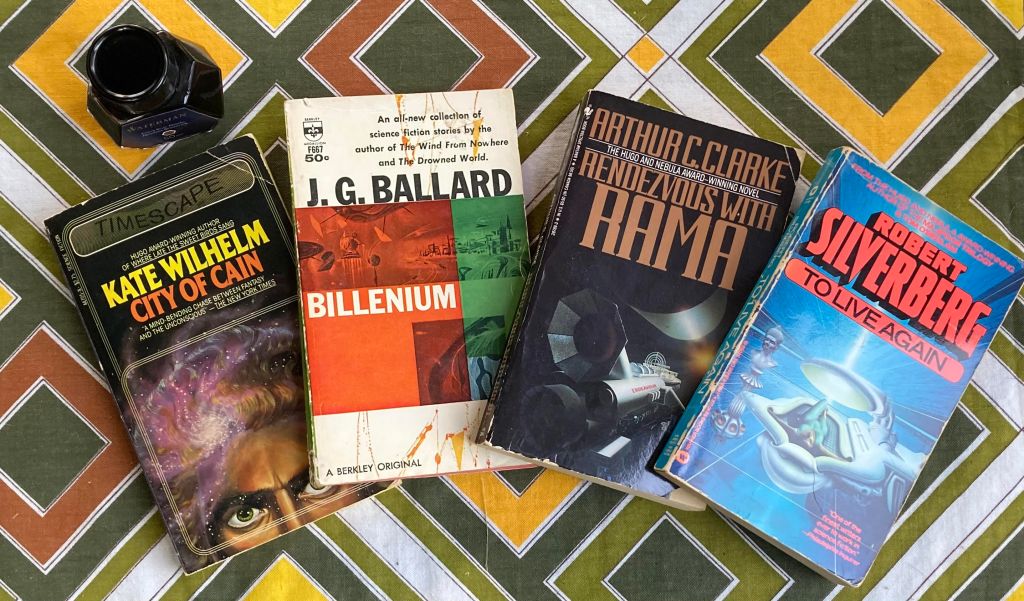
Updates: Recent Science Fiction Purchases No. CCCXXXV (Damien Broderick, Brian W. Aldiss, Sydney J. Van Scyoc, and D. G. Barron)

Back from Norway! Time to acquire more science fiction.

Which books/covers/authors in the post intrigue you? Which have you read? Disliked? Enjoyed?

1. The Dreaming Dragons, Damien Broderick (1980)

From the back cover: “TO THE PLACE WHERE SECRETS LIE SLEEPING. Alf Dean, an aborigine trained as an anthropologist, knew that his tribesmen, for centuries beyond memory, had warned of a dreadful secret in the mountains of Australia.

His ‘slow-witted’ nephew led him to the secret spot–the same spot where men were claimed by deaths that were secret to the world.

Continue reading

What pre-1985 science fiction are you reading? + Update No. XIII

What pre-1985 science fiction are you reading or planning to read this month?

Here’s May’s installment of this column.

As I am currently exploring the north-of-the-Arctic Circle reaches of Norway, why not segue way into this post by re-ruminating on the only Norwegian SF novel I’ve read: Knut Faldbakken’s spectacular Twilight Country (1974, trans. Joan Tate, 1993). I wish I’d thought to bring the sequel — Sweetwater (1976, trans. Joan Tate, 1994). Twilight Country, my second favorite SF novel read of 2021, contains one of the great depictions of a decaying metropolis. It is a densely metaphoric story of survival within its crumbling edifices. The masterstroke of Faldbakken’s novel is the portrayal of the Dump, a border zone containing the cast off fragments of human existence, as a place of recreation. Our characters run to the Dump to escape, to make their lives anew. They’re deeply flawed figures. There’s a tangible sense of organic transformation within the transients who inhabit this liminal zone. Sweetwater and The Dump act as a closed system. One decays into the other. One creates the other. Not recommended unless you like your SF dark and moody like me!

Continue reading

What pre-1985 science fiction are you reading? + Update No. XII

What pre-1985 science fiction are you reading or planning to read this month?

Here’s April’s installment of this column.

First, a bit about Isaac Asimov’s Foundation (1951) from M. Keith Booker’s Monsters, Mushroom Clouds, and the Cold War: American Science Fiction and the Roots of Postmodernism, 1946-1964 (2001), my current history of science fiction read:

Continue reading

Updates: Recent Science Fiction Purchases No. CCCXXXIII (Keith Laumer, Vernor Vinge, Mack Reynolds, Daphne du Maurier)

Which books/covers/authors in the post intrigue you? Which have you read? Disliked? Enjoyed?

1. It’s A Mad, Mad, Mad Galaxy, Keith Laumer (1968)

Back cover: “This frenetic collection of science fiction stories–often disturbing, always entertaining–comes from outstanding and unpredictable SF author Keith Laumer.

Tingle your imagination: In ‘The Planet Wreckers,’ Jack Waverly goes to bed an ordinary mortal and wakes up a movie star. But the trouble is, his life is the price.

Tired of being a 97-pound weakling? “The Body Builders” has the answer for you: Just buy yourself the Body Beautiful.

Exorcise your hostility! A Certain Powers plans to obliterate “the greatest menace in the world today”–coast-to-coast television, better known as ‘The Big Show.'” [I think the last description is not for a story in the collection. Laumer always had a story title “The Big Show” that appeared in 1968. Maybe they were planning on including it in this collection but substitute something else at the last minute?]

Continue reading

What pre-1985 science fiction are you reading? + Update No. XI

What pre-1985 science fiction are you reading or planning to read this month. Here’s March’s installment of this column.

Before we get to books and birthdays and writing plans…

Continue reading

Updates: Recent Science Fiction Purchases No. CCCXXXII (Vernor Vinge, Brian Stableford, Joan Cox, and Pierre Boulle)

Which books/covers/authors in the post intrigue you? Which have you read? Disliked? Enjoyed?

1. The Witling, Vernor Vinge (1976)

From the back cover: “Witling: A pretender to wit. (Webster’s Dictionary)

In the eyes of the inhabitants of Giri the scientific explorers from outer space were witlings. In the context of that primitive-seeming planet, they were.

Because on Giri a peculiarity of evolution had given a special talent to all living things–and this talent had made unnecessary most of the inventions associated with intelligent life elsewhere. Roads and planes, engines and doors… these were the products of witlings, not of ‘normal’ people.

So when the little band from Earth’s exploration team fell into Giri hands, their problem was unprecedented. How to demonstrate that science is worthwhile and how to keep the medieval masters of Giri from realizing their potential for cosmic mischief.”

Continue reading