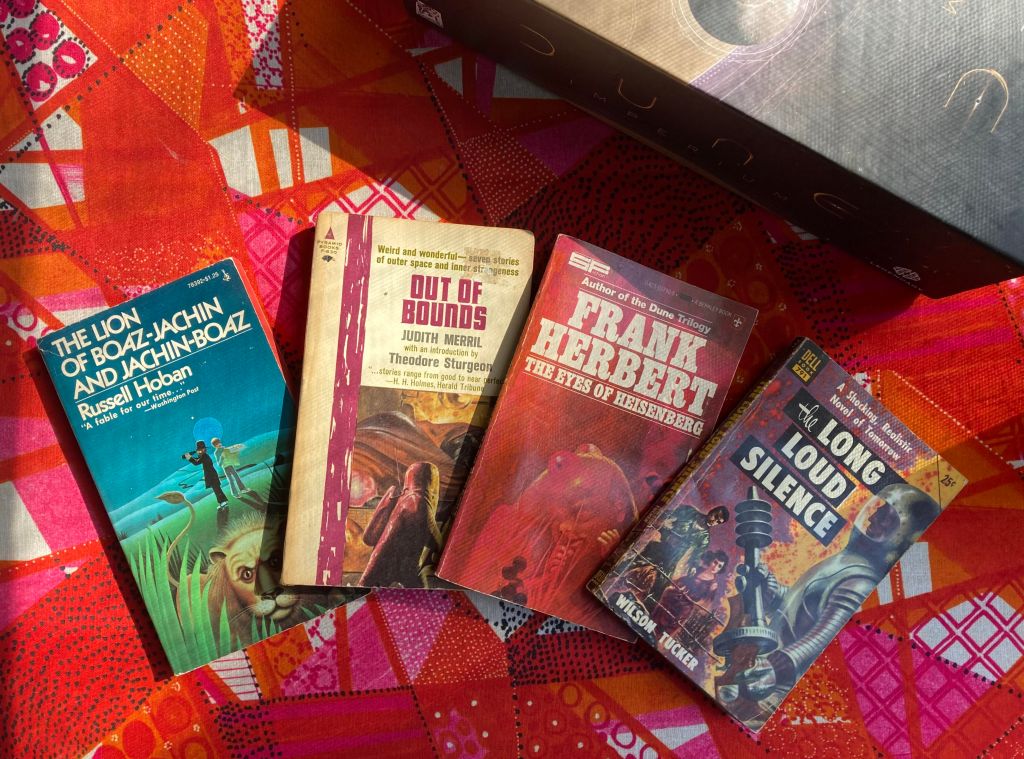
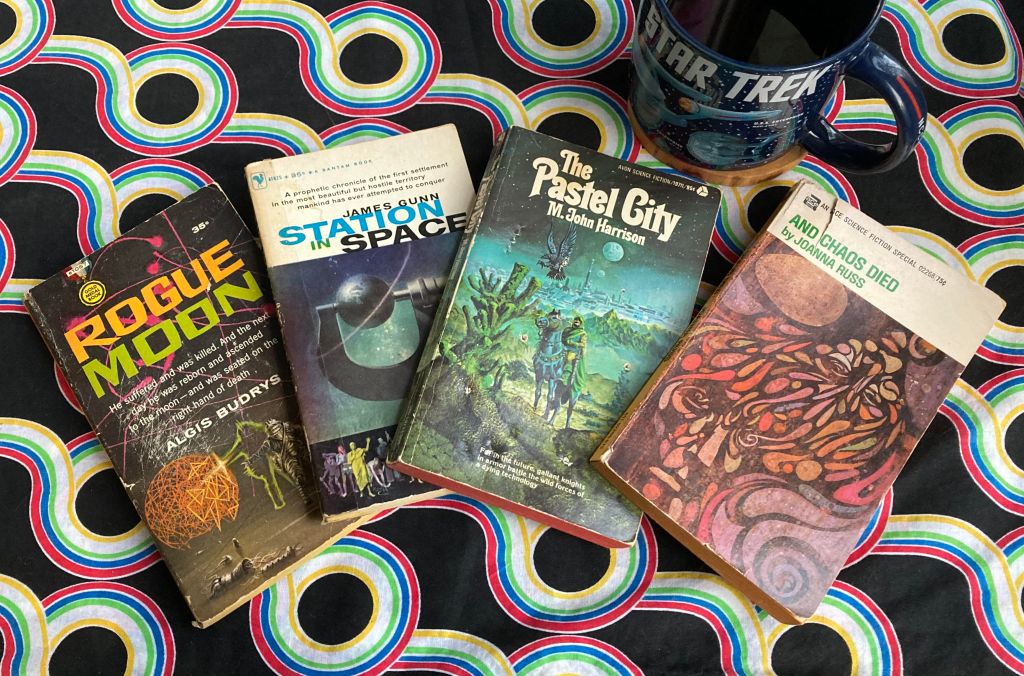
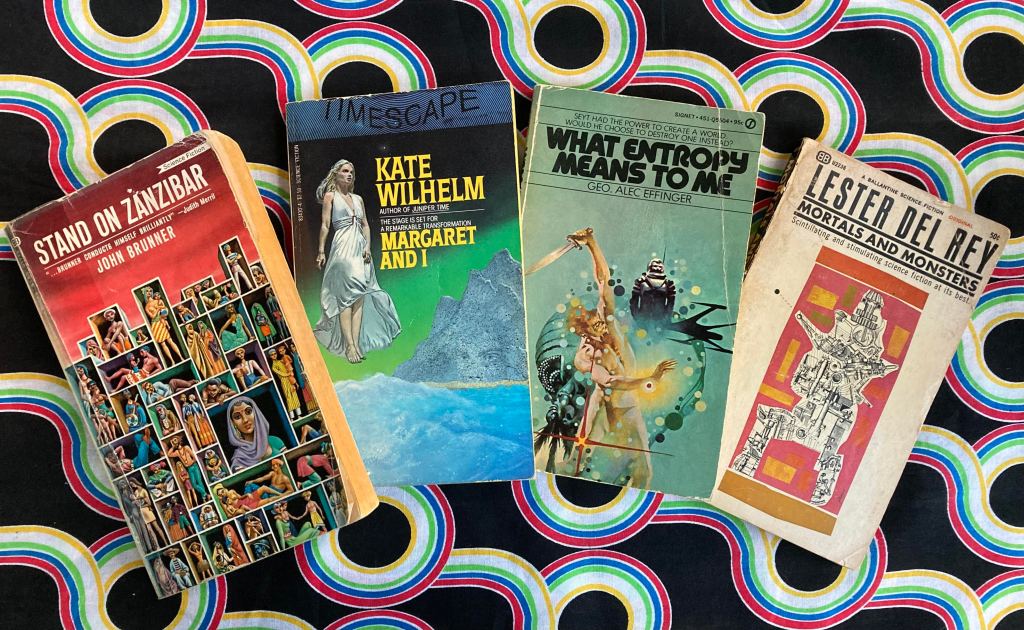
What pre-1985 science fiction are you reading this week?
I apologize for the break in my update schedule. It’s been a month since the previous installment. Alas. As I say week after week, thank you for all the great conversation. The community that’s emerged over the years is one of the main reasons I keep writing. I’ve included a bit about the books in the photograph, birthdays from the last two weeks, and brief ruminations on what I’ve been reading and writing.
My rough start to the semester proves hard to dispel. I’ll get back to my regular programming soon–I promise. In the meantime, I’ve collected some goodies!
Which books/covers/authors intrigue you? Which have you read? Disliked? Enjoyed?
1. The Man Who Fell to Earth, Walter Tevis (1963)
Jim Burns’ cover for the 1982 edition
From inside page: “He was not a man; yet he was very much like a man. He was six and a half feet tall, and some men are even taller than that; his hair was as white as that of an albino, yet his face was a light tan color, and his eyes a pale blue. His frame was improbably slight, his features delicate. There was an elfin quality to his face, a fine, boyish look to the wide intelligent eyes.
What pre-1985 science fiction are you reading this week?
Thanks again for all the great conversation. Make sure to check out the previous installment if you haven’t already. As before, I’ve included a bit about the books in the photograph, birthdays from the last two weeks, and brief ruminations on what I’ve been reading and writing.
What pre-1985 science fiction are you reading this week?
I’ve thoroughly enjoyed the conversations and connections you all have made in the comments over the last two months of this column. Make sure to check out the previous installment if you haven’t already. As before, I’ve included a bit about the books in the photograph, birthdays from the last two weeks, and brief ruminations on what I’ve been reading and writing.
What pre-1985 science fiction are you reading this weekend?
After the success of the previous installment, I’ve decided to make this a bimonthly post (“column”) for my site (“fanzine”). As before, I’ve included a bit about the books in the photograph, birthdays from the last two weeks, and brief ruminations on what I’ve been reading and writing.
This is Part I of II in a series covering the short fiction of Russell Bates (1941-2018), one of a handful of Native American science fiction authors active in the 1970s [1]. I first came across his name while investigating all the authors featured in Craig Strete’s Native American fanzine Red Planet Earth (6 issues in 1974) [2]. I’ve managed to piece together the following information about his SF career.
Born in Lawton, Oklahoma (I’ve also seen Anadarko, OK implied as a birthplace), Bates was an enrolled member of the Kiowa tribe. After he finished high school, he entered the U.S. Air Force. While injured after an explosion at a missile assembly building, he was encouraged to take up a hobby. He began writing science fiction stories–including Star Trek fanfiction (discussed in more detail below) [4].
Interested in honing his craft, Bates attended the famous Clarion workshop in 1969, and his first story, “Legion” (1971), hit print two years later [4]. He published six science fiction short stories between 1971-1977. A seventh–“Search Cycle: Beginning and Ending 1. The Last Quest; 2. Fifth and Last Horseman”–was scheduled to appear in Harlan Ellison’s infamous Last Dangerous Visions, originally slated for 1973. It hasn’t been published elsewhere.
Bates decided to try his luck in Hollywood. He joined a Writer’s Guild program for minorities with the assistance of D. C. Fontana. Initially unsuccessful, his rejected Star Trek story attempt later appeared in The New Voyages 2(1978). He kept the American Indian crew member Walking Bear that later appeared in his only co-written Star Trek credit ST: The Animated Series’ “How Sharper Than a Serpent’s Tooth” (1974). It is for this episode that Bates is probably best known as it is the only episode of the two original Star Trek series that won an Emmy Award. Unfortunately, despite quite a few sales to the motion picture industry, few of his stories saw the screen after his early Star Trek credit [5].
Without further tangents, lets turn to his first three science fiction short stories–each a rumination on violence and trauma–to hit print.
Jim Steranko’s cover for Infinity Two, ed. Robert Hoskins (1971)
Which books/covers/authors intrigue you? Which have you read? Disliked? Enjoyed?
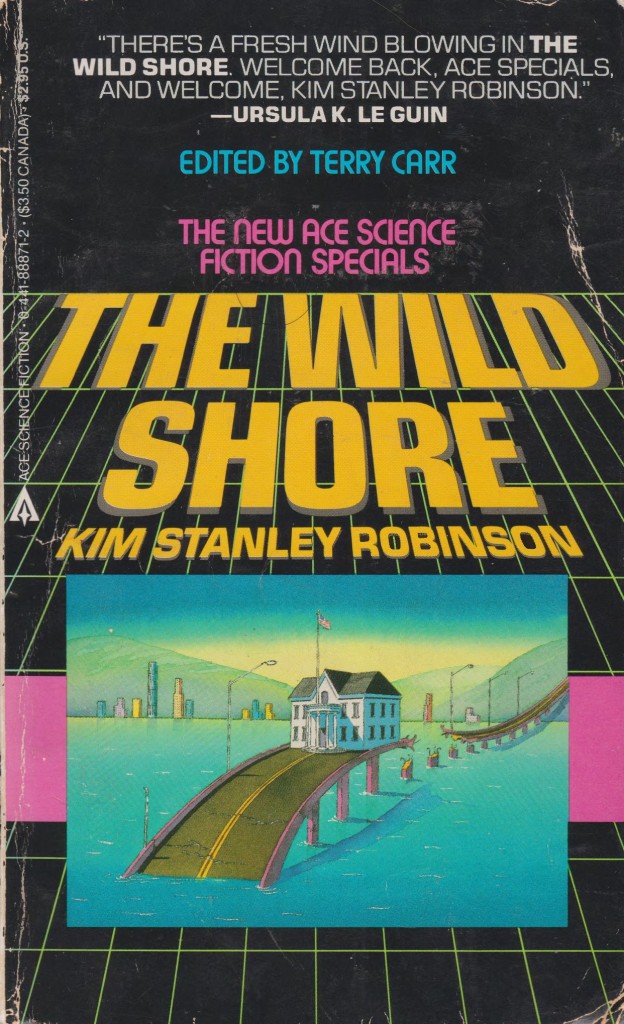
1. The Wild Shore, Kim Stanley Robinson (1984)
Andrea Baruffi’s cover for the 1st edition
From the back cover: “Seventeen-year-old Henry wanted to help make America great again, like it had been sixty years ago, before all the bombs went off. But for the people of Onofre Valley, just surviving was challenge enough. Then one day the world came to Henry, in the shape of two men who said they represented the American Resistance…”
Which books/covers/authors intrigue you? Which have you read? Disliked? Enjoyed?
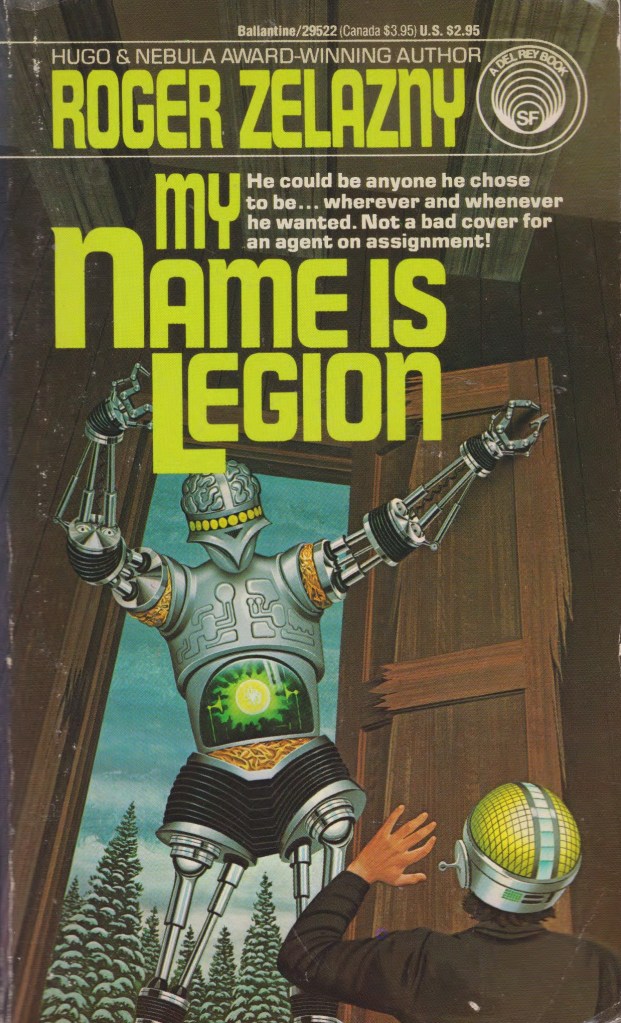
1. My Name is Legion, Roger Zelazny (1976)
Ralph Brillhart’s cover for the 1981 edition
From the back cover: “HE DID NOT EXIST… OR DID HE? He had destroyed his punch cards and changed his face. There was no credit card, birth record, or passport for him in the International Data Bank.
His names were many… any he chose.
His occupation was taking megarisks in the service of a vast global detective agency.
His interworld assignments were highly lucrative, incalculably vital, and terrifyingly deadly.
And more often than not, his life was a living hell!”
Contents: “The Eve of RUMOKO” (1969),” “‘Kjwalll’kje’k’koothaïlll’kje’k” (1973), “Home Is the Hangman” (1975)
Initial Thoughts: In the early days of my site read I reviewed the first in the Nemo sequence–“The Eve of RUMOKO” (1969). At the time I did not care for it. However, I recently read F. Brett Cox’s monography Roger Zelazny (2021) and retrospectively I’m not sure that I understood the character or what Zelazny was trying to accomplish with the story sequence. Often after I read a monograph, I end up making a few impulsive purchases and this is one of them! I hope, at the very least, it gives me a deeper understanding of Zelazny’s SF project. And “Home Is the Hangman” (1975) is a Hugo and Nebula-winning novella that I have not read.