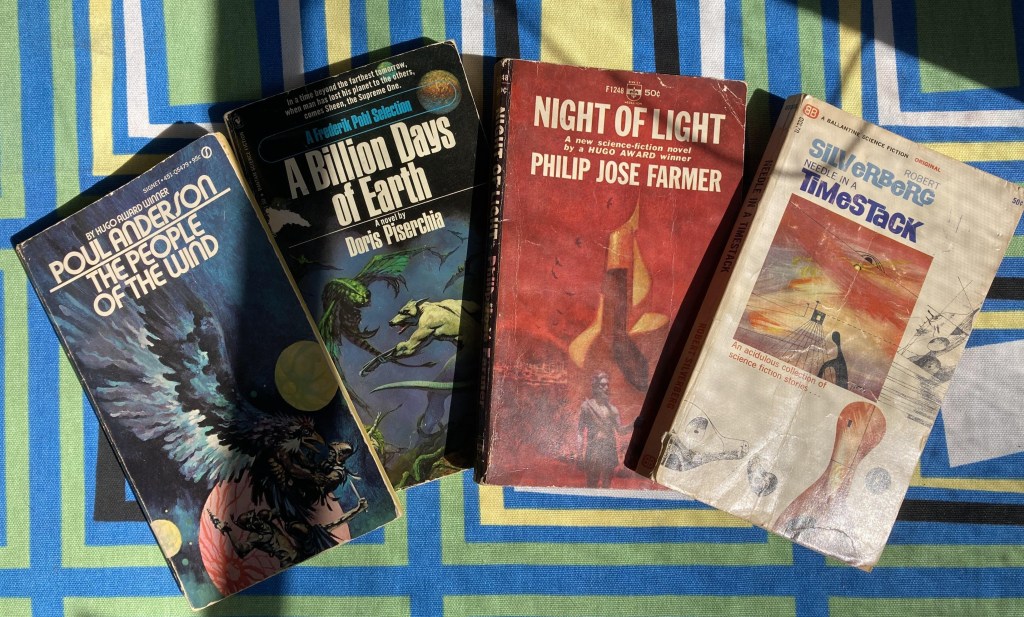
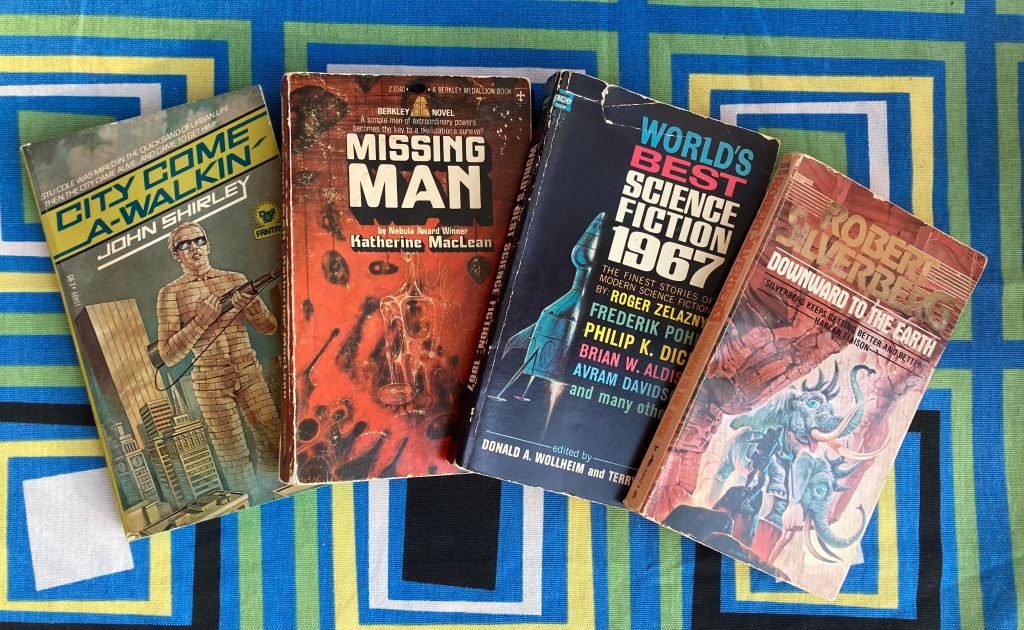
What pre-1985 science fiction are you reading or planning to read next month? Here’s the August installment of this column.
The Power of the List. I adore lists. I’ve compiled lists of science fiction stories on my site about generation ship stories, immortality (abandoned), overpopulation (abandoned), and sports and games (abandoned). I religiously update my SF Novel and Short Story Review index and the Best SF Novels I’ve reviewed index. In your exploration of genre, I imagine you’ve encountered a “Best Of” list that horrified you — they tend to generate controversy, argument, and all sorts of impulsive takes. Lists can be dangerous. Lists can suggest canon. Lists exclude. Lists can be incomplete. Lists can motivate. Ian Sales, a long-time critic, author, and visitor to my site, created the SF Mistressworks (unfortunately, also abandoned) website in response to an egregious list that demonstrate utter ignorance about the wonderful SF written by women.
Alien sex dolls. Carpet stain entities constructing love-nests. Underground retirement community entertainment. Jack Dann’s stories obsessively chart the new rituals of survival in a blasted, irradiated, and decayed future. His characters attempt to identify their place in the world, or, at the very least, stay alive as the world shifts. If you do not care for anti-heroes, a good dose of dystopian perversity, and moments of metaphysical descent, Timetripping (1980) might not be for you. Four of the fourteen stories in the collection were nominated for the Nebula Award.
If you are a fan of the New Wave (and Barry N. Malzberg and Robert Silverberg in particular), and haven’t yet explored Dann’s nightmares, don’t wait as long as I did. Also, go ahead and snag a copy of his later masterpiece The Man Who Melted (1984). I’ve acquired copies of two early fix-up novels Junction (1981) and Starhiker (1976).
My 20 best short story reads of 2025 will undoubtedly include a handful of stories from Timetripping (1980). I found his best works—“The Dybbuk Dolls” (1975), “A Quiet Revolution for Death” (1978), “I’m with You in Rockland” (1972), and “Camps” (1979)—remain cohesive despite moments of metaphysical rumination and deluge of surreal image. Even at his least effective moments of narrative wander, Dann adeptly conjures image and turn of phrase.
Frank R. Paul’s cover for Wonder Stories, ed. Hugo Gernsback (September 1934)
The following review is the 36th installment of my series searching for “SF short stories that are critical in some capacity of space agencies, astronauts, and the culture which produced them.” Some stories I’ll review in this series might not fit or are poor quality. And that is okay. I relish the act of literary archaeology.
Why John Wyndham? I snagged a copy of David Seed’s new book John Wyndham (2025) out via University of Liverpool Press and realized how little I knew about his pre-War science fiction.1 This story, among a few others, jumped out to me due to its critical stance on human exploration.
Uncredited banner for the Table of Contents in Wonder Stories, ed. Hugo Gernsback (September 1934)
3.5/5 (Good)
John Wyndham, writing as John Benyon Harris, published “The Man from Beyond” (variant title: “The Man from Earth”) in Wonder Stories, ed. Hugo Gernsback (September 1954). You can read the story online here.
Zoë Fairbairns’ Benefits (1979) charts the struggles of the British women’s liberation movement in a dystopic near future. An anti-feminist fringe political party called FAMILY comes to power, simultaneously proclaiming family values while systematically dismantling the welfare state. Benefits effectively eviscerates governmental doublespeak and champions the need to organize and educate in order to fight against patriarchal forces and messianic movements that promise to solve all our ills.
The Lay of the Land
The year is 1976. A massive heatwave rocks the UK.1 However, a seemingly innocuous policy will be used to plunge the country into nightmare. The plan? The British government promises to implement “weekly payment to mothers” (5).2 The titular “benefits” would move some earnings from the wallets of fathers into the purses of mothers. The problem? Confronted by a powerful male-dominated trade union movement attempting to protect its male workers, the government “flew in the face of its commitment to women’s rights” and postponed the scheme (5). Mothers decides to go on strike.
This is the 21st post in my series of vintage generation ship short fiction reviews. While not technically a short story, George Hay’s novel clocks in at a mere 112 pages. I’ve decided to include it in my series. While I have dabbled in the more esoteric as of late, thanks go out to all who have joined some part of my read-through already. I’ve also compiled an extensive index of generation ship SF–expanded from a monograph by Simone Caroti–if you wish to track down my earlier reviews on the topic and any that you might want to read on your own.1
In 2019, I made the resolution to read all the pre-1985 science fiction on the theme of generation ships available in English. I’ve made substantial progress, especially on the short story front! Last year I posted the 20th installment of my short story read-through.2 I’ve covered authors from John Brunner to Judith Merril. As I mentioned above, I’ve decided to include George Hay’s short novel Flight of the “Hesper” (1952) in my series. Unfortunately, no online copies exist to link.
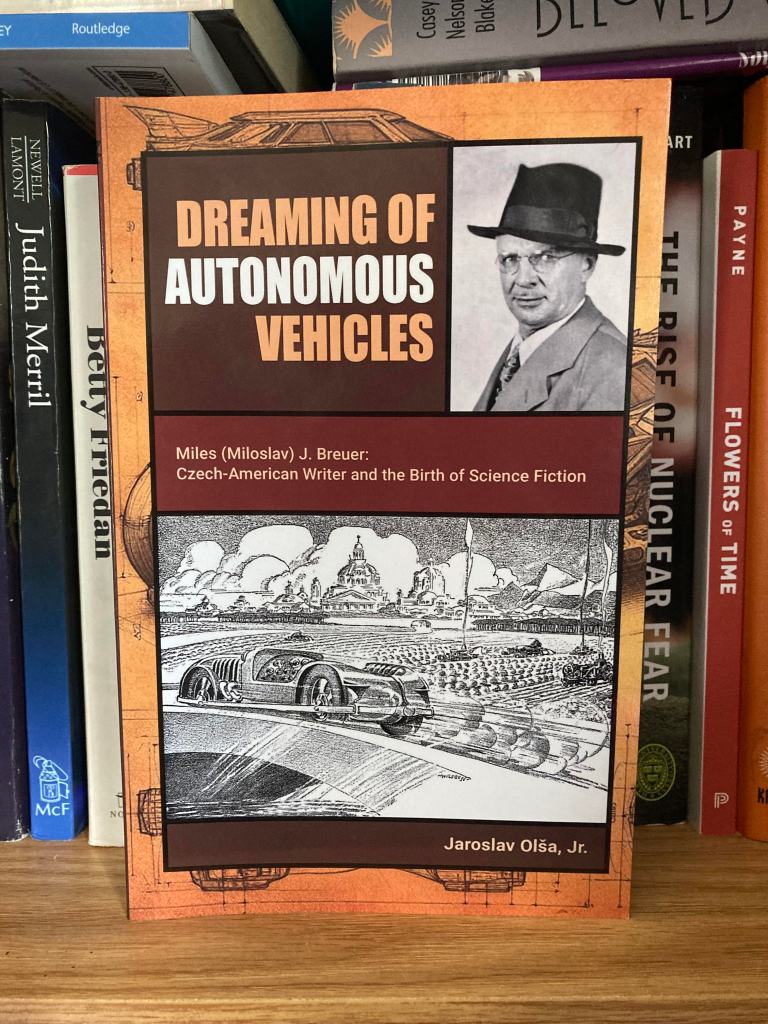
Over the last few years, I have incorporated a smattering of the vast range of spectacular scholarship on science fiction into my reviews and highlighted works with my Exploration Log series that intrigue me.1 Today I have an interview with Jaroslav Olša, Jr. about his brand-new book, Dreaming of Autonomous Vehicles: Miles (Miroslav) J. Breuer: Czech-American Writer and the Birth of Science Fiction (2025). In the book, he covers the life and career of Miles (Miroslav) J. Breuer (1889-1945), the first SF author to regularly write original stories for Hugo Gernsback’s Amazing. Breuer’s career also provides a fascinating window into the literary and cultural world of immigrants in late 19th and early 20th century America.
You can buy an inexpensive physical copy ($15.80 at last look) directly from Space Cowboy Books here (preferred) and on Amazon.
Thank you so much for agreeing to this interview. First, can you introduce yourself and your interests in science fiction?
Since childhood, I have loved reading science fiction, but — except for a short time — I have not been professionally attached to it. After studying Asian and African Studies and social sciences in Prague, Tunis and Amsterdam, I joined the Czech diplomatic three decades ago, and have served in various positions including Director of the African Dept. and the Head of the Policy Planning Dept. at the Czech Ministry of Foreign Affairs. I also served as a Czech Ambassador three times: to Zimbabwe for six years, to South Korea for another six years, and to the Philippines for four years. Since December 2020, I have served as Czech Consul General in Los Angeles in charge of the US West.
In the early 1980s, I became a part of a small but very active fandom when—in the then communist Czechoslovakia—the first science fiction club emerged. I started the SF fanzine Ikarie XB, which in 1990 turned into the first Czech-language professional SF magazine Ikarie, with monthly editions until 2024.
I have also translated many short stories and edited numerous SF anthologies, but never wrote fiction. But since the very beginning, the center of my interest in SF was to write about science fiction. I co-edited and authored entries in the only Czech SF encyclopedia, published in 1995. Thus my book about Miles (aka Miloslav) J. Breuer is somewhat of a culmination of my work on science fiction.
What drew you to the science fiction of Miles (Miloslav) J. Breuer (1889-1945)?
What pre-1985 science fiction are you reading or planning to read this month? Here’s the March installment of this column.
Recently I came across John Boston and Damien Broderick’s three-volume series examining each and every story and non-fiction article in the pre-Michael Moorcock New Worlds and Science Fantasy/SF Impulse magazines in the UK. John Boston is a valued member of my site’s community — frequently stopping by in the comment sections. I thought for this mini-editorial I’d list a handful of active community members with websites, books, and worthwhile SF-related fanzine articles. I, of course, could be missing a few. Community matters more than you might think. I enjoy the discussion. I enjoy reading reviews that others write — even if it’s on science fiction that might not be within my more narrow focus (the historian in me). I always want to learn and share what’s worth reading and/or historically interesting. Thank you one and all.
What pre-1985 science fiction are you reading or planning to read this month? Here’s the January installment of this column (sorry I missed a month).
Before John W. Campbell, Jr. (1910-1971) attempted to raise the “standards and thinking in magazine SF,” David Lasser (1902-1996) attempted his own brief (1929-1933) program to improve science fiction as managing editor of Hugo Gernsback’s Science Wonder Stories, Wonder Stories, and Wonder Stories Quarterly. According to Mike Ashley’s The Time Machine: The Story of the Science-Fiction Pulp Magazine from the Beginning to 1950 (2000), Lasser is a “much neglected revolutionary in science fiction” and through his efforts the genre “started to mature” (66).
Ashley highlights Lasser’s letter of instruction mailed to his regular contributors on the 11th of May, 1931, in which he “exhorted them to bring some realism to their fiction” (72). He also outlawed common tropes like the giant insect story and space opera (73). He emphasized the need to focus on characters that “should really be human” — not everything needs to be a “world-sweeping epic” (73). Stories in this vein, according to Ashley, include Clifford D. Simak’s religiously themed “The Voice in the Void” (1932), P. Schuyler Miller and Walter Dennis’ “The Red Spot on Jupiter” (1931) and “The Duel on the Asteroid” (1934), which featured a grim realism and character development (74).
What pre-1985 science fiction are you reading or planning to read this month? Here’s the December installment of this column.
Lost texts, and the act of reconstructing the fragments, fascinates. The questions pile up. Would the contents reveal a pattern in an author’s work? Intriguing personal details? A startling modus operandi? At the 11th World Science Fiction Convention (Philcon 2), Philadelphia (September 1953), Philip José Farmer gave a speech titled “SF and the Kinsey Report.” Considering Farmer’s recent publication of “The Lovers” (1952), this is not surprising. Alfred Kinsey, the famous sexologist and founder of the Kinsey Institute for Research in Sex, Gender, and Reproduction on Indiana University’s campus, published his controversial Sexual Behavior in the Human Male in 1948. Sexual Behavior in the Human Female appeared in 1953. Like many of Farmer’s earliest speeches, he did not keep copies.
Deeply intrigued by what the speech might have contained, Sanstone and I (on Bluesky) managed to piece together a few general responses from fanzines and magazine con reports.