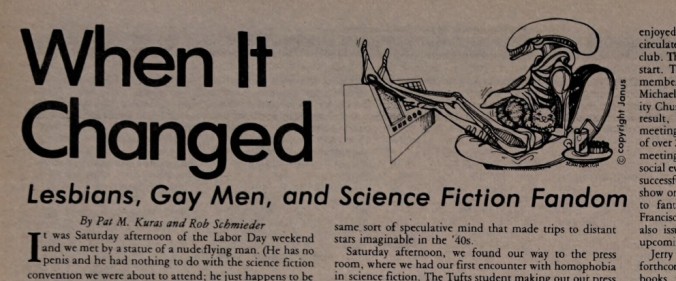
“We also encountered many gay people, feminists and progressives of every stripe. These people were at the convention because present day science fiction has much to offer them. Science fiction is the fiction of ideas, and the ideas coming from the minds of the new writers more and more concern progressive analyses of social issues.”
— Pat M. Kuras and Rob Schmieder (1980)
At the 38th World Science Fiction Convention (29th August–1st September, 1980) held in Boston, MA, organizers scheduled the first Worldcon panel with an openly LGBTQ topic: “The Closed Open Mind: Homophobia in Science Fiction Fantasy Stories” moderated by Jerry Jacks, one of the “early openly gay fans.”1 Around 200 fans attended to hear Elizabeth A. Lynn (SFF author), Samuel R. Delany (SFF author), Frank M. Robinson (SF author and activist), and Norman Spinrad (SFWA President and SF author) (“the token straight”) discuss issues of representation.
Pat M. Kuras and Rob Schmieder’s “When It Changed: Lesbians, Gay Men and Science Fiction Fandom” in the September 27th, 1980 issue of Gay Community News
Note: My read but “waiting to be reviewed pile” is growing. Short rumination/tangents/impressions are a way to get through the stack before my memory and will fades. My website partially serves as a record of what I have read and a memory apparatus for future projects. Stay tuned for more detailed and analytical reviews.
1. Margo Bennett’s The Long Way Back (1954)
Uncredited cover for the 1955 edition
3.25/5 (Above Average)
I’m always on the lookout for lesser-known SF works by female authors. And Margot Bennett’s The Long Way Back (1954) certainly fits the bill. Bennett (1912-1980), a Scottish-born screenwriter and author of primarily crime and thriller novels, lead a fascinating life before her writing career. During the Spanish Civil War, she volunteered for Spanish Medical Aid, and was shot in both legs. Afterwards, she continued to participate in various left-wing political causes such as the Campaign for Nuclear Disarmament.
The Long Way Back manifests, with satirical strokes, her critical stance on nuclear war and British colonialism. In a future collectivized Africa ruled by a calculating machine that grades the population, Grame, a “mechanical-repetitive worker” (7), dreams of a career in physics. Instead, the machine shuffles him off on an ill-fated expedition to the ruined remains of Britain post “Big Bang” (nuclear blast). On the way he falls in love with the leader of the expedition, Valya, who serves as a virginal Bride of the State (24). After their sea plane lands, they are beset by a bizarre range of mutations–ferocious dogs, micro-horses, etc. Eventually they discover a tribe of hairless white survivors holed up in primitive caves. Grame teaches the brightest arithmetic. Valya sets about measuring and applying pseudo-scientific theories to understand white society, religion, and conception of the world i.e. parroting all the pseudo-science and racist theories posed by British explorers of Africa. As they attempt to find a lost city, Hep, the third surviving member of the expedition, imagines the potential exploitation and colonization Africa might implement—“Yellow America” is on the rise and resources will be needed. History threatens to re-cycle through the horrors of the past in more ways than one.
What pre-1985 science fiction are you reading or planning to read this month? Here’s the December installment of this column.
Lost texts, and the act of reconstructing the fragments, fascinates. The questions pile up. Would the contents reveal a pattern in an author’s work? Intriguing personal details? A startling modus operandi? At the 11th World Science Fiction Convention (Philcon 2), Philadelphia (September 1953), Philip José Farmer gave a speech titled “SF and the Kinsey Report.” Considering Farmer’s recent publication of “The Lovers” (1952), this is not surprising. Alfred Kinsey, the famous sexologist and founder of the Kinsey Institute for Research in Sex, Gender, and Reproduction on Indiana University’s campus, published his controversial Sexual Behavior in the Human Male in 1948. Sexual Behavior in the Human Female appeared in 1953. Like many of Farmer’s earliest speeches, he did not keep copies.
Deeply intrigued by what the speech might have contained, Sanstone and I (on Bluesky) managed to piece together a few general responses from fanzines and magazine con reports.
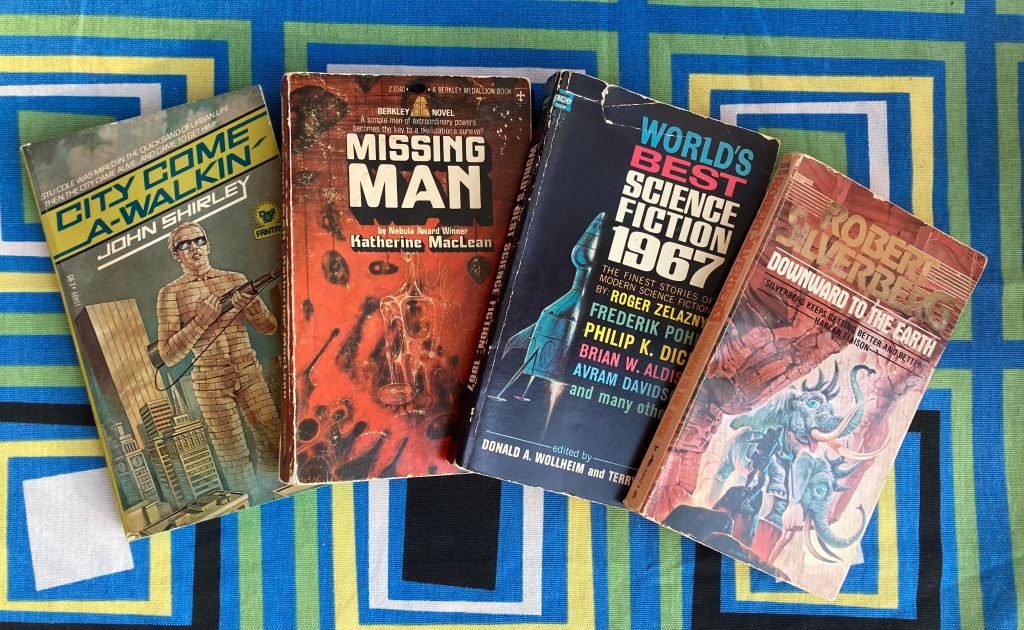
A selection of SF volumes acquired over winter break!
Which books/covers/authors intrigue you? Which have you read? Disliked? Enjoyed?
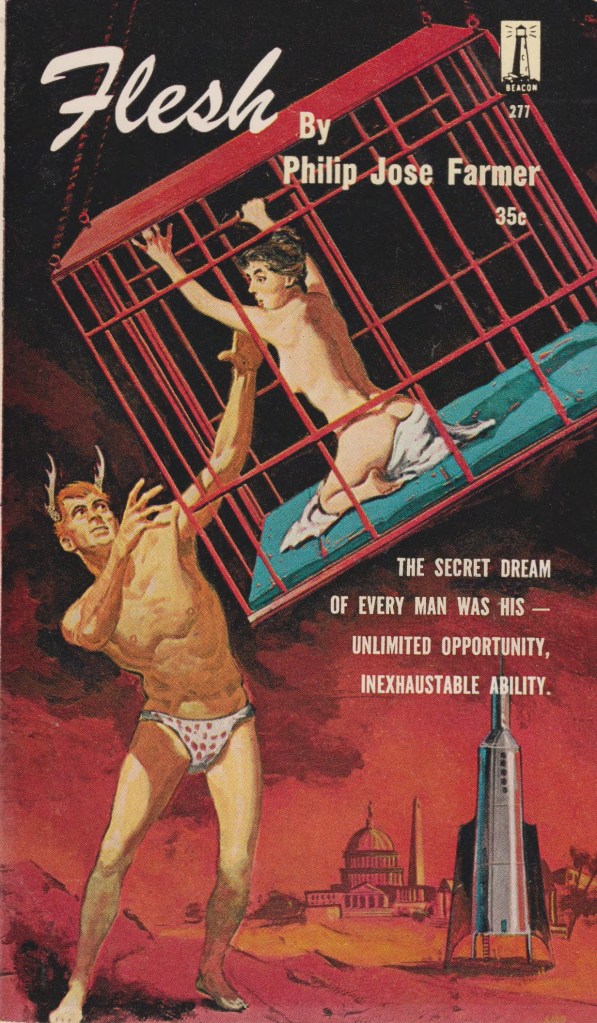
1. Flesh, Philip José Farmer (1960)
Gerald McConnell’s cover for the 1st edition
From the back cover: “Spaceman by DAY… MONSTER by night!
Peter Stagg was caught in the vilest trap ever devised–his own lust-driven body! For FLESH is the pulse-stirring story of a space explorer’s return from the strangest voyage man had ever made–to the strangest world the universe had ever seen–his own Earth!
Over the last few years, I have attempted to incorporate a smattering of the vast range of spectacular scholarship on science fiction into my reviews and highlight works with my Exploration Log series that speak to me.1 Today I have an interview with Jordan S. Carroll about his brand-new book, Speculative Whiteness: Science Fiction and the Alt-Right (2024). In the book, he examines the ways the alt-right uses classic science fiction imagery and authors to mainstream fascism and advocate for the overthrow of the state.
You can buy an inexpensive physical copy ($10) directly from the University of Minnesota Press website or an eBook version ($3.79) on Amazon.
Thank you so much for agreeing to this interview. First, can you introduce yourself and research interests?
Here’s to a happy reading in 2025! I hope you had a successful reading year. Whether you are a lurker, occasional visitor, a regular commenter, a follower on Bluesky or Mastodon, thank you for your continued support. It’s hard to express how important (and encouraging) the discussions that occur in the comments, social media, and via email are to me. This was the third year running of record-breaking numbers of viewers and views in the 13-year history of my site. What were your favorite vintage SF reads–published pre-1985–of 2024? Let me know in the comments.
What a way to finish 2024! Future Powers, ed. Jack Dann and Gardner Dozois (1976) is a well-crafted thematic anthology with seven original stories and two older classics. Other than R. A. Lafferty’s average contribution, all the tales effectively engage with the theme of the complexities of future control both in everyday and the macropolitical contexts.
A few tantalizing fragments: Ursula K. Le Guin’s “The Diary of the Rose” (1976) explores the operations of dystopic control through the eyes of a neophyte doctor (“scopist”); Damon Knight ruminates on the nature and treatment of the psychopath in “The Country of the Kind” (1956); and A. K. Jorgensson’s “Coming-of-Age-Day” (1965) takes the reader through all the unnerving and confusing moments of a child in a strange future attempting to understand the nature of sex.
This is the 20th post in my series of vintage generation ship short fiction reviews. You are welcome to read and discuss along with me as I explore humanity’s visions of generational voyage. And thanks go out to all who have joined already. I also have compiled an extensive index of generation ship SF if you wish to track down my earlier reviews on the topic and any that you might want to read on your own.
Uncredited cover for Cosmos Science Fiction and Fantasy Magazine, ed. L. B. Cole (September 1953)
3.25/5 (Above Average)
Poul Anderson’s “The Troublemakers” (1953) first appeared in Cosmos Science Fiction and Fantasy Magazine, ed. L. B. Cole (September 1953). You can read it online here.
Anderson’s tale is a fascinating collision of two of my recurring interests in post-WWII science fiction: generation ships and organized labor. Due to my love of Ursula K. Le Guin’s “Paradises Lost” (2002) and Brian W. Aldiss’ Non-Stop (variant title: Starship) (1959), I started a review series on generation ship short fiction in 2019. The series has languished recently as I am running out of pre-1985 depictions of the theme available in English to read. I read Anderson’s vision last year but could not muster a review. However, my recent focus on organized labor caused me to reread Anderson’s account of generational conflict, the working class experience, and the contours of power and government.
In The Drift (1985), a fix-up novel comprised of two Nebula-nominated short works–“Mummer Kiss” (1981) and “Marrow Death” (1984), maps a new way forward in an ecologically and genetically ravaged post-apocalyptic age. The entire concoction decays with a sense of grim unease and cavorts around piles of dead that would make a triumvir from the Late Roman Republic proud. It’s a violent, erotic, and disquieting experience that can’t entirely hide its flaws behind the decadent panache.