Book Review: Three Novels (variant title: Natural State and Other Short Stories), Damon Knight (1967)

(Alan Peckolick’s cover for the 1967 edition)

3/5 (Collated Rating: Average)

Damon Knight’s Beyond the Barrier (1964) was so egregious that I have stayed away from his work until recently.  Around a year ago I acquired Three Novels (1969)—containing the two novellas “Rule Golden” (1954) and “Natural State” (1951) and one novelette “The Dying Man” (variant title: Dio”) (1951)—in order to start my reappraisal of the supposed Grand Master of the genre.  I have his collection Far Out (1961) and his novel A For Anything (variant title: The People Maker) (1959) on my shelf.

Although this selection of his 50s short fiction is far superior to Beyond the Barrier only one of the stories made any lasting impression: the philosophical and ruminative immortality themed tale, “The Dying Man.”  With that in mind it might be worth tracking it down in another place of publication, for example the thematic multi-author collection Immortals (1998) ed. Jack Dann and Gardner Dozois.   There is a chance that the other two novellas in Three Novels will satisfy fans of Knight’s Continue reading

Updates: Recent Science Fiction Acquisitions No. CVIII (Malzberg + Bishop + Sheckley + White)

What a haul!  Three are from numerous previous expeditions to choice used book havens….  And I caved in and bought Malzberg’s The Destruction of the Temple (1974) on abebooks because his seldom reprinted works are hard to find.

Sheckley’s Journey Beyond Tomorrow (1962) is near the top of my reading list.  Supposedly one of his best.

And, who can resist Michael Bishop’s magnum opus, No Enemy But Time (1982)?!?

And James White is always solid…

Thoughts?  Anything particularly worth reading?

1. The Destruction of the Temple, Barry N. Malzberg (1974)

(Uncredited cover for the 1974 edition) Continue reading

Updates: Recent Science Fiction Acquisitions No. CVI (Malzberg + Laumer + Sargent + Russell)

A few more wonderful acquisitions from my pilgrimage to Dawn Treader Books in Ann Arbor, MI from month or so ago.

More Malzberg!  And thankfully, one of the few really solid covers to grace his extensive oeuvre.  I read Sargent’s novel Cloned Lives (1976) recently and was disappointed.  Hopefully her short story collection Starshadows (1977) is more my cup of tea.

A 50s “classic” by Erin Frank Russell…

And a collection of short works on time travel by Keith Laumer….  Could not resist the early Di Fate cover which I have featured in art posts before.

Thoughts?

1. Timetracks, Keith Laumer (1972)

(Vincent Di Fate’s cover for the 1972 edition) Continue reading

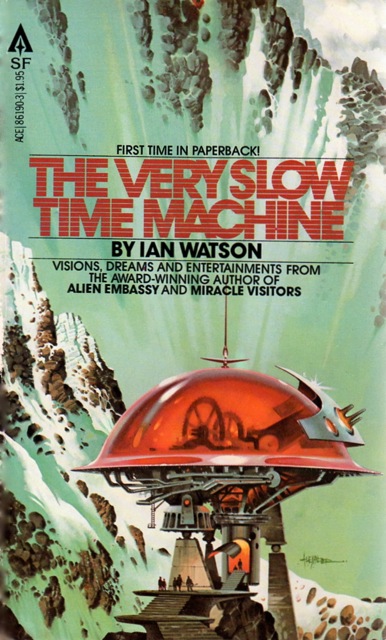
Book Review: The Very Slow Time Machine, Ian Watson (1979)

VRYSLWTM19XX

(Paul Alexander’s cover for the 1979 edition)

4.5/5 (Very Good)

My first exposure to Ian Watson’s extensive SF catalog could not have been more impressive.  The Very Slow Time Machine (1979) is up there with Robert Sheckley’s Store of Infinity (1960) and J. G. Ballard’s Billenium (1962) as the best overall collection of stories that I have encountered in the history of this site.

The collection is filled with narrative experimentation (“Programmed Loved Story,” “Agoraphobia, A.D. 2000,” etc), some awe inspiring ideas (“The Very Slow Time Machine,” “The Girl Who Was Art” etc.), a few delightful allegories (“Our Loves So Truly Meridional,” “My Soul Swims in a Goldfish Bowl”), and a handful of more traditional SF stories that hint at anthropological Continue reading

Book Review: Sign of the Labrys, Margaret St. Clair (1963)

(William George’s cover for the 1963 edition)

2.75/5 (Vaguely Average)

Margaret St. Clair was one of a handful of prolific women SF authors who started publishing short fiction in the late 40s—her first SF story was “Rocket to Limbo” for the November 1946 issue of Fantastic Adventures.  From the late 50s to the early 70s she published eight slim novels, mostly Ace Doubles (paired with authors such as Philip K. Dick and Kenneth Blulmer).  Regardless of her earlier publishing prowess—by the publication date of Sign of the Labrys (1963) she had four novels in print and somewhere around 125 short stories—Bantam Books felt the need to include the following back cover:

“WOMEN ARE WRITING SCIENCE-FICTION!

ORIGINAL! BRILLIANT!! DAZZLING!!!

Women are closer to the primitive than men.  They are conscious of the moon-pulls, the earth-tides.  They possess a buried memory of humankind’s obscure and ancient past which can emerge to uniquely color and flavor a novel.  Such a woman is Margaret St. Clair, author of this novel.  Such a novel is this, SIGN OF THE LABRYS, the story of a doomed world of the future, saved by recourse to ageless, immemorial rites…

FRESH! IMAGINATIVE!! INVENTIVE!!!”

Unfortunately, Sign of the Labrys is a disappointing read.   The post-plague world is dark and creepy and for the first half an uncanny (palpable) tension permeates.  But, ultimately the fantastic setting, revisionist stance on the normal pulp gender dynamics, are weakened by a disjointed (verging on amateur) narrative filled with Wiccan “craft” practices and references.  As other reviewers have pointed out, one could easily substitute the Wicca magic with the pulp SF staple “psi-power” and I agree Continue reading

Updates: Recent Science Fiction Acquisitions No. CIV (Yarbro + Priest + Farmer + Malzberg)

Ann Arbor’s Dawn Treader Book Store contains the best used SF collection I have encountered in my perambulations (fortunately, I live far away or else I would empty my bank account).  Prepare for its manifold and manifest joys (multiple parts over the next month or so)!

What a haul!  I have yet to read a Chelsea Quinn Yarbro novel—this one is her most famous work so I look forward to it despite the creepy wolf/man with blood on the cover.  Also, Farmer has somewhat redeemed himself in my eyes with Strange Relations (1960)—thus, the metafictional account of a man who recreates the Burrough’s Tarzan tales sounds like an experimental New Wave SF novel right up my alley.

As does Christopher Priest’s Indoctrinaire (1970)…  I think I will read this one before I tackle Inverted World (1974) that I acquired a while back but never felt like reading.

And, I bought FOUR novels by one of my favorite authors, Barry N. Malzberg—the first is On a Planet Alien (1974).  Will read this one soon.

Thoughts?  Have you read any of the novels?

1. False Dawn, Chelsea Quinn Yarbro (1978) (MY REVIEW)

(Gary Friedman’s cover for the 1978 edition) Continue reading

Guest Post: Blooded on Arachne (selections), Michael Bishop (1982)

P1050043

(Ron Walotsky’s cover for the 1982 edition)

The seventh installment of my guest post series on the SF of Michael Bishop comes via Carl V. Anderson (twitter: @SteelDroppings) over at the SF/F site Stainless Steel Droppings.  Although he does not often review older SF he was excited to participate in my project.  We decided to split Bishop’s first collection of short stories, Blooded on Arachne (1982).  Although he found a few of the stories rather hit or miss, he was blown away by “In Chinistrex Fortronza the People are Machines” 5/5 among others.  Check out Carl’s worthwhile site (for example, posts on the new Hugo art nominees, Andre Norton reviews etc. etc. etc.)

Screen shot 2014-04-19 at 7.30.08 PM

Blooded on Arachne (1982)–Michael Bishop

When Joachim Boaz asked me to join a group to guest post about author Michael Bishop, I jumped at the opportunity despite my overwhelming schedule. I had not been doing much short story reading, and the proposition of exploring work from an author I had not read…admittedly don’t recall ever having heard of…excited me. Of course there was more to it than that. Having followed Joachim’s site for several years and knowing his passion Continue reading

Book Review: The Empty People, Barry N. Malzberg (as K. M. O’Donnell) (1969)

P1050045

(Howard Winters’ cover for the 1969 edition)

3.5/5 (Good)

“Inspecting a few she found that they were about what she had expected: the science-fiction books seemed to be full of nonsense about extraterrestrials or flights into space, the damnedest silliest stuff imaginable, and the sex part was sheer filth.  There was no question about it; there was no other way to describe those books” (12).

Science fiction as delusion.  More specifically, chapters replete with SF plots with evil aliens with interchangeable names and megalomaniacal claims to power culled straight from the pulps are delusions.  Imagined (perhaps?) by an average American man with “metastases” (14) growing in his brain while a concerned, albeit cheating, normal American housewife waits at his bedside.  The Empty People (1969) is considered Barry N. Malzberg’s (writing at K. M. O’Donnell) first SF novel.  However in the vein of his more famous Herovit’s World (1973), the most convincing interpretation of the novel suggests that the SF elements (purposefully clichéd and vaguely explained) are mere manifestations and torments of a diseased mind.

Originally Malzberg had aspirations to become a playwright and was even awarded multiple university playwright fellowships but was unable to break into the literary market.  Thus, he tried his hand at science fiction in the late 60s with some success (his most famous work would be published in the early 70s).  I would suggest that Malzberg’s palpable frustration writing SF can be found throughout the novel.  In The Empty People pulp science fiction plots, in their most general formulations, serve as instruments of repression Continue reading

Guest Post: No Enemy But Time, Michael Bishop (1982)

NENMYTM1983

(Vincent Di Fate’s cover for the 1983 edition)

The third installment of my Guest Post Series on Michael Bishop’s SF was written by Megan (twitter: @couchtomoon) over at the relatively new but completely worthwhile SF review site From Couch to the Moon.  She’s already put together a substantial list of delightful reviews.  Megan selected Bishop’s single most famous and Nebula award-winning novel, No Enemy But Time (1982)—and sadly, one of few books of his still in print.  Along with Transfigurations (1979), it was republished and selected for the Gollancz Masterwork [list].

michael bishop,header,02

No Enemy But Time (1982) — Michael Bishop

Coming out of Bishop’s 1982 Nebula award winning novel, No Enemy But Time, is like coming out of a time travel trance: the experience is jarring, hazy, and unwelcome. Bishop sweeps the reader into his world—humanity’s distant past—and paints a primitive African landscape dappled with hippos, hyenas, and volcanoes, but lush Continue reading