Book Review: The Joy Makers, James Gunn (1961, magazine publication 1955)

(William Hofmann’s cover for the 1961 edition)

4.25/5 (collated rating: Good)

The three parts of James Gunn’s fix-up novel The Joy Makers (1961) were originally published in magazine form in 1955 as ‘Name Your Pleasure,’ ‘The Naked Sky’, and ‘The Unhappy Man.’  I have not read the originals so I’m unsure of how much was added or subtracted or completely re-conceptualized.  Largely a satire — Gunn pushes his point to the logical, and terrifying extreme — each part is a further chronological progression of a society whose chief aim is to make people happy.  It is hard not to read Part I as a satirical take on some aspects of Scientology,  a movement that was gaining force in the early 1950s.

Because each part is only linked thematically to the others

Continue reading

Book Review: The Eden Cycle, Raymond Z. Gallun (1974)

(Kelly Freas’ cover for the 1974 edition)

4/5 (Good)

Raymond Z. Gallun is best known for his pulp sci-fi from the 1930s-50s.  From the 50s onward he wrote a handful of novels of varying quality.  The Eden Cycle (1974), probably his single best science fiction work, is a successful integration of pulp ideas and lush environments with a poignant and often haunting depiction of the social ramifications of a future world where everyone, “blessed” with immortality, can “live” in any virtual reality of their choice, shift  from simulation to simulation at will, and spontaneously conjure new ones.

Brief Plot Summary/Analysis

In the near future mankind receives mysterious signals from space.  Gallun is careful to slowly reveal the main backstory over the course of the first third of the novel.  After Continue reading

Book Review: Farewell, Earth’s Bliss, D. G. Compton (1966)

(Karel Thole’s cover for the 1971 edition)

4.5/5 (Very Good)

(*some spoilers due to the limited nature of the plot*)

Another D. G. Compton novel, another wonderful (and terrifying) experience…  The only one of his novels so far that has failed to hold my interest was The Missionaries (1971), a lackluster satire on religion.  The Continuous Katherine Mortenhoe (variant title: The Unsleeping Eye) (1973) is a masterpiece and Farewell, Earth’s Bliss (1966) and Synthajoy (1968) are close behind.

Farewell, Earth’s Bliss is best described as a character study of a group of convicts sent to Mars and their attempts to integrate into an incredibly repressive and conservative society (derived in part to to the extreme dangers of the Martian environment) — in short, a piece of race and religion themed social science fiction.  Be warned, there  is little to no action.  As with most of Compton’s works, near future environments are the perfect vehicle for societal ruminations Continue reading

Book Review: Eight Against Utopia (variant title: From Carthage Then I Came), Douglas R. Mason (1966)

(Dean Ellis’ cover for the 1970 edition)

2.25/5 (Bad) 

Eight Against Utopia (1966) is the second escape from a domed city novel published by Paperback Library I’ve read — the first, Rena Vale’s Beyond the Sealed World (1965) was a truly dismal “adventure.”  Mason’s take on the theme is only marginally better.  The first half, life and escape from the domed city of Carthage, is more intriguing and engaging than the second half, an endless unexciting chase sequence along the coast of North Africa.  Mason’s novel is painfully flawed in its social theory and mechanics of delivery.  Even on the level of a future adventure tale, most of Eight Against Continue reading

Updates: Recent Acquisitions XXXVI (Malzberg + Gallun + Harrison + Silverberg)

More Marx Book purchases along with some random 99 cent thrift store finds (Raymond Z. Gallun + M. John Harrison)  that seemed intriguing enough.  I will eventually get to M. John Harrison’s magnum opus series of novels, Virconium– beginning with The Pastel City (1971) — but, as always, I approach an author’s masterpieces through an often circuitous manner.  I suspect my Malzberg find will be of a lesser quality than either Beyond Apollo (1972) or Revelations (1972).

I reviews I’ve found online of Gallun’s The Eden Cycle (1974) proclaim it an underrated masterpiece — with layers of virtual reality, etc.  I’ll read it soon…

As always, have you read any of these?  If so, what did you think?

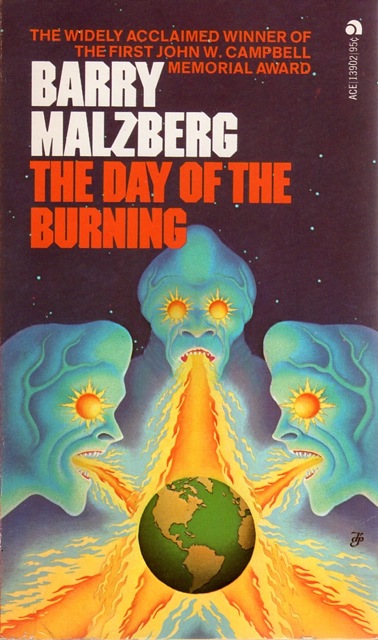
1. The Day of the Burning, Barry N. Malzberg (1974)

(Don Ivan Punchatz’s cover Continue reading

Book Review: Three for Tomorrow, novellas by Robert Silverberg, Roger Zelazny, and James Blish, (1969)

(Uncredited cover for the 1970 edition)

3.5/5 (collated rating: Good)

Three for Tomorrow (1969) contains three novellas written specially for the volume on the following theme selected by Arthur C. Clarke: “with increasing technology goes increasing vulnerability: the more man conquers Nature, the more prone he becomes to artificial catastrophe” (foreword, 8).  In my continuing quest for Robert Silverberg’s work from his Glory Period (proclaimed by me) 1967-1976, I was delighted to come across one of his shorter works paired with two other great authors, James Blish and Roger Zelazny.  If you want to read Silverberg’s novella but not the others, it appeared in many of his later collections — Earth’s Other Shadow (1973) for example.

As with most collections, Three for Tomorrow is uneven.  Silverberg’s installment is the best due to its intriguing social analysis of a city suddenly whose inhabitants are suddenly missing Continue reading

Adventures in Science Fiction Cover Art: Inside the Skull (rats + women + sword fights + robotic circuits + space)

(Ebel’s cover for the 1953 issue of Space Science Fiction)

Previous art explorations which looked at disembodied brains and visualizations of the ultra-intelligent set the stage for this post.  Imagine skulls without brains: sometimes metaphorically, but often, literally hollow skull cavities that hold a vast array of mechanical devies and living captives.  Or, the reader is gifted a voyeuristic peek into the skulls of bodies masquerading as humans but in reality, a mesh of circuits or a metal sheen operates those beautiful limbs and terrifying weapons….

My favorite is by far the pulp goodness of Ebel’s cover (if anyone knows the full name of this artist please let me know) for the 1953 issue of Space Science Fiction.  The gorgeous heroine is held captive in gigantic stone heads with partially glass skulls — a robot that fails to conjure any menace stomps Continue reading

Adventures in Science Fiction Cover Art: Chess/Checkers (with people + planets)

(Ed Valigursky’s cover for the 1962 edition of Cosmic Checkmate (1962), Charles V. DeVet and Katherine MacLean)

Queue Ed Valigursky’s cover for the Cosmic Checkmate (1962): a chessboard arrayed against a background of stars, men stand on different colored squares, as much pawns of some distant player as the pieces nearby.  Spaceships flash across the vast expanse of space — remember, the game has galactic ramifications — with our characters arrayed, the game opens, and the battle (of wits and secret weapons) begins.  Although I have not (yet) read Charles V. DeVet and Katherine MacLean (whose later novel Missing Man (1975) I highly recommend) is explicitly about Chess, or more precisely, a similar alien game, and the ramifications are indeed, galactic in scope.  Other covers are more metaphoric Continue reading

Book Review: Sargasso of Space, Andre Norton (1955)

(Ed Emshwiller’s cover for the 1964 edition)

4/5 (Good)

Andre Norton’s Sargasso of Space (1955), the first installment of her Solar Queen sequence of novels, delivers everything a 1950s juvenile science fiction adventure should.  Sargasso of Space is not only blessed with genuine tension, intriguing situations, heroic young adults, but also a multi-racial cast (an African-American apprentice engineer and two crew members of Asian descent).  This is my first of Andre Norton’s massive body of work I’ve read — Secret of the Lost Race, Star Born, Daybreak-2250 A. D., and Witch World are all on my shelf waiting to be devoured — and I will be looking to add more to my collection.  There’s something so appealing in the classic archetypal trope of the young hero–with the help of loyal friends–solving an intriguing (and dangerous) puzzle.

Brief Plot Summary

Our young/intrepid hero Dane Thornson is an apprentice Cargo-Master Continue reading