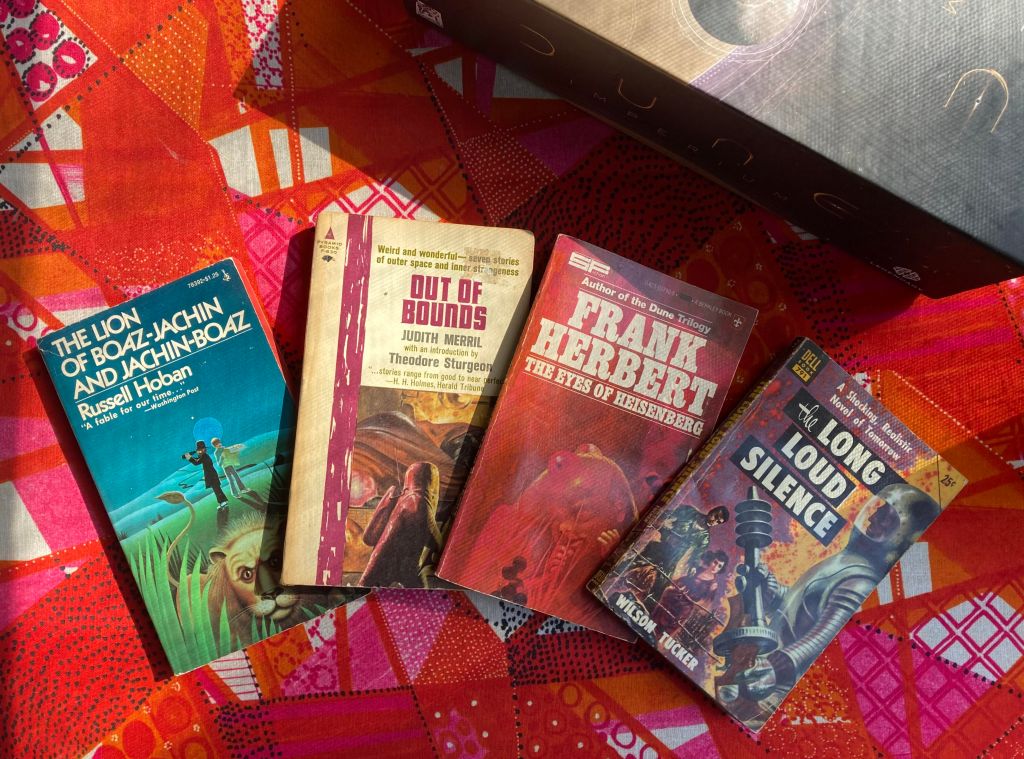
What pre-1985 science fiction are you reading this week?
I apologize for the break in my update schedule. It’s been a month since the previous installment. Alas. As I say week after week, thank you for all the great conversation. The community that’s emerged over the years is one of the main reasons I keep writing. I’ve included a bit about the books in the photograph, birthdays from the last two weeks, and brief ruminations on what I’ve been reading and writing.
Let me know what pre-1985 SF you’ve been reading!
As these posts seem to bring in new readers, if you’re curious about my rationale for the perimeters of my site, check out this recent interview and podcast. And follow me on Mastodon if you don’t already as I no longer post on my Twitter account for Musk-related reasons. It’s hard to say goodbye to Twitter, despite its public implosion, as I’ve spent a decade on the platform accumulating innumerable SF friends around the globe–some of which I’ve visited in my travels across the US and Europe.
The Photograph (with links to reviews and brief thoughts)
- Russell Hoban’s The Lion of Boaz-Jachin and Jachin-Boaz (1972) — the origin of my pen name! A lovely, possibly near-future, fantasy novel about a son who tries to find his famous mapmaker father who absconded with a map to find everything. I’m obsessed with maps. And Hoban’s imaginary maps are delightful. Like the Hoban’s map that shows the places where poets found inspiration, I’d like to imagine that my site serves as a map of the alluring contours of a moment in time.
- Judith Merril’s collection Out of Bounds (1960) contains a good range of her 40s and 50s visions. My favorite is definitely “Dead Center” (1954) as it explores self-delusion, the cult of the astronaut, and the trauma of disaster (all themes I can get behind).
- Yesterday was Frank Herbert’s birthday so I thought I’d include one of his volumes that I’ve reviewed on the site. I read, and adored, the Dune sequence in my late teens. I’ve also included a board game inspired by the series I’ve thoroughly enjoyed as of late.
- Wilson Tucker’s The Long Loud Silence (1952) remains one of the best post-apocalyptic nightmares out there–its conflicted and morose narrator might be off-putting to some.
What am I writing about?
I recently finished writing reviews of Octavia E. Butler’s Mind of My Mind (1977) and Susan Cooper’s Mandrake (1964). I’m currently writing reviews of two 50s post-apocalyptic short stories by Robert Silverberg and Edgar Pangborn.
What am I reading?
I’ve submitted my midterm grades and have this week off for fall break. Reading time beckons! I’m currently eyeing an Orbit anthology, more Edgar Pangborn, and maybe finally finishing an early Joan Slonczewski novel I’ve left unfinished for more than a year through no fault of its own.
And my bonus current history read:

A Curated List of SF Birthdays from the Last Two Weeks
September 25th: Betty Ballantine (1919)-2019) — with her husband she co-created Bantam and Ballantine Books.
September 26th: Douglas R. Mason (1918-2013). An incredibly prolific British SF author… Did he write anything worth tracking down? I’ve not had luck so far.
- Eight Against Utopia (variant title: From Carthage Then I Came) (1966)
- “The Man Who Missed the Ferry” (1966)
- “Six Cubed Plus One” (1966)
September 28th: Mary Gnaedinger (1897-1976) — the influential editor of Fantastic Mysteries and Fantastic Novels Magazine.
October 1st: Donald A. Wollheim (1914-1990).
October 1st: SF and comic artist Richard Corben (1940-2020).

Richard Corben’s cover for The 1975 Annual World’s Best SF (1975)
October 2nd: Jack Finney (1911-1995). Still have not read his classic of Cold War paranoia The Body Snatchers (1955)… I should track down a copy first.
October 2nd: Vernor Vinge (1944-)
October 3rd: Ray Nelson (1931-2022). Best known for his short story “Eight O’Clock in the Morning (1963), the source material for the cult classic They Live (1988).
October 4th: Gerald Jonas (1935-). Published only a handful of short stories–I have my eyes on his Nebula-nominated “The Shaker Revival” (1970).
October 4th: Alvin Toffler (1928-2016). Toffler’s Non-fiction–notably Future Shock (1970)–proved influential for 70s SF on overpopulation and information overload.
October 5th: SF artist George Salter (1897-1967) created some of the earliest covers for The Magazine of Science Fiction and Fantasy.
October 5th: SF editor, blogger extraordinaire, and valued member of my site’s community Rich Horton (1959-).
October 6th: David Brin (1950-). A prominent author of my youth whom I’ve not returned to since. At the time, I adored everything in the Uplift Universe sequence (including the mid-90s Uplift Storm subseries).
October 8th: Richard S. Shaver (1907-1975). If you haven’t read about the Shaver hoax stories in Amazing Stories, you should!
October 8th: George Turner (1916-1997)
October 8th: Frank Herbert (1920-1986). What’s your favorite of his non-Dune novels?
October 8th: SF artist Richard Hescox (1949-)
October 8th: SF artist John Pound (1952-)
October 9th: SF artist and art director of Doubleday Books Margo Herr (1937-2005) Check out my interview with Doubleday artist Emanuel Schongut for insight into Herr’s tenure.
For book reviews consult the INDEX
For cover art posts consult the INDEX
For TV and film reviews consult the INDEX
 Science Fiction and Other Suspect Ruminations
I read Effinger’s “25 Crunch Split Right on Two” yesterday and then I found his first contact basketball novelette “From Downtown at Buzzer”. I’m on a speculative sports kick after devouring The Universal Baseball Association, Inc., J. Henry Waugh, Prop. by Robert Coover
I love Effinger’s “25 Crunch Split Right on Two”! Talk about a hard-hitting short story (no pun intended). Here are my thoughts: https://sciencefictionruminations.com/2016/01/26/book-review-irrational-numbers-george-alec-effinger-1976/
As for other sports-related stories I’ve enjoyed, check out (if you haven’t already) “Roller Ball Murder” (1973): https://sciencefictionruminations.com/2018/02/23/short-story-review-william-harrisons-roller-ball-murder-1973/
And Gary K. Wolf’s surprisingly amazing Killerbowl (1979): https://sciencefictionruminations.com/2018/11/23/book-review-killerbowl-gary-k-wolf-1975/
amazing! thank you! I’m gonna check these out.
Effinger is one of the great underrated SF authors. While not sports-related, “Biting Down Hard on Truth” (1974) might be in my top ten of the 70s: the story circles around a highly regimented cult with Mithraic undertones and iconographies. It’s filled with unusual underground films, psychotic extravagance, and depressing cyclicality.
Effinger did a whole collection of his sports-related stories, IDLE PLEASURES. https://www.isfdb.org/cgi-bin/pl.cgi?17754
Currently reading Sheffield’s 1979 collection “Vectors” in between some other books.
I’ve been meaning to reading some of his short fiction.
I’m reading Report on Probability A by Brian Aldiss.
You have more strength than me! Hah. I have a copy, I love Aldiss, I am fascinated by the concept of that novel, but…. Let me know what you think!
Sheffield’s short SF is very mixed in quality. His early stuff, particularly, is rough.
What he turned out from the mid-1980s on, especially for Gardner Dozois’s ASIMOVS, is notably better.
What pre-1985 SF have you been reading recently Mark?
I read it a couple of years ago, and though I wouldn’t say that I “enjoyed” it exactly, it was a fascinating experience – boring and exhausting in a hypnotic, weirdly mysterious way.
It’s more speculative fiction than SF really, the SF-elements are actually the only parts that doesn’t really work, they seem tacked on with the purpose on making it possible to sell it as SF.
I have followed your writing about my favorite genre for several years. Your summaries help me decide what to read next and introduces me to new authors. I look forward to your posts because, while it’s easy to stay with favorites, it’s even better to find new favorites. Your summaries, ratings, and detail are articulate, concise, and interesting. You make a difference. Thank you.
Thank you for the kind words. What authors do you enjoy? Have you read any wonderful pre-1985 SF recently?
Great to hear and read from you again!
Added the podcast to my playlist right away, sounds really interesting, thanks!
I can understand why you left Twitter and that it must been hard to do so. You had a great thing going on there, and I really loved following you there. I left Twitter a few years now and before i left we exchanged a few messages about me thanking you for all the work you do. Im glad you are still doing great and hope to enjoy all your work for many more years. Take care!
Thank you for the kind words. You escaped at the right time. It’s only gotten worse.
Reading anything that fits the perimeters recently?
Last night i finished a book with a collection of short scifi stories, printed in 1982. I put off reading it for years: i was afraid the language would be too outdated, it has some work of H.P. Lovecraft, and i thought it would be too hard to read.
I was so wrong. I thoroughly enjoyed reading it, it has so many great ideas, stories, ways of writing, it really surprised me, in the best possible way. Some highlights for me are: David Ely; favorite dish, Richard Matheson; Lemmings, Stanley Ellin; The Blessington Method.
I basicly liked every story that it had included. Some stories are onlyu about 2 pages long, yet they create such an amazing story, really happy i finally finished it, will reread it every now and then, and it will take a favorite spot amongst my small scifi books.
What’s the title of the anthology?
While I haven’t read any of Ely’s short fiction, I’m a huge fan of his 60s novel Seconds (1962) and the Frankenheimer film adaptation. https://sciencefictionruminations.com/2019/06/09/book-review-seconds-david-ely-1962/
It’s called: The best Science Fiction stories. With a big red banner saying: Known from radio and tv. Under ”The Golden Label”.
It is a Dutch printed anthology, and from the inside flap it does seem to be an original one made for the Dutch market.
Thank you for the recommendation, i’ll read it!
Is it this anthology? https://www.isfdb.org/cgi-bin/pl.cgi?514839
@Joachim, No, that is a different one, this is the right one (on a Dutch website) https://www.boekenwebsite.nl/science-fiction/de-beste-science-fiction-verhalen
Ah, it’s on isfdb.org as well here: https://www.isfdb.org/cgi-bin/pl.cgi?492630
I recognized that reused cover art for Pohl’s Gateway (1977) right away.
I was trying to figure out which Ely story you referenced. Seems to be a translation of “Countdown” (1962).
Yea its a lovely cover, and seems to be the right story you got there, about the launch of a space mission
Just finished the second book of Cities in Flight, A Life for the Stars. Now reading Michael G Coney’s only collection, Monitor Found in Orbit.
I wrote a short review of the Coney. There were a few that I enjoyed.
I think you would enjoy “The Shaker Revival”. It’s very much of its time, as it could only have been written in 1970 (or the late-‘60s).
I have a copy in The Ruins of Earth anthology, edited by Thomas M. Disch. I would recommend that entire book. Disch wasn’t just an amazing writer, the few anthologies he edited were also far above average.
I am one of the rare people who enjoys Herbert’s other fiction much more than Dune.
I read Dune while I was in high school and was not impressed.
Otherwise, I have a hard time selecting only one Herbert novel as my favourite. Hellstrom’s Hive, The Eyes of Heisenberg, The Green Brain, The Heaven Makers, and The Saratoga Barrier are all very much worth reading.
Hello Chris,
Tempted to track down “The Shaker Revival” — it’s about a strange cult, right?
I have a copy of The Ruins of Earth and another Disch anthology Bad Moon Rising. I snagged the former a few years ago: https://sciencefictionruminations.com/2020/01/11/updates-recent-science-fiction-acquisition-no-ccxxxv-m-a-foster-garry-kilworth-cary-neeper-and-anthology/
As for Dune, I was quite impressed with the series in my teens — other than the fourth volume. So much so that I even read the prequels written by his son. I realized the latter were quite cruddy and moved on to other things.
As for his non-Dune novels, I’ve read all that you listed other than Hellstrom’s Hive. I enjoyed The Eyes of Heisenberg and The Saratoga Barrier. Was not thrilled with The Green Brain, at all. Other than The Eyes of Heisenberg (reviewed), The Whipping Star, The God Makers (reviewed), The Worlds of Frank Herbert (reviewed), and a handful of other short stories, almost everything I read of his was in my late teens.
Yes. It’s not so much a strange cult as a counter-culture cult which wouldn’t have been considered outré at the time it was written.
I found Bad Moon Rising as one of the most impressive science fiction anthologies I have ever come across (and I am a huge fan of anthologies). I enjoyed every story Disch included.
I’m only going off the content tags on isfdb.org for info about “The Shaker Revival” — thank you for the explanation.
I’m a huge fan of anthologies as well. Especially themed ones. Hence the purchase!
Just finished ‘Bring the Jubilee’.
As my knowledge of the US Civil War = pretty much zero, some of the content and names will have passed me by. But I enjoyed the New York sections early in the novel – a nightmarish, impoverished New York, far removed from our reality.
I found the novel very downbeat, from its gripping first line to the narrator’s (enigmatically?) incomplete final sentence.
Perhaps the underlying message of the novel is plus ça change, plus c’est la même chose; I don’t know. The novel sits more within the alternate world sub-genre than time-travel. I thought once or twice about ‘The Man in the High Castle’ and Crowley’s ‘Great Work of Time’ while reading it – both are arguably more sophisticated but perhaps neither would exist in the way they do without Bring the Jubilee.
Not read much Moore previous to this, other than ‘Lot’ – and there doesn’t seem much more of him out there, unfortunately.
I’ve read one average Moore satirical novel, Greener Than You Think (1947), and two short stories — “Flying Dutchman” (1951) and “Lot” (1953). I wrote about “Lot” recently on the site and will write about the former short story in a bit. He’s an interesting character for sure.
From my “Lot” review: “Ward Moore (1903-1978) strikes an unusual–and mostly unknown–figure. Born of Jewish parents, Moore supposedly was kicked out of high school in New York City for anti-war activity during WWI. He claimed to have spent years “tramping” around United States before managing a bookshop in Chicago. He interacted with the “Father of the Beats” Kenneth Rexroth (1905-1982), in whose work he appears as a mad bohemian, and later moved to California (his home for the rest of his life) where he received a Federal Writers Project job for the WPA [note 2]. Mike Davis, in “Ward Moore’s Freedom Ride”, describes him as a “whirling dervish of unorthodox opinion and radical sensibility, a Trotskyist and a libertarian whose avowed literary models were Rabelais, Jarry, and Grimmelshausen” [note 3].
I’ve had a copy of Bring the Jubilee for a while and have been tempted numerous times to pick it up.
Thanks for the info. I read ‘Lot’ in one of the Aldiss Penguin anthologies. A read cracker and has more concentrated power than ‘Jubilee’.
After I finished it (Jubilee) I read a few reviews, scattered here and there, and one or two pointed towards a novella length ‘Jubilee’, which they considered superior. But not that easy to get hold of nor I am I overly bothered.
I just noticed a Wilson Tucker novel above. Am about to read his ‘The Year of the Quiet Sun’. I’d aimed for his Lincoln novel but that is scarce and expensive so settled for the other one for now.
I highly recommend The Long Loud Silence (1952). I read the revised 1969 edition: https://sciencefictionruminations.com/2016/08/17/book-review-the-long-loud-silence-wilson-tucker-1952/
Nothing pre-85, but I spent the scant pleasure-reading time I’ve had in the last month working through M. John Harrison’s most recent novel, The Sunken Land Begins to Rise Again — Harrison obviously of that generation. It’s solid work in the New Weird vein, more like The Course of the Heart than his 70s work or the Kefahuchi Tract books; he continues to manage his neat trick of delivering some sort of emotional closure while leaving you still not quite sure What Just Happened. Recommended.
I see ‘The Sunken Land’ – which contains one of my favourite opening paragraphs of recent years – as concluding a loose trilogy consisting of ‘The Course…’ and ‘Signs of Life’. I’d put that opening paragraph on a par with the opening of Elizabeth Taylor’s ‘Wreath of Roses’.
I thought it (‘Land’) was a huge improvement on the Tract novels – I nearly gave up on ‘Empty Space’ a couple of times. Maybe I read it at the wrong moment.
Personally I’ve always preferred his shorter work. I think stories like ‘Running Down’ and ‘Empty’ are as good as anything else he’s written (including ‘Climbers’).
Have you read the ‘anti-memoir’?
I haven’t; I ought.
There are times when I’d happily say “Climbers” is my favorite of the bunch. I love the Viriconium sequence unreservedly, but I think his work is best when it cleaves closely (however akimbo) to our world.
I really do need to get to THE SUNKEN LAND. THE COURSE OF THE HEART and (especially) SIGNS OF LIFE are remarkable. And I love Elizabeth Taylor but I haven’t read A WREATH OF ROSES. I shall have to get to it.
I would hasten to add that ‘A Wreath of Roses’ is very far from SF. A good read, though.
Well, sure — but I suspect Elizabeth Taylor is even farther from SF! 🙂
As I’m sure you’re aware, it’s the other ET (sic), not the ET of ‘Crash’ fame.
Cheers.
Huge fan of Harrison’s pre-1985 work. I’ve reviewed a bit on the site — The Committed Men (1971), A Storm of Wings (1980), The Centauri Device (1974), and thirteen short stories.
I’m reading ‘The Day of the Triffids’ by John Wyndham. So far it’s gripping stuff and another reminder of why I seek British post-apocalyptic fiction. If I end up liking this I’ll look for ‘The Chrysalids’ next.
Wasn’t the biggest fan of The Crysalids. There’s a short review and great conversation about it on the site.
Just started on Quicksand by John Brunner, liking it so far and it is a welcome change of pace after plodding through some Edgar Allan Poe last week.
I nabbed that one last year after reading Jad Smith’s short but wonderful monograph John Brunner (2012) in the Modern Masters of Science Fiction series for Illinois University Press.
I read Dark Universe by Daniel Galouye, another one recommended on the Galactic Journey website. It takes place in a very novel and interesting post-holocaust setting. The plot is okay, but is mainly about providing the characters with means and reason to explore the setting. Highly recommended. It’s borrowable on the Internet Archive site.
I recommend it as well! One of the first books I reviewed on the site back in 2010: https://sciencefictionruminations.com/2010/09/19/book-review-dark-universe-daniel-f-galouye-1961/
I reviewed one of his collections far more recently: https://sciencefictionruminations.com/2021/04/06/book-review-project-barrier-daniel-f-galouye-1968/
Here’s a handy review index to everything I’ve covered over the decade plus: https://sciencefictionruminations.com/science-fiction-book-reviews-by-author/
Your review of this tracks perfectly with mine. I’ll have keep your list handy and check it before reading anything old, since you clearly have excellent taste…
I can’t promise we’ll always see eye-to-eye — hah. My tastes have evolved substantially over the years.
I don’t know for how long you’ve been following but at the beginning of the year I always have a yearly rundown. Definitely check out my 2022 in review (novels, short stories, academic histories of SF, and themed review series I conducted): https://sciencefictionruminations.com/2023/01/01/updates-my-2022-in-review-best-sf-novels-best-sf-short-fiction-and-bonus-categories/
But yes, despite how long ago I read and reviewed it and how young I was at the time (between 21 and 23) depending on whether it was in the batch of reviews I posted early on that I had previously written, I have very fond memories of the novel and I assume I’d enjoy it now as well.
I just finished R.U.R. by Karel Cepak. It’s really good! The robots have personalities even though they’re robots. I read War with the Newts years ago and it was excellent. Cepak is a very good writer and I wish he’d written more novels.
I’m reading Lester del Rey’s Badge of Infamy. The premise is that the Medical Lobby controls how physicians can practice and they have decided that you can’t perform medical procedures outside of hospitals even if people’s lives are in the balance. The main character is an outcast because broke that rule and he ends up going to Mars and working as an unlicensed physician. I just don’t think the premise is all that plausible. I’m about a third of the way through so maybe it becomes more plausible as it goes on, but I doubt it will. Otherwise, it’s a decent story about a physician practicing frontier medicine on Mars.
The del Rey reminds me of another dystopic medical satire — James Gunn’s wonderful The Immortals (1962). https://sciencefictionruminations.com/2013/04/27/book-review-the-immortals-james-e-gunn-1962/
That looks really good, especially now that so many middle-aged Silicon Valley tech workers are obsessed with staying young via blood transfusions from younger people.
I’ve finally gotten around to Robert Holdstock’s ‘Where Time Winds Blow’–something I’ve been meaning to do ever since reading your brief and evocative review. So far it’s everything I hoped it would be.
I hope the rest proves equally satisfying. Let me know your final thoughts!
Jack of Shadows by Roger Zelazny
Hello David,
I read that one. Not my favorite Zelany and I never managed to review it.
Rereading I An Legend, because it’s the spirit of the season. Read Suzee McKee Charnas’s “The Ancient Mind at Work,” which is the first part of The Vampire Tapestry and which I consider SF (I’ll explain in my review). I’ll also be reading Murray Leinster’s “Pipeline to Pluto” very soon.
My thoughts on the Matheson if you missed them: https://sciencefictionruminations.com/2022/07/06/book-review-i-am-legend-richard-matheson-1954/
Russell Hoban? I always thought you’re pseudonym was inspired by the Bayley novella (ie, The Pillars of Eternity)! (The names are remarkably similar)
It’s really both. I read the Bayley right after the Hoban.
The names are similar because they are both referencing the same thing — the Masonic imagery surrounding the Temple of Solomon. The pillars of the Temple are named Joachim and Boaz.
Hah! I didn’t know that – thanks for the clarification.
I read an obscure and somewhat disappointing Wilson Tucker (Ice and Iron) followed by a terrible Katherine MacLean (Second Game) I might not even bother to review. Or maybe I will track down the short story it’s based on to see if the novel added anything but pages.
James, I liked SECOND GAME more than you did, though it’s easy to see why it can be called “terrible”. But surely you ought to credit (that is, blame!) Charles de Vet for at least half of it! My personal suspicion is that MacLean was a full collaborator on the novelette, but that de Vet did the expansions (to COSMIC CHECKMATE and then to the 1981 Daw edition called SECOND GAME.) I think the three versions can probably be ranked in order of length — each expansion made the story worse. And if you think the novel is bad, the 1991 sequel novelette, “Third Game”, by de Vet alone, is downright dreadful. My review: https://rrhorton.blogspot.com/2018/10/ace-double-reviews-14-cosmic-checkmate.html
Speaking of pre-1985 science fiction, I just posted a review (written in 2001) of Doc Smith’s FIRST LENSMAN. It’s a pretty bad novel.
Other pre-1985 SF or SF-adjacent recent reads: ALIEN ISLAND, by T. L. Sherred; URSUS OF ULTIMA THULE, by Avram Davidson; and (currently in progress) Leigh Brackett’s 1944 noir novel (that is, not SF at all): NO GOOD FROM A CORPSE.
The Sherred review will appear at Black Gate, probably in a couple more weeks. The Smith and Davidson reviews are already up on my blog, and I’ll have a review of NO GOOD FROM A CORPSE there later this week.
Yeah, I never got into the Lensman novels. I tried to read one at some point — didn’t get far.
I have a copy of Alien Island (love the cover art). Let me know when the review is posted.
I forgot to add thanks for the birthday notice and the kind words!
Thank you for the great conversation! I’m really sorry about not interacting as much as I should with your writing on the your site and Black Gate. As I’ve mentioned in a few places, I’m struggling mightily this semester gathering the strength to write. I’ve been reading quite a bit.
Man, per the opening of your review … I tried with Smith when I was the Golden Age (13) … thought I should do the series in order so I started with Triplanetary and AT THIRTEEN I couldn’t get through 50 pages for the prose.
I needed a break a couple years ago so I pulled out a copy of The Galaxy Primes I’d gotten in a batch of paperbacks and holy Ned, it was the worst thing I’d read in twenty years. Life’s too short.
Still making my way through Pohl’s “Midas World” novella – of a piece with the Space Merchants and Gladiator-at-Law in terms of 50s sociopolitical satire but the premise is a bit too counterintuitive to really work. Maybe he resolves this tension by the end somehow? Modestly enjoyable so far.
What a strange collection – all the stories are assembled from a corner of Pohl’s bibliography I was unfamiliar with, a shared premise of a world where a guy has invented cold fusion, thus providing society with an unlimited source of energy. But the problems/scenarios that Pohl envisions as following on from that don’t make a whole lot of sense; his well-known satirical instincts come to the fore in an apparent attempt to paper over the weak conceptualization. (Why, for example, a society with unlimited energy would over-produce consumer items no one wants or needs and then force the populace to consume them is never satisfactorily explored or even articulated at all). Kind of baffling.
What is the name of the anthology? I read “Midas World” when I was much younger and remember little, as with the Space Merchants. I did review Gladiator-In-Law a few years after I started the site.
I reviewed Pohl’s collection The Gold at the Starbow’s End (1972) very recently. https://sciencefictionruminations.com/2023/09/04/book-review-the-gold-at-the-starbows-end-frederik-pohl-1972/
Collection is from the early 80s, and its called Midas World. Contains the titular novella (90 pgs) and then a mixture of stories from the 50s and 80s that all have a shared timeline/scenario, in a manner similar to his Heechee material.
Ah. I’m sorry, I meant that I had read “The Midas Plague,” not the entire Midas World collection.
My bad, I also conflated the two (shouldn’t have posted without the book in front of me!) I’m not sure why Pohl felt compelled to return to this premise/setting again and again, it never really delivers. By the time he gets to stories about robots running for public office while completely sidestepping almost all the questions such a scenario raises I had lost patience.
oh well, on to something else
Well, I thoroughly enjoyed the Pohl stories I recently reviewed at length — and linked above in my earlier comment. I think he’s an adept, if a bit unfocussed, satirist. But yes, I can’t speak much about that collection as I’ve only read “The Midas Plague.”
The problem, as Shaky Mo implies, is that Pohl’s original idea led to a very effective piece of satire — that worked best with an assumed 50s-ish background. Trying to extend it, 30 years or whatever later, was always a bad idea, partly because the basic idea was never met to be extended, and loses force when you do that, and partly because the ’80s weren’t the ’50s.
yeah “Gold at the Starbow’s End” is a good collection, I thought your review was solid. Pohl seemed to have been understandably proud of “Merchant of Venus” (I think it’s the lead-off story in his Platinum Pohl anthology). Been meaning to hunt down a collection that includes his story “Tunnel Under the World”, which sounds like peak Pohl satire, but have just never come across a copy.
Tunnel Under the World is in the public domain and can be found online as an ebook. Among others, it’s available at Project Gutenberg:
https://www.gutenberg.org/files/31979/31979-h/31979-h.htm
I find Pohl’s satires of 1950s consumer society at times perplexing, extremely suggestive and irritating–often all at once! To my mind ‘The Tunnel Under the World’ is superior to ‘The Midas Plague’. However, the former’s “greatness” is still undermined somewhat by its hand-waving science fictional conceit, just as the latter’s unbelievable world is also at the heart of its successful skewering of 50s “affluence”.
I’ve recently thought long and hard about both, here:
‘The Midas Plague’
‘The Tunnel Under the World’
Anthony
Charles Platt – Garbage World… well, yes, I’ve read Your review… the quick descent into not particularly inspired pulpy and clichéd ‘storytelling’ is quite painful in this one, on the other hand the setting is interesting and the transgressive ‘anti-aesthetic of dirt’ is quite consequently done.
Angela Carter – The Passion of New Eve… I’m halfway through and so far so good, the writing is enjoyably rich and strong, although I seem to detect some tendency to squeeze the rather straightforward metaphors and parables a little bit too dry (pun not intended).
I wish I’d managed to review Platt’s The City Dwellers (variant title: The Twilight of the Cities) (1970) — I found it to be his most satisfying novel. I’ve enjoyed quite a few of his short stories though.
I’m a big fan of Carter. I reviewed one of her novels quite recently: Heroes & Villains (1969): https://sciencefictionruminations.com/2022/09/18/book-review-heroes-villains-angela-carter-1969/
I’ve not read The Passion of New Eve but I have copy laying around somewhere.
Your blog’s knowledge of science fiction is truly impressive. These books serve as a medium to explore speculative worlds, serving as a bridge between fiction and scientific possibility.
Thank you for the kind words.
Are you reading any pre-1985 SF at the moment?