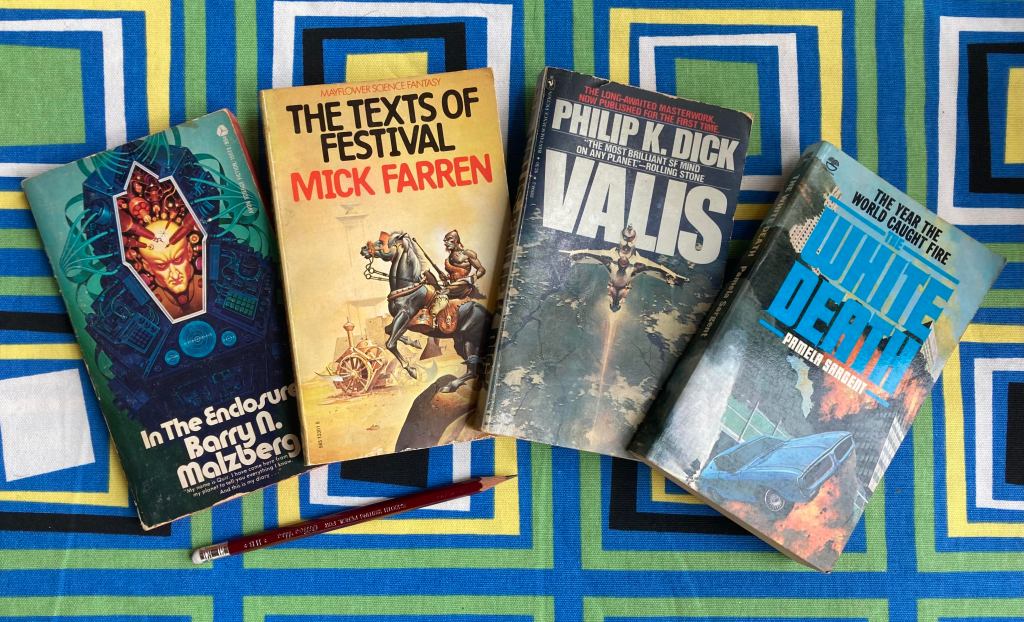
A selection of read science fiction novels from my shelves
What pre-1985 science fiction are you reading or planning to read this month?
Here’s June’s installment of this column.
I’m periodically plagued by the virulent Esoterica virus, the relentless desire to catalogue and write about the less known, and even better, the completely unknown. While attending a Medieval English literature graduate class, I remember a conversation I had with the professor, Robert D. Fulk, during office hours about the sheer quantity of scholarship on Beowulf (here’s his edition of the iconic text). I pointed out the panic I experience if I’m unable to read ALL the scholarship on a popular text.
I rather focus on something that only two people wrote poorly about decades before. I want to be the person who creates the solid preliminary groundwork for later scholars to build off of. Will I accidentally make an argument that someone made in the 60s? Will I forget some vital article that everyone else knows? Fulk, in his measured and brilliant way, pointed out that becoming an expert is a process, the slow accumulation through reading and writing, and there’s always more to learn, and there are always things you haven’t yet read! And, part of the joy of he found while creating a new edition of Beowulf is the power the text, and other classics, continues to have in inspiring fascination with the past and its peoples. Of course, I didn’t have to write about Beowulf. I could pick whatever esoteric topic I wished to conquer. But he encouraged me to not be afraid to address the classics everyone knows.
Maybe Fulk’s response sounds simple or obvious in my telling. Maybe I’m not conveying the calm care in which he talked to a high-stung young me. I wasn’t even one of his graduate students, just someone from another department in his class struggling to identify a research paper topic. Regardless, it was an important moment for me. And when I find myself tracking down every fragment, when the Esoterica virus gets its hook in, and writers’ block causes me to stare blankly at the screen, I remember his words and reopen my notes for another go.
Let’s get to the books in the photo and what I’ve been reading and writing.
The Photograph (with links to reviews and brief thoughts)
- Barry N. Malzberg’s In the Enclosure (1973). One of the first encyclopedic territories I claimed on the website was the work of Malzberg. I read and wrote as much as possible about his work — 22 short stories and 14 novels. He’s an acquired taste but if nihilistic black comedy is your thing….
- Mick Farren’s The Texts of Festival (1973). Farren–also a counterculture musician and underground newspaper journalist—spins a wild drug-tinged adventure, replete with innumerable musical references, across a devastated, decadent, and depopulated future United Kingdom. It’s not a good novel. Action sequences and orgies drown out the inventive elements of the novel. But it was a wild read!
- Philip K. Dick’s Valis (1981). Not sure how I got through this one!
- Pamela Sargent’s The White Death (variant title: The Sudden Star) (1979). Structurally the novel is a tapestry–loosely following the travels of two main characters who are forced to flee their across the post-apocalyptic landscape together after the arrival of a destructive “white star.” Despite the novel’s complete lack of narrative thrust and tendency to sink into dull machinations between crime organizations, The Sudden Star‘s focus on flawed characters and their desperate attempts to create normalcy makes this a worthwhile read for fans of late 70s post-apocalyptical fiction.
What am I writing about?
So many projects! So little time! I’m currently still writing about Clifford D. Simak. I have other writing projects including a review of Alas, Babylon (1959) and further installments of my short stories in translation series in the works.
Recent reviews: Clifford D. Simak’s “Conditions of Employment” (1960), “Retrograde Evolution” (1953), and “‘You’ll Never Go Home Again!’” (variant title: “Beachhead”) (1951); Hugo Correa’s “Alter Ego” (1967) and “Meccano” (1968); and Robert Silverberg’s Those Who Watch (1967).
What am I reading?
I am behind on writing so my reading continues to slow… Enjoying a recommended George Alec Effinger novel at the moment.
A Curated List of SF Birthdays from the Last Two Weeks
June 29th: Brian Herbert (1947-). Ah the shadow successful fathers cast on sons… My only exposure to Brian Herbert’s work have been his miserable prequels he wrote with Kevin J. Anderson to Dune (1965) — House Atreides (1999), House Harkonnen (2000), House Corrino (2001), The Butlerian Jihad (2002), The Machine Crusade (2003), and The Batte of Corrin (2004)… I was obsessed with all things dune in my late teens.

Michael Whelan’s canvas for the 1979 edition of Edgar Rice Burroughs’ collection John Carter of Mars (1964)
June 29th: Artist Michael Whelan (1950-). He’s a good one!
June 29th: Artist David Mattingly (1956-). I’m particularly partial to his cover for Jack Vance’s Marune: Alastor 933 (1975). My review of the novel.
June 29th: Dave Duncan (1933-2018). I reviewed his novel Dark Dominion (1954).

Detail from Ralph Brillhart’s cover for the 1st edition of Philip K. Dick’s Martian Time-Slip (1964)
July 1st: Artist Ralph Brillhart (1924-2007). His cover for PKD’s Martian Time-Slip (1964) is one of my favorite covers of the 60s (see detail above).
July 2nd: Artist Hannes Bok (1914-1964): SFF artist extraordinaire. I’ve fallen under the spell of his garish yet wonderful pastels.
July 2nd: T. P. Caravan (1926-2018). Wrote seventeen SF short stories between 1952-1965 that appeared in a range of magazines including from Other Worlds to The Magazine of Fantasy and Science Fiction. I’ve not encountered his work before–it was seldom anthologized.
July 2nd: M. A. Foster (1939-2020). Best known his Ler sequence of novels. I’ve been eying The Morphodite (1981) as a read for later this year. I’ve only read Waves (1980).
July 3rd: E. Hoffmann Price (1898-1988).
July 3rd: William Rotsler (1926-1997).
July 3rd: Jerome Podwil (1938-): One of the unknown and underrated SF artists. I adore his 1965 cover for Poul Anderson’s The Enemy Stars (1958) in particular. Here’s the ISFDB index with pictures.
July 3rd: Michael Shea (1946-2014). Completely unknown to me. I wish his collection Polphyemus (1987) was ab it cheaper online.
July 4th: Francis Flagg (1898-1946). A regular of the pulps in the 30s and 40s. I recently acquired his novella “The Night People” (1947).

Howard V. Brown’s interior art for H. P. Lovecraft’s “The Shadow Out of Time” in Astounding Stories (June 1936)
July 5th: Artist Howard V. Brown (1878-1945). Created countless influential covers for Astounding Stories and Thrilling Wonder Stories.
July 5th: Garry Kilworth (1941). I’ve reviewed two of his novels (and should read more): In Solitary (1977) and The Night of Kadar (1978)

John Schoenherr’s cover for Analog (December 1963)
July 5th: Artist John Schoenherr (1935-2010).
July 6th: Artist Rick Sternbach (1951-). Perhaps best known for the 1975 edition of Niven’s Ringworld (1970).
July 6th: James White (1928-1999). Check out some of his non-Sector General works! For example, All Judgement Fled (1968) and The Dream Millennium (1974). I’m all for his pacifist outlook.
July 7th: T. J. Bass (1932-2011): In 2011, I reviewed and did not entirely appreciate Half Past Human (1971). I should give it another read — with a deeper sense of New Wave experimentation I think I would appreciate his poetic twist on scientific deluge a bit more.
July 7th: Robert A. Heinlein (1907-1988): Yeah, I always giggle when the Heinlein Society puts out their scholarship winners. I hope they haven’t whispered something bad about one of his books. Back when I was on Twitter, I posted an insignificant snip at one of his books and was immediately unfollowed and placed on the society’s “Haters” Twitter list. You know, someone not liking a book you adore is not an ATTACK ON YOU! Author fan clubs are the worst.
July 7th: Artist Michael Herring (1947-).
July 7th: Jane Gaskell (1941-): An author I need to read. Unfortunately, her SF novel A Sweet Sweet Summer (1969) is prohibitively expensive online.

Alan Aldridge’s “Dr Robert” illustration (1966)
July 8th: Alan Aldridge (1938-2017): The radical Penguin Books artist pre-Pelham. Check out this great article covering his art beyond science fiction.
July 8th: Justin Leiber (1938-2016). Another author son of a far more famous author father! I’ve heard Beyond Rejection (1980) is a terrible novel.
July 8th: Artist Lou Feck (1925-1981).
July 9th: Dean R. Koontz (1945-): Best known for his non-SF work, I’ve yet to explore any of his early science fiction.
July 9th: Mervyn Peake (1911-1968) was born on this day. I’ve only read, and thoroughly enjoyed, the first installment–Titus Groan (1946)–of his Gormenghast sequence. He also created fascinating cover art!
July 9th: Glen Cook (1944-): I’ve only read and reviewed The Heirs of Babylon (1972). Best known for his Chronicles of the Black Company sequence.
July 10th: Jack Coggins (1911-2006): I’d classify him as an underrated SF artist of the 50s. If you’ve ever perused 50s SF magazines like Galaxy and Thrilling Wonder Stories, you’ve probably seen his work.
July 10th: Julian May (1931-2017): I’ve only read one of her earliest 50s short stories for my generation ship short stories review series.

Irv Docktor’s cover for the 1964 edition of Robert A. Heinlein’s Orphans of the Sky (1963)
July 10th: Artist Irv Docktor (1918-2008).
July 10th: John Wyndham (1903-1969) was born on this day. I’ve only read and reviewed The Chrysalids (variant title: Re-Birth) (1955). No Triffids, yet!
July 11th: Cordwainer Smith (1913-1966). Give me three of Smith’s short stories to read. I’ve not had the best luck and need to know more about this influential author.
July 11th: Artist Alan Gutierrez (1958-).
July 12th: Charles R. Saunders (1946-2020): A pioneer of the “sword and soul” fantasy novel While not big on sword and sorcery, I’d love to track down the original DAW volumes of Imaro (1981), The Quest for Cush, and The Trail of Bohu (1985).

Howard Koslow’s cover for Donald E. Westlake’s Anarchaos (1967) (as Curt clark)
July 12th: Donald E. Westlake (1933-2008).
July 12th: James E. Gunn (1923-2020): A favorite from the early days of my site. Check out my reviews of The Immortals (1962) and The Joy Makers (1961) in particular if you haven’t already. I also read but never managed to review his best-known novel The Listeners (1972). He’s also important as a pioneer in the academic study of science fiction. Here’s his bibliography.
July 12th: James Causey (1924-2003). One of many authors who appeared briefly in the magazines primarily in the 1950s. I’ve only read “Competition” (1955).
July 13th: Monique Wittig (1935-2003): A French author, philosopher, and feminist theorist, Wittig wrote a handful of novels that could be classified as SF. I’m interested in Les Guérillères (1969), which I snagged a few years ago.
For book reviews consult the INDEX
For cover art posts consult the INDEX
For TV and film reviews consult the INDEX
 Science Fiction and Other Suspect Ruminations
I have a Pangborn coming up tomorrow, mainly because I was annoyed by TLDV’s TOC. A week from tomorrow, an obscure 1899 novel about Atlantis.
I’ve got to the part of the Brunner reread where I have the time to tackle The Great Steamboat Race, which I guess I should review Martin’s Fevre Dream. I own both, of course.
TLDV’s TOC? Not up on my acronyms. Haha.
Which Pangborn? He’s a favorite of mine. As you probably remember 🙂
TLDV = The Last Dangerous Visions, I think.
Oh. Unfortunately, the Russell Bates story that I was excited to read isn’t one of the many not selected to publish… alas.
I reread his Colliers collection, Good Neighbors and Other Strangers.
Nice! I have that one too. But at the time, hadn’t yet read Davy so the collection sat around for years.
I think I have a copy of every Pangborn book except A-100, which I have never seen or read.
Wow, copies are not cheap…. https://www.abebooks.com/servlet/BookDetailsPL?bi=31649674132&searchurl=an%3Dbruce%2Bharrison%26ds%3D30%26rollup%3Don%26sortby%3D17%26tn%3Da-100&cm_sp=snippet-_-srp0-_-title2
You have some books that greatly appeal to me pictured above. While not one of my favourites by Malzberg, Malzberg is a writer I always appreciate. That Farren novel is one I have been interested in hunting down. I did find a copy of the author’s Synaptic Manhunt (apparently a rarity in North America), which seems to cover similar territory. I loved the Sargent novel. Valis is my favourite work by PKD, and PKD is my favourite writer of genre fiction. I also took note of: Michael Shea-most of his short fiction is horror, so I’m not sure how you’d feel about Shea for the purposes of this project. I have enjoyed his short fiction I have come across; including “Fat Face”, “The Autopsy”, and “Copping Squid”. Jane Gaskell-I know what you mean. That’s the one novel by her I most want to read but it’s quite expensive. I’ve only been able to find her (fantasy) Atlan sequence. As far as what I am reading, I have gotten around to reading Day of the Locust by Nathanael West. It’s undoubtably non-genre. However, the SFE does have it listed, so I’m going to mention it here due to that fact. The writing style is certainly ahead of its time for American literature. It reads more as a type of novel that would only start appearing in the US during the 1950s.”
Something happened to the paragraph breaks in my comment. Sorry about that.
No worries. WordPress is being a bit weird recently with comments.
Malzberg is a top-5 SF author for me. No one does what he does. He’s bleak. He’s hilarious. He’s all about the meta-narrative. He’s incisive. He fits the description that a long-time blog friend used to describe me: “Joachim Boaz likes his SF moody, broody, meta, and twisted.” I want Cocteau Twin’s “When Mama Was a Moth” to be flitting in and out of my consciousness when I read. Oblique. A bit esoteric. Sinister. Haha.
“One more brook
Chills all start screaming
Ribbed and veined
The sunburst and the snowblind
A chill of fear running down my back
When mama was moth, I took bulb form”
Have you read Malzberg’s Revelations (1972)? I think that’s my favorite. Not for the Malzberg newbies though! Hah. https://sciencefictionruminations.com/2012/08/27/book-review-revelations-barry-n-malzberg-1972/
I thought the Sargent and Farren were middling novels at best. I preferred the Sargent.
None of Shea’s work would qualify as SF?
I have not read Revelations yet. I will have to keep an eye out. I recently read Overlay, and I found that to be one of Malzberg’s best.
I thought the Sargent novel was suitably dark and misanthropic, which is something that I look for in 1960s-1970s science fiction.
Shea’s early novels might be considered science fiction, akin to Vance’s “Dying Earth” booos, but I haven’t read them, and they could just as easily be considered fantasy.
Thinking it over further, one of the short stories I mentioned, “The Autopsy” (perhaps Shea’s most famous), is science horror. I don’t think I considered it due to it being included in The Weird anthology. It’s a good example of the type of cosmic weird associated with Love raft
“The Autopsy” is a pretty SFnal science horror story–a big part of the plot involves using one’s brain to solve one’s problems, for certain limited values of “solve.” Very fine story. As I recall, Shea’s “Polyphemus” is about intrepid space explorers! Coming across a big problem exploring an alien planet! Can’t get much more SFnal than that, assuming my recollection is correct–can’t find the book on my sclerotic shelves to be sure I’ve got the right one.
Thank you John. I’m always willing and eager to read authors new to me.
Seconding John B.’s recommendation for Shea’s ‘The Autopsy,’ which arguably is the exemplary instance of a certain strain of SF-horror story (Nigel Neale’s old Quatermass scripts are an instance of the same strain in visual media).
As it happens, I recent bought a Shea ‘best-of’ collection to see if ‘The Autopsy’ held up on re-reading for me these many years later. It did. ‘Polyphemus’ not so much.
Partly, the difference is that ‘The Autopsy’ has a small mining town in the backwoods US in the then-present (1980) or some decades before as its setting, whereas ‘Polyphemus’ features your bog-standard interstellar exploration team confronting a monster on a planet. In the former the small-doctor with cancer and the small-town background are put over very nicely, whereas in the latter the spacemen and women are less plausible.
This is partly due to Shea’s stylistic language. His high-flown, semi-archaic diction was derived from Jack Vance — Shea wrote a number of fantasy novels that hommage Vance’s Dying Earth series — and, I guess, the likes of Clark Ashton Smith. That diction absolutely supports the atmosphere in ‘The Autopsy’, whereas it kind of works against the more SFnal setting and plot — rudimentary as it is — of ‘Polyphemus.’
Having not read as much recently I’ve went on a bitt of a tear over the last couple of weeks and finally read a few books I’ve been wanting to read for a long time. PKD’s Do Android’s Dream of Electric Sheep, Non-Stop by Aldiss, Octavia Butler’s Mind of My Mind and Silverberg’s Downward to the Earth were all devoured and all really enjoyed – was a good way to get back into reading after a period of time doing academic reading.
I also just finished The Butterfly Kid hy Chester Anderson which was a lot fluffier than those above but a good read. Just moved onto Ice by Anna Kavan and have Flowers for Algernon lined up next.
Nice! The PKD, Aldiss, Butler, and Silverberg are all great. I’ve reviewed the last three on my site. I read the PKD before I started writing about genre.
I have a copy of The Butterfly Kid — wasn’t the cheapest thing on the planet. I am always interested in SF takes on the Counterculture. I just read one actually that I will post about in the near future.
Ice is great (I wrote one of my better reviews on the site as well). And Flowers was an influential novella (reading the novel version or novella?) that I read in high school.
Flowers for Algernon is the novel which I gather is less fulfilling than the original novella but you take what you can get sometimes!
Just finished Ice and definitely enjoyed it. It put me in mind of The Crystal World by Ballard in the constant encroachment of a phenomenon (whether it be ice or crystals) and the psychological impact it wrought on the characters.
Actually, I’m not sure what version I read in High School. We definitely had readers that included various shorter fictions but there’s also a chance it was a stand-alone volume that would’ve been the novelization.
Ice is spectacular. I assume you saw my review? https://sciencefictionruminations.com/2015/02/01/book-review-ice-anna-kavan-1967/
Inspired by all your great posts on Clifford Simak recently, I finally finished another of his bonkers 70s books: CEMETERY WORLD (1973). Incredibly, I also read SPACE PRISON (THE SURVIVORS) by Tom Godwin. I really enjoyed this sort of planet bound generation ship story, as it goes through centuries of castaways adapting to a horrific environment. The narrative structure is clever, although it does not leave room for a lot of characterization.
I can’t say I have fond memories of Cemetery World (1973). Although, since I’ve read so much about him I suspect I’d enjoy it more this time around.
The highly recommend the Simak short stories I covered a few days ago: “Conditions of Employment” (1960).
I’ve only read a few Tom Godwin short stories. It sounds like a great premise.
CEMETERY WORLD is a post-apocalyptic novel like A CHOICE OF GODS, but I don’t think I like it as much. The pastoral vision of Earth as a vast, tourist trap graveyard is compelling, however I don’t think it is executed well. Anyway, hopefully you stick to Simak’s 50s and 60s novels!
40s-60s short fiction at the moment. I’ve already read most of the novels from that era besides Ring Around the Sun and Cosmic Engineers. I’ve even read the horror that was Empire (1951) (an adaptation of a junky draft that Campbell, Jr. gave him to rewrite. It was still junky after the rewrite that Campbell didn’t publish it. Years later it appeared in the Galaxy Science Fiction Novel series).
I enjoyed A Choice of Gods more than Cemetery World to be sure (there’s a review of the former on my site). That said, I am not sure I entirely understood what Simak was doing. A Choice of Gods is a manifesto of his ideas that had been distilling for decades. Having read far more of his early short fiction that touches on those ideas, I think it would be worthwhile if I reread A Choice of Gods.
No vintage SF for me right at the moment, as I’m busy finishing some new titles before leaving for Scotland and Worldcon. I did finish Ipomoea, that John Rackham potboiler, which was very much bad bad not good.
If you think Heinlein’s fan clubs are harsh, wait until you encounter Wyndham’s. I generally admire Wyndham. But I could not get over the way the climax of The Chrysalids undermines, if not outright negates, the entire moral theme of the novel. When I panned it on my legacy website, my forum (ah, forums — what memories of the bygone Internet) exploded with resentment from UK SF fans, to whom I guess Wyndham is seen as something of a conquering hero much as Heinlein is revered by a certain graying demographic in the States.
Hey, I also could not get around the climax of The Chrysalids. I few kind fans came by (I assume from the UK) and suggested that the end should be read a bit ironically. The new world mirrors the flaws of the told. There’s a short review on my site. I haven’t read any more Wyndham after that one — I should.
Thanks for the review link. He’s a terrible author.
I got the “But it’s irony!” defense (worded in varying degrees of umbrage) of the ending too, but after multiple rereadings, I don’t think the text actually supports it. It kind of falls in line with a theme from The Midwich Cuckoos, which misunderstands Darwin’s “survival of the fittest” not as a plain biological fact about adaptability but as some kind of moral imperative. There’s nothing necessarily wrong, Wyndham seems to be telling us, with the strong in-groups dominating and destroying the weak out-groups (after all, it’s how we’re built). You just need to do what you can to make sure you’re on the winning side.
Rackham was the kind of awful that actually offends me, because it was a choice and not necessarily a skill issue. The book is the sort where you can easily see all the parts that could have been turned into good SF, but he made the worst possible storytelling choices anyway. Oh well, when your motivation is solely a paycheck that clears…
Maybe it is a lack of skill! Brunner put out masterpieces and also crap… so… there it’s a choice based on his financial needs and the loss of money related to his masterpieces and the time it took to write them. I don’t think Rackham wrote anything that people think is “classic.”
Current book is Clive Barker’s Imajica, which misses your cutoff date by a few years. It’s been 20+ years since I’ve read it, though, and I am discovering how much of it I’ve forgotten, but nonetheless have stolen for use in my own work.
VALIS is one of those books that I periodically revisit. It’s frustrating and fascinating for me because there is so much mundane (and dated) material to slog through to get to the existential horror bits.
I feel the same way about Dhalgren–I would love to see your thoughts on that one.
I think I was 19 or 20 when I read Valis. I do not plan on returning to it, haha.
As for Dhalgren, I have read most of it, years ago. I should read the rest but I can’t promise anything. I recommend thinking of my site as an accumulation of things to explore vs. expecting certain topics to be covered. I am a reader and writer of whim, as you know, and am in completely different lanes at the moment.
I certainly didn’t want my comment to come across as a demand. I enjoy your serendipitous catalog.
Haha, no worries! I don’t want people to be disappointed in me. I am terrible getting to things I promised I’d cover or reading great recommendations that people leave and I show interest in.
I’m with you on falling down rabbit holes looking for obscure articles..but I’m less good at following through and actually reading all the things I’ve found. It’s probably good I fell into librarianship instead of pursuing academics.
I just finished Octavia Butler’s Wild Seed and started Clay’s Ark. Both are much better than Patternmaster, but I wish I had read them in series, not publication order. I usually like to read series in the order they were written (as best I can tell), but in this case reading the far-future story made the earlier parts of the story less compelling.
After I read Mind of My Mind I also wished that I had started with Patternmaster. But Canavan’s monograph is what inspired me to return to her work and he had a very positive take on Mind of My Mind… so I went with that one! And knowing about Doro’s death in Mind of My Mind, I dunno how I’m going to go back to Wild Seed.
I’m planning on Clay’s Ark as my one Butler novel of the year — for the third year running. As I know I have said countless times before, I do not find her fiction easy to write about for a variety of reasons — but I still appreciate her genius.
Yeah, I had a little trouble getting through Wild Seed, having read Mind of My Mind first. I might not have liked it anyway…the main character has too little agency for my taste.
I ended up choosing a dissertation topic in which it was possible to read all existing written articles (and a handful of books). It was still impossible to read all related materials that indirectly dabble around the edges of my topic or approach the main idea using other texts. However, the tradeoff was that the entire text was in Latin with no translation with no real possibility that one will ever exist (it’s massive) — and thus it took me a good 8 years to finish my PhD (and three research trips to France).
Hestia, just posted a review of Clay’s Ark. I loved it. The bleakest SF I’ve ever read for sure…
“Valis” is a difficult novel to read and digest. It isn’t really one of my favourite Dick novels. I think it’s focused self-interest and prolixity lacks concision and isn’t really coherent. “Dhalgren” is similar in a way, except that it’s written in a plainer manner, but is much longer.
I agree to all points.
I’m not surprised that you do.
What SF are you reading this month?
None at the moment, I can’t seem to find or decide what I want.
Simak’s “Conditions of Employment” (1960) that I reviewed a few days ago! It’s short. And… an underrated Simak work. https://sciencefictionruminations.com/2024/07/11/short-story-reviews-clifford-d-simaks-conditions-of-employment-1960-retrograde-evolution-1953-and-youll-never-go-home-again-variant-title-beachhead-1951/
“Julian May (1931-2017): I’ve only read one of her earliest 50s short stories for my generation ship short stories review series.”
You should definitely read “Dune Roller” – it’s a great story (and some of her later blockbusters fall into the pre-1985 category.
I just reread Vernor Vinge’s “True Names” novella – published in 1981 and taking place about now. Cyberspace may seem passe’ but back that it was wildly imaginative.
“Dune Roller” has been on my radar for a bit — and I bought a copy of The Many-Colored Land a while back too. I just haven’t gotten to them yet!
Most of the Vinge I’ve read have been his novels (pre-site). I should rectify that.
I’ll also second Andrewnotwerdna’s recommendation of May’s ‘Dune Roller.’
You know me and recommendations, it could be years. But yes, I’ll keep it in mind.
I re-read “Tom O’Bedlam” from the 17th Century. That poem definitely gave us the title of Poul Anderson’s A Knight of Ghosts and Shadows, and I’m pretty sure “the moon’s my constant mistress” gave Heinlein the idea of tweaking one word. Are there titles of other SF novels in there that I haven’t caught?
I have read and reviewed John Brunner’s Bedlam Planet (1968) — also in reference to the poem. Although, at the time, I did not investigate the quotes from the poem that Brunner uses. https://sciencefictionruminations.com/2017/04/20/book-review-bedlam-planet-john-brunner-1968/
I am finishing up The Doomed City by the Strugatsky brothers. It strikes me as very Soviet: the city is an experiment that none of the subjects understand and all sorts of arbitrary things happen. And the city is not run well at all. It was circulated as samizdat until the wall fell, then published in 1989. By the time you’re 20 pages in, you can easily see why. It would be a good science fiction novel even if it wasn’t a critique of the Soviet system — a city that’s run as an experiment is a great premise for a novel.
I have read both The Day of the Triffids and Stowaway to Mars by Wyndham and liked both of them. One of the things that I like about Wyndham is that he’s a good writer who could have made it as a non-genre writer. (I read a lot of literary fiction and I really like encountering a science fiction writer who could have made it writing literary fiction but chose to write science fiction.) I didn’t realize he was such a major figure in UK science fiction — I think my local library’s only Wyndham title is an ebook of The Day of the Triffids.
I acquired a copy of The Doomed City a while back. Still have not got to it… It’s what happens when you have 1.3k unread volumes. But yes, I’ve heard good things. I am planning on featuring a short story of theirs in my short fiction in translation series soon.
I’ve only read The Chrysdalids (variant title: Re-Birth). Not impressed with the last third of the novel.
I haven’t bothered to read the Chrysalids because it sounds like one of those 1950’s post apocalyptic novels that’s full of violence for the sake of it. I’ve never been a fan of that kind of science fiction. I also don’t have much patience for stories about telepathy. I think I saw too many clips of bad telepathy movies as a kid and that ruined it for me.
I’m curious what you will think of the Strugatsky story.
I can’t lie, I like a good violent 50s post-apocalyptic vision. A few come to mind that I’ve covered here:
Alfred Coppel’s Dark December (1960): https://sciencefictionruminations.com/2019/07/31/book-review-dark-december-alfred-coppel-1960/
Wilson Tucker’s The Long Loud Silence (1952, revised 1969): https://sciencefictionruminations.com/2016/08/17/book-review-the-long-loud-silence-wilson-tucker-1952/
Matheson’s I Am Legend (1954): https://sciencefictionruminations.com/2022/07/06/book-review-i-am-legend-richard-matheson-1954/
Although, in each instance, I would not state that it’s violence for violence’s sake. Rather, each author has a greater purpose.
The ultimate “violent” (again, not violence for violence’s sake) post-apocalyptic novel in my view is from the early 1980s — P. C. Jersild’s After the Flood (1982, trans. 1986) https://sciencefictionruminations.com/2022/05/30/book-review-after-the-flood-p-c-jersild-1982-trans-1986/
But yes, I gave The Chrysalids a 3/5. Did not care for it. Although I did not find it to be terribly violent… unless my memory and short review do not serve me well…
Dark December sounds pretty interesting even with the violence. I’ll have to add that to my growing list. It sounds like on of those books that’s good and even if I don’t end up liking it, at least I’ll be able to appreciate it.
Some of the covers for The Long Loud Summer were pretty striking I really like the one from 1953. An the one from 1980 is like a foreshadowing of ’80’s post apocalyptic movies.
As always, if you get to the novel, let me know what you thought!
I finally posted a review of Pat Frank’s Alas, Babylon (1959). It’s on the cozier side of post-apocalyptic fiction. Most of the violence happens off screen.
If you haven’t read it yet, it might be your cup of tea: https://sciencefictionruminations.com/2024/08/04/book-review-alas-babylon-pat-frank-1959/
I’m probably one of those who have said good things about the The Doomed City – it’s one of my Strugatsky favorites, and I’m a big Strugatsky fan.
Finally posted a Strugatsky review! (a wonderful short story)
I’m currently going through your list of the best of 2023 for anything I’ve missed. Last short story I read was Henry Kuttner’s “Year Day”, which I thoroughly enjoyed and found eerily relevant in our commercial-ridden online world. I should definitely read more from him and C.L. Moore. What would you say are their best works?
Interesting you mention Garry Kilworth. My favorite work from him so far is the short story collection In The Country of Tattooed Men. He excels more in the short form than as a novelist.
Kuttner and Moore’s “Vintage Season” (1946) is not to be missed if you haven’t read it: https://sciencefictionruminations.com/2024/03/29/book-review-clash-by-night-and-other-stories-henry-kuttner-and-c-l-moore-1980/
Glad you enjoyed “Year Day”! A star in my series on media landscapes for sure.
…as for Kilworth, I haven’t read any of his short fiction — just those two novels. I’ve been meaning to, along with many other authors haha.
The aforementioned “In the Country of Tattooed Men” is worth seeking out. https://www.amazon.co.uk/Country-Tattooed-Men-Garry-Kilworth/dp/0586214984
I came across it on eBay randomly while looking for old trade paperbacks and decided to order it on a whim. Didn’t regret my decision. It’s seriously one of the most underrated collections I’ve ever read and a reminder that early 90s SF short fiction is full of unexplored gems.
Unfortunately, all of the stories in that particular Kilworth collection are outside of the remit of my site and current area of historic interest (as in, post-1985). I do have a copy of his 1st collection The Songbirds of Pain (1984) however that I’ve been eying.
Awhile ago I picked up and enjoyed James White’s “All Judgment Fled” based on your review, so when I came across a copy of “The Millenium Dream” in the wild I snapped it up. Of course as I was reading it I was thinking “this is extremely in Joachim Boaz’ wheelhouse” and looked it up and lol of course you had reviewed it already. Generally thought it was great, although the “happy ending” of different alien species of “sheep” cooperatively colonizing a planet felt abrupt and a little hollow. The insanely violent society the humans’ generation ship was escaping cut a little close – I didn’t make the Heinlein connection (a writer I’ve never had time for after exasperated readings of “Stranger in a Strange Land” and “The Roads Must Roll” in high school), so was eye-opening to see that noted in your review.
Glad you enjoyed both! I read each a while ago so I don’t remember much more than my reviews.
I’ve read a ton of Heinlein — I know my enemy (hahaha, perhaps too strongly worded and I definitely understand his historical importance). It was an author my dad had on his childhood shelf at 14. I found the shelf when I visited as an older teen. Read everything. Asked my dad for more to read and that’s what he knew about SF, whatever he was reading at 14. Now I send him the good stuff! But as a result, I’ve read 50 odd Heinlein short stories in various collections and ~25 of his novels — from Orphans in the Sky (fix-up 1963), the short stories in the fix up were influential early takes on the generation ship, to incomprehensible gibberish like Number of the Beast (1980). Do I remember each distinctly? Absolutely not. Did I enjoy them at the time? Many of them, yes. I saw the light trying while muddling my way through the horrid The Cat Who Walks Through Walls (1985). I haven’t returned to Heinlein much since.
Where Time Winds Blow
I’m not sure what whim led me to this but I’m pleased I made the effort. I thought I may be getting into a sort of Roadside Picnic type exploration at the beginning but the novel darted off in all sorts of unexpected directions and it kept me guessing pretty much until the end.
Have also started to delve into some of Keith Roberts’ short fiction – the Machines and Men collection. So far so good, very good indeed at times.
I thoroughly enjoyed it — and ranked it my favorite read of 2021. https://sciencefictionruminations.com/2022/01/01/updates-my-2021-in-review-best-sf-novels-best-sf-short-fiction-and-bonus-categories/
From my short review: “Holdstock’s vision is a well-wrought cavalcade of my favorite SF themes–the shifting sands of time, the pernicious maw of trauma that threatens to bite down, unreliable narrators trying to trek their own paths, a profoundly alien planet that compels humanity to construct an entirely distinct society… It’s a slow novel that initially masquerades as something entirely different. Just like the planet itself.”
Here’s a recent Keith Roberts collection I recently enjoyed: https://sciencefictionruminations.com/2022/06/08/book-review-the-grain-kings-keith-roberts-1976/
Yes am thoroughly enjoying the Roberts’ collection – will get to The Grain Kings as well – am gearing myself up for a crack at Pavane.
It’s a shame that Holdstock didn’t write more SF. I think Mythago Wood can be classified as SFish just about if one’s in the right mood.
The Grain Kings contains one of the Pavane stories. I also enjoyed Pavane, but never managed to write a review.
I read Valis a long time ago, and would like to reread it at some point. It’s a mess, but as a huge PKD fan I find it fascinating to see him at his most unfiltered.
I recently finished Hobans Lion of Boaz-Jachin and Jachin-Boaz. I enjoyed it, though not as much as Riddley Walker.
I also read Silverbergs Regans Planet, which I didn’t care much for – but then, I didn’t expect to, given that it doesn’t seem to be considered one of the good ones and I’m not a Silverberg fan to begin with. I only read it because someone gave me an old beat up copy they had found for free somewhere.
The Hoban novel is the source of my pseudonym (well, also Barrington J. Bayley) — in particular the scene in which they describe the map that charts places of inspiration.
I’m a huge fan of Silverberg but definitely think he wrote a lot of crud as well. I haven’t read Regan’s Planet yet, I suspect I will, eventually.
I recently reviewed Those Who Watch (1967) — which, despite its manifest flaws, did feel like a distinct shift from his earlier 60s work.