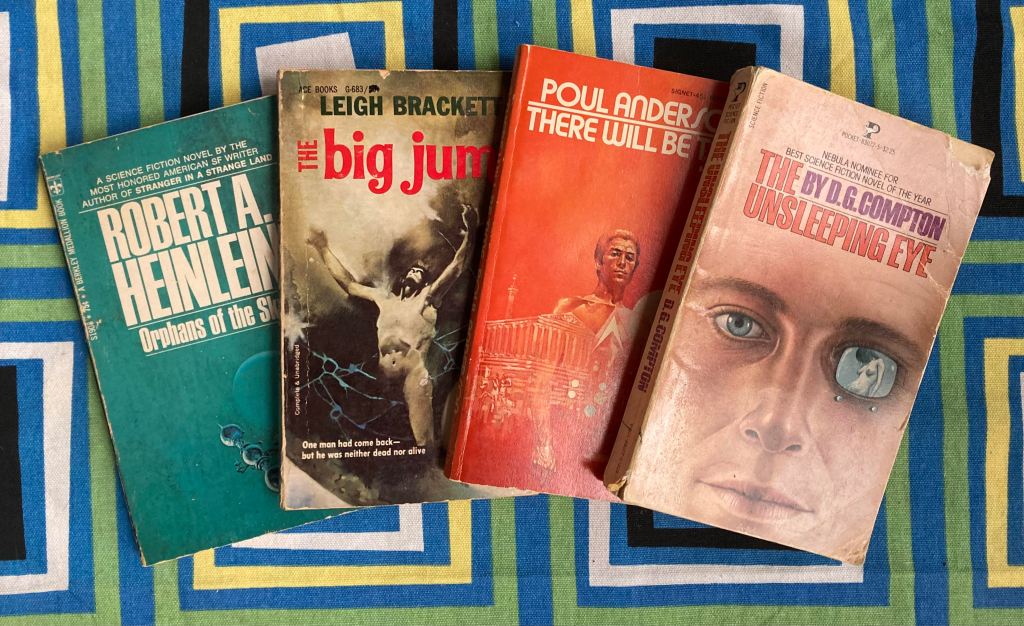
A selection of read volumes from my shelves
What pre-1985 science fiction are you reading or planning to read this month? Here’s the September installment of this column. I am a few days late with this post. We’ll pretend it appeared in October!
I’ve been reading the little scholarship on H. Beam Piper (1904-1964) in order to more adeptly understand his political views when I tackle his various union-related stories for my series. I was struck by the extreme poverty, impact of a memorable cover, and dependence on a responsive agent that he found himself mired in after he lost his railroad guard job and had to rely on writing. He kept himself alive by selling off his gun collection that he had accumulated over the years and eating pigeons his shot on his porch. While he doesn’t seem to have been the best with the little money that came his way, often blowing the majority of a paycheck from Campbell, Jr. on expensive suits, it’s shocking what he had to do to survive between story acceptances. Piper seems to have committed suicide in part due to his financial hardships.
Despite the fact that I can’t wholeheartedly recommend John F. Carr’s H. Beam Piper: A Biography (2008) or Typrewriter Killer (2015) as large sections take the form of haphazardly strung together journal entries with little larger historical analysis, I found Carr’s often unnervingly voyeuristic look into his life lay bare the financial realities of publishing SF, even in a moment when magazines paid well. Unfortunately, Carr leaves comments like Piper’s 1961 letter in which he states “John [Cambell, Jr.] is almost as big a fascist sonofabitch as I am — but he wants a couple of points hammered home a bit harder” un-analyzed.
And let me know what pre-1985 science fiction you’ve been reading!
The Photograph (with links to reviews and brief thoughts)
- Robert A. Heinlein’s Orphans of the Sky (1963). Comprised of two 1941 novelettes — “Universe” and “Common Sense” — Orphans is an important early installment in the history of the generation ship subgenre. I reviewed it 2010, the first year of my website (I think I wrote the review even earlier and had it posted on Amazon). While I can’t say my review is worth the read due to its early date, I have fond memories of the story itself (not something I can say often about Heinlein).
- Leigh Brackett’s The Big Jump (1955). Another review from the earliest days of the site, I described the novel as “a solid (if predictable) pulp sci-fi adventure with a few delightful poetic moments.” I remember nothing about the book. I much preferred Brackett’s The Long Tomorrow (1955).
- Poul Anderson’s There Will Be Time (1972). As of now, my favorite Anderson novel… Surprising considering it’s a time travel tale.
- D. G. Compton’s The Continuous Katherine Mortenhoe (variant title: The Unsleeping Eye) (1973). One of my favorite SF novels — my old review doesn’t do it justice.
What am I writing about?
It’s a secret!
In the past month, I’ve posted reviews of Best Science Fiction of Clifford D. Simak (1967) and three short stories on union-related themes: Philip K. Dick’s “Stand-By” (variant title: “Top Stand-By Job”) (1963), Milton Lesser’s “Do It Yourself” (1957), and H. Beam Piper and John J. McGuire’s “Hunter Patrol” (1959).
What am I reading?
A Philip McCutchan novel (I don’t know why, as I said I’m impulsive)… Lots of scholarship about 50s leftist thought, the political impact of the New Deal, H. Beam Piper (discussed above), etc.
A Curated List of SF Birthdays from the Last Two Weeks
October 19th: Editor and author Maxim Jakubowski (1944-).
October 19th: Russell Kirk (1918-1994). Yes, the conservative political thinker. Until Brian Collins wrote a review of one of Kirk’s fantasies, I did not realize that he was the same person.
October 20th: L. P. Davies (1914-1988).

Candy Amsden’s disturbing cover for the 1978 edition
October 20th: Emma Tennant (1937-2017). I’ve written a post about her science fictional influences and reviewed The Time of the Crack (variant title: The Crack) (1973). I also read, but never managed to review, Hotel de Dream (1976).
October 21st: Edmond Hamilton (1904-1977)
October 21st: Richard C. Meredith (1937-1979)
October 21st: Artist Don Davis (1952-).
October 21st: Ursula K. Le Guin (1929-2018).
October 22nd: Doris Lessing (1919-2013).
October 22nd: Vincent King (1935-2000). A bizarre, unique, and often exasperating voice. He’s obsessed with the ellipses to the point of fault. When I read his work, I imagine someone never able to vocalize a sentence without trailing off. Candy Man (1971) was a strange, strange, verging on incoherent, read.
October 22nd: Suzy McKee Charnas (1939-2023). A favorite of mine due to Walk to the End of the World (1974). I resolve to read the sequel Motherlines (1978) later this year or early next.
October 22nd: Editor and publisher Jim Baen (1943-2006).
October 23rd: Nathalie Henneberg (1910-1977)

Bob Pepper’s cover for the 1983 edition of Philip K. Dick’s The Three Stigmata of Palmer Eldritch (1965)
October 23rd: Bob Pepper (1938-2019). I find his covers fascinating. I imagine a few of his PKD covers are the iconic PKD editions, like his 1983 take on Dick’s The Three Stigmata of Palmer Eldritch (1965) above.
October 23rd: Michael Crichton (1942-2008)
October 24th: Mark Clifton (1906-1963)

Leo Morey’s cover for Amazing Stories (April 1932)
October 24th: Artist Leo Morey (1899-1965).
October 26th: George H. Smith (1922-1996). I thoroughly enjoyed Smith’s “The Last Crusade” (1955). I have not read anything else by him.
October 27th: Robert Thurston (1936-2021). Another large hole in my knowledge–I’ve been eyeing Thurston’s Alicia II (1978) for years.
October 27th: Walter Jon Williams (1953-).
October 28th: William Harrison (1933-2013). The author of “Roller Ball Murder” (1973), the source material for Rollerball (1975). While he has more stories listed on The Internet Speculative Fiction Database, could any others be classified as SF?
November 1st: Zenna Henderson (1917-1983). A gaping hole in my SF knowledge… I have a collection her non-People stories somewhere.
November 1st: Gordon R. Dickson (1923-2001).
November 2nd: Evelyn Lief (1945-). Wrote a handful of SF short stories — I should include her in my momentarily paused series on the first three published short fictions by female authors I should know more about.
For book reviews consult the INDEX
For cover art posts consult the INDEX
For TV and film reviews consult the INDEX
 Science Fiction and Other Suspect Ruminations
Thanks for the shoutout. :3
As for Piper I’ve been itching to read more of his stuff. His politics are… strange. Pretty forward-thinking in some ways, which don’t align with his Pennsyltucky rugged-individualism worldview.
Speaking of Anderson, I’m gonna start reading The Rebel Worlds for the Journey. It’s Flandry, so I’m not expecting peak Anderson, but I am something of an Anderson apologist. I’m also rereading George R. R. Martin’s superb “With Morning Comes Mistfall” so as to write about it (again).
Thank you for your reviews! I always learn something.
Yeah, Piper’s letters suggested that he voted Republican yet was fervently anti-established religion (incredibly dismissive towards Christianity) — and of course, his self-described “fascist sonofabitch” comment, I dunno. Carr includes a letter where he’s very angry that Goldwater lost to Johnson in 1964.
His letters repeatedly demonstrated an extreme hatred of all social assistance components of 50s/60s New Deal-inspired establishment liberalism (social security, etc.).
I believe Piper was one of those “Libertarians who always vote Republican because that’s the best we’ve got” types, much like one of his fellow Golden Agers, the even more hostile to organized religion, Robert Heinlein (who also consistently voted Republican after he “outgrew” his early social credit phase).
I don’t know that much about Piper, but I feel it was his ideological views which led to his suicide. Not just that he faced such poverty, but that he was unable to “pull himself up by his own bootstraps” and couldn’t face the thought of needing to rely on charity. I say this due to PKD also facing some extreme poverty and Heinlein (the two of them were not friends) gave PKD money to help him out. I’m sure someone in the field like Heinlein would have gladly tried to offer assistance to someone like Piper (who shared most of his own political views) had Piper let it be known he was down on his luck.
Considering what I read in the biography from Piper’s letters, it is hard to be more hostile to religion than he was. He straight out calls it the equivalent of a deluding sham. But yes, the Libertarian take is my general assumption as well. According to the biography, Piper refused to ask anyone for help in his final months.
Finished H.G. Wells’ “When The Sleeper Wakes”, moved on to “The Island of Dr. Moreau”, Suzette Haden Elgin’s “Native Tongue”, and Alasdair Gray’s “Poor Things”.
Not very far along in any of them, although Dr. Moreau is very short so that won’t take long.
I’ve been meaning to read the Elgin. Let me know how it is! Was not impressed with Elgin’s At the Seventh Level (1972) or Furthest (1971) which has prevented me from picking up her Native Tongue, her best known novel.
This is the first book of hers I’ve read, was intrigued by the linguistic angle. So far I’m not sure if I’m on board with all of the narrative conceits and her prose is unremarkable, but will stick it out. Looks like it owes a sizable debt to Le Guin, not at all surprised that she was a big booster of it.
I did appreciate that, in a perhaps not surprising coincidence, both the Gray and Elgin books open with the very Wells-ian conceit of an introduction purporting that the following novel is a “found” manuscript, detailing how it came into the hands of the “editor” etc. I am a sucker for that kind of thing.
I enjoy that editor commenting on a text premise especially if it becomes a commentary ABOUT the act of editing or thinking historically about the past. For example, the extra levels of satire established by the pseudo-historical commentary on Hitler’s pulpy SF novel in Spinrad’s The Iron Dream (1972). Or the digressive/strange self-revealing commentary on the invented 999-line poem in Nabokov’s Pale Fire (1962). In short, the more metafictional takes on the commentary premise..
But yes, there are so many 19th century lost manuscripts stories. A few that popped into my mind: De Mille’s A Strange Manuscript Found in a Copper Cylinder (1888) — and crazy stuff like Jan Potocki’s The Manuscript Found in Saragossa (1805), Poe’s MS. Found in a Bottle (1833), etc.
Yes, I enjoy that as well. Gray’s “Poor Things” is neck deep in that approach (which is naturally not present at all in the film adaptation). The only other book I’ve read of his is “Lanark”, which takes a similar, and very funny, approach, especially in its final quarter. Highly reccommend it.
I bought Lanark about a year ago. I have yet to feature it in one of my purchase posts. I have a mountain waiting to be scanned and posted. Haha.
I really enjoyed the movie version of Poor Things. But yeah, can’t imagine adding another layer to that film!
As for my current reading, I’ve recently come into a treasure trove of vintage 1950s science fiction paperbacks from the local used bookstore. I haven’t decided which one I’ll start with, having finished a novel from 2023. On the topic of anti-religion (touched on above), I have been leaning towards The Eleventh Commandment by Lester Del Rey.
It features a theocratic dictatorship ruling the planet which has banned all birth control (I’m sure abortion would be criminalized too) and made it a sin punishable by death to not “be fruitful and multiply”. It’s also an early example of the over-population dystopia sub-genre.
I’m not that familiar with Del Rey’s writing (outside of some short stories), and cannot say I have ever been keen to read much more of his work, but this is the one novel by him that appeals to me.
I’ve read and reviewed the del Rey! In the earliest years of my site… https://sciencefictionruminations.com/2012/10/27/book-review-the-eleventh-commandment-1962-revised-1970-lester-del-rey/
I’ve also collected many (although I haven’t remembered to update the list in the last two or so years) examples of the overpopulation subgenre organized by date here: https://sciencefictionruminations.com/sci-fi-article-index/sci-fi-novels-about-overpopulation/
Eleventh Commandment has the trope of (rot13) “”gur bccerffbef ner frpergyl tbbq thlf” as I recall.
I needed something I’d read before 1982 written by a man and a woman (to eliminate an annoying fraction from my stats) and landed on Mutant by Kuttner and Moore. More comments in my review a week Sunday but I will say it was not helpful to go into the book having confused it with the Hogben stories.
I haven’t read anything in their Baldy sequence yet. I have read a ton about it in the legion of post-apocalyptic monographs I avidly consume. Haha.
I did review a collection of their co-written fictions earlier this year though: https://sciencefictionruminations.com/2024/03/29/book-review-clash-by-night-and-other-stories-henry-kuttner-and-c-l-moore-1980/
Read this edition awhile ago and while they occasionally veer into a comical/ironic 50s style the high points are very high, and its consistently entertaining. https://www.sffworld.com/forum/threads/two-handed-engine-by-henry-kuttner-c-l-moore.13410/
I’m not reading sf at the moment even if I still think about it daily. I tried to get out, but it dragged me back in.
I would love to read you writing on Beam Piper. I have a lot of time for his Paratime stories and Little Fuzzy. Omnilingual is one of the greats of short sf. Was he a fascist sonofabitch like Campbell? I’m not sure about that. He liked guns, that’s for sure. I’m not sure if that makes you a fascist. Fash adjacent maybe!
I have such a huge soft spot for Orphans of the Sky it’s embarrassing! Or is it!?
I’m not sure why I haven’t read the Compton or the Bracket. Your review of the former clashes with my memories of the film version. I have a negative view of The Big Jump for some reason. I just reread your review and can’t understand why I would think this! I should read it sometime.
Yeah, one of the challenges dealing with a self-description — it’s Piper’s own words about himself and comparison to someone else whom he identified as having some similar views. Which is why Carr, the author of the biography, should have interrogated the statement vs. just leave it there in a letter! It was a frustrating moment in the biography. The entire biography comes off as amateur hour historiography. The index is non-sensical. It lists “politics” and then takes you to a section that only vaguely implies political views and then all the other moments, mostly unanalyzed, about politics aren’t listed in the index. I could go on and on but anyone with a modicum of historical training, or who even reads history for fun, will be put off by that volume. Carr tries to weave together large quotes from letters with only vague connections between topics with the intent of identifying every possible micro-fact vs. analyzing and contextualizing. It cites almost no other historical works. It does not try to engage with any larger issues. ARGH. So frustrating.
The Brackett — I remember little to nothing about the book. Not a good sign for its lasting power!
Compton — my absolute favorite of his works. I also enjoyed elements of the movie adaptation but prefer the novel.
Let me know if you squeeze in any SF soon!
Little Fuzzy was written when it was legal for hotels to bar African-Americans – and in Little Fuzzy (as I recall), the hero uses a law much like (what would become) the Civil Rights Act of 1964 to allow his alien friends to stay in a hotel with him, which certainly makes Piper seem pretty progressive.
Yeah, people can be politically complicated for sure. I think that’s the progressive bit that Brian was referencing in his earlier comment.
I’m sure you’re right about what Brian was referring to. Sorry about that.
There’s nothing to apologize for! As I have not read Little Fuzzy, I was assuming a connection between the two comments. I’m glad you gave more specifics 🙂
Finished Dhalgren in October, an uneven experience. At its best it reminded me a lot of the Strugatskys Doomed City, except with a countercultural perspective instead of a soviet one. Unfortunately, the best parts were mostly in the first half, and the second half just got increasingly repetitive and tedious.
Right now I’m reading At the Mountains of Madness. One of the classics I’ve wanted to read for a long time, even though I’ve never been a big Lovecraft fan. I do enjoy it, despite the convulted prose.
Jannik Juhl: At its best it reminded me a lot of the Strugatskys Doomed City, except with a countercultural perspective instead of a soviet one.
Not a comparison that ever occurred to me — or, maybe, anyone else — but it does throw some light.
I think your whole assessment of Dhalgren is fair. People complain the novel is hard, but I’ve read it twice — when it came out and a few years back to see what people were talking about — without problems. People complaining about its difficulty are expecting it to sum up to some complicated structure that it simply doesn’t really have — though, sure, you can up come up with systems of explication, like Dhalgren is about a locus where systems of semiotics are breaking down, etc.
Conversely, Delany appeared (to me) to have simply wanted to write a long book where he put in some of what he’d seen of NY street life in the 1960s and some other things and various thoughts he had about US culture, and extended the writing techniques he’d developed. Indeed, Delay’s main intent in Dhalgren may simply have been to have written a long experimental book.
And taken on those terms, as a long experimental novel, much it is enormously successful and, alternatively, quite a bit of it — as it winds on and Delany searches for ways to extend it and end it with, forex, the double-columned pages and the looped Ouroboros structure — is a freshman-level pseudo-avante garde bore.
~~
Otherwise, I currently seem to be on an ostensibly non-SF kick, reading the short stories of John Cheever and Roberto Bolano.**
However, both writers have large slices of the fantastic in their writing. Cheever, especially, is much, much stranger and more experimental than the shorthand label of the ‘Chekhov of the American suburbs,’ with which people usually sum him up, implies.
People customarily think of him as a realist with the noted exception of a couple of ‘magic realist’ or ‘Kafkaesque stories, ‘The Enormous Radio’ and ‘The Swimmer.’ Not so. By the late 1950s and through the 60s, a lot of Cheever’s stories are in no way conventional realist narratives and quite a few of them are deeply strange and, frankly, more successfully experimental than the likes of Delany. (Forex, the 3000-word ‘A Vision of the World,’ almost resembles something from Thomas Ligotti.)
Cheever gets away with it most of the time because he seems incapable of writing a bad sentence. An amazing writer.
** Each to their own, but even as a maniacal SF enthusiast I cannot summon interest in the likes of the author of Space Viking or Fuzzy, and since I’m not a historiographer I don’t have to.
No worries Mark, I hated Space Viking with a passion — I have not read Little Fuzzy or its sequel (which doomed Piper financially as it was saddled with a trash cover when the press changed executive editors).
Mark, many thanks for alerting us to John Cheever! I read and enjoyed The Enormous Radio (in Ray Bradbury’s anthology Timeless Stories for Today and Tomorrow), and I’ll see if I can find his collected stories. I’ve always loved fantastic literature of various kinds, in addition to SF–fabulist, surrealist, magic realism, etc.
Yes, I didn’t find it a particularly hard read either, except for the longwindedness. At times I wondered if that was by design, as a way to show how the scorpion gang didn’t really have any idea of what to do with the freedom they had in Bellona. But maybe that’s being to generous, I suspect you’re right that Delany simply didn’t know where to take the plot after a certain point.
The first instances where I was reminded of The Doomed City was when reality suddenly seem to break down and there’s a hint of some unknown structure behind it all (like when Kid sees himself as someone else in a mirror), but then it occured to me that there’s some obvious parallels (as well as many differences too, of course): Both books are about people coming to a sort of experimental, potentially “ideal” city, clearly not entirely real, where they’re free to create something from scratch.
Recently read Silverberg’s Feast of St Dionysus. As far as I’m aware this – and the stories within – was written towards the end of his Age of Aquarius period. As ever it’s a pretty strong set, with the first three in particular up there with some of his best stuff from that era. There may be echoes of the title story in Kunzru’s Gods Without Men.
Out of curiosity I read one of Silverberg’s stories – To See the Invisible Man – from his first era. Curious in a sense that I was wondering if something from that era would bear its trappings in the way his peak era does. I don’t know quite what I was expecting, a sort of Richard Yates vibe maybe. Of course the story was nothing of the sort and it seemed a lot less dated than a lot of his older work. One of the best treatments of invisibility I’ve read, not that I’ve read that many.
Wreath of Stars by Bob Shaw up next, probably.
“To See the Invisible Man” was not from Silverberg’s first period, but the first story of his second, after Frederik Pohl offered to buy anything he wrote.
“Pohl and I were good friends, and he knew what my real capacities as a writer were and had frequently urged me to exploit them, but, since I was selling everything I could write by arrangement with the book publishers, I disliked the uncertainties of writing speculatively for magazines. Pohl took the uncertainty out by offering to buy, sight unseen, whatever fiction I wanted to write for him, with the proviso that the first time I gave him a story that he didn’t want to publish, the deal would end. This led to “To See the Invisible Man” (1963), to the Blue Fire series [eventually published in book form as To Open the Sky (1967)], to “Hawksbill Station” (1967), and to many another story that I could not have written in the earlier, restrictive magazine era, and which I would not have written had Pohl not opened the door for me.”
https://lareviewofbooks.org/article/man-in-the-maze-a-conversation-with-robert-silverberg/
Thanks for letting me know – I had no idea about that. What a fine story to launch that phase.
I relatively recently reviewed some solid SIlverberg stories from his first period (collection ctonains a few later ones as well): https://sciencefictionruminations.com/2023/04/16/book-review-dimension-thirteen-robert-silverberg-1969/
I have a new Silverberg short fiction review for my organized labor series on the horizon.
My most recent Silverberg novel review: https://sciencefictionruminations.com/2024/06/27/book-review-those-who-watch-robert-silverberg-1967/
I’ve also reviewed “To See the Invisible Man” (a brief blurb review back when I was less long-winded) and called it worth seeking out: https://sciencefictionruminations.com/2012/12/18/book-review-needle-in-a-timestack-robert-silverberg-1966/
Thanks, all very interesting. I was feeling slightly second phase Silverberged out and was curious about the earlier stuff, though it seems I didn’t go back far enough. Your review is very helpful, as always.
I’m about to start reading the Dune series for the first time.
Whereas I just reread Dune for the n-th time (the first time in this century, though); I enjoyed it still, though in a couple of places I was reminded of how sharp a parody National Lampoon’s “Doon” was (also I was surprised to discover/be reminded that Sting’s battle bikini was canonical).
I’ve never reread the series. I enjoyed it back in my late teens.
I read Dune and all the Frank Herbert authored sequels (and some of his son’s crummy sequels and prequels) in my late teens and early 20s. I have not returned to the series since.
I disliked Anderson’s The Broken Sword but perhaps his SF is better than Norse-inspired fantasy.
He has some great individual short stories by I tire of a lot of his longer works.
I recently finished The Palace of Eternity (1969) by Bob Shaw – that makes three by him that I’ve read in 2024, and three that I have liked a lot. This one is packed with entertainingly outlandish ideas.
I began reading David Brin’s Startide Rising (1983), but paused after Part One as I find Brin a little heavy going. Planning to tackle Zelazny’s The Dream Master (1966) before I go back to it.
I haven’t read that particular Shaw yet. I own a copy somewhere. I look forward to your review. Back in my teens when I read a ton of Brin, I remember thoroughly enjoying Startide Rising (1983). I am not sure what I would think now.
Zelazny’s The Dream Master was quite the read — my sort of satire/humor: https://sciencefictionruminations.com/2014/04/19/book-review-the-dream-master-roger-zelazny-1966/