
A selection of read volumes from my shelves
What pre-1985 science fiction are you reading or planning to read next month? Here’s the July installment of this column.
One of my favorite forms of SF scholarship is careful identification of a intellectual genealogy–tracing what an author read and engaged in dialogue with. Authors are readers. They also can’t escape references and textual traces of what they’ve consumed (or, of course, engagement with the world in which they lived).
I’ve read two interesting examples recently. The first, Carol McGuirk’s “J. G. Ballard and American Science Fiction” in Science Fiction Studies, vol. 49 (2022), is the perfect example of this type of scholarship. She traces Ballard’s engagement with SF, his earliest stories, and the various parallels an interactions between his work and American SF that he read (Galaxy Magazine, Theodore Sturgeon, Fritz Leiber, Robert Heinlein, Frederik Pohl, C. M. Kornbluth, Ray Bradbury, Judith Merril, Federic Brown, Henry Kuttner, C. L. Moore, etc.). She argues that Ballard engaged in “retelling with a twist” (476). She writes that “early Ballard stories rework prior sf in moods ranging from measured homage to barbed repose to parodic photo-bomb” (483).
The second example is David Seed’s John Wyndham (2025). I did not realize that Wyndham’s works so systematically engaged with the SF ideas of H. G. Wells. Not only did Wyndham’s criticism frequently cover Wells’ SF, but his stories were littered with Wells reference, reformulations, etc. Seed indicates references to a vast range of both school reading and also personal favorite authors.
Both works reveal an author as a reader. Fascinating stuff!
Before we get to the photograph above and the curated birthdays, let me know what pre-1985 SF you’re currently reading or planning to read!
The Photograph (with links to reviews and brief thoughts)
- Ursula K. Le Guin’s City of Illusions (1967). I cannot say I remember much about this one! I read it in my late teens. I premise, aliens who do not execute but purge the mind of memories, sounds intriguing.
- Robert Silverberg’s A Time of Changes (1971). While most of the Silverberg I’ve read I’ve also reviewed on the site, I listened to this one as an audiobook. Not my absolute favorite of his but characteristically smooth and though-provoking despite its flaws.
- David R. Bunch’s Moderan (1971). One of the fantastically oddball authors in SF landscape. This collection is not to be missed! Unfortunately, never managed to write a review.
- Mordecai Roshwald’s Level 7 (1959). I thoroughly enjoyed this dissection of the psychological state of the cold war warrior, in this instance an inhabitant of a underground military facility. A gem of the 50s!
What am I writing about?
Despite the stress that comes with teaching at the beginning of the semester, I wrote a lot in August. I reviewed Jack Dann’s fantastic collection of New Wave nightmares Timetipping (1980); resurrected my SF in translation series with Rachel S. Cordasco with our reviews of Arkady and Boris Strugatsky’s “Wanderers and Travellers” (1963, trans. 1966); and continued my series on pessimistic takes on space travel with John Wyndham’s “The Man From Beyond” (1934).
What am I reading?
I recently finished Ryan C. McIlhenny’s wonderful intellectual biography American Socialist: Laurence Gronlund and the Power Behind Revolution (2025). Gronlund’s The Cooperative Commonwealth (1884) is responsible for popularizing Karl Marx’s ideas in the United States, with his own distinctly Christian twist. Edward Bellamy’s utopian SF novel Looking Backward: 2000–1887 (1888) fictionalized many of Gronlund’s ideas.
As for history of science fiction, I finished David Seed’s John Wyndham (2025). I wanted to feature it in my interview series but I haven’t heard back from the author. Alas!

A Curated List of SF Birthdays from the Last Two Weeks [names link to The Internet Speculative Fiction Database for bibliographical info]
August 16th: The influential editor and occasional author Hugo Gernsback (1884-1967). Shockingly considering my focus on post-WWII fiction, I’ve featured a few stories and authors from his magazines recently. See my review of John Wyndham’s “The Man From Beyond” (variant title: “The Man from Earth”) (1934) and my interview with Jaroslav Olša, Jr. about his book on Gernsback’s first “find”: Miloslav (Miles) J. Breuer.
August 17th: Rachel Pollack (1945-2023). I’ve only reviewed Alqua Dreams (1987). I’ve been meaning to feature her first three published SF short fictions in my ongoing series.
August 18th: Brian W. Aldiss (1925-2017). Another Joachim Boaz favorite. Check out my review of Hothouse (variant title: The Long Afternoon of Earth) (1962) if you haven’t already.
August 19th: Gene Roddenberry (1921-1991). Creator of Star Trek.

Karel Thole’s cover for the 1971 edition of D. G. Compton’s Farewell, Earth’s Bliss (1966)
August 19th: D. G. Compton (1930-2023) crafted a fascinating range of SF novels — I recommend The Unsleeping Eye (variant title: The Continuous Katherine Mortenhoe) (1973), Synthajoy (1968), and Farewell, Earth’s Bliss (1966) in particular. In 2021 he rightly won the Cordwainer Smith Rediscovery Award.
August 19th: Artist H. W. Wesso (1894-1948) was one of the iconic Astounding Stories artists.
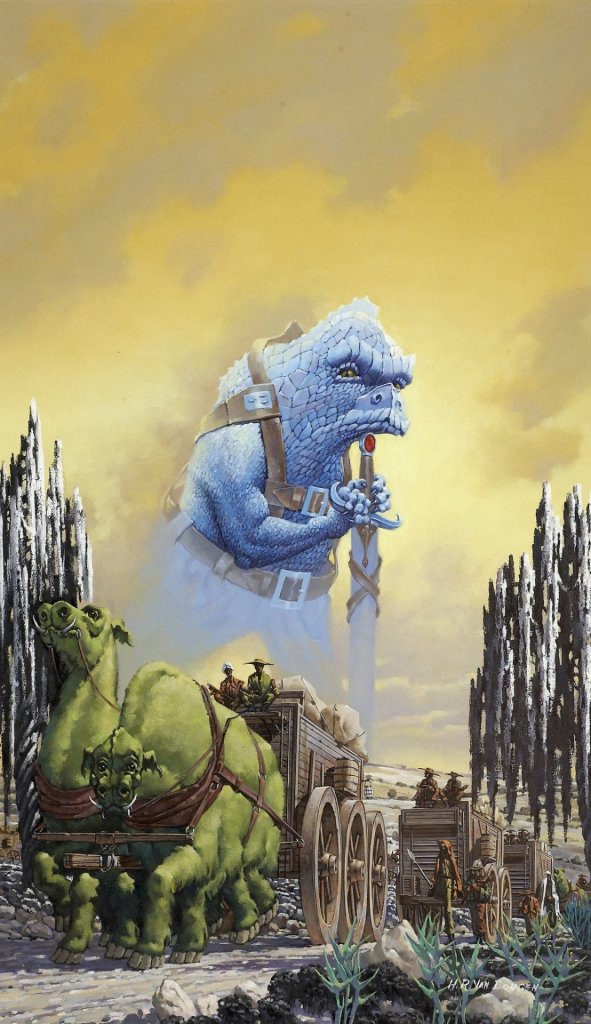
H. R. Van Dongen’s canvas for the 1979 edition of Jack Vance’s City of the Chasch (1968)
August 20th: Artist H. R. Van Dongen (1920-2010).
August 20th: Arthur Porges (1915-2006). I know little about his work. Seems to be prolific in the short form.
August 20th: Greg Bear (1951-2022). In my more expansive SF-reading days, I consumed Bear’s Darwin’s Radio (1999), Blood Music (1985), and Eon (1985).
August 20th: H. P. Lovecraft (1890-1937). If his work tickles your fancy, definitely check out Bobby D.’s wonderful website Deep Cuts in a Lovecraftian Vein. I’ve only read a few stories here and there.
August 21st: Anthony Boucher (1911-1968).
August 21st: Miriam Allen deFord (1888-1975). Check out my review of her collection Xenogenesis (1969).
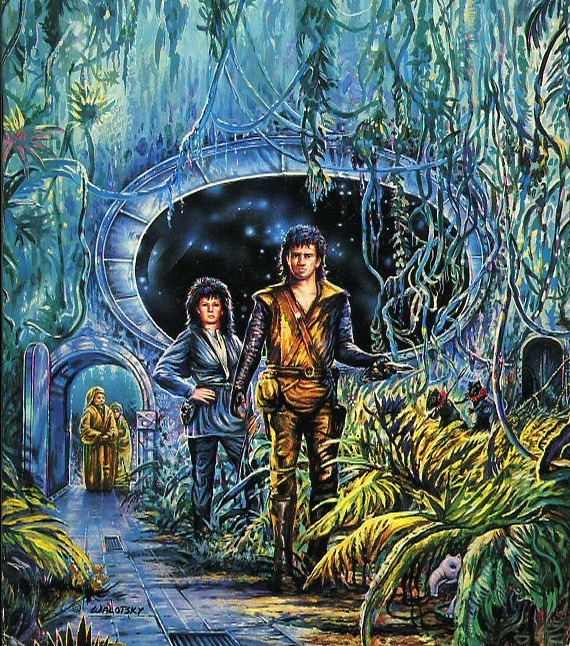
Ron Walotsky’s cover for the 1989 edition of Brian Aldiss’ Non-Stop (variant title: Starship) (1958)
August 21st: Artist Ron Walotsky (1943-2002)
August 21st: Lucius Shepard (1943-2014). I gapping whole in my SF knowledge… Sometimes I feel a bit intimidated by an author. And I think Shepard is that guy at the moment.
August 22nd: Ray Bradbury (1920-2012). Very much an author of my childhood — I remember road trips listening to audiobooks of The Martian Chronicles (1950) and The Illustrated Man (1951). I’ve covered a handful of his stories on the site: “Almost the End of the World” (1957), “The Highway” (1950), “The Pedestrian” (1951). and “The Strawberry Window” (1955).
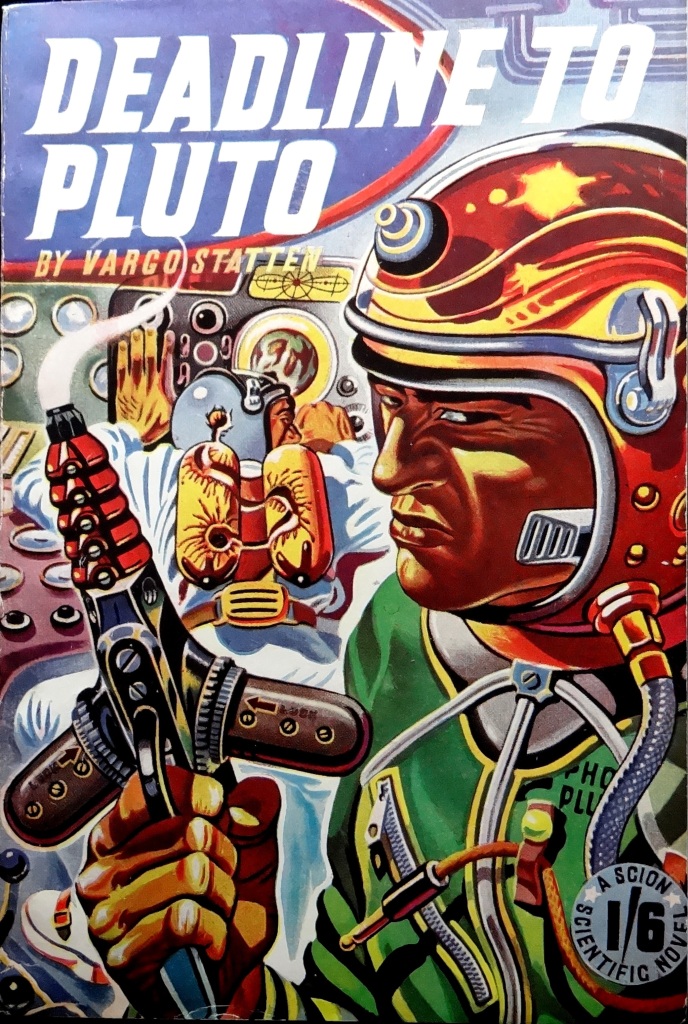
Ron Turner’s cover for John Russell Fearn’s Deadline to Pluto (1951)
August 22nd: Ron Turner (1922-1998). Sometimes I think his garish pulp covers are the only view of 50s SF some people have…
August 24th: James Tiptree, Jr. (1915-1987). A favorite of mine. I’ve covered the following: “A Momentary Taste of Being” (1975), “A Source of Innocent Merriment” (1980), “The Girl Who Was Plugged In” (1973), “Houston, Houston, Do You Read?” (1976), and “Love Is the Plan the Plan Is Death” (1973).
August 24th: Editor Bea Mahaffey (1928-1987).
August 24th: Orson Scott Card (1951-). Another author of my youth… I attended high school in a community with a substantial Mormon population. I was lent copies of Card novels by the dozen. Didn’t realize the connection at the time! In a group of “classic” authors that I have little desire to return to.
August 25th: Jeffrey A. Carver (1949-). I haven’t read any of his work. Let me know if there’s anything of his worth acquiring. Maybe Panglor (1980)?
August 26th: Gerald Kersh (1911-1968). I’ve only read “Whatever Happened to Corporal Cuckoo?” (1953).
August 26th: Otto Binder (1911-1974). Published SF with his brother Earl (1904-1966) under the name “Eando” Binder. After 1934, Otto continued using the pen name without his brother.
August 26th: C. S. Forester (1899-1966), best known for his Horatio Hornblower sequence, also wrote a few science fiction stories!
August 27th: T. L. Sherred (1915-1985)
August 27th: Artist Frank Kelly Freas (1922-2005). I can’t say I’m the biggest Freas fan. Never cared for the fuzzy airbrush feel (with a few exceptions).
August 27th: Edward Bryant (1945-2017).
August 28th: Jack Vance (1916-2013).

Burckhard Labowski and Regine Schulz’s cover for the 1983 German edition of Arkady and Boris Strugatsky’s Roadside Picnic (1972)
August 28th: Arkady Strugatsky (1925-1991).
August 28th: Vonda N. McIntyre (1948-2019). A favorite of mine — check out my review of her Hugo-winning Dreamsnake (1968) if you’re new to her work.
August 28th: Barbara Hambly (1951-).
August 29th: Don Wilcox (1905-2000). Wrote an important early generation ship story: “The Voyage That Lasted 600 Years” (1940).
August 29th: Thomas N. Scortia (1926-1986)
August 20th: Judith Moffett (1942-). Anyone read her fiction?
For book reviews consult the INDEX
For cover art posts consult the INDEX
For TV and film reviews consult the INDEX
 Science Fiction and Other Suspect Ruminations
The Ballard book sounds fascinating! The first thing I read by him was a collection of short stories, The 4-Dimensional Nightmare. It was excellent, but quintessentially Ballardian – ie, he seemed an entirely original voice to me. So I’d be very interested in reading about his actual influences. On the other hand, the fact that Wells was a big influence on Wyndham is one of those insights that’s so retrospectively obvious I wonder why it never occurred to me.
Thanks for stopping by!
I think D. Harlan Wilson’s J. G. Ballard (2017) out via U. Illinois press Masters of Science Fiction series, if I remember correctly, also talks a bit about his influences. But McGuirck’s article really dives into a handful of his earliest stories that were often in dialogue with the fiction that appeared in Galaxy magazine, which he respected. You get a great sense of Ballard as a reader.
Reading and pre-1985 SF as of late?
I was going to say no, then realised I read two Frederick Pohl stories only last week. The Merchants of Venus & The Gold at the Starbow’s End. Both were pretty solid, if of their time (the first read like a repurposed Western). I decided to give him a try because I associate him primarily with Kornbluth for some reason and had read none of his solo work.
Ah, we were just talking about that story (and collection) with Futurevisitations79 (below). Here’s my review of the collection: https://sciencefictionruminations.com/2023/09/04/book-review-the-gold-at-the-starbows-end-frederik-pohl-1972/
If you liked “The Merchant of Venus” you’ll adore his FAR superior Hugo-winning novel Gateway (1977). One I’ve been meaning to reread as my fascination with SF that engages with Freud and existential dread has increased since my late teens — haha.
Thanks for the recommendation!
No problem.
I’ve very fond memories of being enthralled by Roshwald’s ‘Level 7’ – I wasn’t quite sure how the diary entry structure would work, but it proved to be a tremendous achievement. There was a television adaptation in the 60s (adapted by J.B. Priestley), but otherwise I think this deserves to be much better known.
This last month I’ve had the pleasure of reading Matheson’s ‘I am Legend’, Asimov’s ‘Nightfall’, PKD’s ‘Second Variety’, and currently I’m wrapping up the month with Aldiss’s ‘Greybeard’ – the latter easily ranking amongst my top 3 books of the year to date.
Does the TV adaptation survive? I think I’ve heard of it before… maybe it came up in a conversation with someone on the site at some point.
But yes, I found I am Legend a pleasant and subversive surprise. My review if you haven’t seen it: https://sciencefictionruminations.com/2022/07/06/book-review-i-am-legend-richard-matheson-1954/
I really enjoyed Greybeard but never managed to review it.
Thanks – I’ll check out your Matheson review.
Yes, thankfully the 1966 production of ‘Level 7’ survives. It was made for the BBC anthology series ‘Out of the Unknown’ and was highly praised on broadcast. Like many others from this series the master tapes were wiped and for decades it was thought lost. However, a film print was discovered about 15 years ago in the archives of a European TV station (stroke of luck there).
It was released on DVD with other surviving episodes in 2014 – not sure if it’s still available though?
Glad it survived. I have never bought a DVD — hah.
If it were on Youtube I might give it a watch but I couldn’t find it with a cursory search.
What are your next reading plans after you finish Greybeard?
Spoilt for choice at the moment. Likely to end up savouring a few shorter pieces first (including Pohl’s ‘The Gold at Starbow’s End’), before launching into a long overdue reading of Keith Roberts ‘Pavane’, which I just know I’ll enjoy immensely.
I reviewed that Pohl collection: https://sciencefictionruminations.com/2023/09/04/book-review-the-gold-at-the-starbows-end-frederik-pohl-1972/
Read, enjoyed, but never managed to review Pavane. Although, I have some me-specific issues with it…
Excellent – thanks again for the link. That Panther edition is a very nostalgic image for this reader 🙂
No problem. It’s a solid collection with a few notable highlights — including the title story. As for the art, well, I’m not the biggest fan of Foss and his clones (i.e. Peter Jones, Angus McKie, Colin Hay, Elson, etc.). I really only paid attention to the art long after I started reading (and writing) about science fiction. The only cover art the generates a bit of nostalgia for me are the D’Achille covers for Edgar Rice Burroughs’ Mars sequence. They were the copies my dad had on his shelf and gave me. https://www.isfdb.org/cgi-bin/pl.cgi?392158
Yes, I agree – not so much the artwork per se, it’s more about the recollection of that particular edition being the copy I picked up as a youngster – I have a vivid recollection of reading the stomach churning (for me at the time anyway) denouement of ‘Shaffery amongst the Immortals’ 😀
Absolutely! I was more a fantasy reader in my earlier teens (the longer and more bloated the series the better). The SF I read I tended not to care for.
The last pre-1985 SF I read was The Female Man, which is very good indeed.
This week, though, I read an interesting book of gossipy SF history: Space Ships! Ray Guns! Martian Octopods!, edited by Richard Wolinsky. It’s based on a long series of interviews Wolinsky did at the San Francisco public radio station KFPA, often with Lawrence Davidson and/or Richard A. Lupoff, in which they talked to science fiction writers, including a great many veterans of the pulp era, some of them quite obscure.
The book is curiously — but I think successfully — organized — quotes from the interviews are used to sort of tell a gossipy history of SF writing and SF fandom from the ’20s to about the ’80s — so that the same writer or editor or magazine will be discussed by several of the interviewees. There is a very heavy focus on the pulp era — 1923 to 1955 or so, let’s say. Lots of interesting anecdotes, at least some of which are true! (For example, Harlan Ellison claims he was at the gathering when L. Ron Hubbard decided to start a religion, which is a bit hard to believe as Ellison only moved to New York after 1953 when he got kicked out of Ohio State.)
As for Lucius Shepard he could be very good but on the whole I find him overrated. He wrote too long, he told the same story over and over again, his style was undisciplined and not in a good way.
But if you stick to pre-1985 stuff you’ll do OK. “Salvador”. “The Spanish Lesson”. “The Man Who Painted the Dragon Griaule”. “The Jaguar Hunter”. — all those are among his best work.
Hello Rich,
I saw and appreciated your review of The Female Man (and left a comment). I think it is a novel that I would appreciate far more if I were to read it now. Wolinsky’s Space Ships sounds like an interesting book. What were some of the lesser known people he interviewed? Unless there is a specific thing I’m trying to track down, I sometimes bounce pretty heavily off the gossip style of “in” fandom history writing. There are exceptions of course!
As for Shepard, I think he’s a must considering my mostly unrealized in a systematic way interest in Vietnam-inspired SF.
Shepard is definitely a must for Vietnam-inspired SF.
Space Ships! Ray Guns! Martian Octopods! has stuff taken from interviews with the likes of Ed Earl Repp, Stuart Byrne, Stanton Coblentz, Charles Hornig, W. Ryerson Johnson, Frank K. Kelly, Frank Belknap Long, Jane Roberts, Richard Tooker, Basil Wells — as well as many more prominent writers, from Poul Anderson to Ursula Le Guin to Roger Zelazny.
I bet the Jane Roberts comments were fascinating considering her claims…. hah. I’ll keep it in mind. I’ll put it on one of my wish lists. Thank you!
Roberts was actually a pretty good writer of fantasy and science fiction — which I suppose is appropriate for her more notorious stuff! I remember coming across one of her F&SF stories and thinking “Jane Roberts is a common name. Surely that’s not the same woman who did those Seth books!” But it is, of course.
Her comments actually are interesting, dealing mostly with things like being a feminist writer back in the ’50s. No mention of the woo-woo stuff.
Sounds like an interesting interview.
Recently finished Mary Shelley’s The Last Man, which was nominally sf, intermittently fascinating, a bit overwrought. Maybe the most interesting nugget from it is that she appears to have coined the phrase “wings of desire”. The future-plague scenario is more like a thinly veiled metaphor for the narrator’s gradual alienation and disillusionment, and doesnt really fully occupy the narrative until almost the last quarter of the book. I found Beresford’s Goslings (aka A World of Women) a more compelling treatment of the trope.
Recently started in on Russ’s The Two of Them, which is great right out of the gate, her mix of black humor, deft characterization and finely observed analysis of gender politics all in evidence. Its brief, probably wont take me long to finish.
I’ve heard of the Shelley of course but not the Beresford. What is that one about?
I have a copy of the Russ. I should pick it up!
Beresford published Goslings in 1913, it weaves together a few different narratives to portray a plague striking Europe and killing almost all human males, leaving in its wake room for new, matriarchal micro-societies to spring up. Well outside your usual period of interest but I would highly recommend it.
The most interesting thing I’ve read recently is Timetipping (1980), a collection Jack Dann’s earliest fictions. Right up my alley! Paranoid, existential, dark as all hell, and possesses a great turn of phrase. So good!
EDIT: I realized you left a comment on that review.
yeah I put that on my list of things to look out for
I don’t know which version of the comment you saw. Initially I did not realize that you had left a comment on the Dann review. Sorry!
I’ve just recently finished Bester’s The Stars My Destination (1956). I much preferred it to The Demolished Man but didn’t personally find it at all thought-provoking – but lots to think about in terms of how it is constructed as an SF ripping yarn, full of wild ideas and with a breakneck pace. For the moment I’m taking a little break with The Book of Elsewhere (2024) by Keanu Reeves and China Miéville, which so far is (even) more strange and oblique than I expected.
What I meant to say was, thought-provoking in thematic terms!
I was not impressed with The Stars My Destination when I read it as an older teenager. I simply do not know what I would think of it now. Your comments do not give me hope as how it is “constructed as a SF ripping yarn” is of secondary interest to interesting explorations of themes. Of the two, I remember enjoying The Demolished Man far more. As I am conducting (slowly, hit a snag) a Galaxy read-through and The Demolished Man received a serial, I might (again, I have to decide whether to cover things in that series if I’ve already read them) cover that one this year or next year.
Greg Bear had a very good decade in the 1980s. I think I read everything he wrote during that period.
As I read them more than half my life ago, my memory is sketchy. Alas.
I read “Level 7” in the seventh grade during the early 70s. I was going through a brief end-of-the-world phase and also read “Alas, Babylon ” around the same time. I swear I bought both books through one of those catalogs schools handed out every fall (Scholastic?) but given the content of the books I have to question my memory. Still, it was the seventies and a very different world so anything is possible I remember little of the book except that it left me feeling gutted by the end.
I planned on a nostalgic apocalypse read last year and had the book set aside to read after Philip Wylie’s silly but still contextually fascinating “Triumph” but found current events have dimmed my enthusiasm for the sub-genre. Perhaps someday.
Hello, thanks for stopping by!
Coincidentally, I reviewed the Frank’s Alas, Babylon last year: https://sciencefictionruminations.com/2024/08/04/book-review-alas-babylon-pat-frank-1959/
I am relentlessly fascinated by the historical questions (I’m a historian by training and trade and approach towards SF) that end-of-the-world as we know it narratives suggest even if the novels aren’t the best. I have not got to Wylie yet but I’ve read a ton about him in various scholarship on the theme. I have a copy of it on the shelf, somewhere.
Are you reading currently or planning to read any pre-1985 in the near future?
You probably already know this, but if you’re going to read Wylie’s TRIUMPH, be sure to read TOMORROW! first.
Yeah, his views on the topic (survival, preparedness, etc.) change radically over his career.
I’ve just finished Leigh Brackett’s The long tomorrow. I really enjoyed the first 2/3rds of it but struggled to retain interest at the end with the nuclear debate and Bible quotes. Although I’ve been seeing a few things about the 80th anniversary of Hiroshima so perhaps it is more relevant than I thought…
It was a good imagining of a post-apocalyptic USA – I’m a big fan of this trope and it was cool to read her 1955 version after more recent ones like Fallout, Station Eleven.
Recommended.
Here’s my review of the Brackett. I enjoyed it. And I enjoyed its refusal to give a pat ending. https://sciencefictionruminations.com/2020/07/04/book-review-the-long-tomorrow-leigh-brackett-1955/
But yes, I too find myself relentless drawn back to the historical questions brought up by the premise.
I recently read the Gollancz Best of R. A. Lafferty-collection. Idiosyncratic and inspired, and the best stories were brilliant, but for each of the many fascinating ideas used to create something unique, there were as many that he failed to utilise, squandering them on what felt like cosy cleverness.
I struggle with his often “cosy cleverness.” I read him only in small doses!
I’ve reviewed the following on the site — maybe a few are in the collection?
“And All of the Skies Are Full of Fish” (1980)
“And Name My Name” (1974)
“And Read the Flesh Between the Lines” (1974)
“A Special Condition in Summit City” (1972)
“All Pieces of a River Shore” (1970)
“Continued on Next Rock” (1970)
“Days of Grass, Days of Straw” (1973)
“Hands of the Man” (1970)
“Interurban Queen” (1970)
“Nine Hundred Grandmothers” (1966)
“Nor Limestone Islands” (1971)
“One at a Time” (1968)
“Ride A Tin Can” (1970)
“Smoe and the Implicit Clay” (1976)
“Thieving Bear Planet” (1982)
“The World as Will and Wallpaper” (1973)
Yes, “Continued on Next Rock”, “Days of Grass, Days of Straw”, “Interurban Queen”, “Nine Hundred Grandmothers”, “Nor Limestone Islands”, “Ride A Tin Can”, “Thieving Bear Planet” and “The World as Will and Wallpaper” are all in it. Of those my favorites were “Nine Hundred Grandmothers”, Ride a Tin Can” and “The World as Will and Wallpaper” – three of the highlights of the book, actually.
I think my favorite of his stories is “Nine Hundred Grandmothers.” An actual masterpiece!
Last week I read Fugue For a Darkening Island by Christopher Priest. Extremely disturbing in both content and foresight, given the more heated discussions about mass migration, nationalism and tensions in the UK in recent years. The only downside I felt was that the novel was a tad short and ended a little too abruptly.
I look forward to checking out the rest of bibliography. I did attempt The Affirmation back in 2022 but found it slow and gave up about 40 pages in. I’m willing to give it another chance after going through the rest of his early novels, which I hear are more accessible.
I’ve begun reading “The Steel Crocodile” by D.G. Compton.
I actually have a signed copy of Fugue. Do you think it is an expose of racism or an example of racism? Or (what I imagine) a mix of both? I’ve heard a range of opinions on the book. I really enjoy Priest’s works but… I read very mixed things about that one.
There’s a very old review of Compton’s “The Steel Crocodile” on my site.
Is the novel racist or anti-racist? Can’t say for sure. Priest was probably channeling the sentiments and internal divisions of the UK at the time he was writing it, especially in the aftermath of Enoch Powell’s infamous “Rivers of Blood” speech that caused a stir in Parliament. His personal decision to soften the negative racial undertones through a rewrite indicates a change of perspective, possibly due to looking back in hindsight.
The new wave era was also marked by liberal writers using racy language and offensive moments in their writing to ruffle some feathers, so I see it as a product of the time.
Did you read the rewrite? Yeah, I will only read the original. But yes, as window into the moment I think I probably should pick it up.
I prefer reading the original novel as the author intended, even if it’s controversial. It supplies an additional viewpoint into the cultural zeitgeist of the time beside the contemporary non-fiction news reports and documentaries. Haven’t read the rewrite and doubt I will.
I’ll give my two cents about The Steel Crocodile on your review of it eventually. I remember reading Farewell, Earth’s Bliss and liking the dark psychological drama of the Martian exiles as they create their own society. It also reminded me of the equally dark and philosophical planetary prison novel The Status Civilization by Robert Sheckley.
I also reviewed The Status Civilization! I remember Farewell, Earth’s Bliss (also reviewed) far more vividly than the other two.
I don’t have any pre 1985 stuff currently on my reading (only because of how busy I am currently with some other projects), but I have seen you on Bluesky a few things calling SF Ruminations a Fanzine. Are you looking for that as your category for Hugo nominating, or fan writer?
Ah, I did not realize you were on Bluesky. I searched when I migrated from Twitter and did not find your name.
Thank you for thinking of me. While I do think SF Ruminations is a fanzine as I have a handful of guests (Rachel S. Cordasco is the only regular), include an occasional article/minor opinion piece, and interviews, I see myself more as a fan writer. That is the category I would prefer. Thank you again!
I decided to go a bit more anonymous on there after the way X went down.
Ah. No worries.
Ah, I’ve figured out your pseudonym. No worries. It’s safe with me.