I’m periodically plagued by the virulent Esoterica virus, the relentless desire to catalogue and write about the less known, and even better, the completely unknown. While attending a Medieval English literature graduate class, I remember a conversation I had with the professor, Robert D. Fulk, during office hours about the sheer quantity of scholarship on Beowulf (here’s his edition of the iconic text). I pointed out the panic I experience if I’m unable to read ALL the scholarship on a popular text.
Bizarre alien civilizations. Homesickness as psychiatric treatment. The dangers of space travel. Capitalism unleashed. Utopian possibilities? Welcome to the strange wonders of Clifford D. Simak.
Today I’ve gathered together three more fascinating Simak tales that chart his deeply critical views of American business ethic. As in my previous post on the theme, the Grandmaster creates a future in which colonization goes hand-in-hand with the exploitation of resources, workers, and threatens the often bizarre alien intelligences they encounter.1
Two of the three rank among my best reads of the year. And now, to the stories!
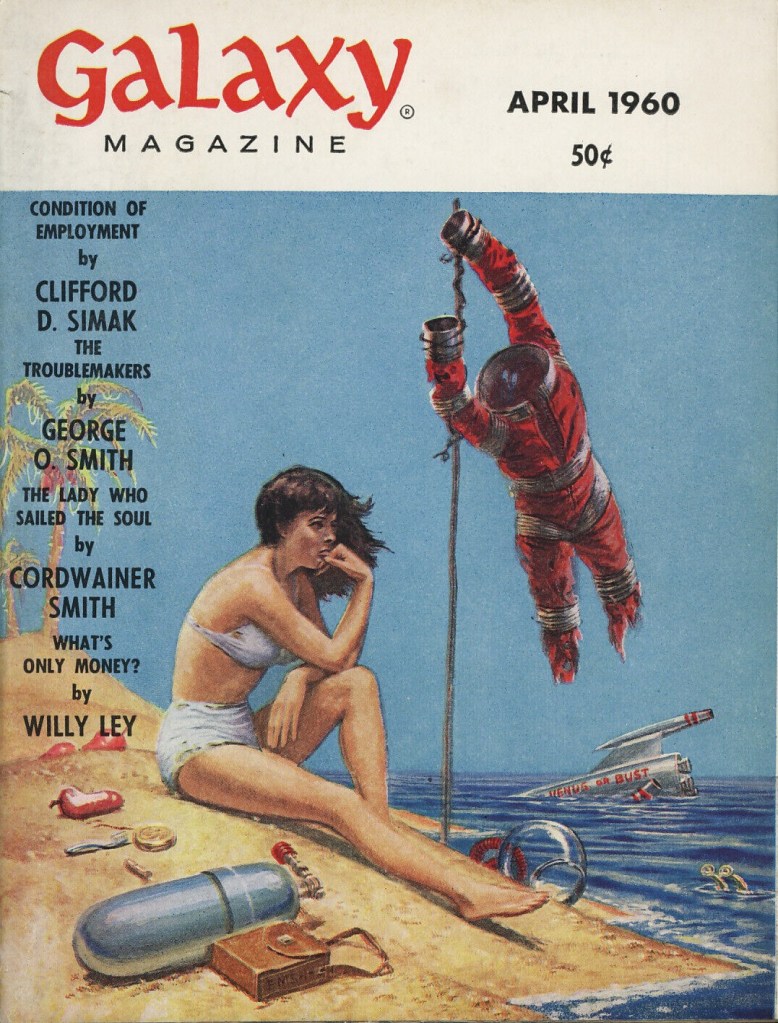
Ed Emshwiller’s cover for Galaxy Magazine (April 1960)
4.75/5 (Near Masterpiece)
“Conditions of Employment” first appeared in Galaxy, ed. H. L. Gold (April 1960). You can read it online here.
Clifford D. Simak (1904-1988) published science fiction steadily between 1931 and his death in the late 80s. His work–from City (1952) to the Hugo-winning Way Station (1963)–often demonstrates a fascination with the rural environment and the lives of “ordinary” people confronted with the alien. As I am currently working on a mini-project related to Simak,1 I thought I’d give a rundown of six of the seven interviews I’ve found reference to. I’ll also provide quotes of interesting passages, and a scanned version of one that isn’t available online. In the interviews, Simak comes across as an author deeply suspicious of rigorous generic distinctions, passionate about all life, and open to science fiction as an ever-changing and evolving entity.
The Internet Speculative Fiction Database lists five interviews on science fiction conducted with Clifford D. Simak–all published between 1975-1980. Muriel R. Becker’s indispensable Clifford D. Simak: A Primary and Secondary Bibliography (1980) includes two more: a video interview from 1971 and another from 1976 in the Minneapolis Tribune.2 I cannot find a copy of the latter. I provide links to the others in the post.
Obviously, which interview you want to read depends on your interests or questions you have about Simak. That said, I found Paul Walker’s the most fascinating (and frequently references in the little scholarship on the grandmaster).
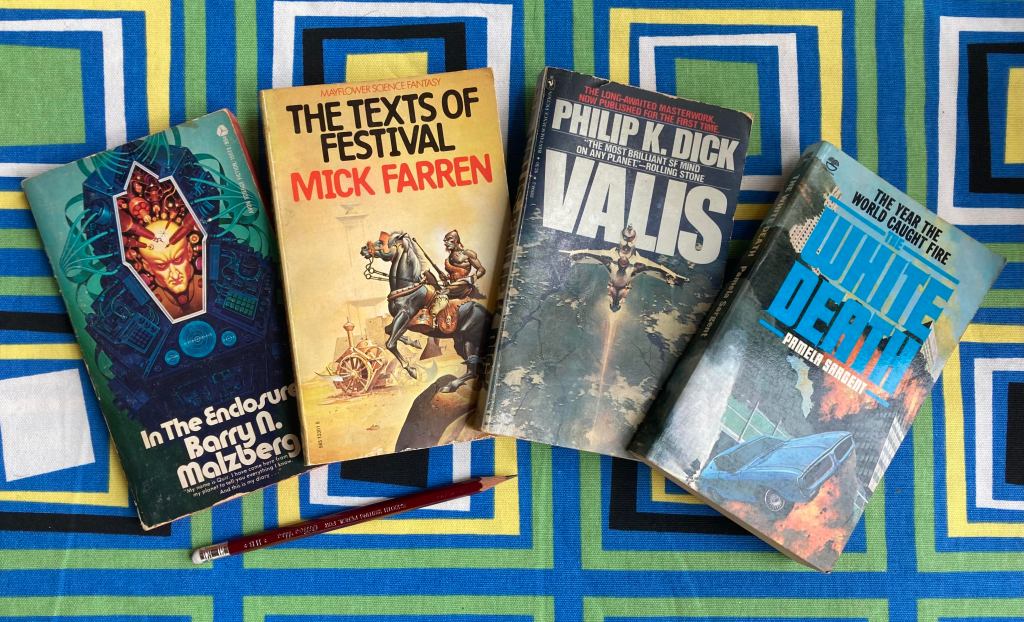
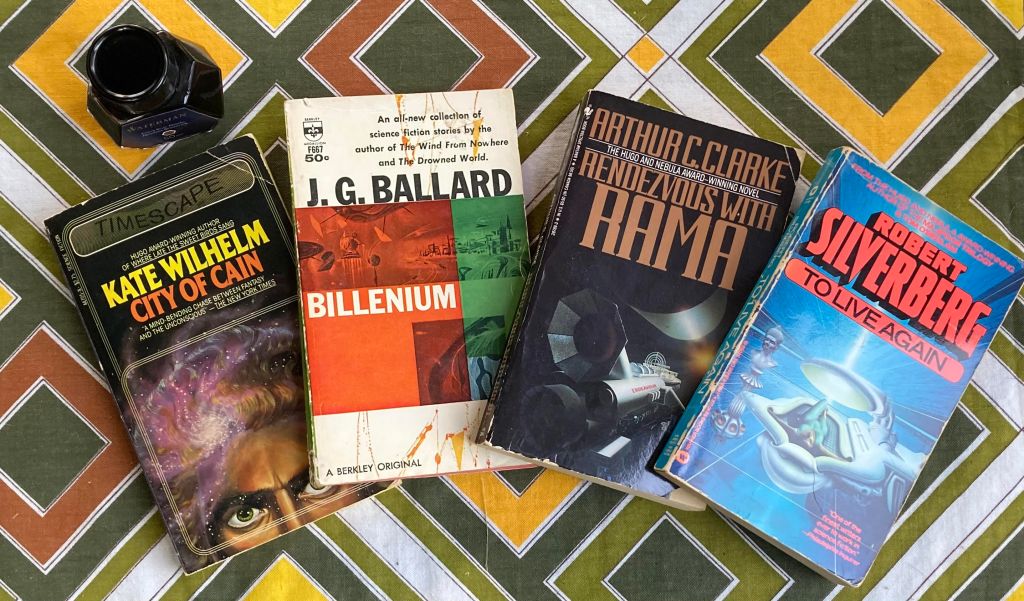
Back from Norway! Time to acquire more science fiction.
Which books/covers/authors in the post intrigue you? Which have you read? Disliked? Enjoyed?
1. The Dreaming Dragons, Damien Broderick (1980)
Carl Lundgren’s cover for the 1st US edition
From the back cover: “TO THE PLACE WHERE SECRETS LIE SLEEPING. Alf Dean, an aborigine trained as an anthropologist, knew that his tribesmen, for centuries beyond memory, had warned of a dreadful secret in the mountains of Australia.
His ‘slow-witted’ nephew led him to the secret spot–the same spot where men were claimed by deaths that were secret to the world.
Today I’m joined again by Rachel S. Cordasco, the creator of the indispensable website and resource Speculative Fiction in Translation, for the third installment of our series exploring non-English language SF worlds. Last time we covered Vladimir Colin’s Lem-esque story of an unusual alien encounter “The Contact” (1966, trans. 1970). We have stories from the Netherlands, Austria, Poland, and France in the queue.
This time we shift continents from Europe to South America with two stories by Hugo Correa (1926-2008). According to SF Encyclopedia, Correa was the “leading Chilean sf author of his generation.” Unfortunately, his best-known work, the novel Los altímos(The Superior Ones) (1951, rev. 1959) remains untranslated. Correa’s brief appearance in the American market–three short stories–came courtesy of Ray Bradbury. In 1961, the young Chilean author received a grant to participate in the writers’ workshops at the University of Iowa. He translated a handful of his own stories from Spanish to English and sent them to Ray Bradbury, who responded “with enthusiasm and encouragement.” Bradbury met with Correa when he visited Los Angeles, and the famous SF author sent a few of the translated stories to various magazine editors. Four stories eventually appeared in the North American market. It’s a shame that more of his work hasn’t been translated — yet alone a complete bibliography compiled at The Internet Speculative Fiction Database. The SF Encyclopedia entry mentions works that aren’t listed in the database. And this Spanish-language website contains a far more extensive bibliography.
We’ve selected two of his four translated stories for this post:
“Alter Ego” first appeared in The Magazine of Fantasy and Science Fiction, ed. Edward L. Ferman (July 1967). You can read it online here.
“Meccano” first appeared in International Science-Fiction, ed. Frederik Pohl (June 1968). You can read it online here.
Both are super short and worth the read.
Now let’s get to our reviews!
Jack Gaughan’s cover for The Magazine of Fantasy and Science Fiction, ed. Edward L. Ferman (July 1967)
A preliminary note: I’m something of a Robert Silverberg completionist, especially work from his glory years of 1967-1975. I’ve reviewed forty-seven of Silverberg’s short stories and thirteen of his novels–I’ve also read but never reviewed A Time of Changes (1971), The Masks of Time (1968), Tower of Glass (1970), and the stories in Capricorn Games (1976).
While a middling Silverberg novel at best, Those Who Watch (1967) almost succeeds as a revisionist take on UFO panic. The aliens do not seek to experiment on, exterminate, or manipulate humans. Instead, this is a book about the lost and lonely, and how their love and care for the injured interstellar visitors that appear on their doorsteps transform their lives. It’s a problematic work that simultaneously pulses with kindness.
As I am currently exploring the north-of-the-Arctic Circle reaches of Norway, why not segue way into this post by re-ruminating on the only Norwegian SF novel I’ve read: Knut Faldbakken’s spectacular Twilight Country(1974, trans. Joan Tate, 1993). I wish I’d thought to bring the sequel — Sweetwater (1976, trans. Joan Tate, 1994). Twilight Country, my second favorite SF novel read of 2021, contains one of the great depictions of a decaying metropolis. It is a densely metaphoric story of survival within its crumbling edifices. The masterstroke of Faldbakken’s novel is the portrayal of the Dump, a border zone containing the cast off fragments of human existence, as a place of recreation. Our characters run to the Dump to escape, to make their lives anew. They’re deeply flawed figures. There’s a tangible sense of organic transformation within the transients who inhabit this liminal zone. Sweetwater and The Dump act as a closed system. One decays into the other. One creates the other. Not recommended unless you like your SF dark and moody like me!
In January, I inaugurated a new review series on the urban landscape in science fiction. I finally present the second post! And it’s a good one. I am joined by Anthony Hayes, a frequent contributor and creator of wonderful conversations over the last few years on the site (as antyphayes). I recommend you check out his website The Sinister Science. In addition to ruminations on science fiction–often through the lens of his academic PhD research in the Situationist International, “as well as other related left-communist and post-situationist writings,” he creates fascinating collages that interweave comic books, textual play, and historical images.
We chose Robert Abernathy’s deceptively complex parable of urban alienation “Single Combat” (1955) as our inaugural story. It first appeared in The Magazine of Fantasy and Science Fiction, ed. Anthony Boucher (January 1955). You can read it online here.
Nick Solovioff’s cover for The Magazine of Fantasy and Science Fiction, ed. Anthony Boucher (January 1955)
Anthony Paul Hayes’ Rumination
Urban alienation writ large: Robert Abernathy’s “Single Combat”’ (1955)
Having planted an explosive device in a forgotten corner of an unnamed, North American city, the similarly unnamed protagonist flees. However, in fleeing the protagonist comes to realise what they had hitherto only suspected: that the city has become a living, conscious thing, and like all such things is willing to fight for its survival.my
Spring semester in the books! It’s now time to read (and go on vacation).
Which books/covers/authors in the post intrigue you? Which have you read? Disliked? Enjoyed?
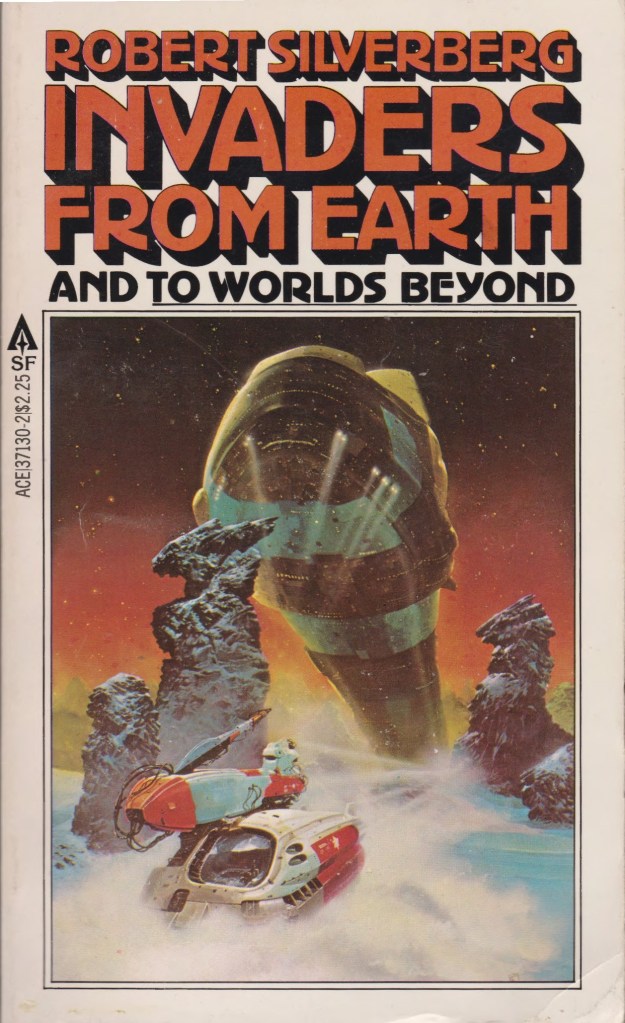
1. Invaders from Earth and To Worlds Beyond, Robert Silverberg (1980)
Chris Foss’ cover for the 1st edition.
From the back cover: “The Ganymedians had a rich, peace culture, peaceful culture extending back hundreds of thousands of years in human time. But the soil of their Jovian moon held uncountable riches in the form of the nuclear fuels Earth so desperately needed. It was a pattern that had been repeated many times in humanity’s bloody history; in Asia, in Africa, in the American West–but the nations of mankind were not ready to make the same mistake again. So when the Corporation decided it wanted those fissionables whether the Ganymedians wanted to give them up or not, they knew they had a job of selling of their hands, to swing the weight of public opinion behind them. And that was a job for Ted Kennedy, ad-man supreme. Kennedy’s record showed he could sell the public on just about anything. Even genocide.”