Updates: Recent Science Fiction Acquisitions No. CCXLV (John Brunner, Marta Randall, Brian Herbert, Amanda Hemingway)

1. A complete unknown! As is frequently the case, I discovered it during a lengthy Internet Speculative Fiction Database browse a few weeks back. I’m not sure what to expect. Although the back cover is problematic –“In danger of losing her sanity, her virginity, and even her life”–is her sanity less important than her virginity? Who knows.

2. John Brunner short stories! He’s a favorite and I buy his collections on site.

A few John Brunner short fictions I’ve particularly enjoyed:

3. In my late teens I read every Dune novel I could get my hands on—including those written by Frank Herbert’s son Brian (I don’t remember being impressed). And yes, I’ve decided to read some of Brian Herbert’s non-Dune related SF.

4. I’ve enjoyed the two Marta Randall novels I’ve reviewed.

Might as well grab the last one I didn’t own? Right? It’s the sequel to Journey (1978).

Let me know what books/covers intrigue you. Which have you read? Disliked? Enjoyed?

1. Pzyche, Amanda Hemingway (aka Jan Siegel) (1982)

(Uncredited cover for the 1982 edition) Continue reading

Updates: Recent Science Fiction Acquisitions No. CCXLIV (John Shirley, Carol Emshwiller, Daniel Walther, and Jacques Sternberg)

1. Few themes make me as excited as dystopic urbanism: the city or suburbia as an arena of all the malignancies of societal decay. The progressive SF symbol of progress, a lake of uplifting spires, tossed into anarchy and chaos….

John Shirley’s City Come A-Walking (1980) takes this premise to its extremes—the city of San Francisco, the “pulsing heart of urbanized madness” gains sentience. Definitely the Shirley novel I’ll read first (recently nabbed Shirley’s 1985 novel Eclipse).

Tarbandu read it and didn’t care for it over at The PorPor Books Blog. I hope my experience is different!

2. Back in 2017, I read and reviewed Carol Emshwiller’s masterful short story “Animal” (1968). It’s about time I read more of her short fictions.

3. I recently read and enjoyed Jacques Sternberg’s collection Future Without Future (1971, trans. 1973). He was a Belgian author who wrote in French. Unfortunately, the only other one of his SF works available in English is Sexualis ’95 (1965, trans. 1967). I’m not sure this erotic SF novel has any merit. We shall see.

Too bad his first SF novel La sortie est au fond de l’espace (1956) remains untranslated. Its premise seems like SF I could get behind: “a black comedy set in space and featuring the last human survivors of a bacterial Holocaust” (SF Encyclopedia).

4. Daniel Walther, a French SF author, positions The Book of Shai (1982, trans. C. J. Cherryh, 1984) as a deliberate anti-Ayn Rand novel. Considering the one man saves everything nature of so many post-apocalyptical and sword-and-sorcery adventures, I’m intrigued how it plays out! I don’t have high hopes.

Translated by fellow author C. J. Cherryh, who appeared to translate a bunch of the DAW French editions….  lists of translations should be a feature of her  isfdb.org listing — alas.

I also find it humorous that Cherryh gives the sequel, which she also translated, 1 star on Goodreads! The third volume of the trilogy remains untranslated.

~

1. City Come A-Walking, John Shirley (1980) (MY REVIEW)

(Catherine Huerta’s cover for the 1st edition) Continue reading

Updates: Recent Science Fiction Acquisitions No. CCXL (Melissa Scott, Ignácio de Loyola Brandão, Sheila MacLeod, and Albert J. Guerard)

1. I have yet to read anything by Melissa Scott — as is my habit, I start with a lesser known novel (in this case, her first one).

2. SF in translation from Brazil! Looks terrifying.

3. And I’m yet again the owner of another one of the worst SF covers. That said, Sheila MacLeod’s Xanthe and the Robots  (1977) seems to be an intriguing take on androids and the the nature of humanity.

4. A complete unknown author (wrote more mainstream lit than SF) and novel… According to SF encyclopedia, Albert Joseph Guerard’s only SF novel Night Journey (1950) “depicts an idealistic soldier against the background of a useless Near-Future European Future War. The loss of his illusions is rendered with psychological acuity, though the narrative itself is dithery.”

Count me intrigued.

Let me know what you think of the books and covers in the comments!

~

1. The Game Beyond, Melissa Scott (1984)

(Alan Gutierrez’s cover for the 1st edition) Continue reading

Updates: Recent Science Fiction Acquisitions No. CCXXXIX (Jack Dann, Judith Merril, Anne McCaffrey, John Shirley)

1. I have yet to read any of Jack Dann’s SF — this surreal (?) post-apocalyptical novel looks promising! And a strange Jim Burns cover to boot…

2. I recently reviewed Judith Merril’s “Wish Upon a Star” (1958) for my generation ship short story read-through (i’ll have a new installment soon). I decided to track down another one of her short fiction collections….

I’ve reviewed the following collections so far:

3. The title of Anne McCaffrey’s collection Get Off the Unicorn (1977) was derived from a humorous misprint. According to the collection’s introduction: “The title was derived by accident: McCaffrey’s working title had been “Get of the Unicorn” but this was misprinted as “Get Off the Unicorn” in Ballantine’s roster of unfilled contracts. After McCaffrey’s editor, Judy-Lynn del Rey, was repeatedly asked what “Get Off the Unicorn” was, del Rey asked McCaffrey what she could do about that theme.”

The collection itself contains a wide-range of her short fictions—from the Pern sequence (a childhood favorite) to the earliest story in the Catteni Sequence. I DEVOURED Freedom’s Landing (1995), Freedom’s Choice (1997), Freedom’s Challenge (1998), and Freedom’s Randsom (2002) as a kid! How to survive and thrive on an alien planet was my “go-to” SF device.

4. I’ve only read a handful of John Shirley’s short stories. It’s time for a novel. Eclipse (1985), set in a future a cyberpunk dystopia, tells the tale of anti-fascist resistance. We shall see!

Let me know what you think of the books and covers in the comments!

1. The Man Who Melted, Jack Dann (1984)

(Jim Burns’ cover for the 1986 edition) Continue reading

Updates: Recent Science Fiction Acquisitions No. CCXXXVII (Rex Gordon, Craig Strete, Graham Dunstan Martin, and an Anthology of European SF)

Clifford D. Simak, Tanith Lee, and M. A. Foster reviews are incoming. The first few weeks of every semester hit with a vengeance—teaching is an exhausting profession.

In the meantime get inspired to read vintage SF by ogling these gems!

1. In my youth I was obsessed with Victorian/Belle Epoque survivalist novels–Jules Verne’s The Mysterious Island (1874), Perseverance Island Or the Robinson Crusoe Of The Nineteenth Century(1885), et al. I judged them on their “realistic” portrayals of how man (and yes, the characters were always men) moved up the technological tree—from fire to steam engines—in a hostile world. Although I’ve utterly disavowed SF that adheres to such  naive technological triumphalism, occasionally nostalgia calls…. Here’s a SF Robinsonade along similar lines.

2. I adore Craig’s Strete unique brand of SF story. I reviewed, in abbreviated form, his spectacular collection If All Else Fails…. (1980). I’ll read this one soon! The Bleeding Man and Other Science Fiction Stories is also a well-designed volume as elements of the cover art are used at the beginning of each short story.

3. Another unknown commodity—seems to combine SF and fantasy tropes.

4. Back in November I acquired the second in the Terra SF series of anthologies edited by Richard D. Nolane of Western European SF in translation. I pointed out that the first volume online was prohibitively expensive. A follower on twitter discovered that a seller on Amazon incorrectly listed the collection under another title—at a radically reduced price. Now it’s a happy member of my collection.

Let me know what you think of the books and covers in the comments!

~

1. First on Mars (variant title: No Man Friday), Rex Gordon (1956)

(Kelly Freas’ cover for the 1976 edition) Continue reading

Updates: Recent Science Fiction Acquisitions No. CCXXXVI (Eric Frank Russell, Cherry Wilder, Tim Powers, and Kevin O’Donnell, Jr.)

1. I adore the SF Rediscovery series published by Avon (full listing with covers here): the large size, the font and formatting, the framing of the art, and the general feel of the volume in my hand. If there’s a downside it’s the so-so quality of the art itself. I own and have reviewed two in the series previously: Barry N. Malzberg’s brilliant Revelations (1972) and E. C. Tubb’s generation ship novel The Space-Born (1955).

I have yet to read any of Eric Frank Russell’s SF—The Great Explosion (1962) seems to fit the satirical anti-Imperialism mode… we shall see!

2. A book an author whom I know little about…. Tony Roberts’ cover and the back-cover blurb intrigue!

3. Tim Powers’ first two novels were science fiction for the Laser Books imprint. I do not have high hopes (the imprint was notoriously low quality) but always enjoy exploring the early visions of authors. Miserable cover aside, it has a fun (if silly) premise!

4. A generation ship novel! (with a few unusual twists?)

Let me know what you think of the books and covers in the comments!

1. The Great Explosion, Eric Frank Russell (1962) (MY REVIEW)

(Chris Foss’ cover for the 1975 edition) Continue reading

Updates: Recent Science Fiction Acquisition No. CCXXXV (M. A. Foster, Garry Kilworth, Cary Neeper, and Anthology)

1. A fascinating, and disturbing, themed anthology edited by Thomas M. Disch. Of the stories in the anthology (see contents below), I look forward to Gene Wolfe’s “Three Million Square Miles” (1971) the most.

Richard Powers’ cover is gorgeous.

2. I recently read and enjoyed Garry Kilworth’s The Night of Kadar (1978) so I pulled the trigger and purchased a handful of his other early SF works. I’m also for ambivalent takes on revolutions…. In Solitary (1977) is Kilworth’s first published novel. According to  SF Encyclopedia, the novel “is set on an Earth whose few remaining humans have for over 400 years been dominated by birdlike Aliens, and deals with a human rebellion whose moral impact is ambiguous; the novel is the first of several combining generic adventurousness – indeed opportunism, for Kilworth seldom accords his full attention to the raw sf elements in his tales – and an identifiably English dubiety about the roots of human action. Consequences of such action in a Kilworth novel are seldom simple, rarely flattering, usually ironized.”

Will read this one soon.

3. I know little about M. A. Foster’s SF other than a few articles I’ve read here and there–The Gameplayers of Zan (1977) included. In 2009 Jo Walton wrote a positive article about the novel on tor.com.

4. A completely unknown author (Cary Neeper) and novel (A Place Beyond Man)…. I don’t have a lot to go on for this one!

Let me know what you think of the books and covers in the comments!

~

1. The Ruins of Earth: An Anthology of the Immediate Future, ed. Thomas M. Disch (1971)

(Richard Powers’ cover for the edition) Continue reading

Updates: My 2019 in Review (Best SF Novels, Best SF Short Fiction, and Bonus Categories)

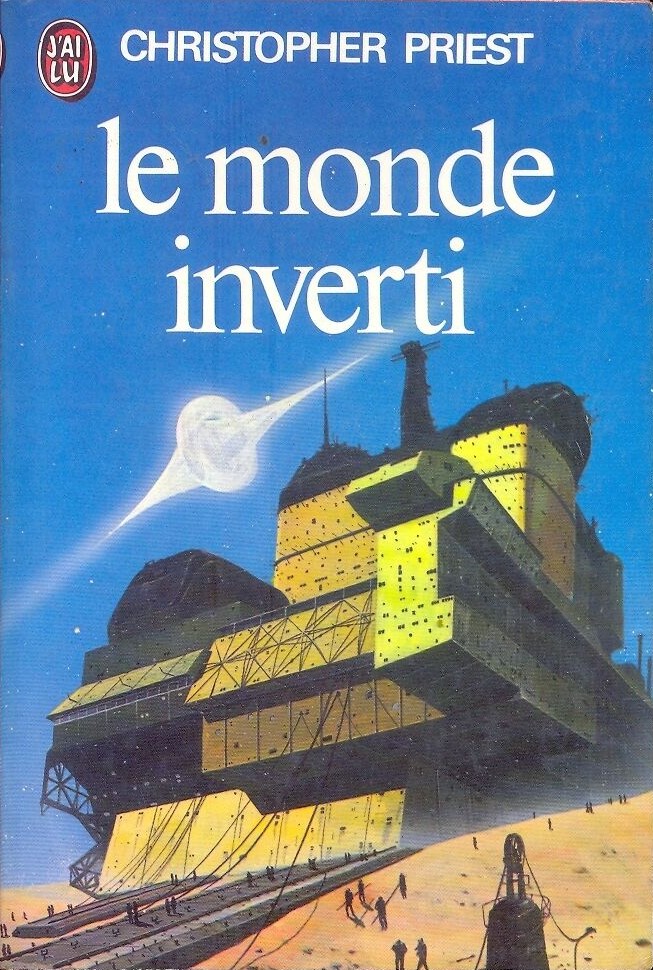
(Chis Foss’ cover for the 1976 French edition of The Inverted World (1974), Christopher Priest)

2019, the tenth year of my site, proved to be a renaissance of sorts. While I managed to read a lot in 2018, I wrote few posts—mostly acquisition and art posts (which take the least effort and time). I have returned, almost, to my earlier levels of productivity and I hope that continues into 2020. Thank you all for reading and commenting be it on the site or on twitter.  It’s greatly appreciated.

And here are my favorite novels and short stories I read in 2019 Continue reading

Short Book Reviews: Harry Harrison’s Captive Universe (1969), John Christopher’s The Death of Grass (1956), Nancy Kress’ An Alien Light (1987), and Joe Haldeman’s Mindbridge (1976)

My “to review” pile is growing and my memory of them is fading… hence short—far less analytical—reviews.

1. Mindbridge, Joe Haldeman (1976)

(Josh Kirby’s cover for the 1977 edition)

4.5/5 (Very Good)

Nominated for the 1977 Hugo Award

Joe Haldeman never struck me as an author who experimented with New Wave methods of telling. Mindbridge (1976) shatters my misconception. Imagine the basic plot of his masterpiece The Forever War (1975) combined with a fascinating experimental structure. The latter intrigued me far more than the former.

The Basic Plot: The Levant-Meyer Translation allows humans to instantaneously travel across the galaxy. The Tamer Agency sends its agents to investigate alien worlds. Continue reading