Book Review: Ground Zero Man (variant title: The Peace Machine), Bob Shaw (1971)

3.5/5 (Good)

Bob Shaw’s Ground Zero Man (1971) is a well-told take on a common 50s/60s/70s sci-fi trope — the discovery of technology which could potentially end the omnipresent danger of all out nuclear war.  Although the premise is straightforward and simplistic, the main character (Lucas Hutchman) and his motivations are drawn in a convincing manner, the ending is somewhat surprising and dark, and the novel is on the whole characterized by solid Continue reading →

Update: Recent Science Fiction Acquisitions N. V

I promised not to buy any more books over the summer unless I ran out — alas, Memorial Day Sale at one of the best Half Price Books in the country (Austin) is a “bad” combination.  I had to reduce my gigantic pile by half before I dared approach the buy counter….

I’m proud of this haul!

1. Hawksbill Station (1968), Robert Silverberg (MY REVIEW)

I’ve wanted to procure Hawksbill Station for quite a while — the premise is fantastic, five dangerous prisoners are held at Hawksbill Station located in the Cambrian era… One bizarre use of time travel!  I hope Silverberg is at his best à la The World Inside and Downward to the Earth.

2. Master of Life and Death, Robert Continue reading →

Book Review: And Chaos Died, Joanna Russ (1970)

4.5/5 (Very Good)

Nominated for the 1970 Nebula Award for Best Novel

“The ground was covered with old names…” (76)

Joanna Russ, famous for her feminist sci-fi novel The Female Man (1975), weaves together a bizarre (and difficult) novel filled with strange images, peculiar characters, and a fragmented/layered/bewildering narrative structure.  And Chaos Died (1970) is a startlingly original take on the staple sci-fi Continue reading →

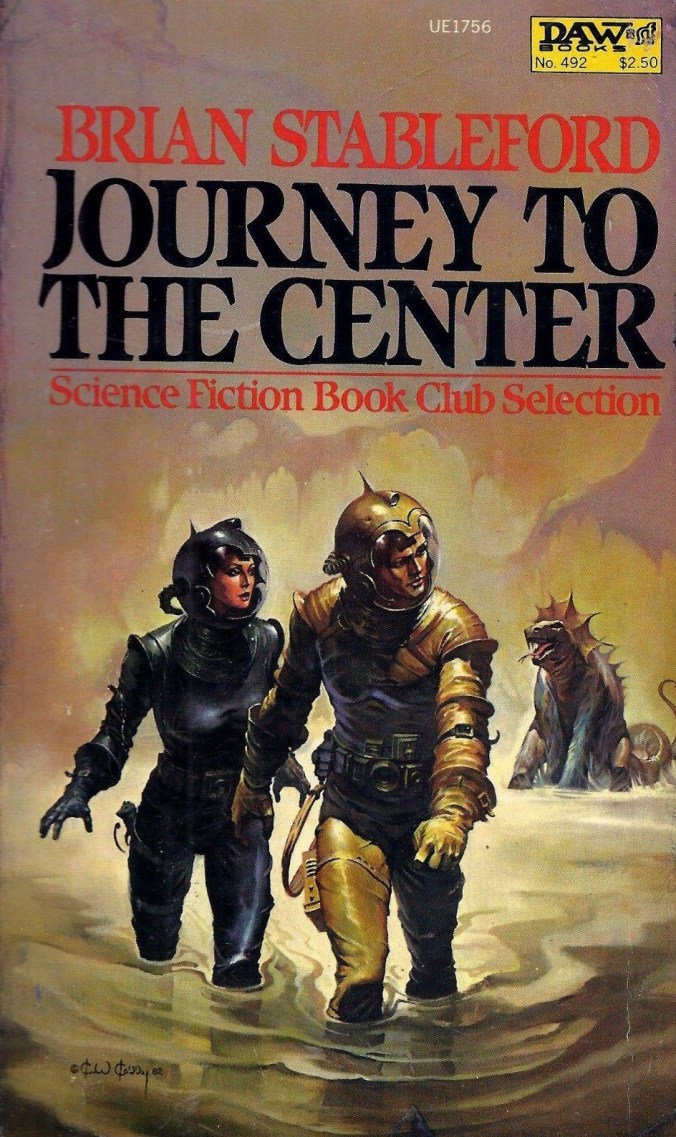
Book Review: Journey to the Center, Brian M. Stableford (1982)

journey to the center.jpg

3/5 (Average)

Brian M. Stableford’s Journey to the Center (1982) is a poor man’s Ringworld (1970) mixed with a light dose of Pohl’s Gateway (1977).  The combination is pleasantly surprising in parts but also downright dull.  Stableford’s alien species are interchangeable and uninteresting and his descriptions of the world — although a fantastic idea — fail to encapsulate the awe Asgard should inspire. Continue reading →

Book Review: The Time Hoppers, Robert Silverberg (1967)

https://i0.wp.com/www.isfdb.org/wiki/images/b/b4/THTMHPPRSC1968.jpg

2.5/5 (Average)

For me Robert Silverberg has finally lost his aura.  I knew it would happen eventually if I delved into his lesser read 60s works — but I’d been impressed recently with a string of his best (Thorns, Downward to the Earth, The World Inside) which created the aforementioned aura.  I believe in the demystification of an author (for nebulous reasons) however painful the reader’s experience might be — at least The Time Hoppers (1967) clocks in at a mere 182 pages.

The Time Hoppers takes place in an overpopulated world Continue reading →

Update: Recent Science Fiction Acquisitions N. IV

I’ve finally acquired enough science fiction books to hold me (hopefully) over the summer YET few enough that I’ll clear out 90% of previous unread novels languishing in dark forgotten corners of my bookshelves….  A valiant statement I know.  Most likely more will arrive mysteriously in the mail — when I sleepwalk I buy books (books in the mail = evidence of sleepwalking)…

1. The Time Hoppers, Robert Silverberg (1967) (MY REVIEW)

https://i0.wp.com/www.isfdb.org/wiki/images/b/b4/THTMHPPRSC1968.jpg

Another overpopulation themed novel!  From the few reviews I’ve read this pales in Continue reading →

Book Review: The Steel Crocodile, D. G. Compton (1970)

https://i0.wp.com/people.uncw.edu/smithms/Ace%20singles/s5N-series/78575.jpg

1971 Nebula Award Nominee for Best Novel

3.75/5 (Good)

D. G. Compton’s novel The Steel Crocodile (1971) is a thoughtful yet ultimately unspectacular exploration of the intersection of religion and science.  Although the work is nowhere near the level of Compton’s masterpieces (Synthajoy, The Unsleeping Eye), it infinitely surpasses the later The Missionaries (1972) which attempted to explore similar themes.  I find his strong female characters Continue reading →

Update: Sci-fi about the social ramifications of overpopulation, a call for suggestions


I need reading suggestions.

After reading John Brunner’s Hugo winning masterpiece Stand on Zanzibar (1968) a few years back I became entranced by science fiction exploring social themes (intelligently) extrapolated from a future Earth condition of extreme overpopulation.  In the recent months I’ve read and reviewed a glut of similarly themed works of uneven quality.  Many of these works were inspired by Paul and Anne Ehrlich’s non-fiction The Population Bomb (1968) which warned of the mass starvation of humans in the 1970s and 1980s as a result of overpopulation. Continue reading →