Book Review: The Hole in the Zero, M. K. Joseph (1967)

the hole in zero(Ed Soyka’s cover for the 1969 edition)

3.5/5 (Good)

I love finding a SF book on the used bookstore shelf by an author I have never heard of.  I am even more excited when a virtually unknown novel is endorsed by one of the great SF critics, in this case John Clute. According to Clute’s SF Encyclopedia entry [link] M. K. Joseph was a UK-born resident of New Zealand where he worked as a professor of English and writer.  His early novels and poetry were not SF—The Hole in the Zero (1967) is his first, and one of his only, SF works.

Brief Plot Summary/Analysis (*as always, some spoilers*)

The Hole in the Zero is primarily a character driven novel that takes a space opera premise, with (initially) very standard space opera characters, and contorts and Continue reading

Updates: Recent Science Fiction Acquisitions No. CXXI (Zelazny + White + Daventry + Gerrold)

A nice grab bag of used book store finds…  I’m nearing completion of my collection of Zelazny’s pre-1980 novels (I do not own nor really want to read any of his purely fantasy works).  Also, I couldn’t help but pick up David Gerrold’s 1974 Hugo and Nebula Award nominated novel The Man Who Folded Himself (1973) although I have been utterly underwhelmed with his work in the past—for example, Space Skimmer (1972) and Yesterday’s Children (1972).

I also found the first volume of a trilogy by Leonard Daventry—owned only the third one for some reason.  And, who can resist another James White novel.  I desperately want to recreate the joy that was White’s The Watch Below (1966).

Thoughts?

1. Damnation Alley, Roger Zelazny (1969) (MY REVIEW)

(Alan Gutierrez’s cover for the 1984 edition) Continue reading

Adventures in Science Fiction Cover Art: A Multiplication of Faces

MNDFGGRQDQ1976

(Uncredited cover for the 1976 edition of Mindfogger (1973), Michael Rogers)

It’s been more than four months since my last Adventures in Cover Art post….  Here is a bizarre, and perhaps less than artistically satisfying, collection of 50s-70s covers.  So what do we mean by a multiplication of faces? The multiplication of a single face might be a more apt title.  The theme evokes images of mind echoes (whatever they might be), bifurcated realities, abnormal, mental abilities, the manifestation of unusual nightmares, awesome alien might.

I am not sure I have a favorite although Howard Winters’ cover for the 1969 edition of The Man Without a Planet (variant title: Siege Perilous) (1966) by Lester del Rey is genuinely Continue reading

Book Review: Universe Day, Barry N. Malzberg (as K. M. O’Donnell) (1971)

(Uncredited—but looks like Paul Lehr—cover for the 1971 edition)

4.5/5 (Very Good)

“…I see no reason why we shouldn’t go to Mars in 1982…” Vice President of the U.S. July, 1969

Barry N. Malzberg’s fourth SF novel Universe Day (1971) is comprised of numerous previously published short stories as well as new material.* It might be best to think of the novel as a thematically linked sequence—in what might be termed a “future history” but unlike any you have ever read—of impressions and snippets of “what really happened” paired with what we want to happen or delude ourselves into thinking happened.  All his major themes are on display, the space program as a manifestation of humankind’s delusions of grandeur, the dehumanizing power of technology, space as playground of existential nightmares, etc.

One of Malzberg’s most appealing qualities is the sheer variety of existential situations he conjures.  Yes, many of the themes are repeated story to story (and novel to novel) but the black comedy elements are so often overlooked.  The chapter/short story “Touching Venus, 1999” encapsulates Malzberg’s absurdist brilliance.  In moments of metafictional delight, he acknowledges the artifice of the array of scenarios he constructs, the Continue reading

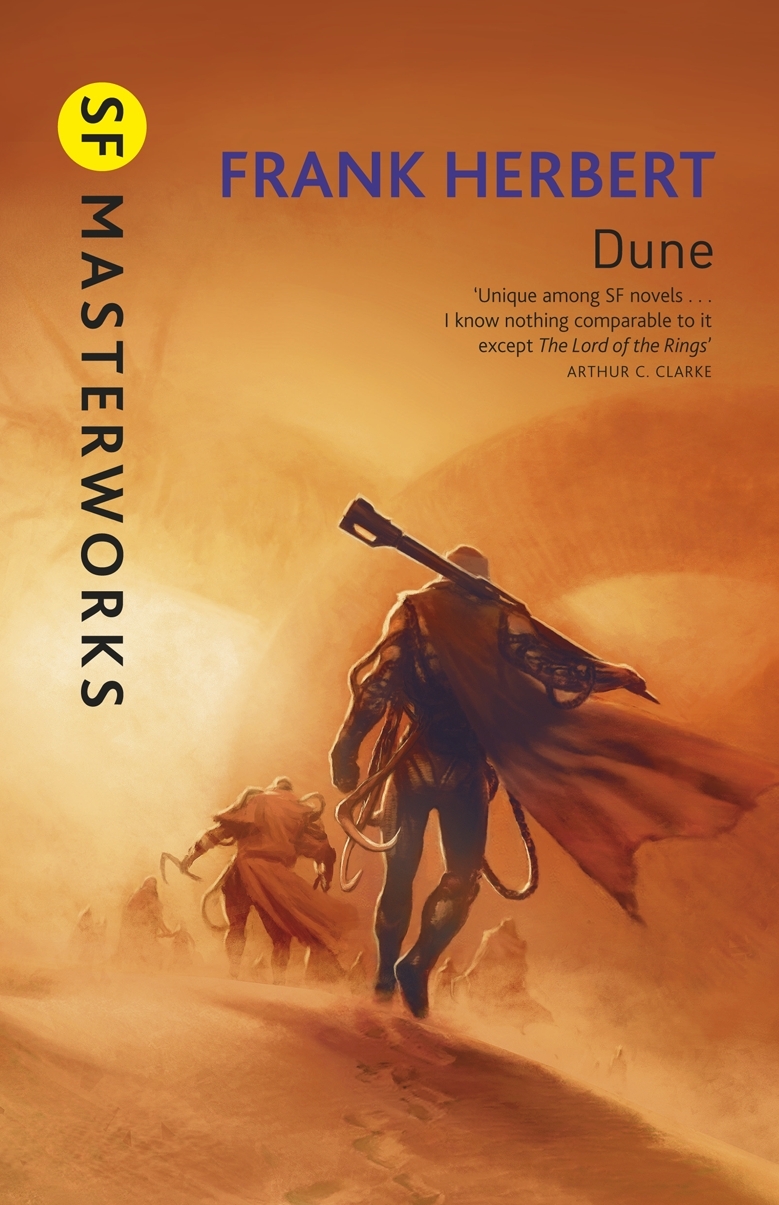
Updates: My Top 10 SF works (pre-1980) for inclusion in the Gollancz Masterwork series

Long-Tomorrow dune

The Gollancz Masterwork series [list] ranges from famous novels such as Ursula Le Guin’s The Left Hand of Darkness (1969) to lesser known short story collections such as The Caltraps of Time (1968) by David I. Masson.  The Masterwork series has the power to introduce readers to the canonical “best of SF” and works that should be considered classics.  Many of the second group have not seen print for decades.  Although I have some qualms about certain inclusions, I was genuinely blown away that they recently chose one of my favorite novels The Continuous Katherine Mortenhoe (variant title: The Unsleeping Eye) (1973) by D. G. Compton—an underread and unjustly forgotten author.

Over the course of the next week or so a handful of my fellow SF bloggers (most of whom have a focus on earlier SF) will release lists on their sites of SF they would like to see featured by Gollancz.  I have not given them any guidelines so the lists should be varied and hopefully will generate some discussion.  I highly recommend you head over to their sites (I will post the links as they come in) and comment.

Thoughts + comments are always welcome (as well as your own lists!).

More “What to Include in the Gollancz Masterwork Series” Lists (blog friends)

Chris over at Battered, Tattered, Yellowed, and Creased 

Megan over at From Couch to Moon

2theD over at Potpourri of Science Fiction Literature

Ian Sales over at It Doesn’t Have to be Right…

Jesse over at Speculiction…

2theD over at Tongues of Speculation (his votes regarding translated SF)

Martin over at Martin’s Booklog

My guidelines for inclusion

1. My frequent readers know that I prefer (passionately) SF from the 50s-70s Continue reading

Updates: Recent Science Fiction Acquisitions No. CXX (Harness + Dickson + Haldeman + Brunner)

An intriguing range of SF novels…  A few thrift store pickups and a few sent by my father.  Excited about the John Haldeman fix-up novel All My Sins Remembered (1977).  Won’t read the Brunner for a long long time—but I’m a Brunner completists so I buy his books on sight if I don’t have a copy.

Still haven’t read anything by Charles L. Harness….  Not sure about this 80s rewrite of his late 40s serialized novel.  We shall see.

Thoughts?

1. All My Sins Remembered, John Haldeman (1977)

(Paul Stinson’s cover for the 1977 edition) Continue reading

Book Review: Homeward and Beyond, Poul Anderson (1975)

(Richard Powers’ cover for the 1976 edition)

2.5/5 (Collated rating: Bad)

Homeward and Beyond (1975) is comprised of four novelettes, four short stories, and one novella.   According to an article I read recently on the Wall Street Journal, Poul Anderson was one of only five authors in the 50s that made enough writing SF without needing a day job—and he was the only one who made a “good living” (he made more money than Asimov, Heinlein, Clarke, etc).  This incredible production did not always yield quality.  Homeward and Beyond is by far one of the poorer Anderson collections I’ve encountered—on the level of  The Horn of Time (1968) and nowhere close to Time and Stars (1964)—despite the presence of his Hugo/Nebula-winning novelette “Goat Song” (1972).

Brief Plot Summary/Analysis (*some spoilers*)

“Wings of Victory” [Technic History] (1972) 2/5 (Bad) serves as the first contact story between human Continue reading

Book Review: Eye Among the Blind, Robert Holdstock (1976)

(Peter Goodfellow’s cover for the 1977 edition)

3.25/5 (Vaguely Good)

Robert Holdstock’s first science fiction novel, the anthropologically inclined Eye Among the Blind (1976), contains kernels of his later genius.  His abilities, according to critics such as John Clute, are fully manifested in works such as his fantasy novel Mythago Wood (1984).

At first glance Eye Among the Blind has the trappings of intellectually inclined “heavy” anthropological SF in the vein of Ursula Le Guin and Michael Bishop.  It tackles themes such as colonization, alien collaboration with the colonizers, aliens who do not choose to engage with the colonizers, humans who choose to live among the aliens, humans who study the aliens but are reluctant to appreciate (or take seriously) those whom they study, Continue reading

Book Review: Drunkard’s Walk, Frederik Pohl (1960)

(Nik Puspurica’s cover for the 1960 edition)

3/5 (Average)

Frederik Pohl’s best early SF was produced with his frequent collaborator C. M. Kornbluth—the most notable of which include the masterpiece The Space Merchants (1953) and Gladiator-In-Law (1954).  The solo work I have read so far from the same period does not reach the heights of his Kornbluth collaborations but rather fluctuates between downright dull satires with intelligent dogs in the vein of Slave Ship (1956) to solid but unspectacular satire about higher education, Drunkard’s Walk (1960).  As of this moment in my SF reading career I place Pohl’s editorial work above his 50s/early 60s solo SF.  That said, I have not read any of his short fiction.

Recommended for fans of 50s/60s Continue reading