Which books/covers/authors intrigue you? Which have you read? Disliked? Enjoyed?
The first purchases of 2026!
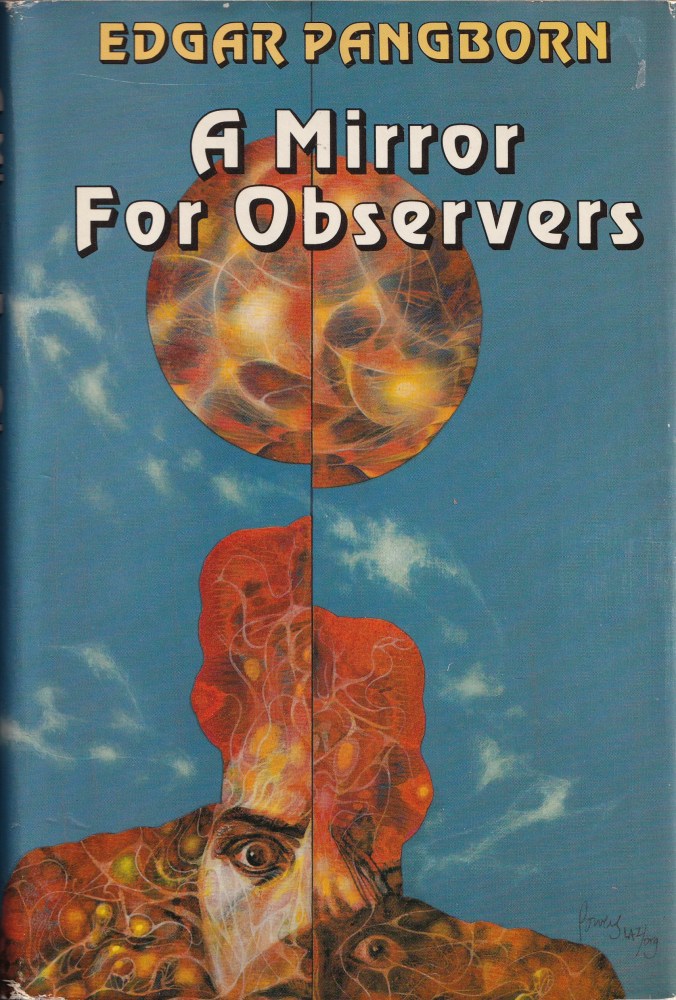
1. A Mirror For Observers, Edgar Pangborn (1954)
Richard Powers’ cover for the 1985 edition
From the back cover: “We would call them Martians, though they refer to themselves as Salvayans. Refugees from their dying planet, they arrived on our world almost 30,000 years ago to make new lives for themselves. From their vast underground cities, hidden from discovery, the Salvayans have ben observing us with care and concern, waiting for the day when humans will be ready to meet them. The Salvayans are not many, but they are long-lived and patient….
What pre-1985 science fiction are you reading or planning to read next month? Here’s the October installment of this column.
A selection of read volumes from my shelves
If I’m feeling a bit unmotivated to write about science fiction, I always end up on Fanacor another online repository of fanzines/newspapers exploring all the old historical fannish debates. I especially enjoy their reports on various conventions and the community (from accepting to reactionary) that emerges. For example, the details I uncovered about a lost Philip José Farmer speech titled “SF and the Kinsey Report at the 11th World Science Fiction Convention (Philcon 2) in Philadelphia (September 1953) and Pat M. Kuras and Rob Schmieder’s article “When It Changed: Lesbians, Gay Men, and Science Fiction Fandom” (1980) on the first Worldcon panel with an openly LGBTQ topic: “The Closed Open Mind: Homophobia in Science Fiction Fantasy Stories” moderated by Jerry Jacks, one of the “early openly gay fans.” I recently edited a friend’s article for academic publication on the role of conventions in forming feminist and political activism. Conventions sound like fascinating places, at least from my historically-minded vantage point and lens.
What pre-1985 science fiction are you reading or planning to read next month? Here’s the August installment of this column.
The Power of the List. I adore lists. I’ve compiled lists of science fiction stories on my site about generation ship stories, immortality (abandoned), overpopulation (abandoned), and sports and games (abandoned). I religiously update my SF Novel and Short Story Review index and the Best SF Novels I’ve reviewed index. In your exploration of genre, I imagine you’ve encountered a “Best Of” list that horrified you — they tend to generate controversy, argument, and all sorts of impulsive takes. Lists can be dangerous. Lists can suggest canon. Lists exclude. Lists can be incomplete. Lists can motivate. Ian Sales, a long-time critic, author, and visitor to my site, created the SF Mistressworks (unfortunately, also abandoned) website in response to an egregious list that demonstrate utter ignorance about the wonderful SF written by women.
What pre-1985 science fiction are you reading or planning to read next month? Here’s the July installment of this column.
One of my favorite forms of SF scholarship is careful identification of a intellectual genealogy–tracing what an author read and engaged in dialogue with. Authors are readers. They also can’t escape references and textual traces of what they’ve consumed (or, of course, engagement with the world in which they lived).
I’ve read two interesting examples recently. The first, Carol McGuirk’s “J. G. Ballard and American Science Fiction” in Science Fiction Studies, vol. 49 (2022), is the perfect example of this type of scholarship. She traces Ballard’s engagement with SF, his earliest stories, and the various parallels an interactions between his work and American SF that he read (Galaxy Magazine, Theodore Sturgeon, Fritz Leiber, Robert Heinlein, Frederik Pohl, C. M. Kornbluth, Ray Bradbury, Judith Merril, Federic Brown, Henry Kuttner, C. L. Moore, etc.). She argues that Ballard engaged in “retelling with a twist” (476). She writes that “early Ballard stories rework prior sf in moods ranging from measured homage to barbed repose to parodic photo-bomb” (483).
Jack Gaughan’s interior art for Arkady and Boris Strugatsky’s “Wanderers and Travellers” in International Science Fiction, ed. Frederik Pohl (November 1967).
Today I’m joined again by Rachel S. Cordasco, the creator of the indispensable website and resource Speculative Fiction in Translation, for the fifth installment of our series exploring non-English language SF worlds. Last time we covered Kathinka Lannoy’s strange (and unsuccessful) Dutch language story “Drugs’ll Do You” (1978, trans. 1981).
Please note that Rachel and I are interested in learning about a large range of authors and works vs. only tracking down the best. That means we’ll encounter some stinkers! Unlike our last entry, this one isn’t a stinker.
The first translated edition of Boris and Arkady Strugatsky’s “Wanderers and Travellers” appeared in Path Into the Unknown, ed. uncredited (1966). Unfortunately, the translator and editor (I assume Judith Merril as she wrote the intro) is unknown. You can read it online here. You can also read it in International Science Fiction, ed. Frederik Pohl (November 1967) online here.
Enjoy!
Richard Powers’ cover for the 1968 edition of Path Into the Unknown, ed. uncredited (1966)
Rachel S. Cordasco’s Review
Arkady and Boris Strugatsky, two of the greatest science fiction authors of the twentieth century, really should be read more widely in the Anglophone world. Thankfully, the Chicago Review Press has been trying to make this happen, reissuing many classics like Roadside Picnic (1972), Hard to be a God (1964), The Inhabited Island (1971), and more. Together, the Strugatsky brothers wrote an astonishing number of novels, short stories, essays, plays, and film scripts, stretching from the 1950s through the 1980s, many of which have been translated into English.
What pre-1985 science fiction are you reading or planning to read next month? Here’s the June installment of this column.
I adore teaching American History for college credit. Every summer I ponder what to change and improve. And this year, I want to integrate a few science fiction stories!
My 1950s unit in the spring semester could be modified with a few science fiction short stories. Considering my ongoing fascination with media landscapes of the future, I want to integrate one story on fears over television and one on nuclear horror (which would fit nicely with a group of assignments I have using song lyrics about atomic panic). Feel free to suggest a story that you would include or wish was included in your own US college course (or advanced high school course). No novels unfortunately. I have access to a range of syllabi and a TON of ideas but I always love to hear your selections.
Before we get to the photograph above and the curated birthdays, let me know what pre-1985 SF you’re currently reading or planning to read!
Photo of Chukwunonso Ezeiyoke’s Nigerian Speculative Fiction: The Evolution (2025)
Over the last few years, I have highlighted a smattering of the vast range of spectacular scholarship on science fiction in my reviews and Exploration Log series that intrigue me.1 Today I have an interview with Chukwunonso Ezeiyoke about his brand new book Nigerian Speculative Fiction: The Evolution (2025), the first ever monograph on Nigerian speculative fiction (science fiction, fantasy, and horror) (SF). Due to the focus of my site and research interests, I focused my questions primarily on the historical portions of his book.
You can buy a copy directly from Routledge here or on Amazon. As academic works aren’t the cheapest, can also request your library procure a copy.
Let’s get to the interview and the fascinating world of Nigerian SF!
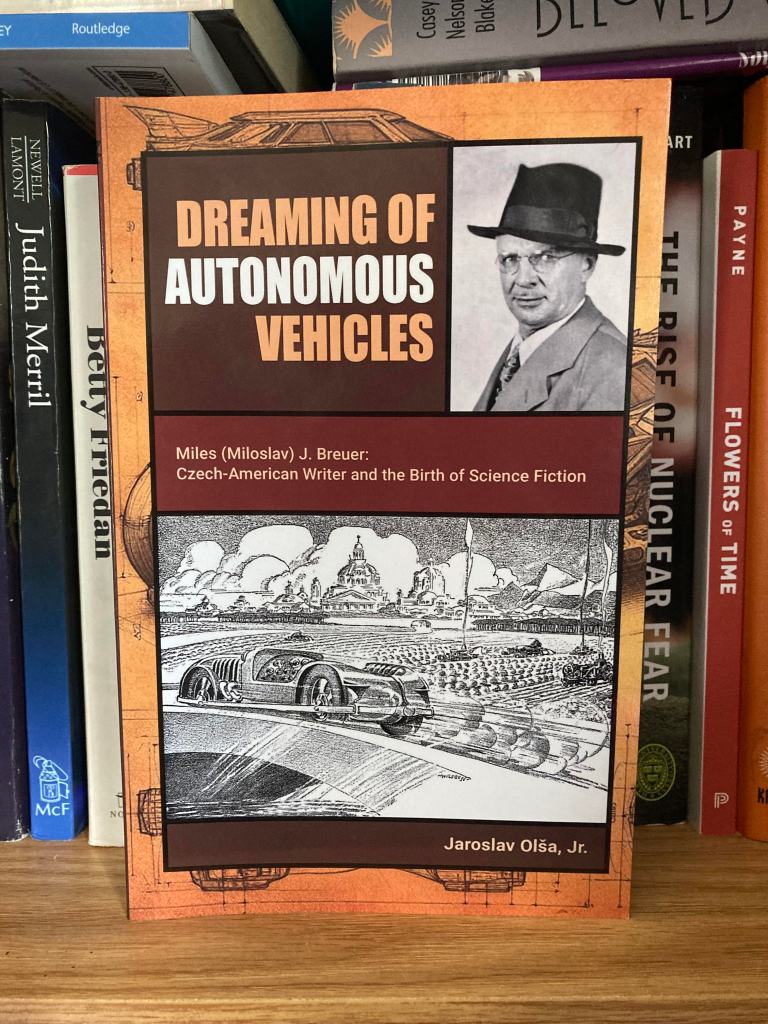
Over the last few years, I have incorporated a smattering of the vast range of spectacular scholarship on science fiction into my reviews and highlighted works with my Exploration Log series that intrigue me.1 Today I have an interview with Jaroslav Olša, Jr. about his brand-new book, Dreaming of Autonomous Vehicles: Miles (Miroslav) J. Breuer: Czech-American Writer and the Birth of Science Fiction (2025). In the book, he covers the life and career of Miles (Miroslav) J. Breuer (1889-1945), the first SF author to regularly write original stories for Hugo Gernsback’s Amazing. Breuer’s career also provides a fascinating window into the literary and cultural world of immigrants in late 19th and early 20th century America.
You can buy an inexpensive physical copy ($15.80 at last look) directly from Space Cowboy Books here (preferred) and on Amazon.
Thank you so much for agreeing to this interview. First, can you introduce yourself and your interests in science fiction?
Since childhood, I have loved reading science fiction, but — except for a short time — I have not been professionally attached to it. After studying Asian and African Studies and social sciences in Prague, Tunis and Amsterdam, I joined the Czech diplomatic three decades ago, and have served in various positions including Director of the African Dept. and the Head of the Policy Planning Dept. at the Czech Ministry of Foreign Affairs. I also served as a Czech Ambassador three times: to Zimbabwe for six years, to South Korea for another six years, and to the Philippines for four years. Since December 2020, I have served as Czech Consul General in Los Angeles in charge of the US West.
In the early 1980s, I became a part of a small but very active fandom when—in the then communist Czechoslovakia—the first science fiction club emerged. I started the SF fanzine Ikarie XB, which in 1990 turned into the first Czech-language professional SF magazine Ikarie, with monthly editions until 2024.
I have also translated many short stories and edited numerous SF anthologies, but never wrote fiction. But since the very beginning, the center of my interest in SF was to write about science fiction. I co-edited and authored entries in the only Czech SF encyclopedia, published in 1995. Thus my book about Miles (aka Miloslav) J. Breuer is somewhat of a culmination of my work on science fiction.
What drew you to the science fiction of Miles (Miloslav) J. Breuer (1889-1945)?
Preliminary Note: I plan on reading all 116 issues of the influential, and iconic, SF magazine Galaxy under H. L. Gold’s editorship (October 1950-October 1961) in chronological order. How long this project will take or how seriously/systematically I will take it are complete unknowns. I am a reader of whim. I will choose whether to reread certain stories that I’ve previously covered. Serialized novels will only be reviewed after I complete the entire work and posted as separate reviews. Why Galaxy, you might ask?
First, I can’t escape the pull of 1950s science fiction focused on social commentary and soft science. Second, I am obsessed with 50s American politics during a time of affluence, the rise of TV and mass culture, and the looming terror of the Cold War. Third, there are a legion of well-known 50s authors I’ve yet to address in any substantial manner on the site who appeared behinds its illustrious covers. Fourth, H. L. Gold was interested in all different types of stories.
As SF Encyclopedia explains, Galaxy was an “immediate success” in part because “Astounding was at this time following John W Campbell Jr’s new-found obsession with Dianetics and was otherwise more oriented towards technology.” Gold’s interests, on the other hand, “were comparatively free-ranging: he was interested in psychology, sociology and satire and other humor, and the magazine reflected this.”
Clifford D. Simak’s Time Quarry (variant title: Time and Again) (1950). Serialized over three issues. I will post an individual review after I complete the serialization.