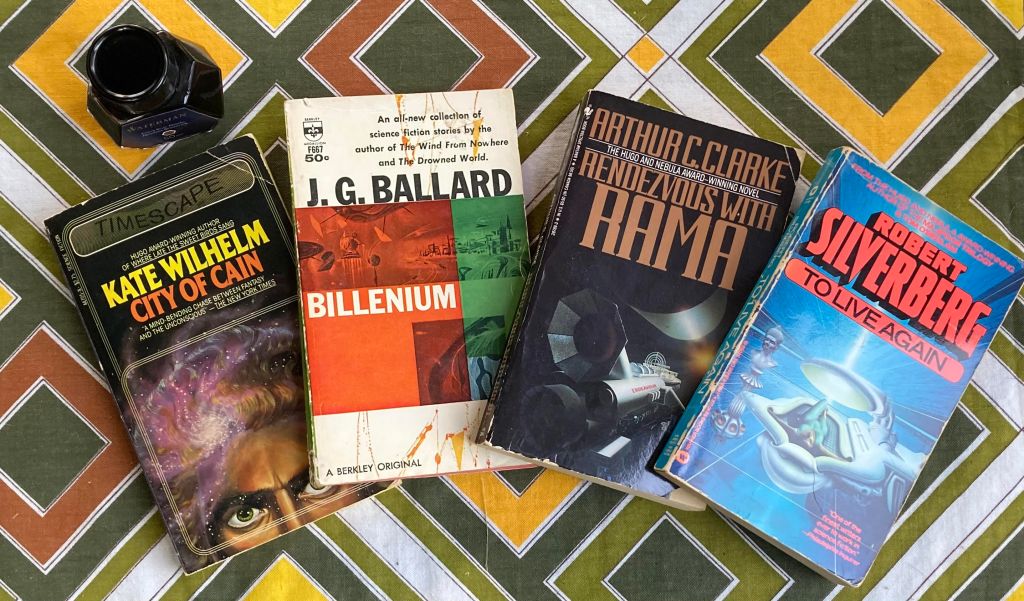
A selection of read science fiction novels from my shelves
What pre-1985 science fiction are you reading or planning to read this month?
Here’s May’s installment of this column.
As I am currently exploring the north-of-the-Arctic Circle reaches of Norway, why not segue way into this post by re-ruminating on the only Norwegian SF novel I’ve read: Knut Faldbakken’s spectacular Twilight Country (1974, trans. Joan Tate, 1993). I wish I’d thought to bring the sequel — Sweetwater (1976, trans. Joan Tate, 1994). Twilight Country, my second favorite SF novel read of 2021, contains one of the great depictions of a decaying metropolis. It is a densely metaphoric story of survival within its crumbling edifices. The masterstroke of Faldbakken’s novel is the portrayal of the Dump, a border zone containing the cast off fragments of human existence, as a place of recreation. Our characters run to the Dump to escape, to make their lives anew. They’re deeply flawed figures. There’s a tangible sense of organic transformation within the transients who inhabit this liminal zone. Sweetwater and The Dump act as a closed system. One decays into the other. One creates the other. Not recommended unless you like your SF dark and moody like me!
Any other worthwhile Norwegian SF in translation that I should track down?
Here are a few examples from my area of interest listed at Rachel Cordasco’s site: Gerd Brantenberg’s Egalia’s Daughters: A Satire of the Sexes (1977), Øyvind Myhre’s “John Henry” (1983), Tor Åge Bringsvaerd’s short story “Codemus” (1968) and “The Man Who Collected the First of September 1973” (1972), and Ingar Knudtsen Jr.’s “Turnabout” (1977).

Iain Stuart’s cover for the 1993 edition
Let’s get to the books in the photo and what I’ve been reading and writing.
The Photograph (with links to reviews and brief thoughts)
- Kate Wilhelm’s City of Cain (1974). While far from her best work, City of Cain is a moody, streamlined, and psychologically heavy near-future SF thriller that treads familiar ground. Peter Roos returns from the Vietnam War a scarred man both mentally and physically. However, he starts to identify a secret within his own family. Wilhelm effectively crafts psychological tension that propels the story forward through powerful images and dreams of subterranean cities, of increasing mechanization, of mind control…
- J. G. Ballard’s Billenium (1962) contains a handful of top-tier Ballard short stories. Check out the titular “Billenium” (1961), “Build-Up” (variant title: “The Concentration City”) (1957), and “Chronopolis” (1960).
- Arthur C. Clarke’s Rendezvous with Rama (1973). I haven’t reviewed this one as I read most of the Hugo-winning SF novels before I started writing about genre. I remember the substantial impact of the mysterious locale inside of vast alien construct (a “Big Dumb Object”) and the sanitized banality of its characters.
- Robert Silverberg’s To Live Again (1969) explores the societal effects of a new technology to upload personalities. The rich and wealthy procure multiple transplants for artistic reasons (for example, to appreciate sculpture), as savvy business moves (using the mind of your dead rival), or even to increase one’s abilities in bed. The transplants often mature their hosts or drive them insane. Unfortunately, I found To Live Again one of Silverberg’s weakest works from his best period: 1967-1975.
What am I writing about?
I am slowly working my way through my backlog of reviews. I finally completed Pat Frank’s Alas, Babylon (1959) on my flight from London to Oslo. Tangent: my wife and I sat next to the members of the fantastic Irish post-punk group Fontaines D.C.. I did not realize it until AFTER we left the plane. They were all reading books. I hope to take notes on put together the start of a review over my Norwegian adventure. I will post the next in my SF short fiction in translation series lined up with Rachel S. Cordasco within a day or two.
In the meantime check out my recent review–with Anthony Hayes–of Roger Abernathy’s fantastic “Single Combat” (1955) and short reviews of Clifford D. Simak’s They Walked Like Men (1962) and Jacques Sternberg’s Sexualis ’95 (1965, trans. 1967).
What am I reading?
Still lots and lots of Clifford D. Simak. I’m also enjoying Jacqueline Foertsch’s Reckoning Day: Race, Place, and the Atom Bom in Postwar America (2013). I should have more to say about it in the next installment of this series.
A Curated List of SF Birthdays from the Last Two Weeks
May 28th: A. Bertram Chandler (1912-1984).
May 29th: Lino Aldani (1926-2009). It’s a dying shame so little of his SF has been translated. Check out my review of “Goodnight, Sophie” (1963) and you’ll understand.
May 30th: Alice Eleanor Jones (1916-1981). I recently completed my readthrough of all five of her published science fiction short stories. I wish she had published more.

Curt Caesar’s cover for I Romanzi di Urania #99, ed. Giorgio Monicelli (1955)
May 30th: Artist Curt Caesar (1906-1974). He was the artist of the pre-Karel Thole years of Italy’s Urania publication series.
May 30th: Artist Art Sussman (1927-2008). I covered his work here.
May 30th: Chad Oliver (1928-1993). A few worthwhile short stories if he’s new to you: “Stardust” (1952) and “The Wind Blows Free” (1957).
May 30th: Marge Piercy (1936-). Dance the Eagle To Sleep (1970) is criminally underrated.
May 30th: John Jakes (1932-2023)
May 30th: William Spencer (1925-2018). One of the pre-Moorcock stable of New Worlds. He wrote some great stuff: “Horizontal Man” (1965), “The Long Memory” (1966), and “Megapolitan Underground” (1964).

Burt Shonberg interior art in Gamma 2 (1963)
May 30th: Artist Burt Shonberg (1933-1977). I covered his work here.
June 1st: Rene Auberjonois (1940-2019). Odo from Star Trek: Deep Space Nine!
June 2nd: Lester del Rey (1915-1993).
June 2nd: Ferenc Karinthy (1921-1992).
June 3rd: Artist Brian Lewis (1929-1978). One of the British SF artists. He created countless covers for New Worlds under Carnell.
June 3rd: Mike McQuay (1949-1995).
June 3rd: Artist Tony Richards (1956-).
June 4th: Artist Sanford Kossin (1926-2023).
June 4th: Charles W. Runyon (1928-2015).
June 4th: Artist Wendy Pini (1951-).
June 6th: R. C. Sherriff (1896-1975). I’ve heard solid things about The Hopkins Manuscript (variant title: The Cataclysm) (1939)
June 6th: Tom Godwin (1915-1980). Famous for the controversial “The Cold Equations” (1954), Godwin wrote quite a few additional stories that seem mostly forgotten. I’ve reviewed “The Nothing Equation” (1957).
June 6th: Robert Abernathy (1924-1990). I recently reviewed Abernathy’s surprising “Single Combat” (1955).
June 6th: Russell Bates (1941-2018), Kiowa (Native American) author, published of a handful of short stories. I reviewed all of his non-franchise science fiction in two posts last year: Part I and Part II.
June 7th: Mildred Downey Broxon (1944-). I should feature more of her fiction in my series on first published works by female SF authors I should know more about. I’ve read “The Night Is Cold, the Stars Are Far Away” (1974) and “The Stones Have Name” (1974).

June 7th: Kit Reed (1932-2017). One of the underrated SF short story smiths — and a kind soul (in my limited interactions before her passing). The stories in Mister Da V. and Other Stories (1967) are not to be missed.
June 8th: John W. Campbell, Jr. (1910-1971)
June 8th: Kate Wilhelm (1928-2018). One of my favorites! Here’s my most recent reviews of her work:
June 8th: Elizabeth A. Lynn (1946-). Another author I should feature in my series on the first published works by female SF writers I should know more about.
June 8th: Anne Charnock (1954-).
June 8th: Frank Riley (1915-1996). Co-wrote the infamous Hugo Award-winning novel They’d Rather Be Right (1957) (with Mark Clifton). He also wrote a handful of short stories that I should investigate.
June 8th: Robert F. Young (1915-1986). I’ve only read “Audience Reaction” (1954) and “Starscape with Frieze of Dreams” (1970). Both were interesting but not great.
June 9th: Keith Laumer (1925-1993)
June 9th: Lin Carter (1930-1988)
June 9th: Joe Haldeman (1943)

Keleck’s cover for the 1981 French edition of Barry N. Malzberg’s The Men Inside (1973)
June 9th: Artist Keleck (1946-2002), aka Jacqueline Barse, supplied many covers for the Titres SF series out of the French publisher J.-C. Lattès.
June 9th: John Berryman (1916-1988). A magazine filler autho? Did he write any gems?
June 10th: John Kippax (1915-1974).
For book reviews consult the INDEX
For cover art posts consult the INDEX
For TV and film reviews consult the INDEX
 Science Fiction and Other Suspect Ruminations
For once my reading is on theme!
I’m currently reading The Singularity by Dino Buzzati, a new translation of 1960’s Il grande ritratto, previously translated from Italian as Larger Than Life.
A scientist is recruited to work on a top secret project to artificially create an artificial mind. Modern computing & miniturisation were in their infancy when it was written and the project occupies an entire hidden valley, with a distributed network of components spread all around the slopes in different buildings. And, of course, the lead scientist wants it to replicate his dead wife!
It’s not very long and quite interesting but the prose is rather flat and without the turns of phrase that Calvino or Eco might have brought to it.
It’s a great one! I read it years and years and years ago under its original English title and translation: Larger Than Life. At the time, not an easy book to find so I’m thrilled there’s a new translation!
https://sciencefictionruminations.com/2017/06/20/book-review-larger-than-life-dino-buzzati-1960-trans-henry-reed/
I would recommend anything by Tor Åge Bringsvaerd you can find in translation. I have read both the short stories you have listed and loved them both. “Codemus” is a nice critique of the technological society. While “The Man Who Collected the First of September” is more akin to a Borgesian type story than outright science fiction, so I’m not sure if it’s something you would read for this site, but it is a favourite of mine.
I had been reading the anthology Protostars, edited by David Gerrold. I saw you reviewed the Gerrold edited anthology Alternities. I enjoyed it more than you did, it seems. Protostars isn’t as good as the other anthology, but I found some hidden gems in its pages. There’s a rare story by Lawrence Yep which is a quality read. The Pg Wyal story is a trip, written in the New Wave style. There’s also a Pamela Sargent story which is worth a read, if you haven’t come across it in a different book. I would recommend picking up a copy for those stories, as long as the price isn’t too high (my copy was a dollar).
The most confounding moment was the inclusion of the first published story by Scott Bradfield. Gerrold took a chance on including Bradfield in the anthology at the age of 14. There’s nothing special about his story, but Gerrold predicts that Bradfield will go on to great things as a writer. I dare say that Gerrold must have precognitive powers, as Bradfield has gone on to become a quite literary genre writer. There’s no hint that Bradfield would fulfill Gerrold’s prediction in the included story. It’s one of those happy coincidences, I suppose.
Hello Chris,
I’ll keep both of Tor Åge Bringsvaerd on my short list. I think I might squeeze one in for my SF in translation series. I love Borges. I’m all about Borgesian short stories.
I think I have a copy of Protostars somewhere. E. Michael Blake’s “The Legend of Lonnie and the Seven-Ten Split” was weirdly the highlight Alternities. And Vonda N. McIntyre put in a good shift. She’s a favorite of mine. Cut out the number of Arthur Byron Cover and Utley stories in the anthology and the rating would jump substantially!
I recently reread Rama (for a book discussion group). I had forgotten (or possibly in my naive youth, simply missed) the polyamorous three-some (two crewmen who have a single wife back home – the relationship being described as “equilateral”).
I think I read “To Live Again” when I was on a Silverberg jag in the late 1980s – I’d have to check my records to confirm.
I had forgotten too until you reminded me. I probably missed it at the time too! I seem to remember Imperial Earth being my favorite Clarke novel. But it’s been so long…
Yesterday I read Katherine MacLean’s “Pictures Don’t Lie” and listened to the X Minus One adaptation, will be writing about it soon. I liked it! Although I’m still trying to wrap my head around the science and figure if it’s actually plausible. I need to read more MacLean.
I’ve enjoyed what I’ve read of hers so far.
“Interbalance” (1960) was my most recent review: https://sciencefictionruminations.com/2022/09/10/short-story-reviews-alice-eleanor-jones-created-he-them-1955-and-katherine-macleans-interbalance-1960/
You do. To my taste, “Incommunicado,” “. . . And Be Merry,” “Defense Mechanism” (all in her collection THE DIPLOIDS), and “Unhuman Sacrifice” (in THE TROUBLE WITH YOU EARTH PEOPLE). No reason to stop there; those are just the ones that struck me the hardest when I was first reading her 60-plus years ago.
I own a copy of The Diploids. I should finally dive in.
What pre-1985 have you been reading recently John?
Right, I also started rereading The Andromeda Strain, the first in what might be a Michael Crichton marathon. Crichton occupies… a very weird place in my personal canon.
I’ve actually never read Crichton but from what I’ve read about him I’m not sure I would enjoy his work — unless it synced nicely into a theme I was exploring.
Did you ever get to the Disch I gave you?
I will read The Genocides before this year is out at least. (By the way, that Disch I recently reviewed is excellent.)
I always read your reviews Brian! (the only ones I sometimes miss are of contemporary SF. But even then I still tend to skim them to learn more about the field.)
Very early Crichton is worth reading. Andromeda Strain, Terminal Man, and Great Train Robbery (his first three books written under his own name, I think) are all pretty good. These all became movies, two of which are good. Unlike his many later novels which read like screenplays packaged as novels, the early ones worked AS novels and actually had to be adapted for the screen.
Just continuing to plod through AMAZING in fake real time. Most recently:
[June 6, 1969] Blue Skies (July 1969 Amazing) – Galactic Journey
I did come across this unexpected reference elsewhere:
“Mr. Anderson was reading in a big chair by a window which framed a view of veld crossed and recrossed by telephone wires. When he demanded gruffly what she wanted, she instinctively switched off the charming manner, sat down, and asked him about his book, confident that that was the key. But no, he thankfully laid the book aside. She saw it was called THREE DAYS TO THE MOON, and on the cover was a picture of something that looked like a bomb with a window in it, through which peered a man and a girl, both half naked. Beside his chair were stacked dozens of similar books. . . .
[After some conversation, irrelevant to our monomaniacal interests:]
” ‘Well, well,’ Mr. Anderson said forbearingly, and picked up his science fiction again. She left him, with a pang for that window and its view of the sun-soaked grasses; and another, much deeper one, of fear that at sixty, some tedious reports and bad novels were all that one could reasonably expect to enjoy.”
— Doris Lessing, MARTHA QUEST (1952) (p. 103 of the 1970 Plume edition, if anyone cares)
I always enjoy the often snide comments about SF within books — even BY SF authors themselves. I’ll have to think of some. As I am away from my library, currently in Trondheim Norway, my mind isn’t conjuring them on demand.
“of fear that at sixty, some tedious reports and bad novels were all that one could reasonably expect to enjoy” — are you suggesting something about my age? Haha (I know you’re not). I’m still in my 30s.
That was part of the quote: Doris Lessing, guying you from beyond the grave. I am but a humble messenger.
Haha, definitely.
Got a question for you all. I’ve been enjoying a lot of the BEST older science fiction books due to the recommendations I’ve gotten from this site. But are there any hilariously BAD science fiction books from the period that you can recommend?
I’m thinking something along the lines of a sci-fi B movie. Bad, but also amusing in its ineptness.
What’s the cheesiest, funniest pre-1985 science fiction you’ve read?
Hello!
As I age, I tend not to complete the novel-length SF that I’d consider really awful. I pick them up, read 50 pages, and put them down. As for the worst I’ve read (and reviewed) since I started my site, check my rating list here: https://sciencefictionruminations.com/science-fiction-book-reviews-by-author/sci-fi-book-review-index-by-rating/
Most of the really awful reviews I’ve posted are from the earlier years of the site for the reasons I mentioned. Most of the really awful stuff I finish reading is of short length — stories by Steven Utley and Arthur Byron Cover come to mind. For reviews of those, check out this link of reviews organized by author: https://sciencefictionruminations.com/science-fiction-book-reviews-by-author/
Much appreciated! I’m going to try to find a copy of Platt’s “Planet of the Voles” because it sounds hilariously dumb. Just the type of thing I am in the mood for right now. lol
That one came to mind when you asked the question along with Irving Greenfield’s Waters of Death (1967) and Rena Vale’s Beyond the Sealed World (1965).
Some of Jerry Sohl’s 1950s novels were sufficiently bad that Damon Knight devoted considerable space to them in In Search of Wonder. The ones that come to mind are POINT ULTIMATE and THE TRANSCENDENT MAN. Also, I think, COSTIGAN’S NEEDLE. But stay away from THE ODIOUS ONES, which actually had some merit.
Gah, Costigan’s Needle is trash. What was the “merit” in The Odious Ones?
THE ODIOUS ONES is a reasonably capably done thriller based on a clever idea, without the gross and obvious stupidities of his earlier novels. Not a great book, but readable without risk of anaphylactic shock. I was wrong to cite Damon Knight; it’s not mentioned in IN SEARCH OF WONDER. No idea where the false memory came from; probably Deros in the pay of George Soros. But here is PS Miller’s lukewarmly generous review from the June 1960 ANALOG:
AN_1960_06.pdf (wasabisys.com) , page 166
Well, that was a blast from the past! An issue of ASF from the transitional period in 1960 when it was Astounding-Analog, and containing a long essay by John Campbell on the Dean Drive, as well.
I started to read the first few lines of the Campbell for the comic frisson, but then my eyes glazed over the sheer impermeably crackpot contentiousness of it.
Has any author ever really done Campbell as a comic character in a historical-type novel of the period?Because he was a figure of grandiosely obdurate blockheadness, a little like a character escaped from a Charles Portis novel.
● So bad they’re good in a bad movie type of way? Some writers are just uneven, like Robert Moore Williams, who has written some really dreadful stuff, but also some interesting things. Same for Ray Cummings. But during the sixties, I just now turned sixty-six, an author who consistently turned out bad, but dumb fun short novels was John Lymington. He was a second-tier writer during the sixties. Also of interest would be the stuff of R. L. Fanthorpe. But, for gawd’s sake, for the sake of your eternal soul and your very sanity, stay away from ANYTHING by Richard F. Shaver. His fiction could often be a mix of sf, fantasy, misogyny, sexism, sleaze, toxic masculinity, hollow Earthism, and pseudo religion.
No, Sohl’s bad books were bad in a dreary, plodding way, with no redeeming amusement value. To be avoided.
Your warning on Shaver is well taken. I have read a few pages of his work but hastily desisted. His writing has an overripe quality with overtones of psychosis; it’s a reading experience sort of like biting into a peach and discovering it is rotten. Very disturbing.
I started reading the short stories collection The Doors of His Face, The Lamps of His Mouth by Roger Zelazny. I had planned on starting The Chronicles of Amber, but I think I need to read more short fictions for now to get better acquainted with him.
I think I read the first few volumes. I was far more impressed (at the time) with novels like Lord of Light and And Call Me Conrad… (variant title: This Immortal).
My most recent Zelazny review was not of one of his best (the novel he wanted to “kill off”): https://sciencefictionruminations.com/2021/12/25/book-review-to-die-in-italbar-roger-zelazny-1973/
@Mo Jamma —
You’re far better off reading The Doors of His Face, The Lamps of His Mouth and others among his 1960s short stories and novelette than the Amber stuff.
Five years ago Samuel Delany selected and introduced a collection of Zelazny stories under the title The Magic: (October 1961-October 1967) Ten Tales. That was how Zelazny’s SF stories — and they were SF, not fantasy — of that era struck readers, including Delany, then.
https://www.isfdb.org/cgi-bin/pl.cgi?694328
Once Zelazny reached the point where he could turn full-time pro (around 1969-70, IIRC, which Lord of Light and Conrad predate) and he could mostly sell any novels he wrote, his quality generally fell — so things like To Die In Italbar appeared — and he defaulted to a fantasy mode more generally, as with the Amber extruded verbiage.
Interestingly, though, he still had it, because every so often he would write something with the old skill and power — ’24 Views of Mt. Fuji, by Hokusai’ or ‘Home Is the Hangman.’ Presumably, it was just a whole lot more work, and the other stuff was easy money.
Hi, Mark.
Thanks for the heads-up. I’ve heard so many good things about Lord of Light, so I think I’ll jump there once I finish the collection. It’s a shame that the Amber series is a dud to you guys, given the premise sounded interesting. Apparently, it’s in the works for a TV adaptation, but given what happened to Rings of Power, I think it’s for the best to just leave it.
I was a HUGE fantasy reader as a younger teen (before I moved to SF). I tended to judge fantasy on its maps, “worldbuilding,” details, etc. i.e. poisoned by Tolkein! hahaha. This is all to say, I doubt a 14-year-old me was a good judge of Zelazny’s fantasy. I am not sure what I would think now. Unfortunately, I gave my Amber series volumes away at some point.
To be fair, I haven’t read enough fantasy. One novel I really liked was John Crowley’s The Deep, despite how dense and sometimes confusing the narrative was (all those similar sounding names between the Reds and Blacks). Do you have any recommendations for dark mature fantasy like that (full of graphic violence, political intrigue and sex)? I’m not looking for Game of Thrones. Something more along the lines of The Pastel City or Book of the New Sun.
Mo Jamma: Do you have any recommendations for dark mature fantasy?
Crowley is as good as it gets. You might try more Crowley — specifically, Little, Big (1982).
https://en.wikipedia.org/wiki/Little,_Big
It’s long, at 538 pages — long, anyway, by the standards of many novels I admire from the 1950s-60s, which commonly clocked in at as little as 165-180 pages (e.g. most P.K. Dick, Jim Thompson, Algis Budrys’s Rogue Moon) with a longish novel then being around 235-240 pages (e.g. Walter Tevis’s The Hustler or Bester’s The Stars My Destination.)
So for me Little, Big had its longeurs, and I trudged through parts. But there’s lots to respect, and I’m someone who loathes most fantasy.
Other than that, Jack Vance’s stuff and Michael Swanwick’s The Iron Dragon’s Daughter, which is a fantasy novel where Faerie has undergone an Industrial Revolution, the elves wear Armani suits and dragons function as jet fighters in the neo-colonial Vietnam-type war the Elf elites are conducting.
Again, this is coming to you from someone who loathes most fantasy.
I’ve read The Stars My Destination and The Man Who Fell to Earth. They’re among some of my favorite sci-fi novels of all time. I’m keen on checking out The Queen’s Gambit and Mockingbird at some point.
I’ll look for Little Big. I don’t mind a longer read to get through the rest of the summer after finishing some short stories.
Unfortunately, I read fantasy before (early teens) I moved to science fiction, and the fantasy I read was the blatant bloated Tolkein ripoff stuff (Robert Jordan, Tad Williams, etc.). I don’t have suggestions as the few examples I’ve read and enjoyed since then — The Pastel City, The Deep, etc. — you already listed.
Edit: One example came to mind. It’s not as good as the Crowley or Harrison — Colin Greenland’s Daybreak on a Different Mountain (1984). But maybe some stuff by Tanith Lee, early Nancy Kress, or Patricia McKillip would also fit your bill (I’ve only read their early science fiction work but both wrote fantasy as well).
I did a talk about robots and AI in Stanisalw Lems works a couple of weeks ago, so I reread a lot of his short stories on the topic, mostly from The Cyberiad, Mortal Engines and Imaginary Magnitude. Mainly things I read a long time ago, but they were just as good as I remembered, if not better. Unfortunately I didn’t have much time and had to skim a lot, so I hope I’ll be able to do a deeper reread soon.
Except for that I didn’t read any SF this last month, but I did read Iain Sinclairs London Orbital, which contain a lot of Ballardian ideas, as well as an interview of sorts with Ballard himself, so it might be of interest here.
@ Jannik Juhl —
Imaginary Magnitude and Golem XIV, together with Lem’s His Master’s Voice, are pretty much the apex, the high-water mark, of what SF can do.
Or, anyway, SF of a certain super-high-flying, intellectual kind
What was the talk for? Tell me more 🙂
The city where I live (Odense) has a lot of robot producing companies, so to promote this industry (and maybe get more young people to study engineering or data science) there was a “Robot and Science”-festival, with all kinds of robot themed activities (as well as quite a few that had nothing to do with robots at all).
In my talk I especially focused on Lems critique of the standard way to think AI- og robot design, ie trying to create copies of ourselves in stead of actually exploring something unknown, a theme prominent throughout his work, not least in one of my all time favorite Lem stories, the sadly almost unknown Doctor Diagoras.
The classic line from Solaris about how we don’t want to find new worlds, only mirrors, also seems to fits perfectly with all these new “robots” (mostly just mobile info terminals) given emoji-like facial expressions to make them “relatable”.
Avoiding the robotic uncanny valley!
I love this chart.
“Hypothesized emotional response of subjects is plotted against anthropomorphism of a robot, according to Masahiro Mori’s statements. The uncanny valley is the region of negative emotional response towards robots that seem “almost” human.”
https://en.wikipedia.org/wiki/Uncanny_valley#/media/File:Mori_Uncanny_Valley.svg
Ha, yes I remember that chart – it always seemed weird to me that zombies have the lowest score, because they don’t seem uncanny to me at all, probably because any “zombie” I have ever seen has been a human in make up playing a role (and often somewhat badly).
As far as I remember Lem never addressed the uncanny walley, his point was always that we shouldn’t try to make machines in our own image, not because they wouldn’t appear “right”, but because its a closeminded, self obsessed and unimaginative approach.
I recently finished “The Eskimo Invasion” by Hayden Howard (1968 Nebula Nominee). It was honestly really, really bad. But onward to better books! The next I’m waiting on is “Black Easter” by James Blish (1969 nominee for Nebula).
Yeah, I’ve not heard the best things about Howard. I haven’t read it yet.
Mark Pontin asked (but there’s no Reply link there): “Has any author ever really done Campbell as a comic character in a historical-type novel of the period?”
Don’t know of any novels, but there is John R. Pierce’s “John Sze’s Future,” original to Groff Conklin’s 1962 anthology GREAT SCIENCE FICTION BY SCIENTISTS, which lampoons his psi mania rather maniacally. I remember it as quite amusing (can’t put my hands on the book for some reason). It’s interesting, since Pierce was a prolific contributor of articles, along with a few stories, under his name and as J.J. Coupling, from the late ’30s to the mid-’50s. Apparently he didn’t burn his bridges since he had a couple of stories in ANALOG in the late 60s.
Not quite what’s looked for, but Asimov parodied Campbell’s style of rejection letter in a poem (in F&SF) (his style of rejection was inscrutable and lengthy, contrasted in the poem with Gold’s rejections (insulting, but still asking for more submissions) and Boucher’s (so complimentary that it was hard to realize that the piece had actually been rejected)
Thanks, John.
As it happens, the Luminist archive has Conklin’s Great Science Fiction By Scientists here.
Also Campbell’s Collected Editorials. But I think I’ll save that rare wine for another day.
Lavie Tidhar’s recent novel The Circumference of the World has Campbell as an off-stage character, in that Tidhar has sections which are letters from Campbell to Asimov, replete with tone-deaf Campbellian comments to ‘Ike’ about the innate intellectuality of ‘your people.’ I assumed Tidhar made them up, but they could as easily be real.
If anything, they’re too mild. I glanced at the Kindle samples of the front matter in the two volumes of Campbell’s letters edited by P. Chapdelaine. They contain an account of Campbell at an SF convention in England in the 1960s, and a panel where after Campbell speaks the microphone is passed to Mike Moorcock for comment and Moorcock just says ‘Christ!’ and passes the microphone on. Chapdelaine — or whomever wrote that particular bit of front matter — then cites this as an instance of how lesser minds just weren’t open enough to accept the ever-questioning genius of John W. Campbell.
Moorcock’s account of the event: “I sat on a panel with him in 1965, as he pointed out that the worker bee when unable to work dies of misery, that the moujiks when freed went to their masters and begged to be enslaved again, that the ideals of the anti-slavers who fought in the Civil War were merely expressions of self-interest and that the blacks were ‘against’ emancipation, which was fundamentally why they were indulging in ‘leaderless’ riots in the suburbs of Los Angeles.”
Link- https://en.wikipedia.org/wiki/John_W._Campbell#Slavery,_race,_and_segregation
This says so much about the New Wave and Moorcock’s role in it.
Recent reading has largely been outside this window (LeGuin’s “Hainish Novels & Stories, Volume Two”, Christopher Priest’s “The Adjacent”, George MacDonald’s “Phantastes”), only the latter of which has really been satisfying. Curious about Wilhelm’s “City of Cain”, generally enjoyed pretty much everything I’ve read of hers, and that plot summary seems very of a piece with her other writing of the period. Still looking for copies of Moorcock’s “Count Brass” cycle (either 70s or 80s editions), which I’ve been meaning to re-read to see how they would measure up to my teenage memories. On the lookout for more Pangborn as well, since I thoroughly enjoyed “Davy” (prompted by your review).
Ah, yeah, only The Word for World Is Forest (1972) in volume two of the Hainish Novels & Stories is within the window. What did you think of it?
I plan on getting to another Pangborn novel by the summer’s end.
The Wilhelm is a functional thriller with some interesting moments. I am fascinated by science fiction that touches on the Vietnam War so I made sure to finish.
I’d read The Word for World is Forest previously so skipped it in this collection (it’s great, obviously). Wilhelm did seem to relish that kind of gloomy 70s technothriller style where scientists and dissidents are caught up in a thicket of conspiracies and ethical conflicts a la “The Clewiston Test” or “Welcome, Chaos” . Enjoyable enough if I’m in the mood.
Well, if you already like those then track down a copy of the Wilhelm!
Other Days, Other Eyes by Bob Shaw.
I have been meaning to read this for ages, but had baulked at the prices being asked for it. Luckily I found a cheap copy (the Ace edition) in a Brighton secondhand bookshop the other day.
I will admit that part of its appeal was its evocative title.
The central idea is brilliant and the novel certainly has its moments. There is a strong current of humour that runs through it, which helps, especially during the wilder lurches of plot (the inventor of slow glass unleashes his inner Sherlock Holmes a couple of times). One of the sub-plots anticipates the end of Gilliam’s Brazil. And the lens implants anticipate Katherine Mortenhoe, maybe.
Whether or not Shaw is trying to warn us, in the novel, of the unforeseen consequences of our actions I don’t know. It could be he is just trying to spin a good yarn. Despite the composite elements I think he succeeds in that. I may give some of his other stuff a go at some point – Wreath of Stars, perhaps. If anyone reading this could recommend further Shaw I’d be interested to hear their ideas.
Hello!
All the Shaw I’ve read I’ve reviewed on the site. Nothing I’ve covered, 2 novels and 1 additional short story, approaches the quality of the chunk of Other Days, Other Eyes that I read. But as you probably know, Other Days, Other Eyes is a fix-up novel of previously published stories, hence its composite nature. I’ve read, and enjoyed, one portion of the novel — “Light of Other Days” (1966)– but haven’t read the complete fix-up.
I wrote the following short review: “Part of his Slow Glass sequence of stories gathered together six years later in the fix-up novel Other Days, Other Eyes (1972), “Light of Other Days” places a SF technology—glass that slows down the passage of light—into a richly moving story about the power of memory. The narrator and his wife arrive at a slow glass store in remote Scotland and decide to buy panes for their own house. The windows of the store, installed with the glass, suggest a bucolic and peaceful existence as they slowly play forth images from the store owner’s past. But they learn that behind the glass a different existence transpires, an existence shrouded with sadness and loss. And this glimpse allows the narrator and his wife, potentially, to navigate their own strife—or at the very least reinforce the possibility of rekindling their connection.
Affective without being saccharine and the imagery is beautiful….”
Light of Other days crops up early in the novel and is one of its best passages.
I was relieved not to have forked out a small fortune for it but am pleased to have finally read it. Shaw will probably remain one of my bookshop authors, someone whose work I’ll read as / when I stumble across it. Absurdly I would pick up the UK edition as I prefer its cover.
Good luck with the Simak.
Yeah, I own the uncredited 1978 UK Pan edition. Here’s my purchase post from a few years ago: https://sciencefictionruminations.com/2018/05/30/updates-recent-science-fiction-acquisitions-no-cxci-bob-shaw-james-morrow-richard-e-peck-anthology-of-french-sf/
I wish I owned the 1972 Ace edition. I think it’s my favorite edition: https://www.isfdb.org/wiki/images/a/a6/THRDSTHRST1972.jpg
If you lived in dear old Blighty I’d offer to swap.
Neither cover are ugly at least.
I actually liked “Alas, Babylon”–much, much better than the more celebrated “On the Beach,” which covered some of the same ground and came out around the same time–major Hollywood movie etc etc. And MUCH better than the fairly repellant “One Second After” more recent series. “Alas, Babylon” was pretty touching in its optimism about a post-nuclear Florida, though. Denis Johnson’s very weird “Fiskadoro” probably nailed it better.
I should have a review up in the next two or so weeks. I am a incredibly slow writer and just got back from vacation with a stack to write about! Stay tuned.
As for Fiskadoro, I snagged a copy a few years ago but haven’t read it yet. I can’t say the William R. Forstchen novels sound that interesting, even earlier work that fits the bill of my site like Ice Prophet (1983).
“Ice Prophet” is “Dune on Ice!” but I liked the series when I was in college in the 80s
He is not a name I knew.
I weirdly enjoy Don Dixon’s alien on the cover for The Alexandrian Ring (1987)! https://www.isfdb.org/wiki/images/a/aa/BKTG03359.jpg
In the 1980s Forstchen taught at a private school in Maine – and one of my college friends had been one of his students, so that’s how I heard of him.
I am a big fan of Denis Johnson and of Fiskadoro, which is a post-apocalyptic novel deeply unlike any that anybody else ever wrote, and for that matter unlike anything else Johnson himself wrote (beyond the fact that he was a writer who could pull off unconventional, hallucinogenic effects; forex the LARP underground tunnel sequences in his Vietnam novel, Tree of Smoke).
I’ll be interested to see what you make of it.
It may be the case that you don’t finish it, or make it through but find it resists your ability to say anything sensible about it although you admire it. It’s that kind of novel, as weird as Ballard’s The Unlimited Dream Company — or weirder, really, because the post-apocalyptic reality it presents is arguably reflective of a possible real-world future.
Agree with Mark about FISKADORO. But then it seems I almost always agree with Mark.
I reviewed Fiskadoro here, in case you’re interested.
Thank you!
I posted my Alas, Babylon review today. Here’s a link: https://sciencefictionruminations.com/2024/08/04/book-review-alas-babylon-pat-frank-1959/
At present, it’s Ordeal in Otherwhere by Andre Norton.
An author I wished I knew about earlier in my SF reading adventure (was more a fantasy kid as a teenager)… I enjoyed the few of her works I’ve read.
Doc Smith’s late attempt to keep up, The Galaxy Primes (1959). Literally one of the worst things I’ve ever read (including technical manuals).
Yes! Flamboyantly terrible, unlike, say, Jerry Sohl, who was rather drably terrible.
Oops, that was intended as a reply to Gray’s question about bad books — but that was years ago.
What I’ve read this month: I finally got to Kuttner/Moore’s No Boundaries. “Vintage Season” is certainly the high point, but almost everything else is at least good, if you can read it with 50s eyes. “The Devil We Know” is basically a Faust, but it’s a tough chew if the casual misogyny offends you, and it’s central to the plot. A couple robot stories that still resonate with current AI concerns: “Home There’s No Returning” (Hugo nom, title cribbed uncited from a Housman poem) and “Two-Handed Engine” (also another Faustian pact-gone-wrong). And “Exit the Professor”, a damp squib of Hillbilly humor in dialect that’s dated worse than the above-mentioned misogyny. Earth unshaken but a pleasant enough evening flashback to the mid-50s.
Also, the first of Lord Dunsany’s “Irish novels”, The Curse of the Wise Woman, which I’d have to spoil to talk about whether it’s genre fantasy or not, but has some of the best landscape word-painting I’ve read since J.A. Baker’s The Peregrine.
Sounds awful. I struggled to get through some of his earlier “masterworks” despite understanding their historical importance.
I finished my first Fritz Leiber in The Big Time (1958) a couple days ago. I’ve started my second Larry Niven, The Integral Trees (1984).
I enjoyed both — for radically different reasons — as an older teen. I have soured massively on Niven’s work since then and grown to appreciate Leiber even more.
In honor of the 40th anniversary of William Gibson’s “Neuromancer” on July 1st, I am reading the book again. Thank you for the question.
Definitely a good one! No problem.
The most recent pre-1985 novel I read is AFTER LONDON by Richard Jefferies, first published in 1885. I was quite impressed with the opening section, which described how nature reclaimed the world after the fall of civilization. The second section is an adventure story set in this new post-apocalyptic world. It’s pretty good, but not as impressive as the first section.
The next old SF book I plan to read is THE MEMOIRS OF A SURVIVOR (1974) by Doris Lessing. Our times makes me want to read fiction about collapsing civilizations.
I read your review of After London. Sounds intriguing. For anyone who might want to take a look: https://classicsofsciencefiction.com/2024/06/22/after-london-by-richard-jefferies/
I’ve had the Lessing on my list to read for years and years and years and have never convinced myself to pick it up. I eagerly await your thoughts.