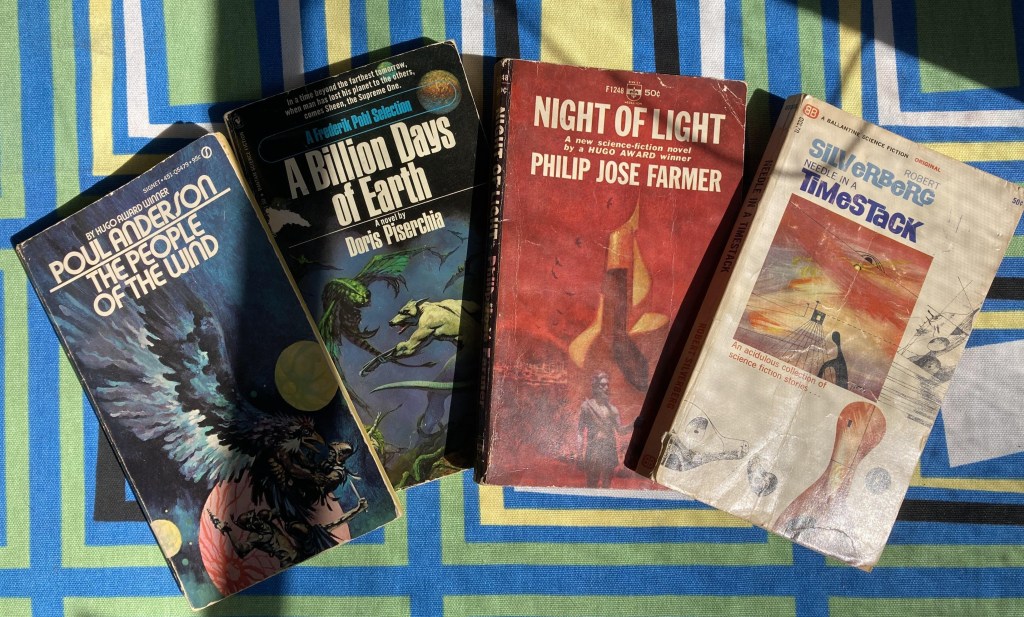
A selection of read volumes from my shelves
What pre-1985 science fiction are you reading or planning to read this month? Here’s the January installment of this column (sorry I missed a month).
Before John W. Campbell, Jr. (1910-1971) attempted to raise the “standards and thinking in magazine SF,” David Lasser (1902-1996) attempted his own brief (1929-1933) program to improve science fiction as managing editor of Hugo Gernsback’s Science Wonder Stories, Wonder Stories, and Wonder Stories Quarterly. According to Mike Ashley’s The Time Machine: The Story of the Science-Fiction Pulp Magazine from the Beginning to 1950 (2000), Lasser is a “much neglected revolutionary in science fiction” and through his efforts the genre “started to mature” (66).
Ashley highlights Lasser’s letter of instruction mailed to his regular contributors on the 11th of May, 1931, in which he “exhorted them to bring some realism to their fiction” (72). He also outlawed common tropes like the giant insect story and space opera (73). He emphasized the need to focus on characters that “should really be human” — not everything needs to be a “world-sweeping epic” (73). Stories in this vein, according to Ashley, include Clifford D. Simak’s religiously themed “The Voice in the Void” (1932), P. Schuyler Miller and Walter Dennis’ “The Red Spot on Jupiter” (1931) and “The Duel on the Asteroid” (1934), which featured a grim realism and character development (74).
Lasser also seems like a fascinating individual. He wrote the The Conquest of Space (1931), the first “non-fiction English-language book to deal with spaceflight,” was a member Socialist Party, and was elected head of the Workers Alliance of America (a merger of the Socialist Unemployed Leagues and the Communist Unemployment Councils). He also was banned from federal employment by name in legislation passed by the U.S. Congress due to his political connections. President Jimmy Carter sent him a personal letter of apology when he was finally officially cleared as a subversive in 1980!
The Photograph (with links to reviews and brief thoughts)
- Poul Anderson’s The People of the Wind (1973). I mysteriously adored this one back in 2010… Sometimes my oldest reviews befuddle. I praised Anderson’s refusal to create “monumentally homogeneous societies” yet despaired at its moments of silly and dull battle sequences.
- Doris Piserchia’s A Billion Days of Earth (1976). The best of Piserchia’s novels I’ve read so far. She was an original voice.
- Philip José Farmer’s Night of Light (1966)– a fix-up of “Night of Light” (1957). I remember enjoying this Father Carmody tale despite my inability to write a review. As many know, it influenced Jimi Hendrix’s song “Purple Haze” (1967).
- Robert Silverberg’s collection Needle in a Timestack (1966) contains one of my favorite early Silverberg tales–“The Pain Peddles” (1963).
What am I writing about?
Since my last installment, I’ve posted a review of Star Science Fiction Stories No. 3, ed. Frederik Pohl (1955) which contained three standout stories: Philip K. Dick’s “Foster, You’re Dead” (1955), Richard Matheson’s “Dance of the Dead” (1955), and Jack Williamson’s “Guinevere for Everybody” (1955). I did not know Williamson was capable of such things. In addition, I posted short reviews of two middling (but interesting) novels: Margot Bennett’s The Long Way Back (1954) and Mack Reynolds’ The Earth War (1964).
I compiled a rare Adventures in Science Fiction art post in order to commemorate Rodger B. MacGowan’s passing. Few know his early science-fictional work in Vertex magazine.
Continuing my general interest in science fiction on themes of sexuality and identity, I surveyed an account of the first gay and lesbian-themed SF panel at a Worldcon.
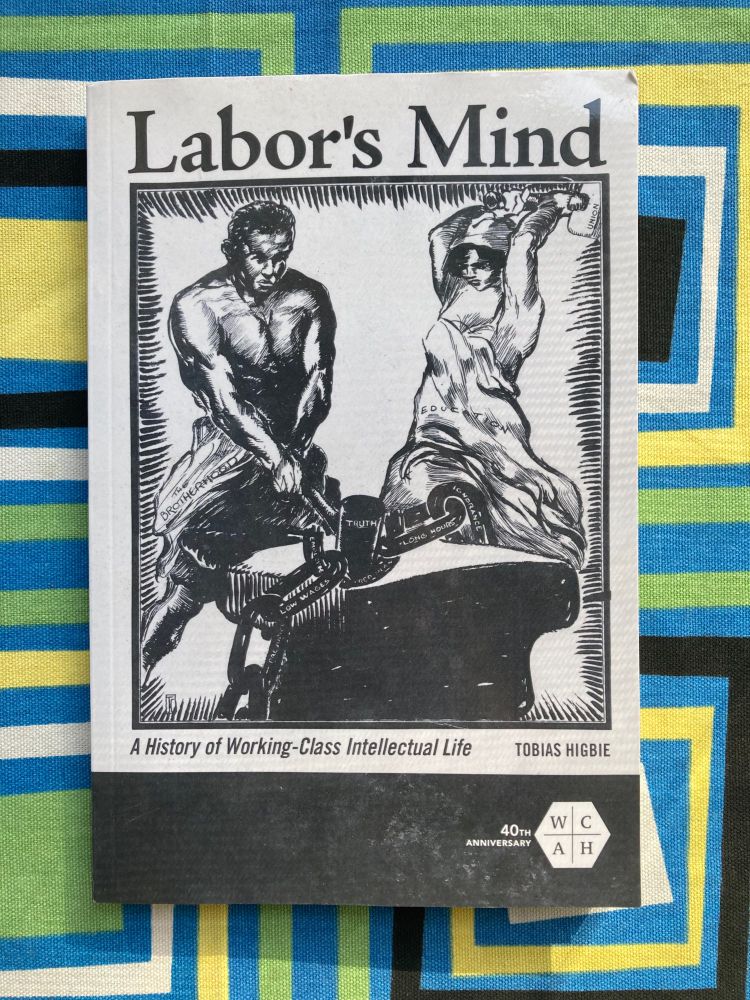
What am I reading?
Makes secret/sad noises. I’m fighting exhaustion on all fronts. I’m struggling to complete projects or stay focused. The only way I get through these spells is to refuse to make plans. This is all for fun! That said, my history reading continues to focus on the working-class experience. See Tobias Higbie’s fascinating book in the previous photo.
A Curated List of SF Birthdays from the Last Two Weeks
March 3rd: Artist Ric Binkley (1921-1968)
March 5th: Author Mike Resnick (1942-2020).
March 5th: Artist Attila Hejja (1955-2007). The master of the blues!
March 6th: Author William F. Nolan (1928-2021). Best known for Logan’s Run (1967).
March 7th: Author Leonard Daventry (1915-1987). Wrote A Man of Double Deed (1965)–which I described as a “dark and grungy tale of polyamory, telepathy, and apocalyptical violence.”

Tadanoi Yokoo’s cover for the 1979 edition
March 7th: Kobo Abe (1924-1993). Secret Rendezvous (1977, trans. 1979) is one of my favorite SF novels of the 70s. And it received a thematically and visually perfect cover by Tadanoi Yokoo (above).
March 7th: Author Elizabeth Moon (1945-).
March 7th: Author and editor Stanley Schmidt (1944-).
March 9th: Author William F. Temple (1914-1989). Another prolific magazine author whom I’ve not read…
March 9th: Author Manly Banister (1914-1986).
March 9th: Author Pat Murphy (1955-). She left a lovely comment on my review of The Shadow Hunter (1982) recently. I need to fast track my post on her first three published short stories.
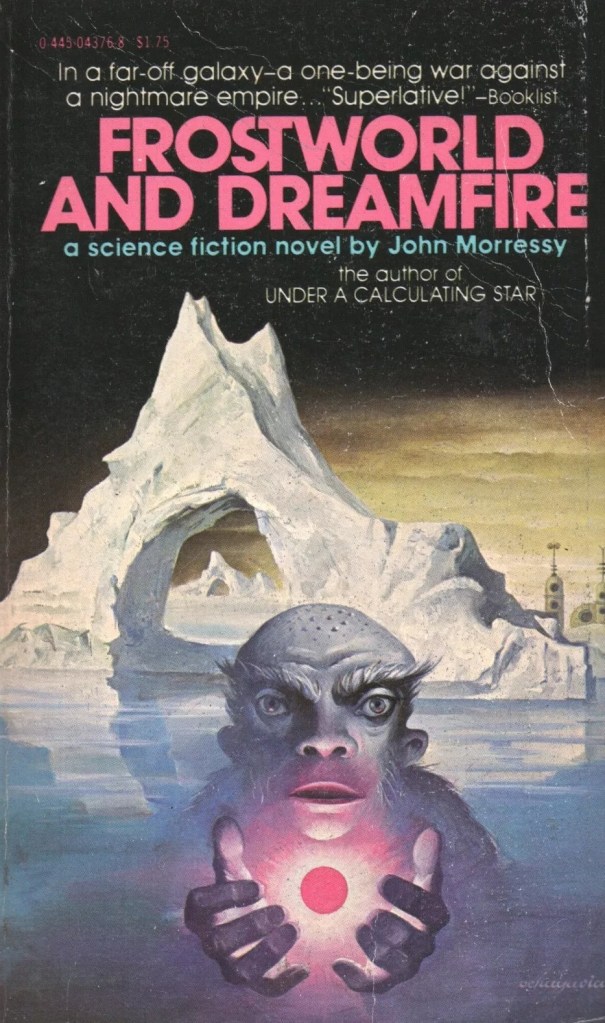
Carlos Ochagavia’s cover for the 1979 edition of John Morressy’s Frostworld and Dreamfire (1977)
March 10th: Artist Carlos Ochagavia (1913-2006). I’ve featured his work here.
March 11th: Author F. M. Busby (1921-2005). Despite missteps like Cage a Man (1973), Busby was capable of some effective introspection — notable “If This is Winnetka, You Must Be Judy” (1974).
March 11th: Author Douglas Adams (1952-2001).
March 12th: Author Harry Harrison (1925-2012). 2025 if finally the year I get to Make Room! Make Room! (1966). Say it with me!
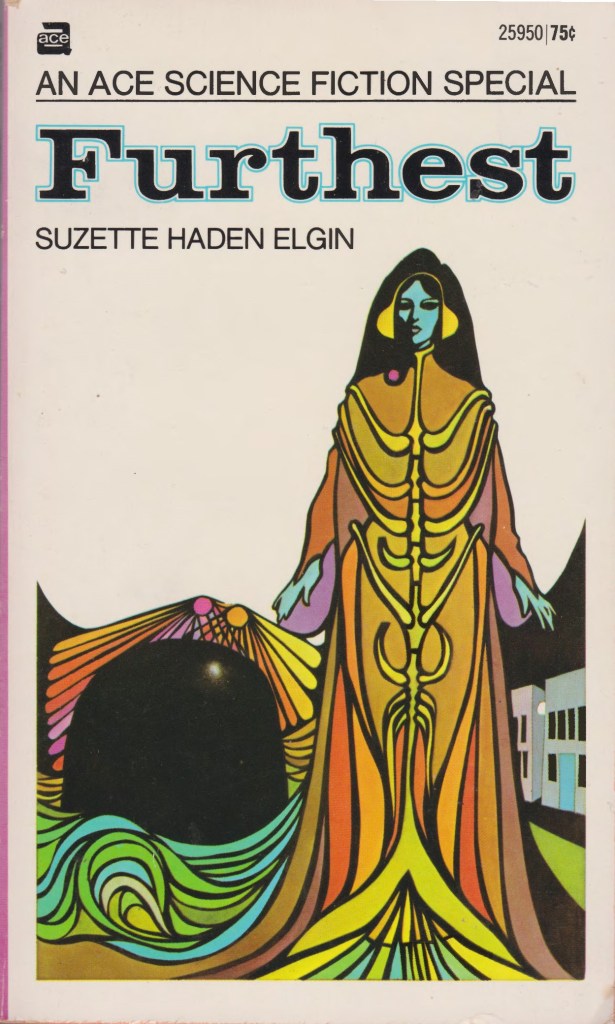
Diane and Leo Dillon’s cover for Suzette Haden Elgin’s Furthest (1971)
March 13th: Artist Diane Dillon (1933-). One half of the illustrious art partnership of the 60s/70s/80s! Diane created fantastic cover art with her husband Leo. I’m particularly partial to their cover for Suzette Haden Elgin’s Furthest (1971) (above).
March 13th: Author William F. Wu (1951-). With his short stories of the late 70s, Wu is one of the earlier Asian-American SF authors. I need to read his work.
March 14th: Author Mildred Clingerman (1918-1997). Another hole in my SF knowledge… I own her collection A Cupful of Space (1961).
March 16th: Artist Chris Foss (1946-). As I say every year as the fans circle… He’s iconic. He spawned a lot of clones. People love him. He’s not for me.
March 16th: Author P. C. Hodgell (1951-). God Stalk (1982) is supposed to be bizarre.
March 16th: Artist James Warhola (1955-). Best known for his cover for the 1st edition of Gibson’s Neuromancer (1984).
March 17th: James Morrow (1947-).
March 17th: William Gibson (1948-). Very much an author of my youth — I devoured Neuromancer (1984), Virtual Light (1993), Idoru (1996), All Tomorrow’s Parties (1999), Count Zero (1986), the stories in Burning Chrome (1986), and Mona Lisa Overdrive (1988). I haven’t returned to his work in almost two decades.
For book reviews consult the INDEX
For cover art posts consult the INDEX
For TV and film reviews consult the INDEX
 Science Fiction and Other Suspect Ruminations
Most recently thumbing through F&SF’s December 1971 issue. Has a fun two-page movie review of The Omega Man written by Baird Searles. “At least here he (Heston) doesn’t take all his clothes off, one of the meany horrors of Planet of the Apes.”
P.S. with you on Chris Foss
Hello John, I had to go look at contents of that issue — I am most intrigued by the Keith Roberts and Josephine Saxton. I find the fiction of both underrated.
I don’t get Foss. Maybe if I grew up with his covers all around me, I’d get the appeal. I find them repetitive, rarely connected even theoretically with the contents of the book (not a requirement), and only occasionally structurally well put together.
There are exceptions of course. His wonderful cover for Keith Roberts’ collection The Grain Kings comes to mind: https://sciencefictionruminations.com/2022/06/08/book-review-the-grain-kings-keith-roberts-1976/
Searls was my favorite book reviewer; from the late 1970s up to his death, he recommended many good books to me.
Currently reading Greg Benford’s Artifact – which is from 1985, so at least it’s probably *written* before 1985 (I read it when it was new, and talked my bookclub friends into picking it for the next meeting – and some of those weren’t born in 1985).
I wasn’t born in 1985 (born in the later 80s) 😉
I’ve not read a lot of Benford beyond a few co-written stories with Eklund. And maybe Timescape (1980) as a teen as it won a Nebula and I was all about award lists.
I am turned to dust.
I’ve read about a dozen Benford novels.
Well, let’s hope your reading group responds favorably. I’m glad you have a ready group that doesn’t frustrate you! I think of my site as my personal reading group — but where I decide every time what to read. Muahaha.
Love for Lasser and Ashley. I seem to remember the Lasser era of Wonder Stories having some interesting gender-themed stuff as well.
I’ve been reading and reviewing the February 1951 issue of Galaxy. I’ve got a review of a Simak story therefrom in the pipeline for tomorrow morning and I should have a review of Bradbury’s The Fireman up next week. Also reading part 2 of Asimov’s Tyrann (later The Stars Like Dust) but probably not reviewing it.
Otherwise digging on some Edward Page Mitchell stories from the late 1870s and Julian Huxley’s “The Tissue-Culture King.” I can recommend the former but don’t know who I’d recommend the latter to.
I really want to read the novel version of Night of Light but never have.
Which Simak? I’ve been writing religiously about him… as you probably know.
As for gender-themed stuff under Lasser — Ashley brings up two that might fit the bill: Don Mark Lemon’s spoof on male-dominated society “The Scarlet Planet” (1931) and Richard Vaughan’s account of women creating a utopia as men had all but destroyed themselves “The Woman from Space” (1932).
Yep! I read both of those last year off the Internet Archive’s collection of Wonder Stories when I was picking through Ashley’s book.
The Simak story is “Second Childhood.”
Were either as cool as they sound?
I have not read that Simak. I look forward to your review.
Vaughn is more readable than Lemon. I wrote long Twitter threads https://x.com/willekysff/status/1754195002018644370?s=46&t=vgx_ULQ7AhiOGiEAaPGmLg
https://x.com/willekysff/status/1751305814621479068?s=46&t=vgx_ULQ7AhiOGiEAaPGmLg
I deleted Twitter (years after I should have but saying goodbye to the followers I had accumulated over a decade and various friends who still had not migrated to another platform was hard). Sorry. One needs an account to view them now. Alas.
Recently got my hands on a long-sought-after copy of Joanna Russ’s “The Country You Have Never Seen”, a collection of her reviews and criticism, and oh wow that did not disappoint. Scabrously funny, incisive, ahead of her time in almost every way. Includes contemporaneous reviews of Moorcock (dismissive of Elric, loves Jerry Cornelius), Disch, Bunch (“Moderan”!), Wilhelm, Spinrad (who she rightly takes to task for the flat characterizations in “Bug Jack Barron”), McCaffrey, so many more. She is comically cruel and dismissive of hackwork, generous and effusive with her praise, but also never hesitates to highlight when something is both hacky *and* enjoyable (and why). In all cases she is thoughtful and perceptive; unsurprisingly (if one knows anything about her) she is especially engaging on portrayals of gender and sexuality. Longer form essays addressing broader topics in the field are also included and similarly open-hearted, brutally honest, and funny. I can’t remember the last time I read a collection of criticism that was so engaging, very highly recommended.
I’ve always enjoyed her reviews when I’ve come across them in various issues of F&SF. What did she say about Moderan? I loved that collection — was unable to review it, I wish I had!
I no longer have it in front of me (had to return it to the library) but I recall her being very enthusiastic about it and its portrayal of hyper-exaggerated toxic masculinity, while acknowledging some of its structural deficiencies (repetitive, etc.)
Have also been re-reading Peake’s Gormenghast trilogy. Doesn’t really get into SF territory until the third book but I find its glacial pacing makes for enjoyable bedtime reading.
Related to that, check out Gwyneth Jones’ Joanna Russ (2019) in the Illinois U. Press Modern Masters of Science Fiction series if you haven’t already. The volume focused extensively on both her non-fiction and fiction.
Lasser does look like a fascinating guy. Too bad there isn’t a biography on him. And he doesn’t seem to have written much after the 1930s.
Hello John,
He does seem to feature quite heavily in Eric Leif Davin’s Pioneers of Wonder (1999). I should track down a copy.
Have you been reading any good pre-1985 SF as of late?
Not recently. I’m currently trying to catch up to all the SF magazines I’m subscribed to (Analog, Asimov’s, FSF) — I like to keep up to date with current sf, at least in the short fiction space.
I believe the last pre-1985 sf I read was Gather Darkness by Fritz Leiber a couple of months ago, which left me a little disappointed. I have an audiobook version of The Dispossessed queued up on my phone.
Fritz Leiber is a favorite of mine — although more for his short fiction like “A Bad Day for Sales” (1953), “The Moon is Green” (1952), and “The Girl with the Hungry Eyes” (1949).
My Leiber reviews: https://sciencefictionruminations.com/science-fiction-book-reviews-by-author/
As for the Le Guin, I read that in my late teens (went on a Hugo award reading binge). At the time I thought it paled in comparison to The Left Hand of Darkness but was absolutely worth reading.
Mildred Clingerman’s work is mostly describable as minor and charming. An exception is her story “The Wild Wood,” which is worth digging up A CUPFUL OF SPACE for even if you never read anything else of hers. Creepy and powerful, though reliant on repellent stereotype to a degree. If you’re up for another, try the sunnier “Mr. Sakrison’s Halt,” a pretty astonishing little vision for a Southerner in the ’50s.
I own a copy of A Cupful of Space. Thank you John! I’ll look at those first.
Looking forward to reading PKDs ‘Foster, You’re Dead’ shortly, so it was heartening to hear your positive review 👍
March was off to a strong start for me by finally getting around to Wells’ ‘The War of the Worlds’. Superlative timeless piece of fiction – I kept having to remind myself it was written at the close of the 19th century. A few short pieces followed: Clarke’s ‘Nine Billion Names of God’ and then (as I’m slowly working my way through his Collected Stories) Ballard’s ‘Studio 5: The Stars’. All very much in my comfort zone really!
Thanks for stopping by! Yeah, “Foster, You’re Dead” hits a lot of my buttons — it’s sinister, satirical in its intent (anti-commercial, etc.), and polished.
I’m all for Ballard! Clarke and Wells not as much, or rather, they are more authors I read as an older teenage and haven’t returned to in any systematic way.
Ballard’s ‘Collected Stories’ tome remains one of the best purchases I ever made. Compelling short works from the outset. Just when I think I’ve got the ‘measure’ of him, I read the next story and I’m prompted to think again 🙂
I’ve read quite a few of his short stories (and novels) over the history of the site. I’ve reviewed 23 of his short stories and two of his novels. I’ve also read but never got around to reviewing The Drought, The Drowned World, and The Crystal World.
Here are a few:
“The Cage of Sand” (1962) for my subversive accounts of the space age review series: https://sciencefictionruminations.com/2021/05/10/short-story-review-j-g-ballards-the-cage-of-sand-1962/
And “Thirteen Centaurus” (1962) for my generation ship short fiction review series: https://sciencefictionruminations.com/2019/12/25/generation-ship-short-story-review-j-g-ballards-thirteen-to-centaurus-1962/
My general review index: https://sciencefictionruminations.com/science-fiction-book-reviews-by-author/
Thanks for the heads-up. Will certainly check these out. His early years are quite a treasure trove – looking forward to working my way through his later 69s output too.
No problem. Some of the 23 short stories I mentioned (and novels) are post-1969 as well.
Excellent, thank you 👍
No problem.
My most recent Ballard review is actually his disowned first novel: https://sciencefictionruminations.com/2020/10/17/book-review-the-wind-from-nowhere-j-g-ballard-1962/
I just finished Cherryh’s Gate of Ivrel, as part of a loose drive to read more debuts/early works of authors whose later work overshadows their earliest stuff (John Crowley was who gave me this idea after loving his first three novels). I quite enjoyed it, a bit rough but her sensibilities still came through strong.
Thanks for stopping by. I might have read that one during my Cherryh binge days in my late teens. I can’t remember.
On a similar programmatic line, have you been following along my series reviewing the first three published short stories by authors whom I should know more about? My most recent post on Leigh Kennedy: https://sciencefictionruminations.com/2024/11/17/short-fiction-reviews-leigh-kennedys-salamander-1977-whale-song-1978-detailed-science-1980-and-speaking10-to-others2-speaking3-to-others20-1981/
I’ve been enjoying those for sure! I read few short stories compared to novels (less than ideal given my interest in such a short story heavy genre/period), I remember reading Aarnason’s Warlord of Saturn’s Moon cause of your review and it’s really stuck with me.
Good good. Yeah, I read more and more short stories every year. In part because I’m such a glacially show writer, and the longer the book the longer it takes for me to take notes. The reality is science fiction is maybe 30% of what I read in a year — history dominates the rest.
I’ve just finished a William Tenn novelette, The Ionian Cycle, first published as the cover story in the August 1948 Thrilling Wonder magazine.
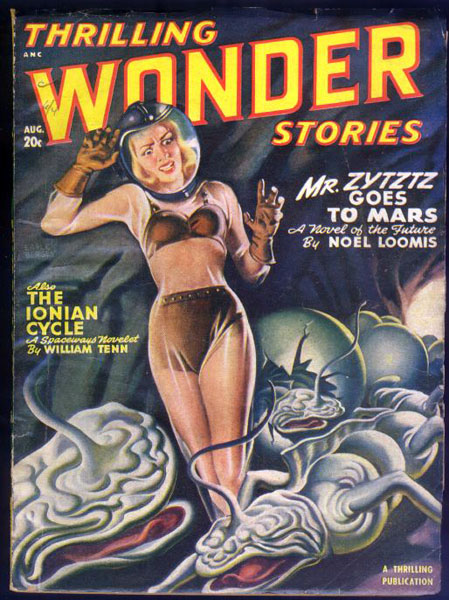
It’s a bit clunky with stock characters but still quite readable as it tells how a spaceship lifeboat crashlands with almost no fuel on a previously unknown planet.
The fuel they need is contra-Uranium (I assume that’s anti-matter uranium, formed when the universe was created), which is crystaline and so doesn’t need refined (lucky!) And there are two apparently separate alien species which don’t even realise the other one exists, who might be persuaded to help…
It’s 15 years ahead of his classic The Men in the Walls (expanded into Of Men and Monsters, which I really liked) and isn’t particularly original but it has some nice touches, and also has lines such as ‘Well, grow me tentacles and call me a sagittarian!’ or ‘…you know how to cuddle a control board…’ and ‘Great gravities!’
Not a Tenn I’ve read yet. I’m a big fan of his short fiction.
“Generation of Noah” (1951) and “Eastward Ho!” (1958)
Of All Possible Worlds (1955)
The Human Angle (1956)
And, as I assume you already know, Of Men and Monsters (1968) as well.
Recently read The People of the Wind, Was not impressed.
Yeah, not returning to that one.
Not sure if this counts but I’m reading “The Remaking of Sigmund Freud” by Barry Malzberg, published in 1985. A 1986 nebula nominee, in the early stages it feels a unique take on space exploration as a subgenre.
One of the Mazlberg novels I still need to read. He’s a favorite of mine.
Those are some neat covers to those books! I just began reading Marion Zimmer Bradley’s novel, “A Door in Space” from 1961 but the edition is 1979 with good cover art. So, farther story’s been interesting. It takes place on a world called Wolf that’s colonised by Earth and so there are tensions between the Earthlings and the native peoples.
I’ve had Bradley’s Endless Voyage on my list for a while due to my need to read all the pre-1985 generation ship tales.
I’ve been reading the Robert Sheckley stories collected in the Penguin omnibus. All of them are from the 1950s I think.
Not a dud amongst them. I particularly enjoyed A Ticket to Trenai and The Prize of Peril. Not sure if the latter is the first story published on this theme but it packed a lot into its 20 odd pages. Not a word wasted.
From this collection I nearly jumped to the recentish NYRB collection but decided to try some of his 70s stuff first so picked up The Robot Who Looked Like Me collection.
I’m a big Sheckley fan. I’ve read and reviewed quite a few of his short stories (including “Prize of Peril”) and two novels
I’ve been meaning to review some stories from Wonder Stories when it was at the height of its powers, but my schedule has been rather packed. Maybe I should find room for it next month…
I’ve been reading Stephen King’s The Stand, which is actually more fantasy than SF although the plague at the center of it is presented as having scientific basis. At first. Of course it turns out SATAN is involved. It’s also unspeakably long, and unfortunately the original cut version is long out of print.
I also started reading Suzee McKee Charnas’s The Vampire Tapestry, which despite being about vampirism provides a totally SFnal explanation for the vampire’s existence. It’s not even really a horror novel. I know you like Charnas, and I do think you’d dig this one a lot. It’s great so far. I reviewed the first chapter of it, “The Ancient Mind at Work,” on my blog quite a ways back.
Then there’s Tim Powers’s The Anubis Gates, which is… fantasy? Science-fantasy? It involves Egyptian mythology, but also time travel, which is usually but not always in the domain of SF. Really liking this one so far as well. Powers is really a fantasy and horror writer so he’s kinda outside your wheelhouse.
I’m looking to start reading the original anthology Infinity One for Galactic Journey very soon. I’m pretty sure you had sent me a copy of another entry in that series.
As we discussed on disccord, there’s definitely a chance I feature some stories from Wonder Stories as well (I also compiled a list of more realistic/negative takes on space travel from that era).
I’m intrigued by the Charnas — although, as with I Am Legend, the vampire/zombie angle (I know vampires in the Charnas) put me off. I’m glad I finally got to the Matheson, I assume I’ll enjoy the Charnas too.
As for Powers, I have acquired some of his early SF works — I think I own two or three of them (including from that terrible Laser press imprint which I assume he’d like to forget he ever wrote for).
It’s always good to see Piserchia get some exposure, she’s such a strange and unique writer. Billion Days of Earth is probably a good beginner, as it’s slightly more coherent than some of her other ones (not necessarily saying much), yet it still super bizarre and inventive. Personally, I love her most rambling, trippy works like Earthchild and Doomtime.
Right now I’ve started reading Aldiss’ The Dark Light Years, which I found a free copy of recently. I like it so far, even though it’s quite messy and seems to have been written in a hurry. It’s much more satirical than I expected.
Prior to that, I read Ian Watsons The Book of the River. This was more YA and fantasy-ish than what I usually like (though it is definitely SF), but I’ve enjoyed Watson before, and I bought it as a present for my niece, who is about the age where she should be ready to move on from teen/romance-SF and into a bit heavier stuff; this having a bit of each could maybe be a gateway drug.
A blog acquaintance recently wrote an intriguing article about Piserchia’s work: https://www.superdoomedplanet.com/blog/2025/03/03/on-doris-piserchias-spaceling-and-the-dimensioneers/
I have no plans to read more of her stuff at the moment beyond, perhaps, short stories.
I reviewed The Dark Light Years in the first few years of the site. I thought it had some great ideas and, as you said, a messy hurry. I found it overshadowed by his superior Non-stop (also reviewed by me in the first years of the site).
>>A blog acquaintance recently wrote an intriguing article about Piserchia’s work: https://www.imdb.com/title/tt0066666/?ref_=tt_mlt_i_4<<
Sounds interesting – it seems to be a wrong link, though.
I just finished The Dark Light Years, and Non-stop was certainly much better (at least from what I remember, I read it long time ago). DLY had so much potential in the premis, and Aldiss obvioulsy had a ton of ideas that he wanted to include, but without the time or space or determination to expand them, let alone combine them into a whole.
Weirdly, it felt a bit like Vonnegut to me; an extremely dark and despiriting story told with a lot of absurd humor and in a deceptively lighthearted tone. All the pieces just didn’t come together like they do in the Vonnegut I’ve read.
Sorry! Link fixed: https://www.superdoomedplanet.com/blog/2025/03/03/on-doris-piserchias-spaceling-and-the-dimensioneers/
Thank you very much!
Another Piserchia write-up: https://chadgayle.com/the-rediscovery-of-forgotten-science-fiction-author-doris-piserchia/#bookreviews