What pre-1985 science fiction adventures have you started this summer? Any great reads? Disappointing ones? Intriguing discoveries? Here’s the April installment of this column.
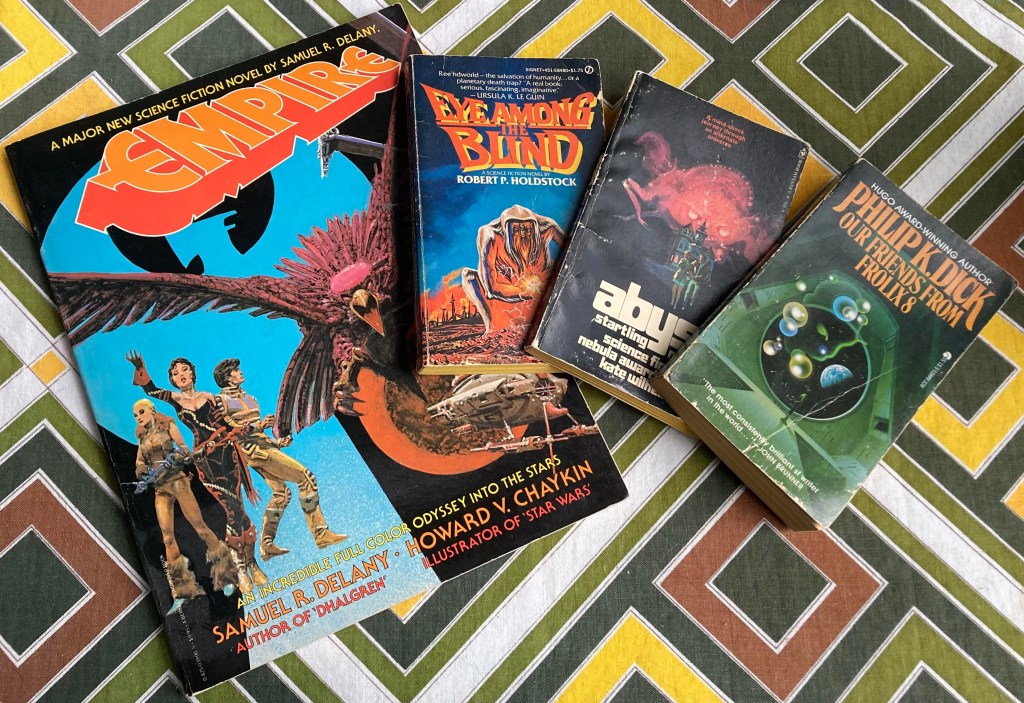
A selection of read volumes from my shelves
In a conversation on Blueksy, someone asked for my history of science fiction recommendations (including a few general surveys). I scoured my shelves and came up with an all-too-large pile (with some notable volumes I wanted to include but could not find) of favorite histories of science fiction. See photo below. I tried to include monographs that were not studies of single authors.
As I am a historian by training and trade who holds on to some of my disciplinary ticks and hangups, I also included works by trained academics with two major exceptions 1) Mike Ashley’s multi-volume study of science fiction magazines (but no other recent works exist and they’re really good for the nuts and bolts of genre magazines) and 2) Alec Nevala-Lee’s approachable and well-researched group biography Astounding: John W. Campbell, Isaac Asimov, Robert A. Heinlein, L. Ron Hubbard, and the Golden Age of Science Fiction (2018). Both should be read.
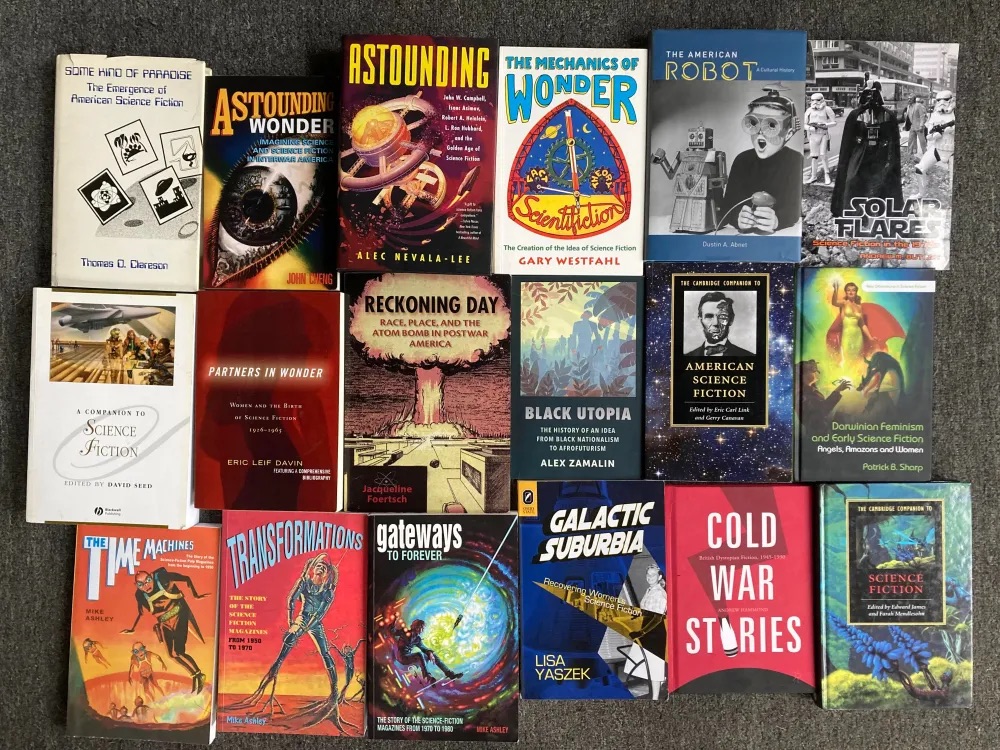
A photo of a few of my history of science fiction recommendations
I deliberately avoided works by science fiction authors like Damon Knight, Brian W. Aldiss, and Frederik Pohl. They’re great sources and I own and have read many of them but…. they are not histories by trained scholars. I do not mean for this to come off as elitist. Rather, my personal remit for my list—I needed to winnow down the hundreds and hundreds I own–was deliberately narrow! I read and use sources widely. Remember, these are my favorites — they might not be the best but they got me thinking and reading and writing. And that’s what we all should be doing, reading what makes us happy.
Before we get to the the curated birthdays and brief thoughts on the science fiction volumes above, let me know what pre-1985 SF you’re currently reading or planning to read! You’re also welcome to list your favorite histories of the genre.
The Photograph (with links to reviews and brief thoughts)
- Samuel R. Delany and Howard V. Chaykin’s Empire (1978). I love the art! The story? One of Delany’s weakest outings. It’s a shame.
- Robert Holdstock’s Eye Among the Blind (1976). His anthropologically inclined first novel contains “kerns of his later genius” according to my 2014. Most details have faded. That can’t be said to his far superior Where Time Winds Blow (1981). If you only know Holdstock for Mythago Wood (1984), definitely check out his earlier more overt science fictional works. That said, I really need to read Mythago Wood!
- Kate Wilhelm’s Abyss (1971) is a underrated outing (two novellas) by a master near the top of her game. I particularly enjoyed “The Plastic Abyss” (1971): As the human drama (the entrenched patterns and fritctions of society’s expected social roles) swirls at the forefront, the SF premise generates the unease—in this case an attempt to secure funding for an experimental absorptive material onto which life-like images can be projected.
- Philip K. Dick’s Our Friends From Frolix 8 (1970). One of many PKD novels that have clumped together into a terrifying indistinguishable distillation of his unease and what makes him great. This is too say, I read a lot of PKD early in my SF reading career and can’t remember which details relate to which books!
What am I writing about?
The merciful appearance of summer break early this month — and a summer with little planned travel — has allowed me to get back into the flow of writing reviews and working on larger projects. Since the April installment of this series, I’ve read reviewed and written about the following: Exploration Log 14: Anti-Racism in Chandler Davis’ “Stereotypes Are Dangerous” (1950), two posts on Clifford D. Simak: “Madness from Mars” (1939) and “Hermit of Mars” (1939) and his collection The Worlds of Clifford Simak (1960), Polly Toynbee’s Leftovers (1966) and Lewis Gibbs’ Late Final (1951), Richard Wilson’s “Strike” (1953), and Knut Faldbakken’s Sweetwater (1976, trans. Joan Tate, 1994), which appeared originally in the first issue of Rachel S. Cordasco’s magazine Small Planet: The SF in Translation Magazine.
The summer has allowed me to return to my article (and accompanying historical research) on Edward A. Johnson’s Light Ahead for the Negro (1904). First major summer step? I finished Richard A. Paschal’s Jim Crow in North Carolina: The Legislative Program from 1865-1920 (2021) to integrate into my article! I will spend as much as the afternoon as possible at my favorite coffee shop trying to eek out a few more pages or to reacquaint myself with my 200+ electronic newspaper clippings I’ve collected.
I’m also working on my review of SF in translation for the second issue of Small Planet: The SF in Translation Magazine. I’ll keep the author and book secret until it appears in the first few weeks of August. As for non fiction for the site, I’m working on a few early Clifford D. Simak fanzine articles for my Exploration Log series.
What am I reading?
This is a rare moment for reasons connected to my before-mentioned article that I do not have a science fiction work already lined up to read. It’s a radically attempt to FINISH writing projects that have acted as anchors to other writing and reading. That said, no worries blog friends — I have plenty of half-finished reviews waiting in the wings. Stay tuned.

Photo of Steve Batterson’s The Prosecution of Professor Chandler Davis: McCarthyism, Communism, and the Myth of Academic Freedom (2023) on my history shelf with other books
On the non-fiction front: I have been eying Steve Batterson’s The Prosecution of Professor Chandler Davis: McCarthyism, Communism, and the Myth of Academic Freedom (2023) after writing about Chandler Davis’ amazing fanzine article “Stereotypes Are Dangerous” (1950) for my Exploration Log series.
A Curated List of SF Birthdays from the Last Two Weeks [names link to The Internet Speculative Fiction Database for bibliographical info]
June 10th: Artist Don Maitz (1953-).
June 11th: Josephine Saxton (1935-2023). I recommend The Hieros Gamos of Sam and An Smith (1969). She was a unique and underrated voice of the New Wave. I also covered her first three published short stories.
June 12th: Frank K. Kelly (1914-2010). I wrote about an example of his dark 30s pulp here: “Famine on Mars” (1934).
June 12th: Henry Slesar (1927-2002).
June 13th: Artist Ralph McQuarrie (1929-2012). Best known for his Star Wars art. He also created SF covers.
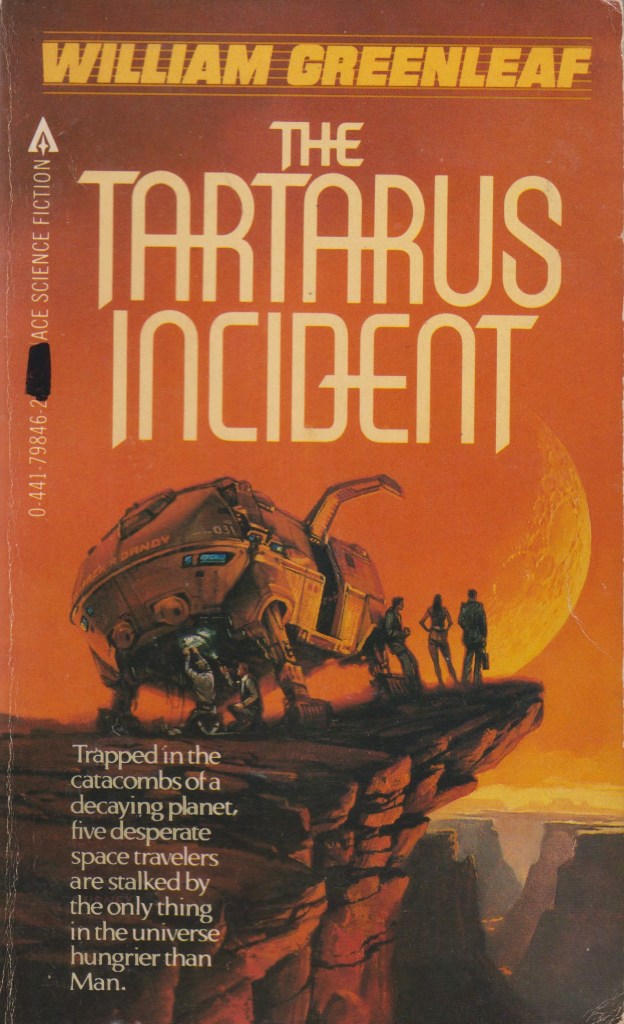
James Gurney’s cover for William Greenleaf’s The Tartarus Incident (1983)
June 14th: Artist James Gurney (1958-). Best known for Dinotopia (1992) (and the sequels). Another very influential book in my childhood. He also created a SF covers.
June 14th: Stephen Tall (1908-1981).
June 14th: Ruthven Todd (1914-1978). I recently acquired his marginally SF work The Lost Traveller (1943). I’ll feature it in a purchase post eventually.
June 14th: Laurence Yep (1948-). A complete unknown to me. I acquired one of his novels recently: Seademons (1977) .
June 14th: Artist Peter Goodfellow (1950-2022). One of my favorite British SF artists.
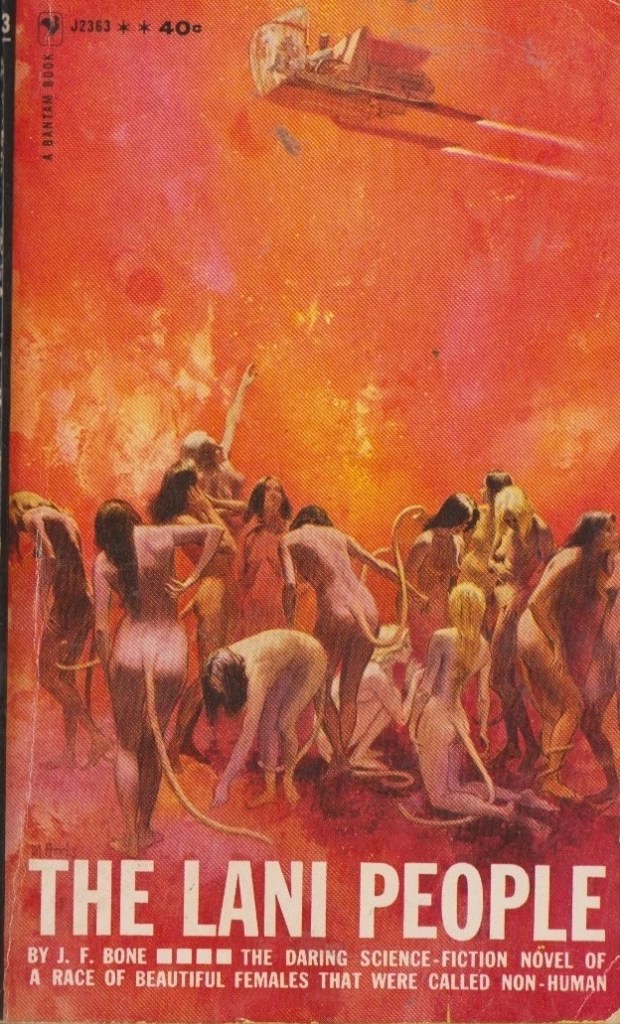
Mitchell Hooks’ cover for the 1962 1st edition
June 15th: J. F. Bone (1916-2006). Best known for his novel The Lani People (1962). One of many novels with humanoid cat women. Blargh.
June 15th: Artist Neal Adams (1941-2022). Best known for his Tarzan covers.
June 15th: Brian Jacques (1939-2011). I’ve mentioned my love his Jacques’ Redwall sequence in previous year installments of the birthday list. If there’s a single author responsible for my adoration for reading and maps, it’s him.
June 17th: Wallace Wood (1927-1981).
June 17th: John Hersey (1914-1993). Best known for his non-fiction work Hiroshima (1946), Hersey also wrote three SFF volumes. I read and enjoyed his overpopulation themed novel My Petition for More Space (1974). I acquired his satire of the National Defense Education Act (1968) novel The Child Buyer (1960).
June 17th: Garen Drussaï (1916-2009). She wrote five science fiction stories in the mid-50s, including her “consumer hell” story “Woman’s Work” (1956) that I must finally get around to reading.
June 17th: Dean Ing (1931-2020).
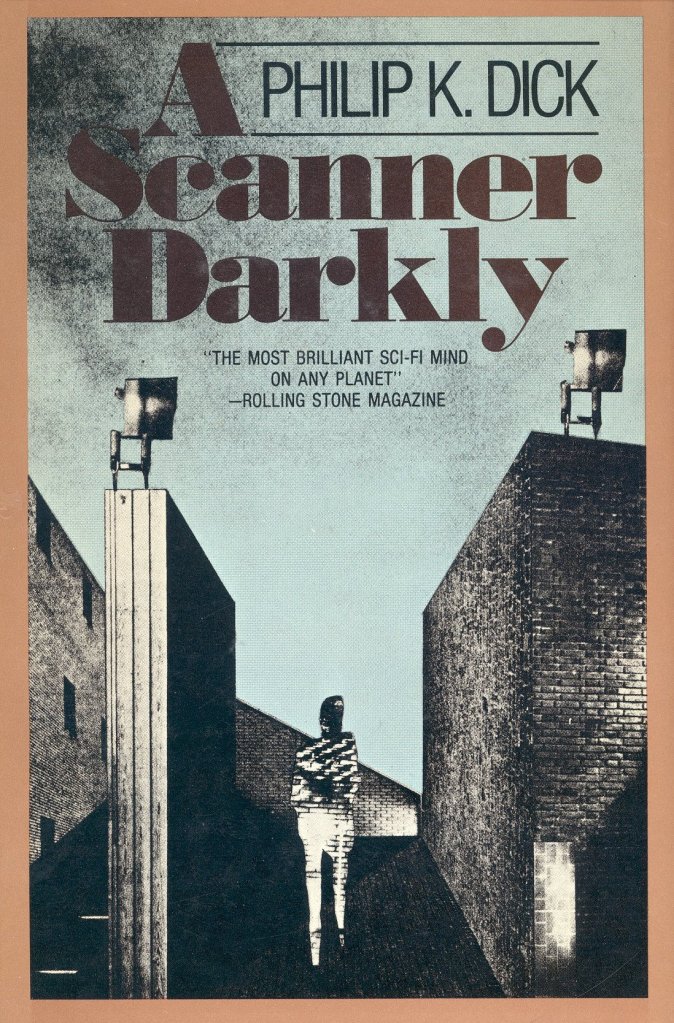
The Brothers Quay cover for the 1st edition of Philip K. Dick’s A Scanner Darkly (1977)
June 17th: Tim and Steve Quay (1947-) (The Brothers Quay). Before their brilliant short films, they created a handful of covers early in their career! I found their 1st edition cover of PKD’s A Scanner Darkly (1977) the best.
June 18th: Artist Jody A. Lee (1958-).
June 18th: Roger Ebert (1942-2013). Ebert, a famous film-reviewer, also published two science fiction short stories in 1972.
June 19th: Mark Adlard (1932-). I reviewed the first volume–Interface (1971)–in his Tcity trilogy back in 2015.
June 19th: Brian Ball (1932-2020). A slick pulp-SF author, if that is your thing. I reviewed Singularity Station (1973) in 2013.
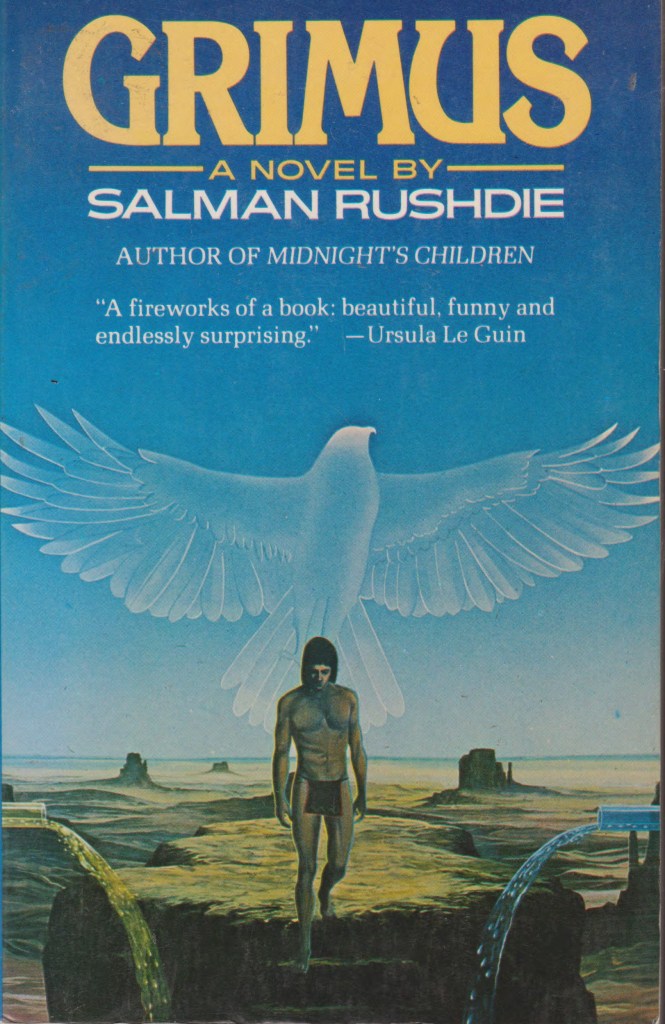
Peter Goodfellow’s cover for the 1977 UK edition of Grimus (1975)
June 19th: Salman Rushdie (1947-). I have my eyes on his first SF novel Grimus (1975) (above).
June 20th: Pamela Zoline (1941-). I love the rightly celebrated “The Heat Death of the Universe” (1967) and wish she wrote more than the handful of short stories.
June 21st: Cleve Cartmill (1908-1964). Best known for the controversy over “Deadline” (1944) “which described an atomic bomb a year before one was ever dropped, which the government attempted to suppress.” Should I read it? I imagine it is historically important but a poor story. Did he write anything else worth reading?
June 21st: David J. Skal (1952-2024). I’ve only read Skal’s short story “Chains” (1971).
June 22nd: Lima de Freitas (1927-1998). One of my top 5 science fiction artists — I love his line work. For a few examples I gathered, see this thread on Bluesky. I also posted about his work on my site: The Futuristic Cities of Lima de Freitas.
June 22nd: Octavia E. Butler (1947-2006). I’ve reviewed Clay’s Ark (1984), Dawn (1987) and Mind of My Mind (1977). Clay’s Ark (1984) is really really good. Covered it last year.
June 23rd: Michael Shaara (1928-1988). His collection Soldier Boy (1982) judges me from the shelf. I’ve been meaning to read it since 2015!
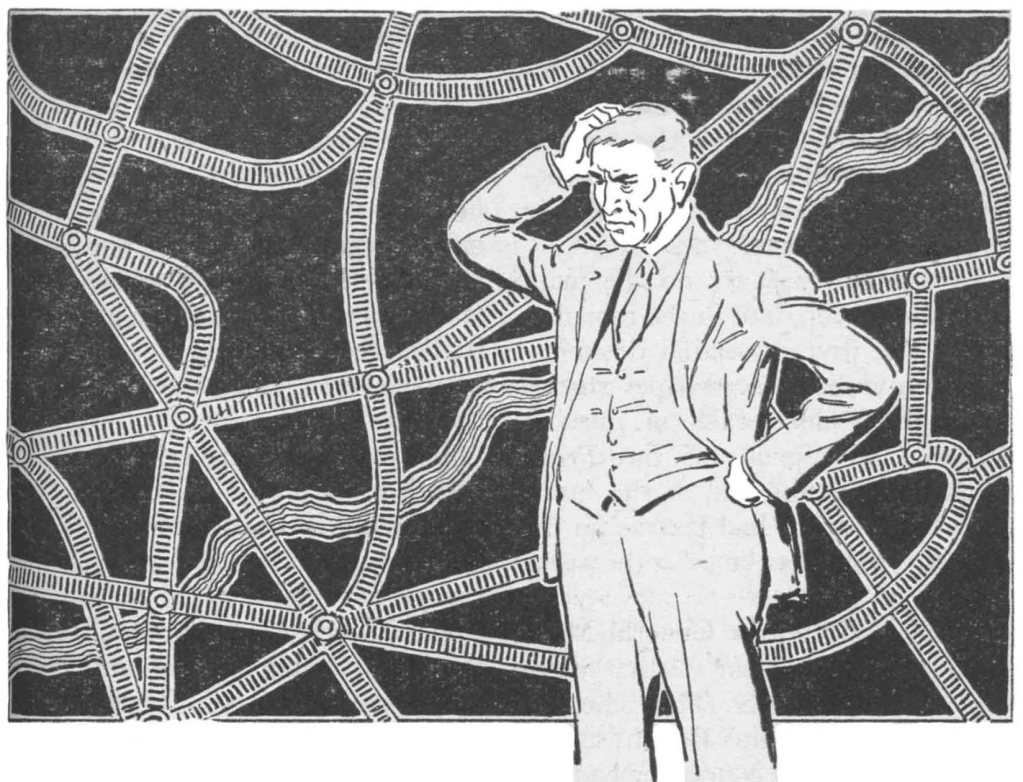
Paul Orban’s interior art for A. J. Deutsch’s “A Subway Named Mobius” (1950) in Astounding Science Fiction, ed. John W. Campbell, Jr. (December 1950)
June 23rd: Artist Paul Orban (1896-1974). I enjoy his style of interior art — the variety of lines and shading.
June 23rd: Artist Alan Craddock (1956-). I do not enjoy his style of cover art!
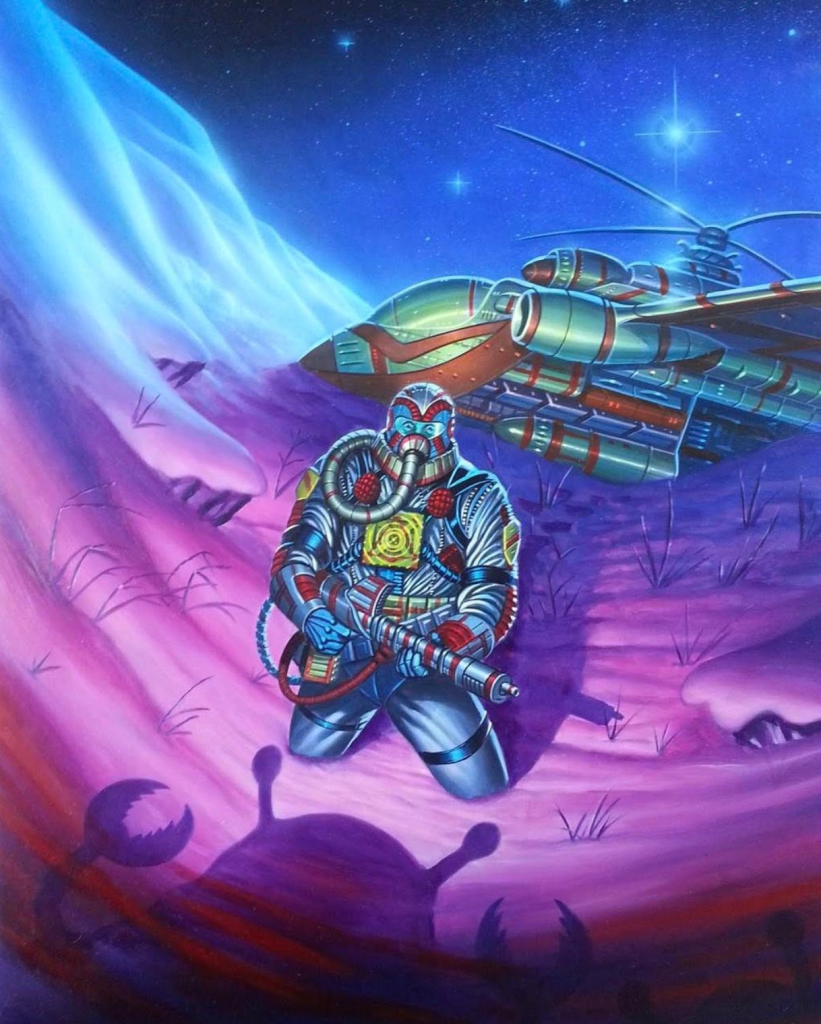
Alan Craddock’s cover art for the 1985 Orbit edition of David Gerrold’s A Day for Damnation (1984)
For book reviews consult the INDEX
For cover art posts consult the INDEX
For TV and film reviews consult the INDEX
 Science Fiction and Other Suspect Ruminations
Interesting you should ask! Back in 1960, I read a story in an anthology that I’ve never forgotten — it is so profound and actually timely in a way. Last month, with the help of Chat GPT, I tracked it down online, and made a pdf of the whole story, “The Survivor.”
I’m attaching the pdf of the story to this reply to your email. If you have any feedback or can add anything to what I know about it, would you please let me know?
Best, Ellen Azorin
Thanks for stopping by. I assume you mean Walter F. Moudy’s “The Survivor” (1965)? There’s no need to send anything to me. The PDF is available for all to read online here. The magazine has been digitized. I link it in my review. https://sciencefictionruminations.com/2022/06/28/future-media-short-story-review-walter-f-moudys-the-survivor-1965/
In the middle of the Library of America edition of Ursula Le Guin’s Hainish Cycle, an overall concept which she somewhat took issue with. Currently on the 2nd novel: Planet of Exile.
Hello,
What did she take issue with?
I read them before I started my site. I posted my review of Planet of Exile in 2010! It was originally up on Amazon.
Leigh Brackett’s The Ginger Star. I’ve loved what I’ve read of her earlier work, and thought this would make a fine read for sunny days in the garden. Ho hum, sadly. Most of the book was just John Stark getting moved up the map, regularly captured by various peoples who proceed to transport him in exactly the direction he was going anyway. Picked up in the final chapters, so I’ll try the next in the trilogy sometime, but this wasn’t the planetary romance I was expecting.
Hello, thanks for stopping by. While I have not read that one, I did enjoy the stories in The Coming of the Terrans. It contains one Stark story. For whatever reason didn’t manage to review it.
My single favorite Brackett remains her novel The Long Tomorrow. My review: https://sciencefictionruminations.com/2020/07/04/book-review-the-long-tomorrow-leigh-brackett-1955/