Note: My read but “waiting to be reviewed pile” is growing. Short rumination/tangents/impressions are a way to get through the stack before my memory and will fades. My website partially serves as a record of what I have read and a memory palace for future projects. Stay tuned for more detailed and analytical reviews.
1. John Collier’s Tom’s A-Cold (1933)
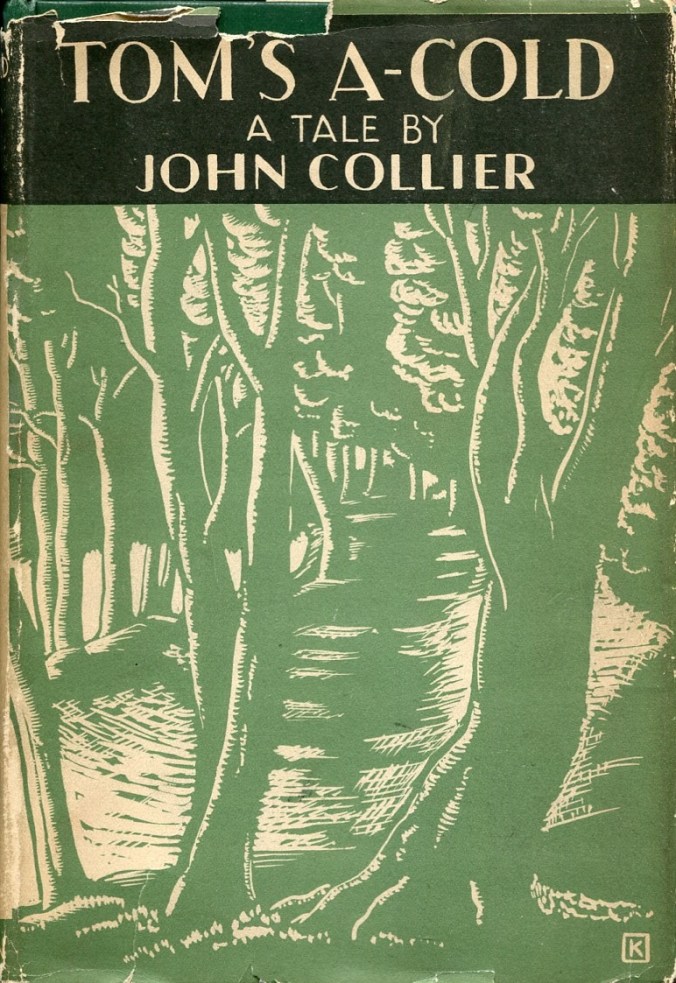
Uncredited cover for the 1st edition
4.25/5 (Very Good)
If it were not for my general writing slump with a growing, and demoralizing, backlog to cover, I’d give John Collier’s Tom’s A-Cold (variant title: Full Circle) (1933) a full review. It’s the surprise of the year so far. According to SF Encyclopedia, John Collier (1901-1980) is best known for his “rather precious short stories” featuring “acerbic snap” endings common to the “disillusioned, wary kind of slick fantasy.” I can’t say that’s a writing style that appeals to me. In stark (and Boaz approved) contrast, John Clute characterizes Tom’s A-Cold as “radically dissimilar to his most familiar work.”
The novel is set in the year 1995. The nature of catastrophe remains unclear. A war reaches the islands and peters out. The survivors, decades later, eek out a marginal existence ensconced in valleys. A few more powerful entities rebuilt towers and bastions. The story follows one of the hidden valley tribes and their machinations of power between the generations. The machinations reenact–with variation–Roman myth and Shakespearian drama. The Chief and Harry, the chief-designate, support a raid against a distant sheep-grazing distant polity near Swindon. Retelling the Roman myth of the Rape of the Sabine women, Harry and his right-hand man Crab leave their valley for the first time in their lives–following the faint contours of a map preserved in the wood planks of a room–to plan the raid. They traverse a Britain tethered to the ruins and forests of the past. Harry imagines a more imperial future. The raid is a success. The women are abducted and handed out as spoils. Disaster and betrayal looms.
This is an absolutely gorgeous novel. The prose sings. In one instance as the tribe eats, Collier pairs the proximity of the tables with factional distance: “A second glance would have found the silent heads, and found it apparent that each of them, dark and fair, was a little world; its closeness to the others a convenience only, an illusion, like that of the spheres in an astronomical drawing” (25). As Harry and Crab plan their expedition, they gaze at the map scratched into the wall in a seldom trod upstairs room. It’s far from a precise copy. Instead, with each generation new element become accentuated representing the shift in society value and need: “with each renovation, however, some of the old landmarks had been left out, or a reproduced less consciously, until, in the end, a peculiar inversion of values had taken place” (44). At turns stark, creepy, and hellish, it’s all tied down with a redolent sense of place, the desperate holding on, the inevitable violence.
John Collier’s Tom’s A-Cold is never weighed down by its dialogue with layers of half-remembered myth. Instead, there’s the sense that we cannot escape re-enacting the drama of the past. Thankfully a much needed reprint appeared in 2020. If a moody, broody, and allusion-laden post-apocalyptic nightmare appeals, track down a copy.
Highly recommended.
2. Kenneth Bulmer’s The Insane City (1971)
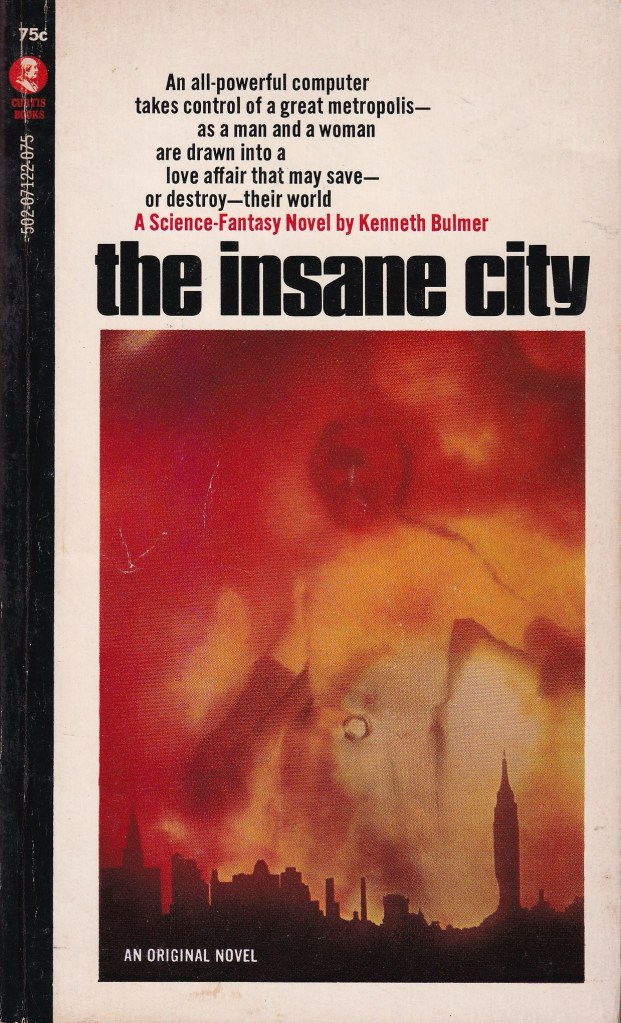
Uncredited cover for the 1st edition
3.25/5 (Above Average)
Earlier this year Kris Vyas-Myall reviewed Kenneth Bulmer’s The Insane City (1971) over at Galactic Journey. Especially as Bulmer, despite his prolific output, isn’t often elevated above the mid-to-lower tier of British authors, Kris’ very positive assessment piqued my interest. Also, as the child of two architects, I’m always open to science fiction that speculates on future urban landscapes.
The Insane City (1971) follows Frank Ridgway, a media man for DESS, a computer company that manufactures “robex” — robots that are linked into a central mainframe computer. Bulmer dapples with the idea of some sort of proto-cyberpunk network beamed across a city that links together all types of computer units. Ridgeway, an appealing bloke, seems unnerved by the rapid and unregulated technological changes of his day. He feels alienated by the rapidly approaching reality of a networked and autonomous city. DESS runs up against the machinations of Serven, the far more successful competing conglomerate. The clash between the two major companies unfolds after a mysterious event where Ridgeway sees a woman who, a few days before, appeared to die in a wreck before his very eyes. DESS also starts to act in an unusual manner. Rather than the predicted plans to evict and modernize a section of the Eastern city, DESS suggests incorporating the old into the new. With the assistance of Aldous Carrit, an academic with access to another megaframe computer, they soon uncover a series of entwined secrets about the nature of their machines and the fate of their human creators.
While I am far from as ebullient about the experience as Kris, I agree that The Insane City is an underrated and intriguing SF thriller with a perpetually seductive premise. It’s topical. It’s unnerving at moments. It’s contains a functional and occasionally evocative prose. While missing the early 70s excitement (and terror) about computers, I recommend Robert Abernathy’s superior short story about urban alienation “Single Combat” (1955).
2. Peter Tate’s The Thinking Seat (magazine 1966, novelized 1969)
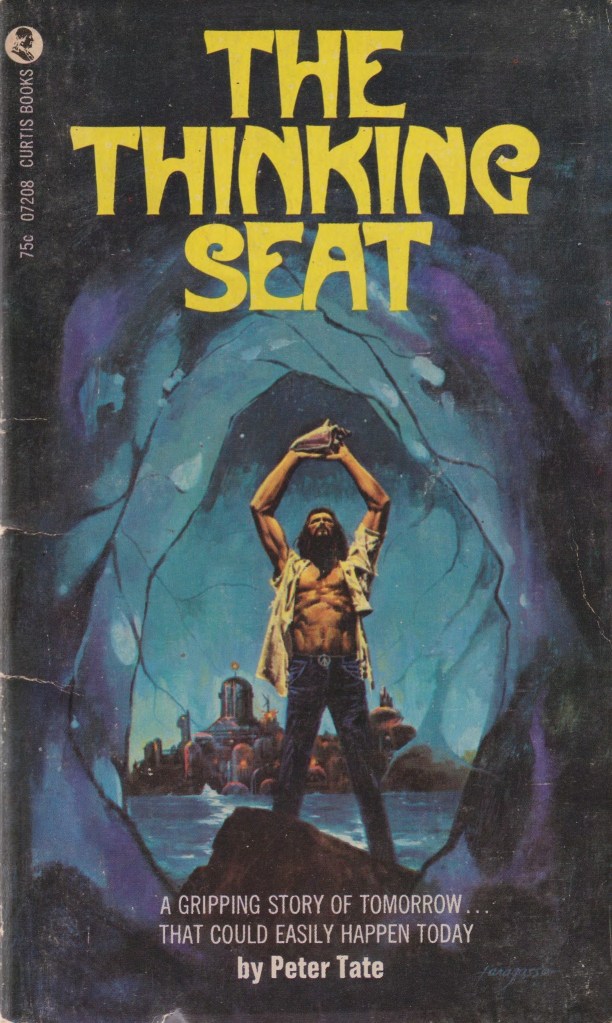
John Faragasso’s cover for the 1969 edition
2.75/5 (Below Average)
Peter Tate (1940-) is a Welsh New Wave author whom I have only recently become aware of. As I’ve pointed out before, I am all for SF that engages (in positive or negative ways) with the Counterculture and The Thinking Seat (1966, novelized 1969) fits the bill–albeit, in a rather confusing (and dare I say muddled) way. While framed as a thriller, Tate spins a character study over a series of tenuously connected scenes. The setting? A near-future California in the year 1973. However, it’s a California transformed by a nuclear power plant that raises the temperature of the nearby Ocean. In this metamorphosed new environment, the rocky coast of Monterrey and its environs is transformed into a series of manufactured beaches with bars and vacationers. Gone are the crabs and their parasites and ribbon fish and…. you get the picture. Complete ecological erasure.
The story follows Simeon, the unofficial leader of a similarly aimless group of unhappy youths called the Budkins, and various individuals who come into contact with him. He parrots rhetoric about the evils of the new beaches. He doesn’t have clear plans or objectives.
The novel’s prolog introduces attempts to suggest a deep ecological framework to the proceedings. The biological diversity of the California of the past is conveyed with almost documentary-esque biological details — “the hermit and porcelain crabs” with their “cargoes of protective algae” (5). This vividly alive past clashes with the new manmade beaches and their aimless inhabitants in the novel’s present. Tate wants to create a deep sense of loss for what was. However, I found a lack of intwining of narratives. The prologue reads instead as an afterthought. Another element that felt forced and forgotten, was Simeon’s supposed charisma. I remain unsure how anyone finds him appealing. He does not appear to have a well-formed ideology. He’s an aimless drifter more interest in minor acts of control. And maybe this is partially Tate’s satirical point, the Counterculture’s co-opting of meaningful narratives of societal change and ecological activism by self-proclaimed guru figures like Simeon.
Due to my Counterculture interests, I still think there’s enough of value in this volume to track down the two sequels Moon on an Iron Meadow (1974) and Faces in the Flames: Fourth in a Series of Small Wars (1976) in the Simeon sequence. For everyone else, I can’t entirely recommend this one. Despite its short length and fascinating ecological themes, it’s a mighty slog.
For book reviews consult the INDEX
For cover art posts consult the INDEX
For TV and film reviews consult the INDEX


As noted on Bluesky, I finished your recommended Level 7 (thanks again) and my TBR stack of post-apocalyptic lit was practically zero (still waiting for an affordable reprint of the Faldbakken novels). I was looking for something and thanks to you, I picked this one up today.
Hello John, glad you enjoyed Level 7. I have very fond memories of that one. As for the Collier, it’s very interesting. Told in a detached and brutal manner. Loved the interplay with Roman myth. So good.
Have you read any Angela Carter? Another post-apocalyptic novel for your list, Heroes & Villains (1969). https://sciencefictionruminations.com/2022/09/18/book-review-heroes-villains-angela-carter-1969/
No, I have not read her works. Appreciate the recommendation! Looks like there is an audiobook version as well and I’ve added to the list.