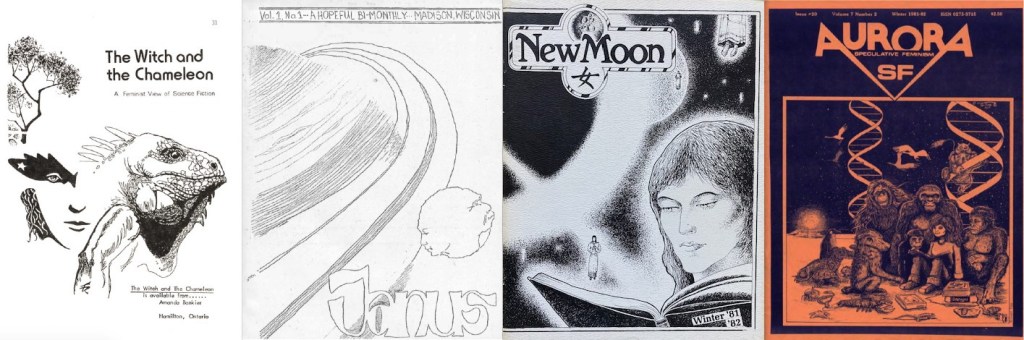
Exploration Log 17: Interview with Loïg J. F. Pascual on 1970s-1980s Feminist Science Fiction Fandoms

Over the last few years, I have highlighted a few curated pieces of science fiction scholarship in my Exploration Log series that I’ve found memorable, historically important, and worth sharing.1 Today I have an interview with SF scholar (and friend) Loïg J. F. Pascual, author of the recently published article “The Collective Memory of 1970s-1980s Feminist Science Fiction Fandoms: A Case in Reflexivity and Historiography for fan Studies Practices” (2026). The article appeared in Transformative Works and Cultures, Vol. 49 (2026) You can read a translated version in English and in the original French. The French version includes multiple Youtube video interviews with important figures in the movement.

More than just an interview about his specific area of research, Loïg dives into the larger history of feminist fanzines and the vital role of fan culture in the creation and memorialization of genre. Enjoy!


1. Thank you so much for agreeing to this interview. Please introduce yourself and your interest in feminist SF fandoms in the 70s and 80s.

My name is Loïg J.F. Pascual, and I am a Ph.D. student at the Université du Québec À Montréal. I started reading science fiction (SF) with the books my father bought—collections of Philip K. Dick stories, Hard to Be a God (1964) by the Strugatsky brothers, and Robert Charles Wilson’s Spin (2005), Axis (2007), and Vortex (2007) series. We would spend hours looking for new SF reads in used bookstores.

Continue reading
Updates: Recent Science Fiction Purchases No. CCCLIII (C. J. Cherryh, Alan Burns, Brian M. Stableford, and Irene Clyde)

Which books/covers/authors intrigue you? Which have you read? Disliked? Enjoyed?

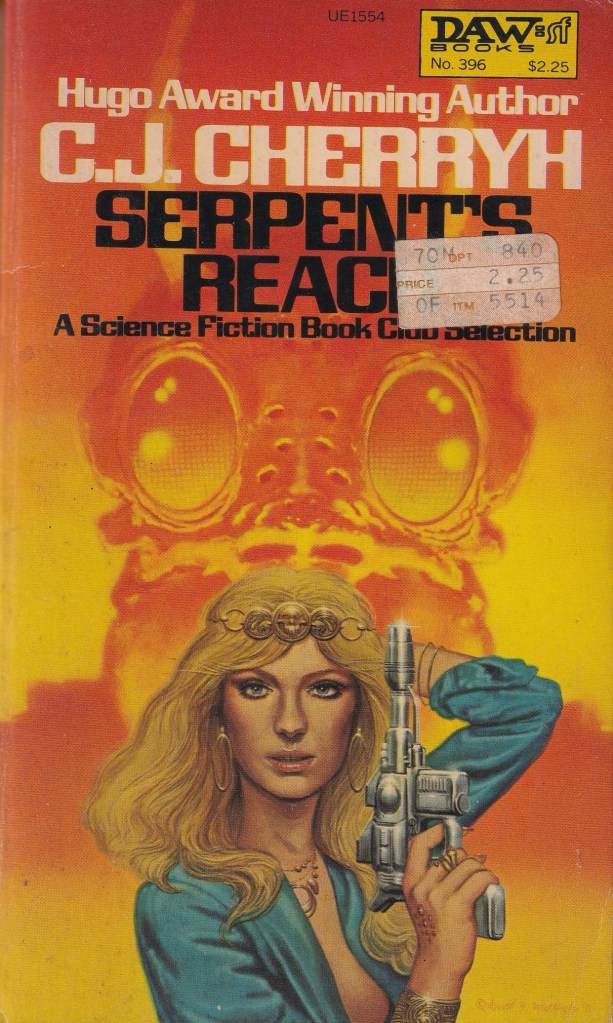
1. C. J. Cherryh’s Serpent’s Reach (1980)

From the back cover: “The constellation of Hydrus, known as the Serpent, is compact and obscure as seen from Earth’s sky. Even in the great era of interstellar colonization it remained obscure. For it was under strict quarantine – harboring an intelligent race, powerful, alien, and inhuman.

Yet there were human colonies within the Serpent’s Reach, cut off from the galaxy beyond, with their own inbred culture, their Families and traditions, and their special relationships to the inhuman majat.

This is the strange and brilliant novel of Raen, the last of the massacred Sul Family, and of her lifetime pledge to find vengeance. It was to take her across the worlds of the Reach into the very center of the alien webwork, into the strands of thought and counter-thought that knit the forbidden constellation into a complex of interbred cultures that no outsider could hope to unravel.”

Continue reading

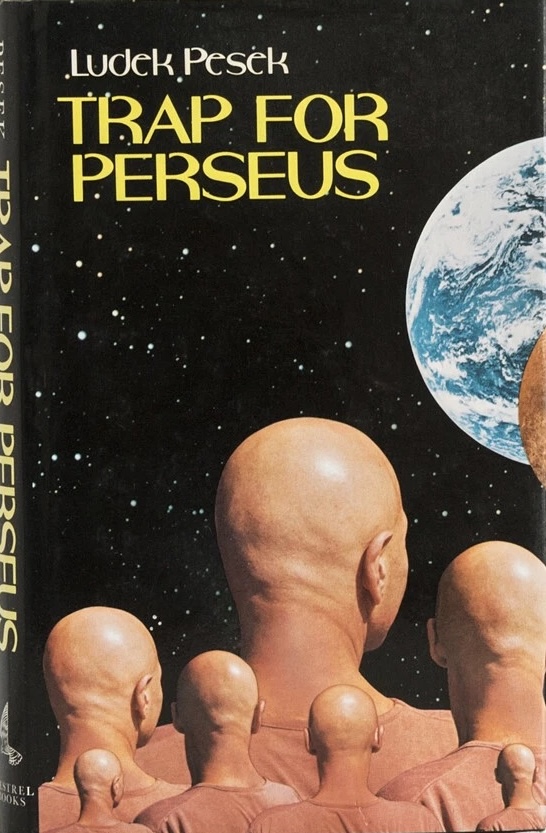
Book Review: Luděk Pešek’s Trap for Perseus (1976, trans. Anthea Bell, 1980)

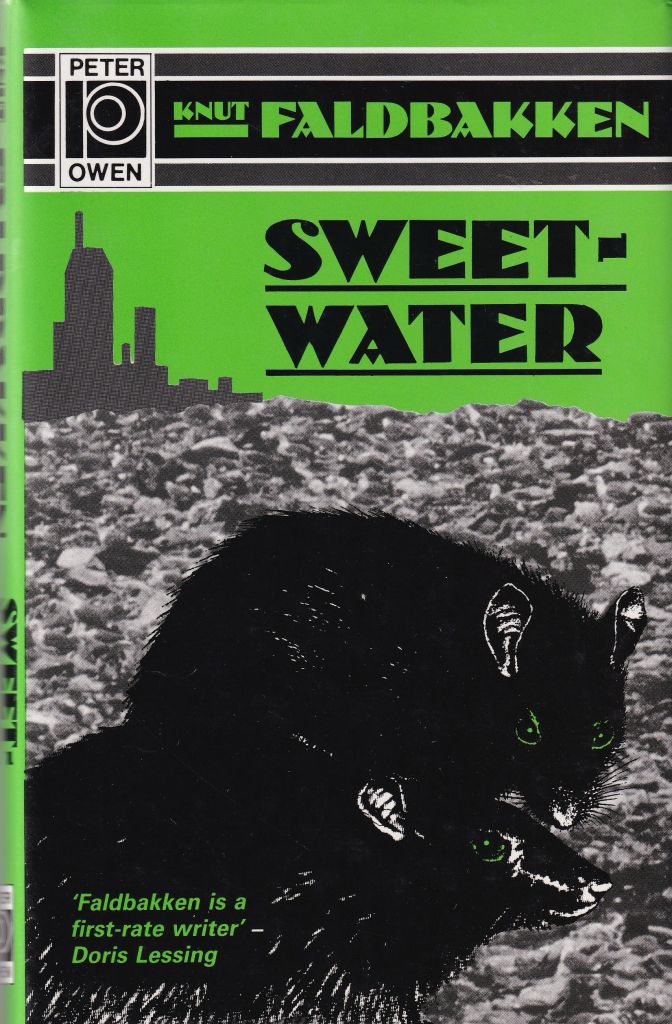
Preliminary note: This review originally appeared in the second issue of Rachel S. Cordasco’s new magazine Small Planet: The SF in Translation Magazine. You can read the entire issue for free here! I plan on contributing one review of pre-1985 SFF in translation for each issue. In the first issue, I reviewed Knut Faldbakken’s harrowing dystopia Sweetwater (1976, trans. Joan Tate, 1994).

3.5/5 (Good)

Czech author Luděk Pešek (1919-1999), also a painter of space landscapes and photographer, emigrated to Switzerland with his wife in 1968. Due to his political beliefs and penchant to criticize the state in his early literary works, the Union of Czechoslovak Visual Artists expelled Pešek from its ranks. In Switzerland, he focused on painting space landscapes and providing illustrations for foreign publishing houses like Penguin Books and the National Geographic Society.1 He also wrote three science fiction novels in Czech, his native language: The Earth is Near (1970, trans. Anthea Bell, 1973), Flight into the World of Tomorrow (1975), and Trap for Perseus (1976, trans. Anthea Bell, 1980). All three first appeared in print in German translations.2 Anthea Bell translated two of the novels, The Earth is Near and Trap for Perseus, from German to English.3 I am unsure if the Czech manuscripts still exist. In the safety of exile, Pešek’s Trap for Perseus re-imagines the generation ship, so often a symbol of humanity’s technological triumph, as an isolated microcosm of Stalinist extremes detached entirely from its original purpose to colonize the stars.

The Lay of the Halls and Plantations and Other More Conceptual Places

Continue reading

Short Book Reviews: Tanith Lee’s Drinking Sapphire Wine (1977) and Edmund Cooper’s All Fool’s Day (1966)

Note: My read but “waiting to be reviewed pile” is growing. Short rumination/tangents/impressions are a way to get through the stack before my memory and will fades. My website partially serves as a record of what I have read and a memory palace for future projects. Stay tuned for more detailed and analytical reviews.

1. Tanith Lee’s Drinking Sapphire Wine (1977)

3.5/5 (Good)

In 2019, I read and mostly enjoyed Tanith Lee’s Don’t Bite the Sun (1976). The sequel Drinking Sapphire Wine (1977) follows the same nameless narrator of the first volume. It’s set in the same post-scarcity future  replete with advanced technology where youth, the Jang, are encouraged (and “taught” via hypno-schools) to engage in all forms of excess. The narrator, sometimes female and other times male, attempts to find life’s purpose in a society without need. In cities surrounded by desert sand and the hidden ruins of ancient habitation, humans deploy technology to satiate all their whims. Society falls into three groups: The Jang, or the youth. In Limbo, new bodies are made for the Jang who commit suicide and others who want a change in costume or gender. Old People, the post-Jang state, are allowed to have children and pursue simple jobs (of course, backed up entirely by machines!). They too are able to change gender and create new bodies… The third and final “human” state are Quasi-Robots, who are humanoid androids and care for every human need.

Continue reading

Updates: Recent Science Fiction Purchases No. CCCLII (Joe Haldeman, Jack C. Haldeman II, Zenna Henderson, Thomas Burnett Swann, and Edwin Corley)

Which books/covers/authors intrigue you? Which have you read? Disliked? Enjoyed?

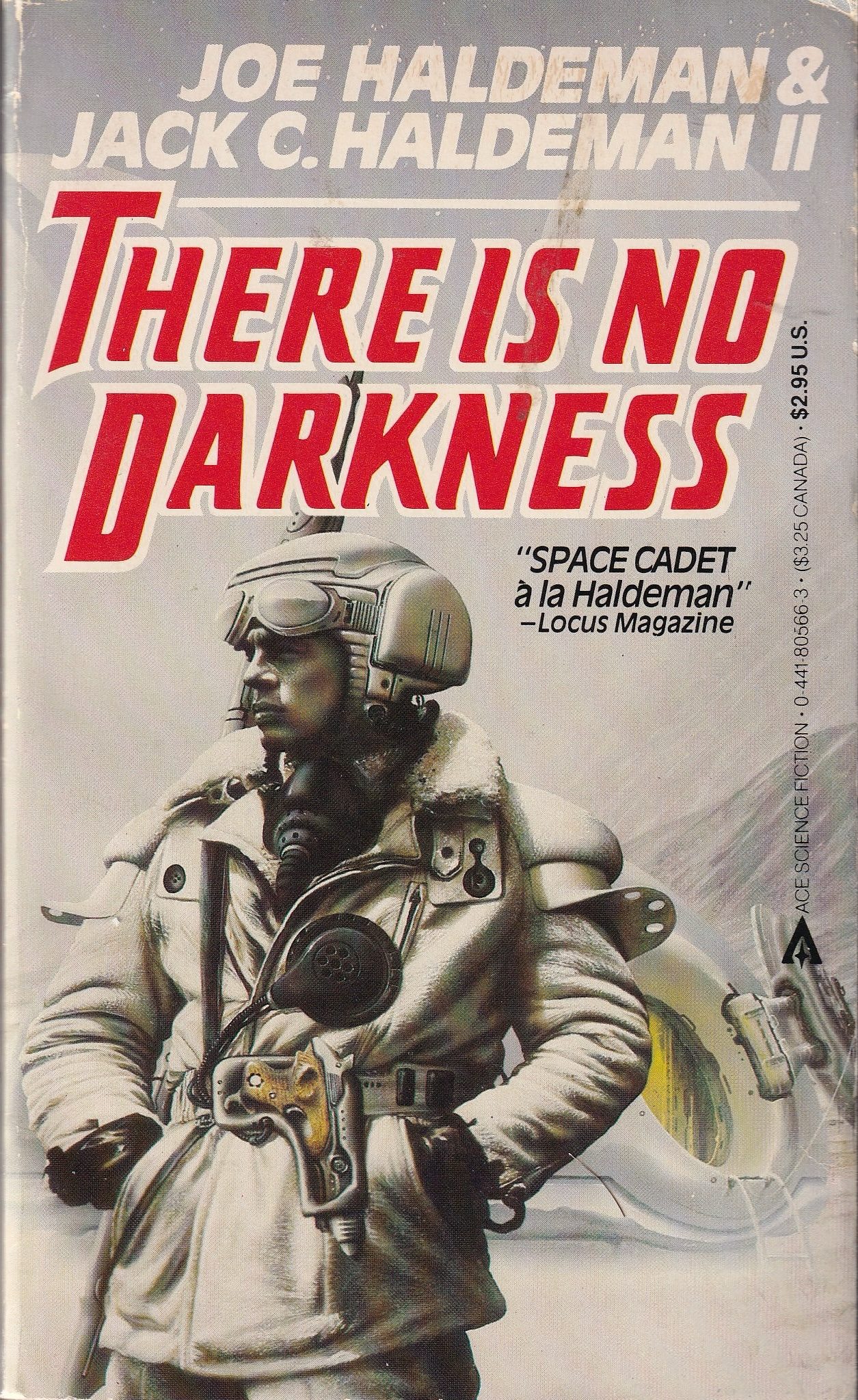
1. Joe Haldeman and Jack C. Haldeman II’s There is No Darkness (1983)

From the back cover: “The universe is not interested in fair play. The universe is interested in survival. That is lesson number one aboard the giant advance-training ship called ‘Starschool.’ Those who fail to learn lesson one very rarely have cause to worry about what comes next…”

Initial Thoughts: Even at his worst, I find Joe Haldeman a polished author. I’ve only read a few of his brother’s short stories. I’ve hear this volume is a bit on the juvenile SF side of things. We shall see.

Continue reading

Updates: Recent Science Fiction Purchases No. CCCLI (Arkady and Boris Strugatsky, Philip K. Dick, Howard L. Cory, Ward Moore and Avram Davidson, and Muriel Jaeger)

Which books/covers/authors intrigue you? Which have you read? Disliked? Enjoyed?

1. Arkady and Boris Strugatsky’s Roadside Picnic (1972, trans. Olena Bormashenko, 2012)

From the back cover: “Red Schuhart is a stalker, one of those misfits who are compelled, in spite of the extreme danger, to venture illegally into the Zone to collect the mysterious artefacts that the alien visitors left scattered around. His life is dominated by the place and the thriving black market in the the alien products. Even the nature of his mutant daughter has been determined by the Zone. And it is for her that he makes his last, tragic foray into the hazardous and hostile territory.”

Initial Thoughts: One of those obvious holes in my SF knowledge… I certainly have read about the writing pair but I’ve only read a story here and there–for example “Wanderers and Travellers” (1963, trans. 1966)–and one novel that I never managed to review. My father has been pushing me to read more of their work. And yes, Andrei Tarkovsky’s adaptation Stalker (1979) remains one of my favorite movies. I took a History of Russian Film class in college and wrote my term paper on Tarkovsky’s use of color.

Continue reading

What pre-1985 science fiction are you reading? + Update No. XXIX

What pre-1985 science fiction adventures have you started this summer? Any great reads? Disappointing ones? Intriguing discoveries? Here’s the April installment of this column.

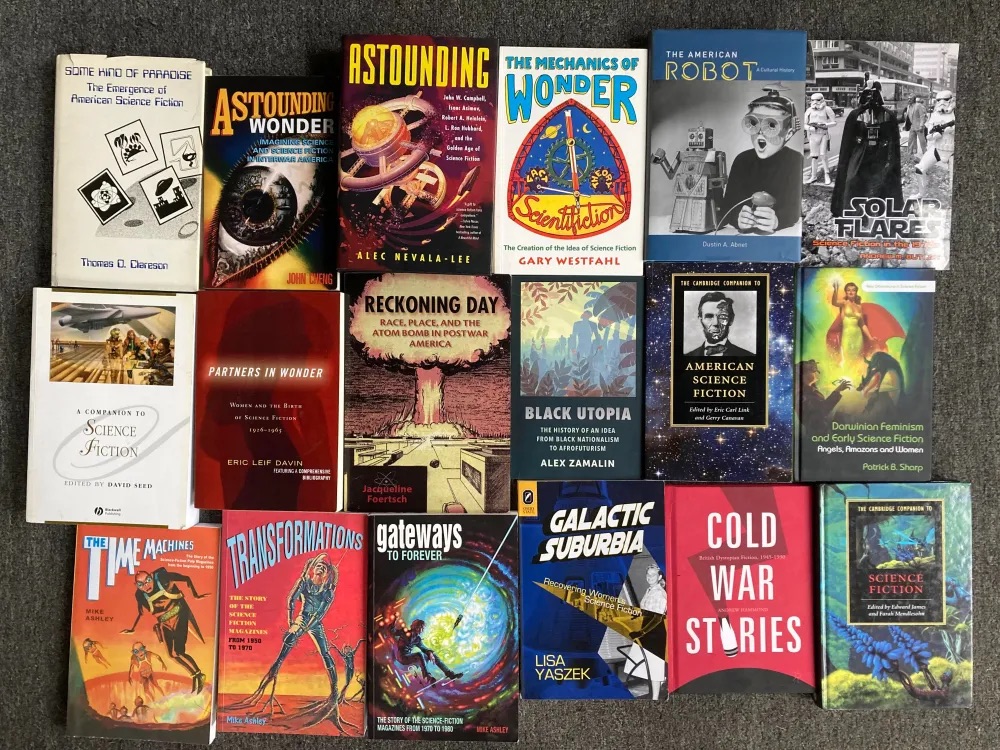
In a conversation on Blueksy, someone asked for my history of science fiction recommendations (including a few general surveys). I scoured my shelves and came up with an all-too-large pile (with some notable volumes I wanted to include but could not find) of favorite histories of science fiction. See photo below. I tried to include monographs that were not studies of single authors.

As I am a historian by training and trade who holds on to some of my disciplinary ticks and hangups, I also included works by trained academics with two major exceptions 1) Mike Ashley’s multi-volume study of science fiction magazines (but no other recent works exist and they’re really good for the nuts and bolts of genre magazines) and 2) Alec Nevala-Lee’s approachable and well-researched group biography  Astounding: John W. Campbell, Isaac Asimov, Robert A. Heinlein, L. Ron Hubbard, and the Golden Age of Science Fiction (2018). Both should be read.

I deliberately avoided works by science fiction authors like Damon Knight, Brian W. Aldiss, and Frederik Pohl. They’re great sources and I own and have read many of them but…. they are not histories by trained scholars. I do not mean for this to come off as elitist. Rather, my personal remit for my list—I needed to winnow down the hundreds and hundreds I own–was deliberately narrow! I read and use sources widely. Remember, these are my favorites — they might not be the best but they got me thinking and reading and writing. And that’s what we all should be doing, reading what makes us happy.

Continue reading

Updates: Recent Science Fiction Purchases No. CCCL(Jack Vance, Adolfo Bioy Casares, Thom Keyes, and Kenneth Bulmer)

Which books/covers/authors intrigue you? Which have you read? Disliked? Enjoyed?

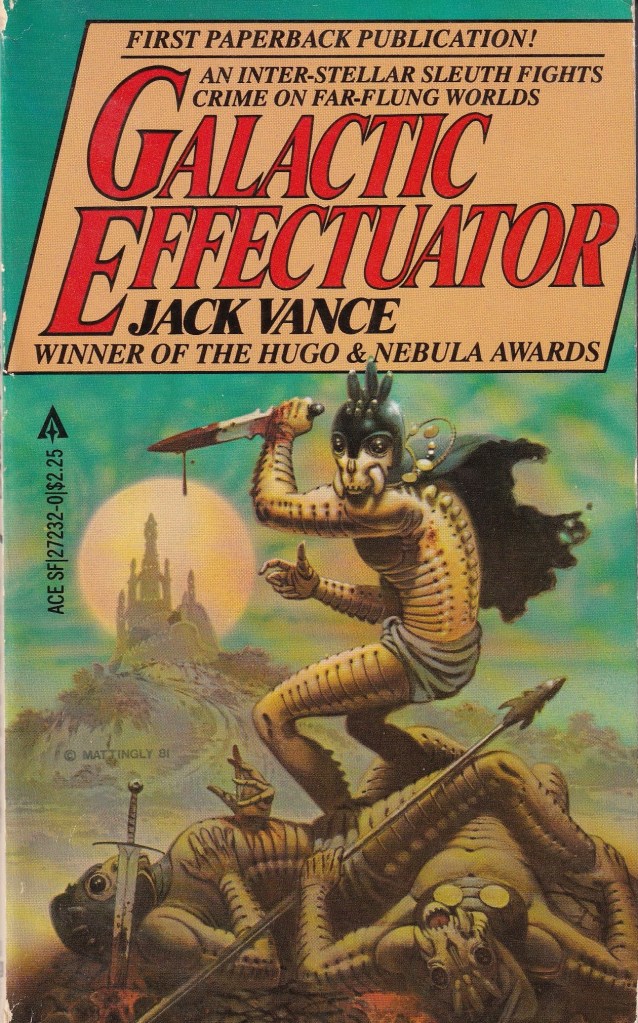
1. Jack Vance’s Galactic Effectuator (1980)

From the back cover: “Meet Miro Hetzel, Galactic Effectuator. He’s part gentlemen, part detective, part fraud, and his trail of exploits cuts through some of the more improbably civilizations in the universe. Join him in a trip to the planet Maz, whose natives are so fierce that they’ll fight three battle before lunch and then dine on the enemy–a planet that only a man with Miro Hetzel’s steely nerve would dare to visit at all.”

Initial Thoughts: This is a fix-up novel containing “The Dogtown Tourist Agency” (1975) and “Freitzke’s Turn” (1977). I previously reviewed “Freitzke’s Turn” (1977) and did not classify it amongst Vance’s best. As many know, I’ve soured a bit on Vance in the last decade. That said, I still think novels like Wyst: Alastor, 1716 (1978) and Emphyrio (1969) are worth the read.

Continue reading

Book Review: Knut Faldbakken’s Sweetwater (1976, trans. Joan Tate, 1994)

Preliminary note: This review originally appeared in the inaugural issue of Rachel S. Cordasco’s new magazine Small Planet: The SF in Translation Magazine. You can read the entire issue for free here! I plan on contributing one review of pre-1985 SFF in translation for each issue. In addition to my review, there’s a fantastic range of other articles and interviews.

4.5/5 (Very Good)

Knut Faldbakken (1941-), a prolific Norwegian novelist, wrote a science-fictional duology titled Sweetwater early in his career. The first volume, Twilight Country (1974, trans. Joan Tate, 1993), followed an odd collection of refugees from a disintegrating urban metropolis, the titular Sweetwater, as they cast off the entangling membranes of lost paths and the weight of melancholy souls and attempt to chart a new beginning in the city Dump.

In volume two, Sweetwater (1976, trans. Joan Tate, 1994), a deathly equilibrium is reached. In an obliquely hinted at dystopia, the city slowly withers and depopulates due to the effects of global warming, industrialization, and malignant societal decay. As the city dies, less and less refuse enters the Dump. The community of outcasts, who inhabit a collection of huts around a camper and crumbling home with small garden plots surrounded by refuse, can no longer scavenge for supplies and food. They must abandon the uncertain topography of the Dump and return to the city. 

Continue reading