[Short] Book Reviews: Samuel R. Delany and Howard V. Chaykin’s Empire (1978), Kate Wilhelm’s City of Cain(1974), Charles Sheffield’s Sight of Proteus(1978)

My “to review” pile is growing and my memory of them is fading… hence short—far less analytical—reviews.

1. City of Cain, Kate Wilhelm (1974)

(Uncredited cover for the 1978 edition)

3.5/5 (Good)

Kate Wilhelm’s City of Cain (1974) is a moody, streamlined, and psychologically heavy near-future SF thriller. Peter Roos returns from the Vietnam War a scarred man both mentally and physically. After a technical error on a helicopter, a missile it was carrying explodes killing half the crew and sending shrapnel into Roos’ body. Back in the US, Roos engages Continue reading

Book Review: Seeklight, K. W. Jeter (1975)

(Kelly Freas’ cover for the 1975 edition)

3.5/5 (Good)

K.W. Jeter’s first published novel is a promising one (*). On a nameless colony world, entropic forces influence all. Humankind speaks less and less and resorts to animistic grunts. Robotic priests go mad. Speculation abounds of a “Dark Seed” (52) implanted by the eugenicists on Earth in the colonist gene pool creating an increasingly crude and lazy population, “wretched and fearful of any change or effort” (46). The landscape itself  is inscribed with the entropic effects: most of the population seems to be engage in quarrying, hillsides are covered with the Continue reading

Book Review: Don’t Bite the Sun, Tanith Lee (1976)

(Brian Froud’s cover for the 1st edition)

3.75/5 (Good)

My friend Hergal had killed himself again. This was the fortieth time he had crashed his bird-plane on the Zeefahr Monument and had to have a new body made” (9).

Tanith Lee’s Don’t Bite the Sun (1976) posits a post-scarcity future  replete with advanced technology where youth, the Jang, are encouraged (and “taught” via hypno-schools) to engage in various forms of excess. The nameless female Jang narrator (N) attempts to find life’s purpose in a society without rules, struggle, Continue reading

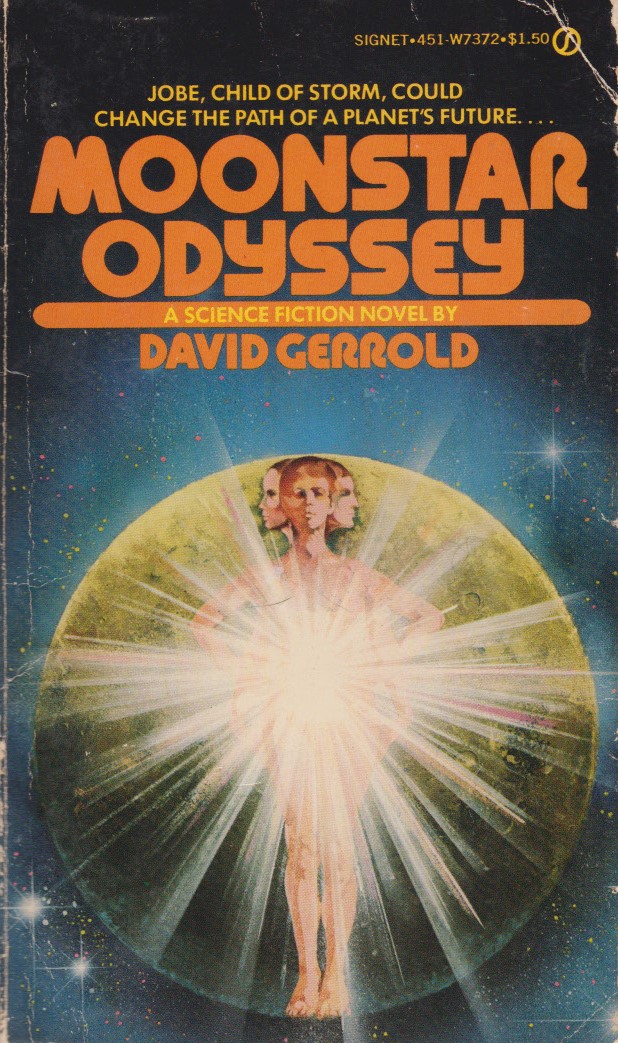
Book Review: Moonstar Odyssey, David Gerrold (1977)

(Gene Szafran’s cover for the 1st edition)

4.5/5 (Very Good)

David Gerrold’s Moonstar Odyssey (1977) is a careful and introspective reflection on identity and gender set in a fascinating world made habitable by terraforming.  While the back cover suggests the presence of a driving narrative–the fulfillment of a prophecy propelled by a catastrophic cataclysm–instead, Gerrold’s novel is a bildungsroman that follows the self-realization of a precocious child named Jobe.  The dominate struggle that forms the core of the novel is “The Choice”–the moment in a young person’s life when they chose to move from their androgynous state to either “Reethe [or] Dakka, between female Continue reading

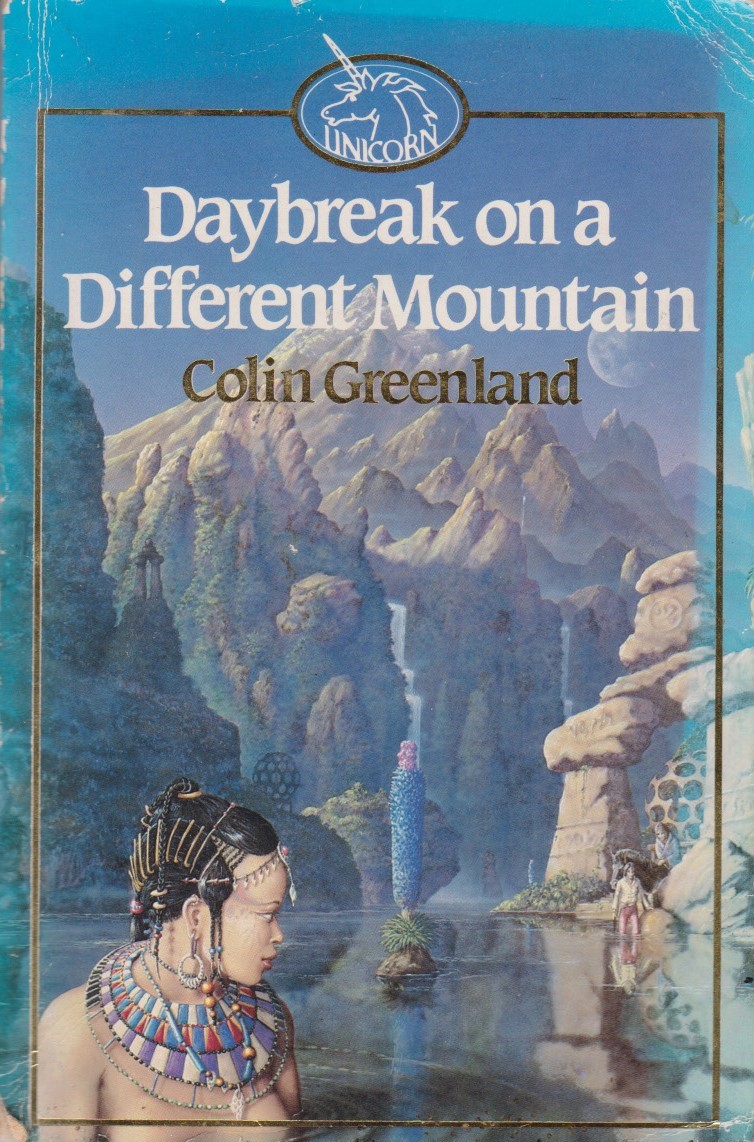
Book Review: Daybreak on a Different Mountain, Colin Greenland (1984)

(Steve Weston’s cover for the 1st edition)

4/5 (Good)

Fantasy and science fiction that deploys geographical and urban allegory—Italo Calvino-esque cities balanced over chasms, the skeletons of urban human interactions measured out in string, etc.*—relentlessly intrigues. In John Crowley’s The Deep (1975), the world as chessboard is perched on top of a pillar with endlessness on all sides. In Garry Kilworth’s Cloudrock (1988), two tribes eek out their existence on a levitating rock surrounded by poisonous gasses. Terry Carr’s Cirque (1977) posits a city next to an abyss out of which crawls a tentacled beast…. Sculpted urban and geographic artifice can, in the hands of an adept author, create meaning-rich texts as characters inscribe new patterns on the landscapes they traverse. Continue reading

Book Review: Seconds, David Ely (1962)

(Uncredited cover for the 1963 1st edition)

5/5 (Masterpiece)

You’ve got what almost every middle-aged man in American would like to have. Freedom. Real freedom. You can do any damned thing you want to. You’ve got financial security, you’ve got no responsibilities, and you’ve got no reason at all to feel guilty about what you’ve done. The company’s taken care of everything. Right?” (91)

David Ely’s Seconds (1962), a disquieting and sparse thriller, posits a near future where a shadow organization can grant the wealthy new identities via plastic surgery and staged deaths. Wielding deceptively simple prose, Ely ruminates on the existential dread of the male mid-life crisis–an undefined desire to escape, to redo, to break free from the expectations and constraints of the suburban existence. It is a careful novel. A well-crafted nightmare Continue reading

Short Book Reviews: Lloyd Biggle, Jr.’s The World Menders (1971), Pamela Sargent’s The Sudden Star (variant title: The White Death) (1979), Josef Nesvadba’s In the Footsteps of the Abominable Snowman (variant title: The Lost Face)(1964, trans. 1970)

Note: My “to review” pile is growing. Short reviews are a way to get through the stack. Stay tuned for more detailed and analytical reviews.

But first…. three completely different volumes.

1.  The  World  Menders, Lloyd Biggle, Jr. (1971)

(David Bergen’s cover for the 1975 edition)

3.5/5 (Good)

Despite the idiotic moments in Star Trek: Insurrection (1998), as a kid I adored the first sequence–the undercover team observing the Ba’Ku community from a hidden observation station (before Data’s malfunction). Of course, Star Fleet assumed the Ba’Ku were pre-warp drive (and thus first contact shouldn’t be initiated). The mechanics of going undercover to initiate or prepare a society for contact is a fascinating and endlessly replayable SF premise. Continue reading

Book Review: Cybernaut, E. G. Valens (1968)

(Robert Andrew Parker’s cover art for the 1968 edition)

2.75/5 (Vaguely Average)

E. G. Valens’ Cybernaut (1968), a narrative SF poem, translocates earth exploration metaphors into the endless emptiness of space with varying degrees of success.

The narrator’s deep space exploration–“Operation C / Exploratory / A first incision in the skin of time. / Objective: / Lay back the superficial tissue / Lay bare the cortex of / The galaxy” (13)–is not all triumph. Continue reading

Book Review: Under a Calculating Star, John Morressy (1975)

(Paul Alexander’s cover for the 1978 edition)

3/5 (Average)

After finishing John Morressy’s Frostworld and Dreamfire (1977), I tracked down another volume of his Del Whitby sequence. Although far from as engaging and emotionally affective as the former, Under a Calculating Star (1975) provides the historical background to the Morressy’s weirdly primitive far future world: the origins of the Sternverein (the dominant business polity), the explanation of why swords and knives are the weapons of choice while high-tech spaceships roam the interstellar expanses, and the role of Old Earth in the colonization of the far flung reaches. Historical content aside, Under a Calculating Star‘s plot and characters fail to engage and the worlds and societies are one-dimensional in comparison to Frostworld and Dreamfire‘s metamorphic Onhla and the planet Hraggellon, locked in its unusual orbit. Continue reading