Short Story Reviews: Chan Davis’ “The Nightmare” (1946), “To Still the Drums” (1946), and “The Aristocrat” (1949)

Chan Davis (1926-2022) was a fascinating figure. He was a communist activist, fanzine editor, mathematician, and political prisoner. He was fired from the University of Michigan in 1954 and imprisoned for six months in 1960 on charges of contempt of Congress leveled by HUAC. The Hugo Book Club recently posted a fantastic interview, from which I derived the bibliographic blurb above, with Steve Batterson, the author of The Prosecution of Professor Chandler Davis: McCarthyism, Communism, and the Myth of Academic Freedom (2023) that I plan on purchasing soon.

Today I have selected three of Chan Davis’ thirteen published SF short stories. The connecting theme? 1940s speculations on nuclear war in the immediate post-Hiroshima world. All three appeared in Astounding Science Fiction under the tutelage of John W. Campbell, Jr.


3/5 (Average)

“The Nightmare” first appeared in Astounding Science Fiction, ed. John W. Campbell, Jr. (May 1946). You can read it online here.

A few months before the atomic bomb attack on Hiroshima (August 6th, 1945), a group of scientists at the University of Chicago published The Franck Report (June 11th, 1945). James Franck and his colleagues argued that “within ten years other countries may have nuclear bombs, each of which, weighing less than a ton, could destroy an urban area of more than ten square miles.” They point out the great disadvantage of the United States with its “agglomeration of population and industry in comparatively few metropolitan districts” in comparison to countries with a population and “industry […] scattered over large areas.” In the months after Hiroshima, Chan Davis published his first SF story “The Nightmare” with The Franck Report warning firmly in mind [1].

Continue reading

Short Story Reviews: Robert Silverberg’s “Road to Nightfall” (1958) and Edgar Pangborn’s “The Music Master of Babylon” (1954)

I can’t escape the post-apocalyptic wasteland. Like a voyeuristic shadow, I follow the denizens of the charred surface as they plod their slow movements toward the end. I observe how they push away the looming violent redness that blots out the sky, and, when everything else seems lost, they turn interior. A final movement that lays bare tattered dreams and ephemeral memories…


5/5 (Masterpiece)

Edgar Pangborn’s “The Music Master of Babylon” first appeared in Galaxy Science Fiction, ed. H. L. Gold (November 1954). You can read it online here.

Fresh of Edgar Pangborn’s masterpiece Davy (1964), I decided to cover some of his short fiction on the site. He’s shaping up to be my author of the year. “The Music Master of Babylon” (1954), which I suggest should be included as part of his Tales of a Darkening World sequence due to multiple references to events and people present in the world of Davy, contains many of the embryonic concerns that crop up in the later novel. Pangborn is the master of interweaving narrative and personal memory and the ways art–in this instance music–lays bare the topography of self.

Continue reading

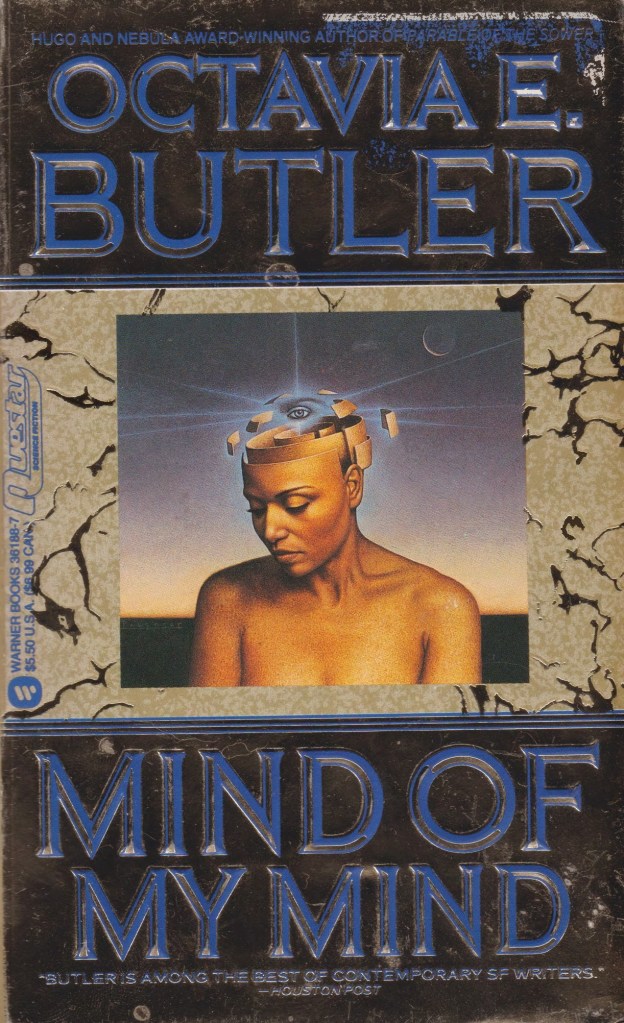
Short Book Reviews: Octavia E. Butler’s Mind of My Mind (1977) and Susan Cooper’s Mandrake (1964)

Note: My read but “waiting to be reviewed pile” is growing. Short rumination/tangents are a way to get through the stack before my memory and will fades. My website partially serves as a record of what I have read and a memory apparatus for future projects. Stay tuned for more detailed and analytical reviews.


1. Mind of My Mind, Octavia E. Butler (1977)

4/5 (Good)

Octavia E. Butler’s Mind of My Mind (1977) is the second-published and second chronological installment of her Patternist series of novels (1976-1984), that chart the dystopic and hyper-violent development (and destruction) of a telepathic society. The series also contains her disowned (and hard-to-afford without selling a child) novel Survivor (1978). I wish I had read Wild Seed (1980) first!

The immortal Doro, able to hone into those with telepathic talent and shift his essence into new human bodies at will, oversees a generations-old telepathic breeding project. The harrowing story follows one his many daughters, Mary, a rare active telepath (vs. latent), as she comes of age and begins to understand the role that she is designed to play. Doro preys on the downtrodden and abandons the majority of latent telepaths to live miserable lives, unable to filter out the emotions they sponge up. Doro pairs Mary with another active telepath named Karl in order to guide her through her transition. But something new appears in her mind, she seems to have created a pattern that compulsively draws in actives from across the country. And Doro begins to feel threatened by his own creation.

Continue reading

Book Review: The Gold at the Starbow’s End, Frederik Pohl (1972)

3.75/5 (Collated rating: Good)

After Frederik Pohl (1919-2013) left his editorial position at Galaxy and If in 1969, he set his pen towards a productive vein of form in the 70s that would culminate in his Hugo and Nebula-winning Gateway (1977). The Gold at the Starbow’s End contains five short stories–including the first of his Heechee sequence–from this period. Two of the best stories, the titular “The Gold at the Starbow’s End” (1972) and “The Merchant of Venus” (1972), demonstrate Pohl’s characteristic blend of hyperbolic satire and delirious energy. There are no duds in this collection.

Continue reading

Short Story Review: Kate Wilhelm’s “Planet Story” (1975) and Clark Ashton Smith’s “Master of the Asteroid” (1932)

The following review is the 27th and 28th installment of my series searching for “SF short stories that are critical in some capacity of space agencies, astronauts, and the culture which produced them.” Some stories I’ll review in this series might not fit. And that is okay. I relish the act of literary archaeology.

Kate Wilhelm’s “Planet Story” (1975) charts a planetary mystery that seems just out of reach of the cold, factual truth of scientific instruments. And Clark Ashton Smith’s “Master of the Asteroid” (1932) imagines the fragile minds of human explorers unable to grapple with the interplanetary gulf.

As always, feel free to join the conversation.

Previously: Philip K. Dick’s “The Precious Artifact” (1964) and Henry Slesar’s “Mr. Loneliness” (1957)

Up Next: Clifford D. Simak’s “Conditions of Employment” (1960).

4/5 (Good)

Clark Ashton Smith’s “Master of the Asteroid” first appeared in Wonder Stories, ed. Hugo Gernsback (October 1932). You can read it online here. I read it in the 1958 edition of Strange Ports of Call, ed. August Derleth (1948).

Cark Ashton Smith (1893-1961) is characterized as “one of the big three of Weird Tales, with Robert E. Howard and H. P. Lovecraft.” His fiction was deeply influenced by his psychological afflictions, “including intense agoraphobia,” and nightmares. Due to the Great Depression and the declining health of his parents, Smith wrote more than a hundred short stories between 1929-1934. “Master of the Asteroid” (1932), produced in this productive moment, reads like an unnerving catalog of manias.

Continue reading

Book Review: Davy, Edgar Pangborn (1964)

5/5 (Masterpiece)

Nominated for the 1965 Hugo Award for Best Novel [1]

Edgar Pangborn’s Davy (1964) takes place in a future devastated by a partially abortive nuclear war and the depravations of subsequent plagues (50). A powerful theocracy and perpetually warring microstates in the American Northeast emerged from the Years of Confusion. The novel takes the form of an autobiography. We follow a young orphan in love with life and desperate to escape his unfortunate circumstances.

Continue reading

Short Story Reviews: Philip K. Dick’s “Precious Artifact” (1964) and Henry Slesar’s “Mr. Loneliness” (1957)

The following reviews are the 25th and 26th installments of my series searching for SF short stories that are critical in some capacity of space agencies, astronauts, and the culture which produced them. Some stories I’ll review in this series might not fit. Many are far from the best. And that is okay. I relish the act of literary archaeology.

I’ve paired two stories, one by Philip K. Dick (1928-1982) and another by prolific but forgotten Henry Slesar (1927-2007), that puncture the grandiose illusion of humanity’s progress.

Thank you Richard Fahey, “Friend of the Site,” for the PKD recommendation.

Previously: Philip K. Dick’s “The Infinites” (1953) and James Causey’s “Competition” (1955)

Up Next: Kate Wilhelm’s “Planet Story” (1975) and Clark Ashton Smith’s “Master of the Asteroid” (1932)

4/5 (Good)

Philip K. Dick’s “Precious Artifact” first appeared in Galaxy, ed. Frederik Pohl (October 1964). You can read it online here.

A vast array of scholarship charts the continuing allure Mars holds in the popular imagination [1]. David Seed writes that “since the late nineteenth century Mars has tantalized the literary imagination with the possibility that life might exist on that planet” [2]. The visions of Edgar Rice Burroughs, Leigh Brackett, Ray Bradbury, and countless others created a seductive and sometimes complex vista of longing and conquest. Brackett, for example, evocated a Mars that was “more complex and varied” than Burrough’s “imperial triumphalism” [3]. In Brackett’s “The Beast-Jewel of Mars” (1948) (scheduled for this series), Mars becomes the location for the revenge perpetrated by the colonized [4].

Continue reading

Short Story Review: Henry Kuttner’s “Year Day” (1953)

Today I’ve reviewed the 28th story in my series on the science fictional media landscape of the future. In Henry Kuttner’s masterpiece “Year Day” (1953), a couple attempts to rekindle their relationship in the midst of a sonic deluge of advertising that threatens to blot out their thoughts.

Previously: Kate Wilhelm’s “Ladies and Gentlemen, This Is Your Crisis” (1976) and Langdon Jones’ “The Empathy Machine” (1965)

Up Next: Sydney J. Van Scyoc’s “Shatter the Wall” (1962)

5/5 (Masterpiece)

Henry Kuttner’s “Year Day” first appeared in his collection Ahead of Time (1953). Some of the other stories in the collection were co-written with his wife C. L. Moore. You can read the story online here.

The Air, Throbbing with Electronic Breath

Continue reading

Book Review: Mission: Manstop, Kris Neville (1971)

3.25/5 (Collated Rating: Above Average)

The career of Kris Neville (1925-1980) can be divided broadly into two parts. In his most productive period (1949-1957), Neville’s SF appeared in all the major magazines of the day, The Magazine of Fantasy and Science Fiction in particular. Afterwards, while he continued to publish short stories at a far reduced clip until his death, he wrote a handful of fix-up novels between 1964-1970. This trajectory neatly maps onto the restriction of magazine markets in the late 50s and the growing importance of the SF novel.

Continue reading