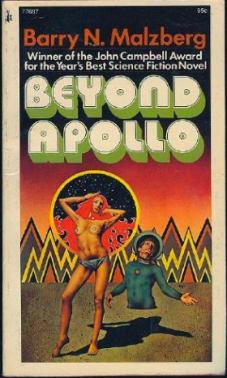
SF Article: Barry N. Malzberg (b.1939): Metafiction and the Demystification of the Cult of the Astronaut

This was my recent guest post on Little Red Reviewer.

For those who didn’t see it I decided to post it here….

——-

 Barry N. Malzberg (b. 1939): Metafiction and the Demystification of the Cult of the Astronaut
Screen shot 2013-01-14 at 1.55.20 PM

In the World Book Encyclopedia Science Service publication The United States Astronauts and their Families: A Pictorial Presentation (1965), each astronaut is allotted a two-page spread replete with staged photos of their family life and hobbies.  Otis L. Wiese, the editor of the volume, proclaims grandiosely “Man’s reach for the world of space is born of his insatiable curiosity about the unknown… his indomitable drive for accomplishment… his instinctive response to a challenge. Astronauts-Husbands-Fathers: these men are the men featured here but it’s essentially as family men that we portray them” (i).

The photographs are fascinating.  Roger B. Chaffee’s wife Martha teaches him lunar geography (22), L. Gordon Cooper, Jr. sits at the helm of his speedboat Bluebonnet which is capable of reaching 80 knots (28), in another photo him and his family spend time with their German shepherd (29), Donn F. Eisele teaches his daughter “the finer points of marksmanship” (35), while Alan B. Shepard, Jr. plays piano tunes for his daughters (61) and in the facing image shakes hands with John F. Kennedy (61).

Their families illustrate the epitome of the American family: the ultra-masculine man with his cars and boats, the supportive wife facilitating Continue reading

Updates: Recent Science Fiction Acquisitions No. XLVV (Herbert + Anderson + Brackett + Kornbluth)

More Christmas gifts + Winter break used bookstore finds….

Two more Richard Powers covers from the 50s…

A non-Dune Frank Herbert find with a wonderful Vincent Di Fate cover…  I’ve been somewhat ambivalent with Herbert’s non-Dune corpus in the last few years.  A 50s Poul Anderson adventure, a later Leigh Brackett novel, and another scathing satire from the delightful pen of C. M. Kornbluth…

1. The God Makers, Frank Herbert (1972) (MY REVIEW)

(Vincent Di Fate’s cover for the 1973 edition) Continue reading

Updates: Recent Science Fiction Acquisitions No. XLVIV (Crowley + Strete + McAllister + Bond)

Christmas presents!

Intriguing literary sci-fi by Craig Strete and John Crowley…

Works of unknown quality, Bruce McAllister’s Humanity Prime (1971) and Nelson Bond’s collection No Time Like the Future (1954)…

And one of my favorite Powers’ covers.

1. Humanity Prime, Bruce McAllister (1971)

(David Meltzer’s cover for the 1971 edition) Continue reading

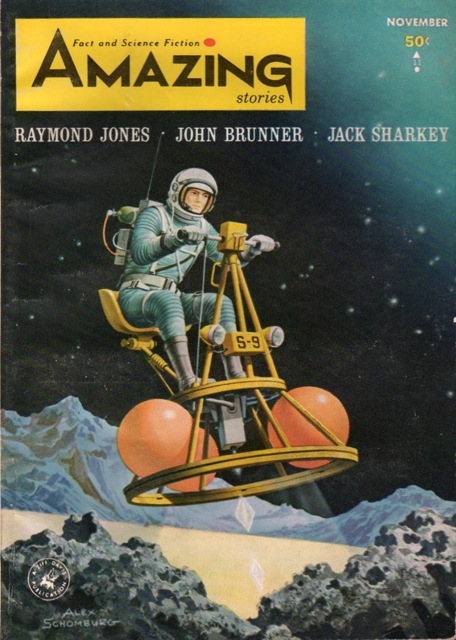
Updates: Recent Science Fiction Acquisitions, Magazine Edition No. I (Galaxy 2x, Worlds of If 3x, The Magazine of Fantasy and Science Fiction 1x)

My first science fiction magazines!

Although I’m not sure that I want to collect the entire catalogues of either Worlds of If or The Magazine of Fantasy and Science Fiction, I wouldn’t mind starting a collection of Galaxy (one of the more famous magazines).  I’ve been tentative in the past about purchasing magazines for one simple reason: a large percentage of their contents, especially if by well-known authors, are rewritten/expanded/re-conceptualized for later short story collections or novel publication form.  Thus, what version you read in the magazine is rarely the more polished version found in later editions.  For example, in the August 1965 issue of Galaxy Frank Herbert’s Do I Wake or Dream? was expanded for the 1966 novel publication under the title Destination: Void (which was revised again for the much later 1978 edition).  Novels like Dune (1965) are themselves fix-up novels from shorter novels previously serialized in magazines — Dune World (1963) and The Prophet of Dune (1965).  However, six magazines for one dollar each was too good of a deal to pass up….

The only magazine I desperately want to collect is New Worlds due to the quantity of experimental New Wave material which was published during Moorcock’s editorship.

(Gray Morrow’s cover for the August 1965 issue) Continue reading

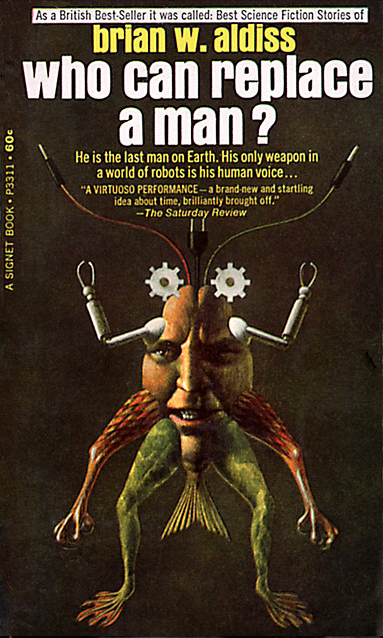
Updates: Recent Science Fiction Acquisitions No. XLVIII (Asimov + Brunner + Aldiss)

It’s been a while since I returned to one of the more well-known authors of the 50s — Isaac Asimov.  I’ve read many of his novels and short story collections (Foundation Trilogy, The Caves of Steel, The Naked Sun, The Robots of Dawn, Robots and Empire, The Currents of Space, The Gods Themselves, Nemesis, etc) and have never been too impressed.  However, with a run of recent bad 50s sci-fi works under my belt (review for David Duncan’s egregious Dark Dominion is upcoming) I feel the need to reappraise a few of the 50s greats. So, when I was perusing some gorgeous old paperbacks with well-preserved covers I purchased two Asimov novels for the first time since I was a young teenager.

And another Brunner to add to the 20+ works of his I already own….  Unfortunately the one edition I find was the one edition where the editor edited + modified Brunner’s words without his permission.

And some Aldiss short stories from the 50s….

A gorgeous collection of covers!

1. Pebble in the Sky, Isaac Asimov (1950) (MY REVIEW)

Screen shot 2012-12-24 at 9.50.07 AM

(Uncredited cover for the 1957 Continue reading

Book Review: Lords of the Starship, Mark S. Geston (1967)

(John Shoenherr’s cover for the 1967 edition)

3.75/5 (Good)

Mark S. Geston’s first novel Lords of the Starship (1967), written at the age of 21 while he was an undergraduate history student, revolves around a fascinating premise: The construction of a massive (fake) spaceship intended to lift a society out of a crippling malaise.  The narrative covers hundreds of years and seemingly innumerable characters.  The lack of distinct characters is the most frustrating aspect of the work.  However, the extremely dark tone and satirical underpinnings lift the novel above the endless morass of earlier pulp sci-fi.

For fans of 50s/60s space opera and more traditionalist 60s Continue reading

Updates: Recent Science Fiction Acquisitions No. XLVII (Merril + Sheckley + Stableford + Anderson)

Three short story collections and one novel from my Texan hunting grounds.  I enjoyed Merril’s short story collection Daughters of Earth (1968) so I quickly snatched up another…  I’ve been disappointed with Brian M. Stableford before but multiple fellow readers have claimed that The Halcyon Drift (1972) is worth reading.  We shall see…  And one can never have too many Sheckley and Anderson short stories…

1. Out of Bounds, Judith Merril (1960)

(John Schoenherr’s cover for the 1963 edition) Continue reading

Book Review: Needle in a Timestack, Robert Silverberg (1966)

(Richard Powers’ cover for the 1966 edition)

*Review for the 1966 edition.  The 1979 and 1985 editions were revised.*

collated rating: 3/5 (Average)

Needle in a Timestack (1966) is an uneven collection of ten short stories from the late 50s and early 60s by Robert Silverberg.  By the late 60s and early 70s Silverberg was producing his masterpieces.  However, earlier in his career he wrote mostly pulp novels and short stories.  A few in this collection tackle, in varying degrees of success, social science fiction themes: the media, war propaganda, colonialism, unusual criminal punishment, the suburban lifestyle etc.  Many of these Continue reading

Adventures in Science Fiction Cover Art: Pyramids (spaceships + future earthscapes + alien temples)

THPRMDSFRM1971

(Jack Faragasso’s cover for the 1971 edition of The Pyramids from Space (1970), Jack Bertin and Peter B. Germano)

This post is in a series on the interaction between television/film and science fiction cover art (The Statue of Liberty on Pre-1968 Magazine and Novel Covers and Cosmic Fetuses + Other Uterine Spaces).  In the former, the scene at the end of Planet of the Apes (1968) drew directly on pre-existing pulp science fiction art tropes.  In the later, Kubrick’s baby in a balloon scene in 2001: A Space Odyssey (1968) inspired many artists to reproduce the image of the cosmic fetus.  There isn’t a direct line of influence in this post between these covers and Stargate (1994) and its sequels.  I simply seek to illustrate that there has always been an obsession, verging into the sci-fi genre, with re-interpreting Continue reading