Book Review: Dance The Eagle To Sleep, Marge Piercy (1970)

(Uncredited cover for the 1st edition)

4.5/5 (Very Good)

In the turbulent 1960s, the radical socialist Students for a Democratic Society (1960-1974) were one of the most influential organizations in the nascent New Left. SDS’s 1962 political manifesto, the Port Huron Statement, proclaimed in idealized terms the importance of egalitarianism, participatory democracy, labor rights, Civil Rights, and nuclear disarmament.  Marge Piercy (1935-) wrote her first SF novel Dance The Eagle to Sleep (1970) while working as an organizer with the SDS regional office in New York (biography). In the last years of the 60s, while she was writing the novel, she describes SDS devolving into “warring factions” and her own personal disillusionment as  the Vietnam War raged on.

In this context, Dance The Eagle To Sleep (1970) can be read as the rise and fall—intense, ecstatic, meaningful, tempestuous—of an SDS-esque student-driven movement (The Indians) in a near-future totalitarian America. Piercy follows a cast of characters whose paths, visions, and routes to revolutionary activity differ. As the movement is beset by external and internal Continue reading

Short Book Reviews: Samuel R. Delany’s The Ballad of Beta-2 (1965), Barry N. Malzberg’s The Last Transaction (1977), and Philip McCutchan’s A Time for Survival (1966)

My “to review” pile is growing and my memory of them is fading… hence short—far less analytical—reviews.

1. The Ballad of Beta-2, Samuel R. Delany (1965)

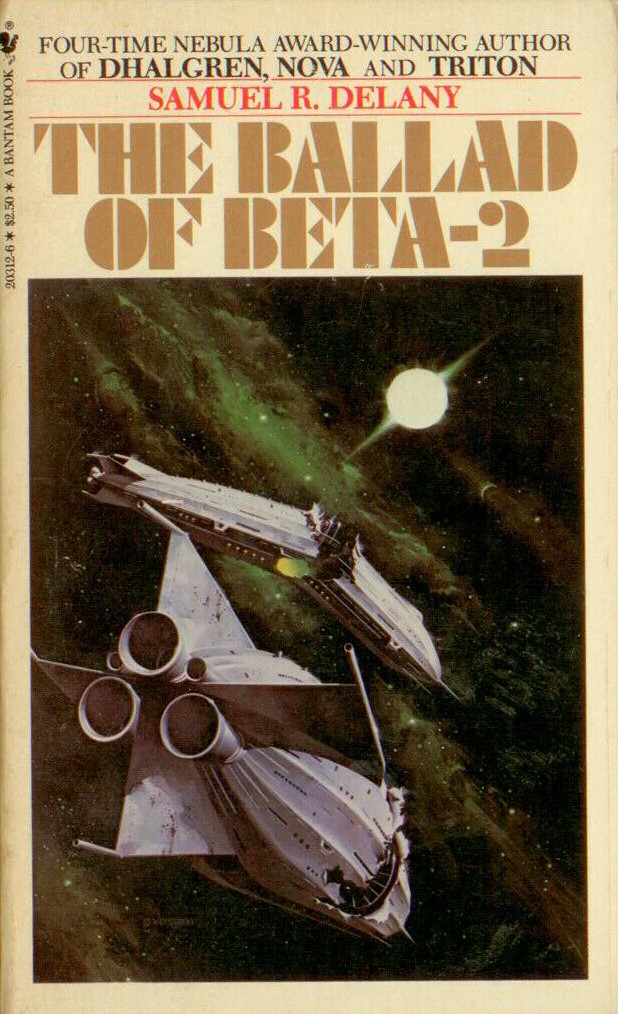
(Vincent Di Fate’s cover for the 1982 edition)

3.25/5 (Vaguely Good)

As I’ve been on a generation ship kick as of late, I was excited to pull out my copy of Samuel R. Delany’s early novel The Ballad of Beta-2 (1965). Delany subverts the standard (and infuriating) trope of cultural stasis—for the sake of societal stability—that authors suggest will occur between the colony ship’s departure and arrival. Instead, Delany explores the intermediary generations by examining a series of ballads Continue reading

Updates: Recent Science Fiction Acquisitions No. CCXLVI (Michel Jeury, Sheila MacLeod, Vietnam War anthology, The Year 2000 anthology)

1. I’m a sucker for themed anthologies! Especially of original stories… This one is on the top of my list to read!

2. The lengths the cover blurb goes to proclaim Sheila MacLeod’s Circuit-Breaker (1978) not SF is humorous. The blurb writer ends up describing the aim of New Wave science fiction (interior vs. exterior space). So many of these arguments demonstrate a lack of knowledge of genre and depends on dismissive stereotypes. As it my practice, I try to avoid these exclusionary/gate-keeping arguments. I recently picked up a copy of her only other SF novel Xanthe and the Robots (1977).

Curious about this one — and all SF about potentially insane astronauts.

A handful of favorite stories of (possibly) insane astronauts

Barry N. Malzberg’s Beyond Apollo (1972), The Falling Astronauts(1971), and Revelations (1972)

Gene Wolfe’s “Silhouette” (1975)

3. Another themed anthology! The topic here is the Vietnam War. Huge fan of Vietnam War inspired SF — especially Ursula Le Guin’s The Word for World is Forest (1972) and Kit Reed’s Armed Camps (1969).

What are your favorite Vietnam War-themed SF works? I’m thinking of putting together a resource on the topic.

4. French SF in translation. Here’s Michel Jeury’s bibliography. This appears to be the only one of his MANY SF novels to be translated into English. Alas.

Let me know what books/covers intrigue you. Which have you read? Disliked? Enjoyed?

~

1. The Year 2000, ed. Harry Harrison (1970)

(Pat Steir’s cover for the 1st edition) Continue reading

Book Review: Candy Man, Vincent King (1971)

(Patrick Woodroffe’s cover art for the 1973 edition)

3.5/5 (Good)

The Candy Man wanders from place to place in a crumbling mega-city with his sole companion, a mechanical dog named Wolf who comes with a handy handle. Candy Man instigates the lobotomized, with primal speeches and drugged sugar floss tinted with pulverized beetles, to revolution. His reward for turning in those he encouraged deviate from the will of the Deep Machine and their Teachers? Vials of drugs. Enter the hypnagogic world of Vincent King’s Candy Man (1971), an unsettled landscape inhabited by the degenerate remnants of humankind and the arcane workings of a computer program that cannot escape its original perimeters.

Fresh off Vincent King’s short story “Defense Mechanism” (1966), I tracked down a copy of his second novel. Occupying a similar space as “Defense Mechanism” (conceptual breakthrough in a decaying world city), King pushes the narrative Continue reading

Updates: Recent Science Fiction Acquisitions No. CCXLV (John Brunner, Marta Randall, Brian Herbert, Amanda Hemingway)

1. A complete unknown! As is frequently the case, I discovered it during a lengthy Internet Speculative Fiction Database browse a few weeks back. I’m not sure what to expect. Although the back cover is problematic –“In danger of losing her sanity, her virginity, and even her life”–is her sanity less important than her virginity? Who knows.

2. John Brunner short stories! He’s a favorite and I buy his collections on site.

A few John Brunner short fictions I’ve particularly enjoyed:

3. In my late teens I read every Dune novel I could get my hands on—including those written by Frank Herbert’s son Brian (I don’t remember being impressed). And yes, I’ve decided to read some of Brian Herbert’s non-Dune related SF.

4. I’ve enjoyed the two Marta Randall novels I’ve reviewed.

Might as well grab the last one I didn’t own? Right? It’s the sequel to Journey (1978).

Let me know what books/covers intrigue you. Which have you read? Disliked? Enjoyed?

1. Pzyche, Amanda Hemingway (aka Jan Siegel) (1982)

(Uncredited cover for the 1982 edition) Continue reading

Updates: Recent Science Fiction Acquisitions No. CCXLIV (John Shirley, Carol Emshwiller, Daniel Walther, and Jacques Sternberg)

1. Few themes make me as excited as dystopic urbanism: the city or suburbia as an arena of all the malignancies of societal decay. The progressive SF symbol of progress, a lake of uplifting spires, tossed into anarchy and chaos….

John Shirley’s City Come A-Walking (1980) takes this premise to its extremes—the city of San Francisco, the “pulsing heart of urbanized madness” gains sentience. Definitely the Shirley novel I’ll read first (recently nabbed Shirley’s 1985 novel Eclipse).

Tarbandu read it and didn’t care for it over at The PorPor Books Blog. I hope my experience is different!

2. Back in 2017, I read and reviewed Carol Emshwiller’s masterful short story “Animal” (1968). It’s about time I read more of her short fictions.

3. I recently read and enjoyed Jacques Sternberg’s collection Future Without Future (1971, trans. 1973). He was a Belgian author who wrote in French. Unfortunately, the only other one of his SF works available in English is Sexualis ’95 (1965, trans. 1967). I’m not sure this erotic SF novel has any merit. We shall see.

Too bad his first SF novel La sortie est au fond de l’espace (1956) remains untranslated. Its premise seems like SF I could get behind: “a black comedy set in space and featuring the last human survivors of a bacterial Holocaust” (SF Encyclopedia).

4. Daniel Walther, a French SF author, positions The Book of Shai (1982, trans. C. J. Cherryh, 1984) as a deliberate anti-Ayn Rand novel. Considering the one man saves everything nature of so many post-apocalyptical and sword-and-sorcery adventures, I’m intrigued how it plays out! I don’t have high hopes.

Translated by fellow author C. J. Cherryh, who appeared to translate a bunch of the DAW French editions….  lists of translations should be a feature of her  isfdb.org listing — alas.

I also find it humorous that Cherryh gives the sequel, which she also translated, 1 star on Goodreads! The third volume of the trilogy remains untranslated.

~

1. City Come A-Walking, John Shirley (1980) (MY REVIEW)

(Catherine Huerta’s cover for the 1st edition) Continue reading

Updates: Recent Science Fiction Acquisitions No. CCXLII (C. J. Cherryh and T. A. Waters)

All the following books came from the Chicago, IL bookstore Bucket O’Blood. I bought them online to support one of my favorite bookstores negatively impacted by the Covid-19 pandemic. Check them out!  If able, support your favorite stores (buy online, buy gift cards for later purchases, etc.) in this trying time.

I hope all of you are well.

1. Book two of C. J. Cherryh’s Faded Sun trilogy. I bought the first one a few months ago.

While I’ve only reviewed two of Cherryh’s novels on my site—-Merchanter’s Luck (1982) and Port Eternity (1982)—she was one of my favorite pre-blog authors. I’ve previously read fifteen or so of her novels including Cyteen (1988) and Downbellow Station (1981). I have yet to read any of her pre-1980 novels so I look forward to diving into this trilogy.

2. An unknown author and novel (at least to me)…. with a flashy/fun cover. According to SF Encyclopedia, “A counter-cultural ethos also inspired the grimmer Centerforce (1974), in which motorcycle dropouts and commune dwellers combine in opposition to a Near-Future police-state America.”

3. One of C. J. Cherryh’s few standalone novels–Hestia (1979). Seems like a standard anthropological mystery on an alien world. Thoughts? As always, annoyed by the cat woman alien art….

4. Book three of C. J. Cherryh’s Faded Sun trilogy.

Let me know what you think of the books and covers in the comments!

~

1. The Faded Sun: Shon’Jir, C. J. Cherryh (1978)

(Gino D’Achille’s cover for the 1979 edition) Continue reading

Adventures in Science Fiction Cover Art: Cathy Millet illustrates Michael Moorcock, Bob Shaw, and John Cristopher

(Interior art for the 1975 French OPTA edition of The Death of Grass (1956) and The Long Winter (1962), John Christopher)

I cannot ascertain the identity of Cathy Millet. There is a well known Catherine Millet—a French writer, art critic, curator, etc. However, I do not think they are the same. If you know more information about who she might be, please please please let me know! (French articles are fine — I can read them easily).

Cathy Millet created a handful of covers and larger number of interior illustrations for the French publisher OPTA. Here’s her incomplete isfdb.org listing which I used as a jumping off point. The ones which caught my eye are her spectacular interior illustrations for two John Christopher post-apocalyptic Continue reading

Book Review: Electric Forest, Tanith Lee (1979)

(Don Maitz’s original canvas for the 1979 edition)

5/5 (Masterpiece)

“Two years,” Claudio said. “Wasted. I used to go hunting, searching. For someone like you, my Magdala. But you’re unusual, my dear. A freak. Hard to come by. And it had to be someone like you. A genetic mistake. An atrocity, crawling about its hopeless round. Devoid of normal self-preservative wariness. Mewing, inside its warped little soul, for rescue. Not quite human. Here we are (23).”

Tanith Lee spins a gauzy, sinister, and terrifying tale of manipulative resurrection. A brilliant inventor projects the mind of a grotesque social outcast into a new transcendent body—but this isn’t an altruistic act. There’s a plot afoot. Electric Forest (1979), a shimmery nightmare of psycho-sexual manipulation,  enters my pantheon of favorite 70s SF visions.

Electric Forest demonstrates marked improvement over Don’t Bite the Sun (1976). It’s more Continue reading