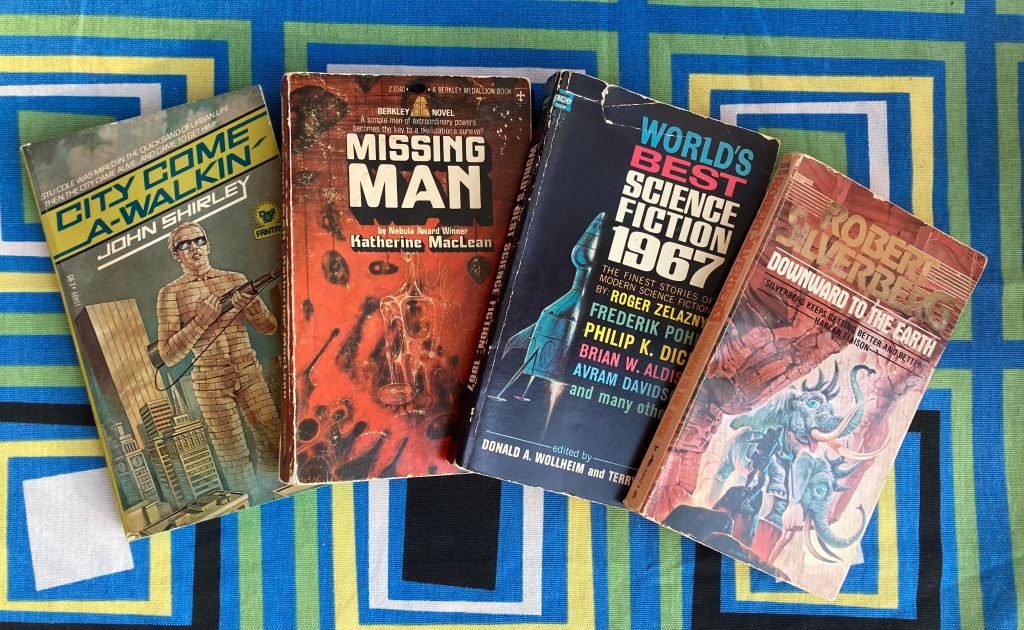
A selection of read volumes from my shelves
What pre-1985 science fiction are you reading or planning to read this month? Here’s the December installment of this column.
Lost texts, and the act of reconstructing the fragments, fascinates. The questions pile up. Would the contents reveal a pattern in an author’s work? Intriguing personal details? A startling modus operandi? At the 11th World Science Fiction Convention (Philcon 2), Philadelphia (September 1953), Philip José Farmer gave a speech titled “SF and the Kinsey Report.” Considering Farmer’s recent publication of “The Lovers” (1952), this is not surprising. Alfred Kinsey, the famous sexologist and founder of the Kinsey Institute for Research in Sex, Gender, and Reproduction on Indiana University’s campus, published his controversial Sexual Behavior in the Human Male in 1948. Sexual Behavior in the Human Female appeared in 1953. Like many of Farmer’s earliest speeches, he did not keep copies.
Deeply intrigued by what the speech might have contained, Sanstone and I (on Bluesky) managed to piece together a few general responses from fanzines and magazine con reports.
1) In the December 1953 issue of the fanzine Nite Cry, Earl Kemp wrote: “Then it came. Sex reared it’s [sic] wonderfully compatible head. SF AND THE KINSEY REPORT, a very interesting report on the works of the good Dr.’s Kinsey, Pomeroy, etc. delivered by Phillip Farmer [sic]. Very well handled talk, regardless of the absence of SF, by a very sincere individual. He was somewhat embarrassed, at the conclusion of his talk, as were most of the delegates, when some fan, after securing the floor mike, praised the speech a little too highly for comfort.”
2) In the November 1953 issue of the UK magazine Authentic Science Fiction, the editor H. J. Campbell briefly states: “among other first-rate and informative speakers was Philip Jose Farmer on ‘SF and the Kinsey Report,’ a serious and thoughtful study which was well appreciated by the audience.”
3) Robert A. Madle’s report in the March 1954 issue of Future Science Fiction wrote: “[Farmer’s] talk, ‘SF and the Kinsey Report,’ was quite unusual — to say the least! Farmer, in addition to indicating that he was one of Kinsey’s’ statistics, delved into a subject which isn’t the ordinary Sunday morning, pre-breakfast fare.” I’d love to know what Farmer meant by “he was one of Kinsey’s statistics.
EDIT: Matthew Davis below reproduced a portion from Farmer’s autobiographical essay “Maps and Spasms” in “Fantastic Lives” (ed. Martin H. Greenberg, 1981): “While describing his university days in 1939, Farmer writes: Dr. Kinsey came to Bradley to interview male students about their sexual habits, and I was one of those who got to be questioned by this great man. His pioneering work didn’t come out until years later, however.'”
4) Milt Rothman’s Philcon II Reminiscence recalls: “Among scheduled talks were “The Future of Love,” by Irvin Heyne, and “SF and the Kinsey Report,” by Philip José Farmer, author of “The Lovers.” At that time heterosexuality was just coming out of the closet.” No other details are provided.
5) Dave Kyle’s article “Sex in Fandom” in the fanzine Mimosa #10 (1991) on describes the speech, along with many other tangents, as follows: “Maybe sf fans invented the 1960s in the 1950s. (Although I must say that, whatever the excesses, the only drug prevalent to a minor extent was alcohol.) By 1953, women were now a fixture in the sf firmament. Bea, Katherine MacLean, and the two Evelyns had a panel at Philcon II and there were talks on “The Future of Love” by Irvin Heyne and “SF and the Kinsey Report” by Philip José Farmer. Phil Farmer really broke the sex barrier in sf, and Kate MacLean was an unabashed advocate of “free love” and took explicit photos with Charlie Dye.”
If you know of more references, let me know if the comments.
And let me know what pre-1985 science fiction you’ve been reading!
The Photograph (with links to reviews and brief thoughts)
- I often think back to John Shirley’s fascinating City Come A-Walkin’ (1980). While I struggled to get behind the barebones plot, the vibrancy of the world, the positive take on urban subculture, and the sense and feel of the descriptions made it a heady brew. Inspired by a commenter, I procured a copy of Richard Sennett’s The Uses of Disorder: personal Identity and City Life (1970).
- Katherine MacLean’s Nebula-nominated Missing Man (1975) ranks high on my shortlist of unknown masterpieces. She won the Nebula for the novella “The Missing Man” (1971), that later became the first part of the novel.
- World’s Best Science Fiction: 1967, ed. Donald A. Wollheim and Terry Carr (1967) contains a large number of gems–PKD’s “We Can Remember It for You Wholesale” (1966), Bob Shaw’s “Light of Other Days” (1966), Roger Zelazny’s “The Keys of December” (1966), R. A. Lafferty’s “Nine Hundred Grandmothers” (1966), and Michael Moorcock’s “Behold the Man” (1966).
- Robert Silverberg’s Downward to the Earth (1970) is one of his best novels.
What am I writing about?
On January 1st, I posted a review of Future Power, ed. Jack Dann and Darner Dozois (1976) — it contained many of my best 20 short stories read in 2024. If you missed it, definitely check out my Best Reads of 2024 post. I also posted reviews of Philip K. Dick’s “Explorers We” (1959) and James Tiptree, Jr.’s “Painwise” (1972) recently for my series on subversive takes on “space agencies, astronauts, and the culture which produced them.”
As for future projects, I find I’m more likely to complete them if I keep the specifics under wraps. As always, I have grand plans and limited time due to my exhausting profession.
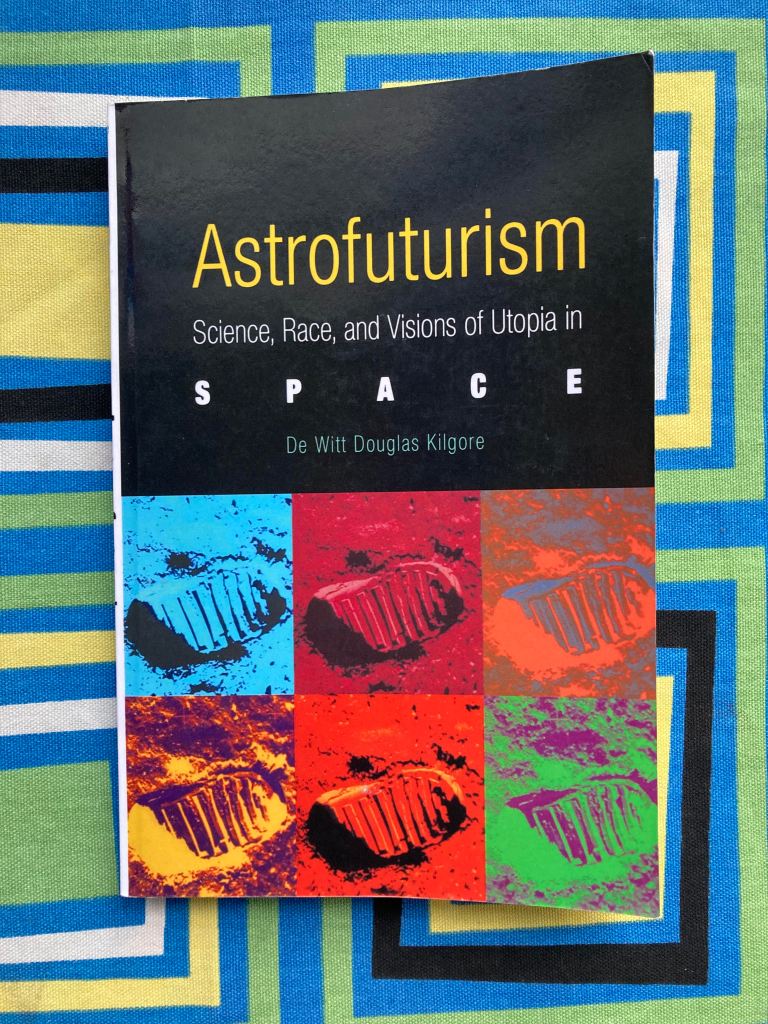
What am I reading?
As Barry N. Malzberg recently passed away, I thought I read a few of his novels that I’ve missed. I reviewed Malzberg last in 2021. Hopefully, more novel reviewed will be posted in 2025 than previous, often sparse, novel-reading years.
I also plan on reading De Witt Douglas Kilgore’s monograph above.
A Curated List of SF Birthdays from the Last Two Weeks
January 11th: Jerome Bixby (1923-1998)
January 11th: Terry Goodkind (1948-2020). As a teenager, I was obsessed with bloated fantasy sequences (Robert Jordan, Tad Williams, Stephen Donaldson, etc.). I thought Goodkind would be the perfect addition to my addiction. I tried at least three times to tackle Wizard’s First Rule (1994), the first book in the Sword of Truth Universe, but never got more than a 100 pages in.
January 12th: Jack London (1876-1916). I must confess, I’m utterly ignorant of his SF works like The Iron Heel (1907). My father read The Call of the Wild (1903) to me as a kid.
January 13th: Jody Scott (1923-2007). I should feature her in my first three published stories by female SF authors I should know about. Her noel Passing for Human (1977) judges me from the shelf.
January 13th: Ron Goulart (1933-2022). I have not been impressed with his brand of satire. See my review of After Things Fell Apart (1970).
January 14th: Kenneth Bulmer (1921-2005).

Frank Kelly Freas’ cover for the 1974 edition of Joseph Green’s Conscience Interplanetary (1972)
January 14th: Joseph Green (1931-). He must rank amongst the oldest SF authors still alive… I have not read any of his work.
January 15th: Robert Silverberg (1935-). An absolute favorite of mine! I’ve reviewed 46 of his short stories and twelve of his novels. I’ve also read but never reviewed A Time of Changes (1971), the stories in Capricorn Games (1976), and Tower of Glass (1970). The Man in the Maze (1969) and The Second Trip (serialized: 1971) might be his most underrated novels.
January 16th: Christine Brooke-Rose (1923-2012) is an author of experimental SF-adjacent works (and a YA SF volume or two). I acquired one of the latter Xorandor (1986), a few months ago. I’d love a copy of her early novel Out (1964)–SF Encyclopedia’s description: a SF novel “set after World War Three in a Post-Holocaust Afro-Eurasia where the colour barrier has been reversed, ostensibly for medical reasons, as only the ‘Colourless’ seem to be fatally afflicted by a form of radiation poisoning.”
January 17th: Paul O. Williams (1935-2009).
January 18th: Arno Schmidt (1914-1979). I tried to read The Egghead Republic: A Short Novel from the Horse Latitudes (1957, trans. 1979) at one point.
January 18th: Artist Eddie Jones (1935-1999). A British artist who contributed an immense number of covers for German SF presses.
January 18th: Clare Winger Harris (1891-1968). I acquired her collection (published after she had stopped writing), Away from Here and Now (1947), a while back. To the best of my knowledge it’s the first collection by a female SF author who appeared in genre magazines ever published.
January 19th: Margot Bennett (1912-1980). I finished Bennett’s The Long Way Back (1954) recently. Stay tuned for my thoughts.
January 19th: George MacBeth (1932-1992).

Victor Kalin’s cover for the 1st edition of Theodore Sturgeon’s Venus Plus X (1960)
January 19th: Artist Victor Kalin (1919-1991).
January 20th: Author Nancy Kress (1948-). Another one of my favorites! “Talp Hunt” (1982) is a killer of a short story. I also reviewed her first three published short stories–“The Earth Dwellers” (1976), “A Delicate Shape of Kipney” (1978), and “And Whether Pigs Have Wings” (1979).
January 21st: Peter Phillips (1920-2012). I’ve promised myself I’d get to his fiction for years. I’m looking at you “Dreams Are Sacred” (1948)!
January 21st: Judith Merril (1923-1997). My most recent Merril review: Survival Ship and Other Stories (1974).
January 21st: Gina Berriault (1926-1999). Author of one intriguing SF novel of fallout shelters and paranoia–The Descent (1960).
January 21st: Charles Eric Maine (1921-1981).
January 22nd: Robert E. Howard (1906-1936).
January 22nd: Katherine MacLean (1925-2019). As mentioned above, her Nebula-nominated novel Missing Missing Man (1975) is one of the great unknown SF noels.

Ray Feibush’s cover for the 1974 UK edition of George Zebrowski’s The Omega Point (1972)
January 22nd: Artist Ray Feibush (1948-1998).
January 23rd: Helen M. Urban (1915-2003). Another author I should feature in my series on the first three published short stories by female authors I want to learn more about.
January 23rd: Walter M. Miller, Jr. (1923-1996). A favorite of mine! If you’re new to his non-A Canticle for Leibowitz stories, check out “Death of a Spaceman” (variant title: “Memento Homo”) (1954).
January 23rd: Artists Tim Hildebrandt (1939-2006) and Greg Hildebrandt (1939-2024).
January 24th: C. L. Moore (1911-1987). I recently enjoyed her collection of co-written stories (with her husband Henry Kuttner) Clash by Night and Other Stories (1980).
January 24th: Gary K. Wolf (1941-). Killerbowl (1979) is almost a 70s SF classic.
January 24th: David Gerrold (1944-). I thoroughly enjoyed Moonstar Odyssey (1977).
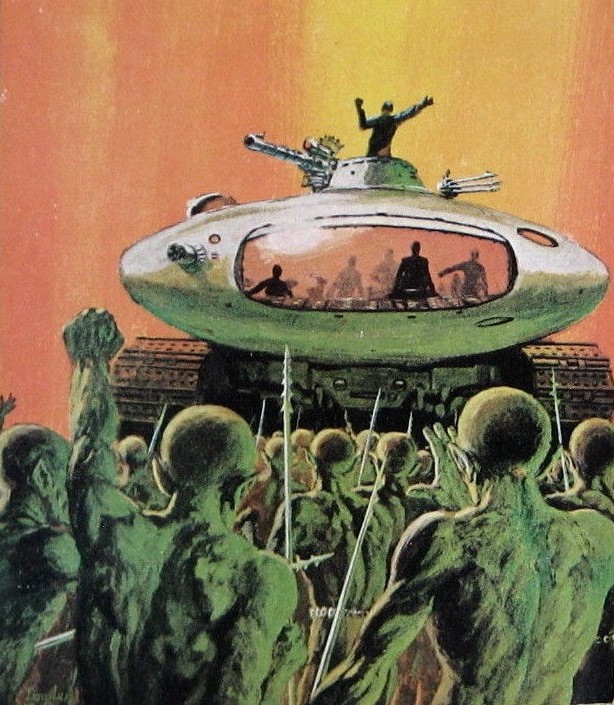
Douglas Chaffee’s cover art detail for the October 1968 issue of Galaxy Magazine
January 24th: Artist Douglas Chaffee (1936-2011).
January 24th: René Barjavel (1911-1985).
January 25th: Pauline Ashwell (1926-2015). Best known for her early short story Hugo-nominated “Unwillingly to School” (1958). I’ve reviewed Nebula-nominated “The Wings of a Bat” (1966).
For book reviews consult the INDEX
For cover art posts consult the INDEX
For TV and film reviews consult the INDEX
 Science Fiction and Other Suspect Ruminations
I highly recommend Arno Schmidt’s Nobodaddy-related fiction. I wasn’t a fan of his The Egghead Republic either (it sounds as if you couldn’t finish it, and I think I may have been the same).
His novella “Leviathan” is masterful. It’s mainly non-genre (taking place during the final days of Nazi Germany), but it steers into fantasy fiction at time (or is it just fantasy?), and I’d argue it could easily be classified as horror fiction. It certainly makes you start to lose hope in life.
The Nobodaddy stories tie in to Schmidt’s personal Gnostic metaphysical views. Very dark but powerful reading.
As far as “Dreams Are Sacred”, I wouldn’t say you are missing much. I found it very over-rated, kind of full. If you’ve read Zelazny’s The Dream Master, you’ve read a far superior version already.
*kind of dull, not full
I wanted to read “Dreams Are Sacred” due to my encyclopedic interest in SF about dreams and psychiatry etc.
But yes, I was not able to finish The Egghead Republic. I took a lot of notes and marked up page-after-page but it felt more like a chore than enjoyment so I set it down.
I have read and reviewed The Dream Master: https://sciencefictionruminations.com/2014/04/19/book-review-the-dream-master-roger-zelazny-1966/
Your comparison makes me want to read it even more! It’s a much earlier story (remember, remember, the historian in me– haha).
I can understand your wanting to read it for the historical value. I found too much of the plot of “Dreams Are Sacred” to read as sword and sorcery, which I’m not a fan. I enjoyed The Dream Master because there was a tone of depression underlying a lot of the novel, which added extra layers to the Zelazny. I’m sure there was influence by Phillips on Zelazny.
Yeah, The Dream Master worked as a black comedy — and I’m all for undertones of depression.
The influence is definitely what I’m interested in. And that entire immediate post-WWII moment in which beneath the pulpy exteriors — the paraphrase a discussion with Brian Collins (who stops by the site occasionally)–there’s a more serious grappling with revelations of the WWII (think Simak and his City stories) and commentary on contemporary issues.
I’m rereading “Flow My Tears, the Policeman Said” and “Whwre Late the Sweet Birds Sang” as I read all the Nebula nominees. I’m not rereading every one I have already read but these two I felt were worth revisiting.
“Flow My Tears, the Policeman Said” is one of the few PKD novels I have not yet read.
…and I assume you already know what I think of Wilhelm (she’s a favorite!).
My most recent Wilhelm review: https://sciencefictionruminations.com/2023/08/19/short-story-review-kate-wilhelms-planet-story-1975-and-clark-ashton-smiths-master-of-the-asteroid-1932/
In terms of physical books, I’ve read more sci fi adjacent stuff than actual sci fi. I read Blish-Atheling’s The Issue At Hand and I’ve been picking at Damon Knight’s In Search of Wonder (3rd Edition). I have managed to listen to audiobooks of Nova by Samuel R. Delany and Dune. I have queued up to read stories by L. Ron Hubbard and M. C. Pease from the December 1949 issue of Astounding. I think next science fiction novel I will tackle as an audiobook is Past Master by R. A. Lafferty.
That MacLean novel looks interesting. I read her medical science fiction story “Contagion” in a 1950 issue of Galaxy last year and it stuck with me. I’d like to get more into her stuff.
P. S. As you may remember, I am a devotee of Farmer. I may have a line on the speech you mention. If it pans out, I’ll message you via BlueSky.
Nova is one of only a handful of SF novel’s I’ve reread. Not much of a rereader. It’s my favorite of Delany’s novels that I’ve read so far.
As for the Farmer speech, definitely let me know. To the best of my knowledge the speech does not exist but perhaps there is a better description of it somewhere.
I’ve tried to read Lafferty’s Past Master at least three times. I’ve set it down for nebulous reasons. I think I prefer him in small doses.
I’ve been reading through The Selected Letters of Philip K. Dick Vol. 6: 1981-1982 in preparation for a video I’m working on.
Ah, I was recently working through some of his letters (earlier volumes in that series) for any comments on unions.
In January, I read Next of Kin by Eric Frank Russell, which I didn’t like as much as Wasp. I found the attempts at humour immature and ineffective.
Then, I reread Charles Harness’ The Paradox Men, an entertaining, convoluted novel, a lot of fun. Finally, it the was the turn of James P. Hogan’s The Genesis Machine, which had interesting ideas, but rather indifferent style.
Next up is Mission by Patrick Tilley.
I’ve read far more about those four authors than their actual work. As a fan of Cold War paranoia, I should read Russell’s Wasp at least. I am put off completely by Hogan due to his hard SF style for the decades I am interested in — and, at least later in life, horrifying Holocaust denial.
WASP is more of a WWII-style thriller than Cold War paranoia, and to my taste fairly dull–more ambling than Ambler, one might say. If you’re only going to read one Russell novel I’d suggest THREE TO CONQUER, a possession paranoia story in the same ballpark as THE PUPPET MASTERS and BODY SNATCHERS. It was also William S. Burroughs’s favorite SF novel; he was captivated by the notion of a mind virus.
I seem to remember you recommending it to me before. I did not know about the Burroughs connection.
Reading anything worthwhile recently yourself?
Nothing from your catchment era except plowing through the old (well, middle-aged) AMAZING for GJ. Excellence is scarce. Otherwise, desultorily catching up with best of the year volumes, finding a lot of very capable writing, but like the feller famously said, where’s the bloody horse? Just started the “new” NEBULA AWARDS SHOWCASE, number 56, with stories from 2020 (apparently a catch-up sprint is planned). First story, which I just finished, is “Advanced Problems in Portal Math” by Aimee Pichi, a benignly feminist fable about a young girl then woman looking for a portal out of this sexist world, by an author who has probably been taken by “The Heat Death of the Universe,” but not far enough. If not twee, within sight of it. Next item is titled “Badass Moms of the Zombie Apocalypse,” which I am sure will be amusing.
A twee version of “Heat Death” sounds original at least. I do not know the author nor do I plan on reading the story but I’m a huge fan of the Zoline’s nightmare!
Just read Life in the West by Brian Aldiss, the first of his Squire Quartet. It’s not sf, although the other three books are. It reads like Aldiss trying to justify his philandering and it’s not a nice book. Squire is a land-owning, Daily Telegraph-reading Little England Tory – the novel is supposedly semi-autobiographical – with a particular hatred of Marxism and communism, and a head full of ideas and attitudes that have not aged at all well. The book is also sexist and male-gazey.
Have you read Kincaid’s monograph on Aldiss? Highly recommended. I found it particularly helpful in providing connection between and context for his diverse output.
No, I haven’t, although I’ve read some reviews of it. I agree with Paul’s general conclusion – Aldiss was an important writer in UK sf, and wrote some excellent novels and stories, but also a lot of bad ones. I suspect he was also an unpleasant person.
A quote from his intro: “He was one of the guiding spirits of the New Wave in Britain but was never entirely comfortable in that milieu. He produced the essential narrative history of the genre at a time when, as he told the story, he had largely lost interest in writing science fiction. He sought and enjoyed literary respectability, and for most of what might be called the literary establishment he was the acceptable face of science fiction, all while science fiction itself was at its most anti-establishment.
It is impossible to write about Brian Aldiss without coming face to face with these contradictions. He is, for that very reason, not an easy person to write about. He produced at least as many abject failures as he did towering achievements, yet which works will belong in which category will depend entirely on the reader. He remains controversial, difficult, infuriating. And yet it is as hard to imagine postwar British science fiction without him as it is to imagine British science fiction in general without Wells” (5).
I met Brian W. Aldiss, once. He was spending a week in Austin, Texas, as part of a book tour. AggieCon happened to be going on at Texas A&M University that weekend, so a couple of fans in Austin drove him down to see wha SF fans in America were like. A couple of other authors and some fans came to sit in the canteen at the Memorial Student Building where Mr. Aldiss was holding court.
The discussion got onto books and I asked why there was a Heliconia Spring, a Heliconia Summer, and a Heliconia Winter, but why had he never written a Heliconia Autumn. He replied, quite seriously, that it was because his publishers wanted the books to sell in the United States. If he had called it Heliconia Autumn, none of the people would have known what it was about and if he had called it Heliconia Fall they would all have thought it was about Milton’s Paradise Lost.
Well, siting in the Memorial Student Center, (where you were not allowed to walk on the grass unless you were a member of the military corps) at Texas A&M (that’s Agriculture & Military) University, in College Station, Texas, right smack in the buckle of the Bible Belt, that made a certain amount of sense. Thinking about it afterwards, though, I realized that saying we would not know what Autumn meant was a bit condescending and the crack about Paradise Lost meant he had no idea what was in the mind of your average redneck hick. I can’t speak to whether he was unpleasant or not but he was definitely patronizing.
A humorous story although I can’t say I wouldn’t have snipped a slight bit at that question 😉 muahaha.
I’m a huge fan of a lot of Aldiss’ fiction (haven’t read the Helliconia sequence yet). As for his personality, I don’t know what to say. There’s a reason I’ve never been that interested in meeting authors. I’ve never been to a Con. I should have gone to WorldCon Chicago recently as it was only a few hours away. I would participate on a panel and have been invited… but… Maybe in the future.
I’ve not been reading quite as quickly recently as I was through the summer. Currently I’m reading The Lost World by Arthur Conan Doyle which is fairly dense in it’s prose, something I always notice going back to writing from that time period having read more new wave type things. Before that I had read through Triton by Delaney, Dying Inside by Silverberg and The Dark Is Rising by Susan Cooper. As LL three had their merits, of them I probably enjoyed Dying Inside the most. Triton was good in places and I still have Dhalgren in my to read pile, that one is intimidating me a little with the side of it, not sure how I will find it.
I don’t know if you know but Susan Cooper’s first novel was science fiction — only recommended if you’re the fan of that special brand of UK horror/SF about the malignant countryside… It shows a lot of her frustration (and nostalgia) with the UK after her move to the US: https://sciencefictionruminations.com/2023/10/07/short-book-reviews-octavia-e-butlers-mind-of-my-mind-1977-and-susan-coopers-mandrake-1964/
I loved her The Dark is Rising series as a kid. And of course, Dying Inside is one of my favorite Silverberg novels.
Yes I have Mandrake – I’ve been trying to pick up all of the vintage Penguin Sci Fi books releases here in the UK. The only one I haven’t picked up off the top of my head is P. D. Ouspensky’s ‘Strange Life of Ivan Osokin’. I rather enjoyed Mandrake.
I’ve read most of the Dark Is Rising but still have to get ‘Over Sea, Under Stone’s. Really enjoyed the series so far and been fortunate enough to find all of them in charity shops so far.
I was obsessed with fantasy as a kid (long before SF). I think I read all of the Dark Is Rising series in order when I was 11-13 or so. I think they’re still on the shelf at my parents’ home!
Strange Life of Ivan Osokin sounds intriguing.
I read the Dark is Rising series early enough that I had to wait a year before the last book was published. You can bet I made sure the library had that pre-ordered…
The cover of Venus Plus X reminds me that it’s one of the relatively rare SF books in which a character refers to a specific other SF book (Wylie’s The Disappearance).
Nice! I had to wait for later volumes of Robert Jordan’s Wheel of Time to hit shelves! (I did not read those published after his death). I spent my hard-earned allowance on those hefty bloated tomes.
Venus Plus X is a fascinating book. I’m still not sure I entirely understand his intention. I particularly enjoyed the pairing of the more contemporary (or near future?) narrative with the far future one.
Hey, Joachim. I just started reading “The Best of C. M. Kornbluth” (ed. with intro., Fred Pohl; 1976). I’ve got a bunch of Kornbluth’s stuff in my SFF shelves, but have only so far read “The Space Merchants” (quite a few years ago now).
Hello Adam,
It’s great hearing from you. I feel like it’s been a while!
Kornbluth is a favorite of mine. I’m a sucker for any 50s social satirist who pushing buttons in an effective and thought-provoking way.
I reviewed one of his last stories somewhat recently (I assume it’s in the Best of Collection): “The Advent on Channel Twelve” (1958)
Yes, it has been a while! I seem to remember The Space Merchants being a smart piece of satire (the whole “Chicken Little” sequence now seems fairly prophetic).
Yep, that story you mention is in this collection – haven’t got to it yet.
I also have faint memories of The Space Merchants as I read it before I started my site and writing reviews. I was in my late teens at the time. I know that Rich Horton, a frequent commenter on the site, wrote an article for Journey Planet about its treatment of organized labor (I wrote an article for the same issue on Simak). You can download the entire issue here: https://sciencefictionruminations.com/2024/09/13/exploration-log-5-we-must-start-over-again-and-find-some-other-way-of-life-the-role-of-organized-labor-in-the-1940s-and-50s-science-fiction-of-clifford-d-simak/
Just remembered Farmer had a longish autobiographical essay, “Maps and Spasms” in “Fantastic Lives” (ed. Martin H. Greenberg, 1981). Dug out my copy, and while describing his university days in 1939, Farmer writes:
“Dr. Kinsey came to Bradley to interview male students about their sexual habits, and I was one of those who got to be questioned by this great man. His pioneering work didn’t come out until years later, however “
Thank you! Ah, he was interviewed by Kinsey — I though that might be what he meant by the reference to being one of his statistics. It’s good to have confirmation. I edited the post to reflect your contribution.
I just finished Bulgakovs The Fatal Eggs, which was interesting as early soviet satire, but pretty uninteresting as science ficition.
Recently I also reread Brunners The Dramaturges of Yan. I read it maybe ten years ago and enjoyed it very much, so having since then seen your very negative review, I wanted to see how it held up. Well, it still had all the flaws that I remembered (including an absolutely abysmal translation which makes it hard for me to guess how hacky the original might have been), and I nevertheless still enjoyed it. Though never given the space to really unfold, I find the setting, mood and overall ideas intriguing.
I think a younger me (in my early twenties when I wrote that review) couldn’t get over the inane space surfboards… I still think it is one of his weakest novels, perhaps not as poor as I made it out to be.
The “surfboards” you mentioned in your review was actually one of the things I wanted to see if I had misremembered, as I couldn’t recall anything about them. I still don’t think there were any mentioning of surfing – the “goboards” in the danish translation (which could have mangled the meaning, like so much else) simply seemed to be a kind of teleportation.
Similarly, the “ape” slur wasn’t used for the Yan folk in general, but solely for the young, impatient ones who admire and imitate human culture, and are seen as sort of pathetic by humans and older, conservative Yan folk alike. So all in all, I guess the writing in the original version must have been really sloppy and confusing – maybe the translation even improved it somehow, though it’s hard to imagine.
I trust you. I definitely do not remember enough to clarify, rebut, or dismiss anything someone might say about it. Haha. I’d have to reread it. But, there is so much more Brunner I haven’t read that I rather explore first. And if I’m going to reread Brunner, it would probably be Stand on Zanzibar — my favorite SF novel (albeit, which I have only read once).
Hello America
I think on balance I prefer Ballard’s shorter fiction to his novels. While (to my mind) Hello America is an improvement on the novel that preceded it (The Unlimited Dream Company) I don’t think it comes close to the power of stories like My Dream of Flying to Wake Island from the sameish era.
For all that, Hello America has its moments. It doesn’t drag in the manner of some of his longer work. The mystical desert scenes – numerous drained swimming pools and all – are powerful and the journey to Las Vegas has a faint Mad Max air about it. I’m not surprised Ballard admired Mad Max 2.
Other parts of the novel seem less successful to me. The dramatic denouement is reminiscent of The Stand. The tribes seem under-developed to the point of being an off-hand joke and the (very familiar) psychiatric issues dogging most of the one-dimensional characters become slightly wearing over the course of an entire novel, especially with all the corny dialogue. Ballard does however shuffle the characters around enough so you don’t get too fed up with them.
But I smiled when I came across the words ‘make America great again’ later on in the novel. Perhaps there are prophetic elements to Hello America – it could be I missed the entire point of the novel.
@ Kralin
Ballard worked in phases — ‘periods’ we’d say were we talking about a visual artist like Picasso (e.g. ‘Picasso’s Blue Period’) — and after the Crash, High Rise, and Concrete Island trilogy, he seems to have decided that approach was sufficiently used-up, as the ‘condensed novels’ approach had been before that, and the four ‘disaster novels (The Drowned World, The Crystal World, and etc.) before them.
So then it was time for him to move on and formulate a new Ballardian mode again. And my guess is that he took note of the rising success of fantasy and Latin American magic realism, then decided to see what he might do if he took an analogous tack.
Because that’s what The Unlimited Dream Company arguably is: Ballard doing fantasy and magic realism, but set in Shepperton, London, where he himself lived. Personally, I found it a bore. Simultaneously, one has to — I do, anyway — give it credit for being a unique and fairly extreme kind of fantasy/magic realism, unlike anybody else’s. Well, unless it’s Bruno Schulz’s, maybe.
In Hello America Ballard continued working in this mode. But here there are conventional fictional characters on a journey through a future America, and there’s been plenty of that in SF hitherto so we SF readers now have our bearings. As you say, it’s far more readable than The Unlimited Dream Company. Still, Ballard seems to have been intelligent enough to see that this was not a particularly interesting direction to take further.
Which meant it was time for a new mode again! And what he did is turn at a 180 degree direction away from magic realism to straight realism — as straight realism as he was capable of, anyway, writing about his own life, which was the last thing most people expected. (Of course.)
And so we get The Empire of the Sun and The Kindness of Women.
Arguably, then, The Unlimited etc and Hello America are important novels in the Ballardian canon. But it’s precisely because they lead to this enormous productive realist phase of his writing.
Finally, let me put in a strong recommendation for the latter novel, The Kindness of Women. It’s not much read in the U.S. I suspect, but I thought it just as good as or better than Empire and more easily enjoyable. Again, Ballard did something you’d never expect: a social picture of a character called Jim Ballard changing through the 1950s, 60s, 70s, and 80s as the English society through which he moves changes.
Consequently, there are set pieces: Jim Ballard’s wife dies young in a tragic accident in the 1950s and he takes on raising their kids on his own (as happened); Jim Ballard takes acid in the 1960s; Jim Ballard goes to a convention in Rio de Janeiro and meets the cast of Star Trek, then has sex with a Brazilian prostitute in the 1970s and….
But read the book. It all works and people should check it out if they enjoy Ballard, because IMO it’s up there amongst the very best of his novels.
It’s not science fiction, of course.
But it’s from Ballard. So it has the attitude. We need a lot more ‘mainstream lit’ like it.
Thanks very much Mark for such a thoughtful and considered response.
I’ve read The Kindness of Women and enjoyed it. It helped join some of the dots. One of the strongest memories I have of it is the description of his Shepperton neighbours playing extras in the film version of Empire of the Sun. It’s such a wonderful circular conceit. (I also remember the account of I think a Turkish pilot trying to fly non-stop to Turkey from Canada, with a comment along the lines of ‘he’s probably still trying to get there’).
Canada seems a critical part of the jigsaw as I think he read a lot, via magazines left lying around, of the SF of Kornbluth, Sheckley, Vance et al out there and that all helped focus the direction he wanted to go in.
I enjoy dipping into the Extreme Metaphors collection of interviews. As I’m sure you’re aware there’s been a recent collection of his non-fiction published, though it seems a lot of it overlaps with Users Guide.
So many characters of today’s world seem to have stepped straight into it from his novels.
I’ve been musing on the influence of Iris Murdoch on his fiction, though it may be of course he never read a word of hers and that they were both tapping into a similarish source.
So many characters of today’s world seem to have stepped straight into it from his novels.
Yes. It’s a pity he died in 2009 because he’d have had a field day with Donald Trump and America now. Forex –
‘The advanced societies of the future will not be governed by reason. They will be driven by irrationality, by competing systems of psychopathology.’ — J. G. Ballard
(Though of course someone might respond to this: [A] It’s not just the advanced societies of the future, it’s all societies and ruling elites throughout human history, who have invariably been psychopath; [2] Is America even an ‘advanced society,’ anyway?)
I’ve been musing on the influence of Iris Murdoch on his fiction…
Hah. Interesting comment. I’d never thought about it, but now you mention it it feels like there are similarities, though they’re a little subterranean to me because I struggle to articulate them.
I guess one fundamental similarity is, they were both writers whose books were concerned with and structured around ideas about what civilization is worth and how human beings are at a time when a lot of English novels were deeply unconcerned with ideas.
As for whether Ballard read Murdoch, I think it’s pretty likely.
Firstly, if you were around then, Murdoch’s door-stoppers used to arrive with some regularity every one or two years and she was a prominent cultural presence in the UK to the point of people parodying her. (I wasn’t there but I kept in touch.)
Secondly, Ballard did a lot of journalism so he may have reviewed one or more of her books. I’ve got Ballard’s Users’ Guide to the Millenium and last year’s Selected Nonfiction, 1962–2007 (if you haven’t) and I’ll take a look in the next couple of days, and get back to you if I see Ballard talking about Murdoch anywhere,
Just started Brunner’s The Traveler in Black (1971 version) last night, having a bumpy ride. The fix-up was published during his golden period but the stories’ origins span the 60s; in the first at least he’s not quite in the control of the material I’m hoping for by the end.
Interesting to see Earl Kemp as the reporter on Farmer’s speech given his own involvement with the history of “sex and SF” (as part of the SF-to-Pornwriting pipeline). Kemp’s an interesting figure of the period, seemingly almost completely forgotten today; he serialized his memoirs in his zine back in the 00s, chaotically organized and interspersed with other random current events and commentaries (his and others’). Archived at https://efanzines.com/EK/ and well worth dipping into (try eI11 for starters, for the Harlan Ellison stories).
Ah, thank you for identifying the name — at the time I did not make the connection. I know him for the “Who Killed Science Fiction” (1961) fanzine that won the Hugo. I did not know much about his other endeavors. I’ll check out the link.
I am in the middle of a project to read (or in most cases, reread) all the short stories that Gene Wolfe that are linked to The Book of the New Sun. These include a couple that are set on Urth during the period of Severian’s Autarchy, and a few that are tales found in The Brown Book mentioned by Severian. Most or all of these stories can be found in two collections: Endangered Species and Starwater Strains. And, in the way of things, I’m also reading the rest of those books.
And I just finished my reread of The New Atlantis, and I’ll have a review in Black Gate some time in the next few weeks.
Joachim, I’ve always liked your reviews, particularly of things I remember reading before you were born. Even if I grumble “young whippersnapper”. Particularly if they’re by guys I’ve actually known in my life of attending cons.
I have the January 1945 issue of Astounding, with all pages remaining. Which is pretty, er, amazing considering it was on wartime paper. I had to tape the covers back on, so it’s not worth selling, but for the cost of postage I’d certainly send it to you if you’d be interested. Big names like van Vogt, and all the war bonds ads you’ll ever need.
(email this name at a company that sounds a lot like whoopee!)
Hello! Thanks for stopping by. I’m glad you enjoy my reviews. I’ve never been to a con 😉
As for the issue, thank you for the offer. Due to rapidly diminishing space, I’ve not been collecting many magazines — especially as all the major ones are digitized online. Thank you again for the offer, it means a lot.
What pre-1985 SF have you been reading recently?
I’m in process of moving and downsizing, so that issue of Astounding is it right now. But I’ve read endless amounts of pre-1985 SF over my many years in fandom and even before that.
I’ve bought “The Last Dangerous Visions” but haven’t read it yet. I understand some of the stories in it go back to the original days.
No worries, I’ll send the Astounding to my brother, who has two stories AND a basement in his house.
Although I might re-read “The Best of Edmund Hamilton” before I take it to the used book store.
I’ve been reading Again, Dangerous Visions, an anthology of short stories from the early 70s edited by the late Harlan Ellison.
It’s actually a sequel to the earlier Dangerous Visions which I liked a lot better because the stories were tied together better, they were darker and so lived up to the book’s title more, and Ellison who also edited this one had a story of his own in it (about a future Jack the Ripper). But the sequel book still has some good stories in it of what I’ve read so far.
The original is better than the sequel, although the sequel isn’t bad. The Last Dangerous Visions finally got published last year (although not quite in the form Ellison originally intended). It pains me to say it, but two thirds of the way through the anthology I’ve only seen one or two good stories. However, the 59-page section about Ellison’s life and what happened with the book is almost worth the price by itself.
I’ve added a few books to my collection that I haven’t read yet:
Right now I’m reading Virtual Unrealities, a short story collection by Alfred Bester. The Stars My Destination is one of the greatest sci-fi novels of all time and I doubt he’d reach the heights he did with his magnum opus and The Demolished Man. Still, I’m intrigued on how he did with shorter works.
I’d like to acquire a copy of The Gas. I despised Garbage World unfortunately. Although I understand what he was doing and thought it was hilarious at moments… There’s a review on my site.
I’ve also enjoyed some Bester shorts and mean to review one or two this year. We’ll see. I recommend the wonderful monograph on him by Jad Smith — read it in 2023. https://www.press.uillinois.edu/books/?id=p082139
MisterJamma1988: I’m intrigued on how he (Bester) did with shorter works.
Bester was once considered one of the great SF short story writers, up there with C.M. Kornbluth.
So his ‘Fondly Fahrenheit’ is in there in the big Science Fiction Hall of Fame anthology Robert Silverberg put together after a SFWA poll at the 1960s’end. I’ve seen ‘Fondly Fahrenheit’ claimed as the single best SF story ever, which is silly (how can a single SF story be the best ever when SF can do almost anything?). But that and ‘5,271,009’ (aka ‘The Starcomber’ in a few anthologies) are Bester’s two stories of particular note and they’re in Virtual Realities, as are the other half-dozen others published at about the rate of one yearly through the 1950s, which made his rep as a short-story writer among his peers.
As with The Stars My Destination and its influence on the New Wavers in the 1960s and on later writers like W. Gibson, the short stories had some influence; there are Silverberg and Zelazny stories from their prime periods that clearly used Bester short stories as models/angles of attack.
P.S. Bester went away to become an editor at Holiday magazine at the start of the 1960s and there’s nothing like the relatively lazy life of being an editor (and having the kind of expense account they had during the golden age of American magazines) to ruin a writer. So he mostly stopped writing SF, then (as you may know) tried to make a comeback during the 1970s-80s and had pretty much totally lost it. It was kind of sad.
I just finished John Brunner’s The Stone That Never Came Down. It’s one of his sociological books, and like most of them in my experience is pretty good. It also feels like it applies to current events.
Not one I have read yet. I think I have a copy somewhere.