Book Review: The Heirs of Babylon, Glen Cook (1972)

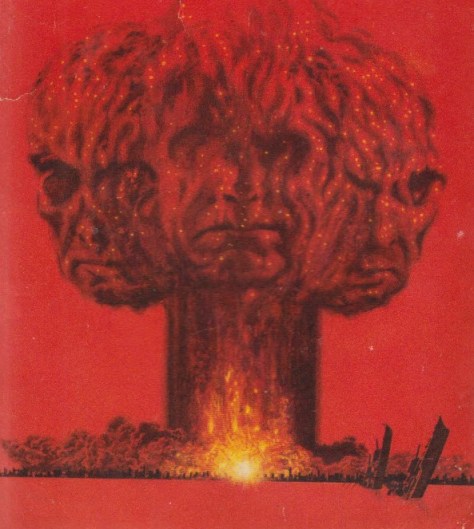
Detail from Dean Ellis’ (?) cover for the the 1st edition

3/5 (Average)

Glen Cook’s first novel, The Heirs of Babylon (1972), is one of a handful of science fiction works in his extensive catalog. He’s best known for two fantasy sequences, Chronicles of the Black Company and Dread Empire. Operating in standard post-apocalyptic territory (wrecked landscapes created by nuclear and chemical warfare), Cook weaves a disturbing tale of the power of militaristic fantasies and traditions. While suffering from diminishing narrative impetus as the ancient warship Jäger steams towards its inevitable end, The Heirs of Babylon transpires within a well-wrought Earth hellscape with a deeply flawed main Continue reading

Book Review: Doctor to the Stars, Murray Leinster (1964)

John Schoenherr’s cover for the 1964 edition

3.25/5 (Collated rating: Vaguely Good)

I am fascinated by medical-themed science fiction. While my tendencies gravitate towards  the more meta-fictional/experimental takes of this theme, for example William Kotzwinkle’s Doctor Rat (1976) and Elizabeth Baines’ The Birth Machine (1983), I wanted expand my horizons by reading earlier incarnations of the subgenre.

Murray Leinster’s Doctor to the Stars (1964) gathers three stories published in the late 50s and early 60s in the Med Series sequence. As a whole, the stories are positivist, pro-peace, anti-big business, pro-science, and pro-service. Our hero Calhoun, Continue reading

Book Review: The Long Tomorrow, Leigh Brackett (1955)

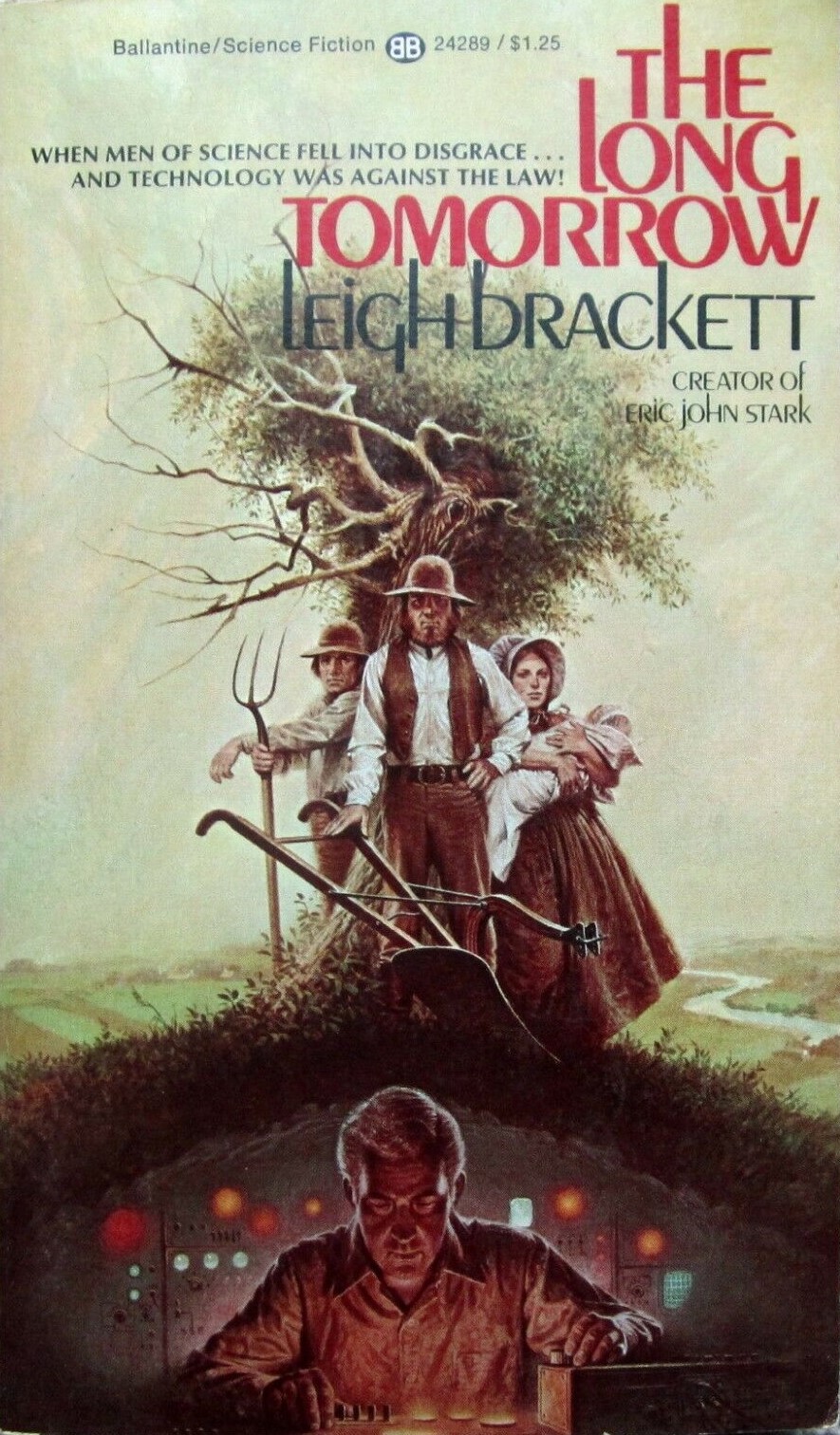
(Darrell K. Sweet’s cover for the 1974 edition)

4.5/5 (Very Good)

“No city, no town, no community of more than one thousand people or two hundred buildings to the square mile shall be built or permitted to exist anywhere in the United States of America” (Thirtieth Amendment of the United States Constitution) (1)

Nominated for the 1956 Hugo Award for Best Novel. Leigh Brackett’s The Long Tomorrow (1955) not only clocks in as the best of her work I’ve read so far but also joins my pantheon of favorite 50s SF visions (*).  At first glance Brackett’s novel appears to traverse standard SF juvenile territory where a teenage boy, in a religiously and socially oppressive society, encounters an object  and memories of the past that opens up a path to self-discovery. But memories are memories. And dreams are Continue reading

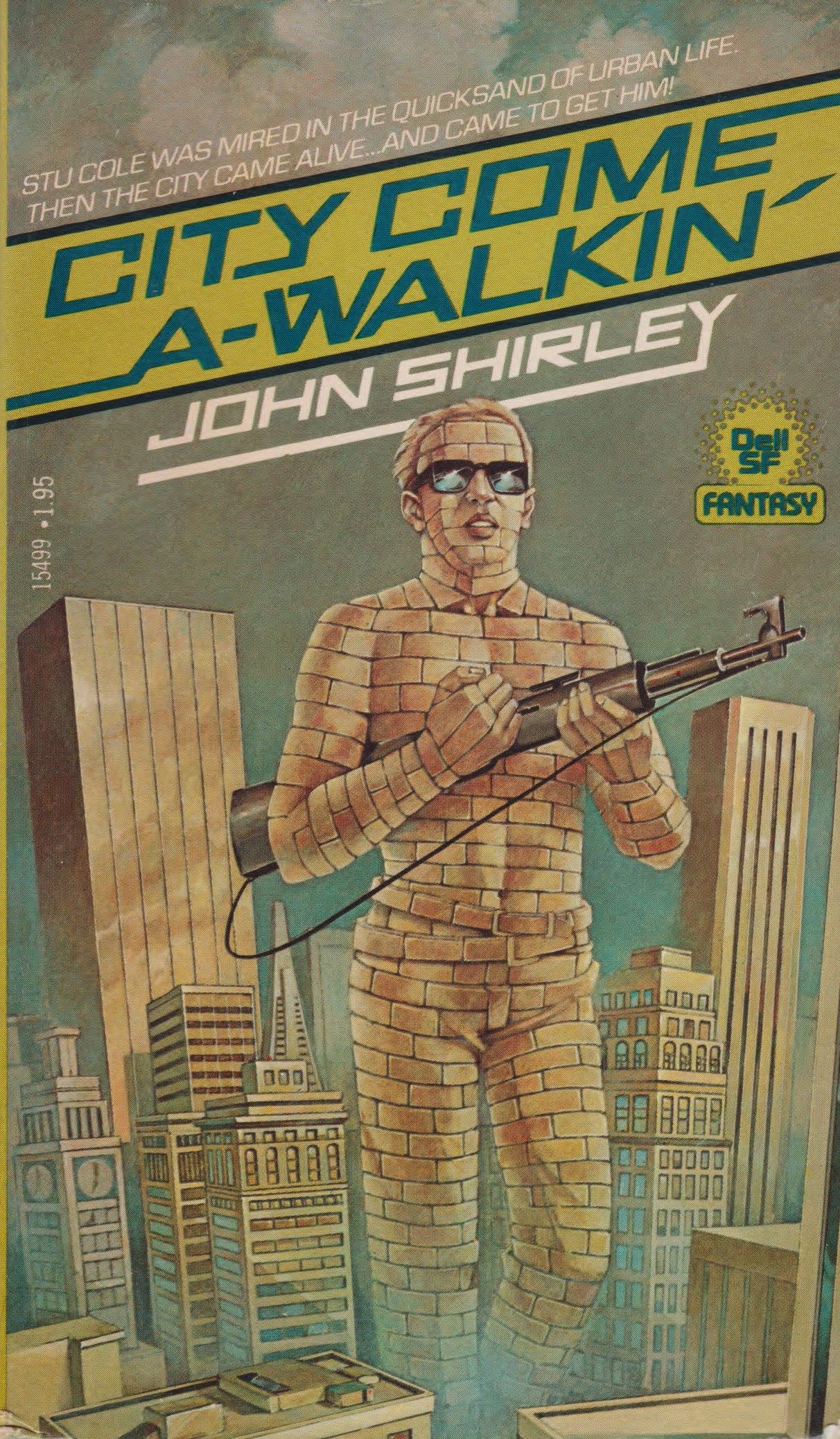
Book Review: City Come A-Walkin’, John Shirley (1980)

(Catherine Huerta’s cover for the 1st edition)

4/5 (Good)

“It’s the gestalt of the whole place, this whole fuckin’ city, rolled up in one man. Sometimes the world takes the shape of gods and those gods take the form of men. Sometimes. This time. That’s a whole city, that man” (18).

John Shirley’s City Come A-Walkin’ (1980), an early cyberpunk novel, succeeds as a surreal and earthy paean to  diverse urban community and punk rebellion. A club owner and angst rocker join forces with a physical manifestation of San Francisco to fight the forces of technological change. While a brilliant evocation of aesthetic and emotion with sympathetic main Continue reading

Book Review: Termush, Sven Holm (1967, trans. 1969)

(Uncredited cover for the 1969 edition)

4.5/5 (Very Good)

“[He] maintained that it was in fact essential to conceal what could be concealed; indeed, an inspired lie could be preferred to a malignant truth” (24).

Sven Holm’s Termush (1967, trans. 1969) depicts, with stark minimalism, the psychological state of wealthy survivors holed up in a hotel shelter after an apocalyptic nuclear event. This brief work, a mere 110 pages, is not an adventure story. It is not an exercise in nightmarish brutality like The Road (2006) or an account of humanity’s turn towards evil as the gauze of “civilization” falls away like The Death of Grass(1956).

Rather, Sven Holm (1940-2019) (SF Encyclopedia entry), a Danish author of mainstream literature, delves into the psyche of the survivors, their isolation and inability to grasp the immensity of the changes beyond their walls, and their Continue reading

Book Review: The Dead Astronaut, ed. uncredited (1971) (J. G. Ballard, Ursula K. Le Guin, Arthur C. Clarke, et al.)

(Pompeo Posar’s cover for the 1st edition)

3/5 (collated rating: Average)

“The dead astronaut: The phrase is filled with anxiety, the words themselves evoking the tension and anguish that gripped the whole world in that fateful month of April 1970, when a technical malfunction came close to costing the lives of astronauts Lovell, Swigert and Haise” (5).

The Dead Astronaut (1971) contains a range of 50s and 60s SF stories—from Ursula K. Le Guin to J. G. Ballard—on the broad theme of astronauts, that appeared in Playboy Magazine. For a  reader of genre for only the last decade (and a bit), it’s shocking to consider that Playboy, at one point, contained top-notch science fiction! That aside, The Dead Astronaut contains a range of soft and hard science fictional accounts of astronauts Continue reading

Book Review: The Black Corridor, Michael Moorcock and Hilary Bailey (1969)

(Detail from Bob Haberfield’s cover for the 1973 edition)

4.25/5 (Very Good)

In the Star Trek: Voyager episode “One” (1998), Seven of Nine, unaffected by a nebula’s subatomic radiation, must care for the crew while they’re placed in stasis. Alone on the ship, Seven experiences the prolonged effects of isolation including disturbing dreams and hallucinations. Ever since I saw “One” as a child, I’ve become fascinated with the strategies that humans might use in space to cope with isolation and the rituals they might enact to preserve sanity. Michael Moorcock and Hilary Bailey’s The Black Corridor (1969) (see note below), explores Continue reading

Book Review: Dance The Eagle To Sleep, Marge Piercy (1970)

(Uncredited cover for the 1st edition)

4.5/5 (Very Good)

In the turbulent 1960s, the radical socialist Students for a Democratic Society (1960-1974) were one of the most influential organizations in the nascent New Left. SDS’s 1962 political manifesto, the Port Huron Statement, proclaimed in idealized terms the importance of egalitarianism, participatory democracy, labor rights, Civil Rights, and nuclear disarmament.  Marge Piercy (1935-) wrote her first SF novel Dance The Eagle to Sleep (1970) while working as an organizer with the SDS regional office in New York (biography). In the last years of the 60s, while she was writing the novel, she describes SDS devolving into “warring factions” and her own personal disillusionment as  the Vietnam War raged on.

In this context, Dance The Eagle To Sleep (1970) can be read as the rise and fall—intense, ecstatic, meaningful, tempestuous—of an SDS-esque student-driven movement (The Indians) in a near-future totalitarian America. Piercy follows a cast of characters whose paths, visions, and routes to revolutionary activity differ. As the movement is beset by external and internal Continue reading

Short Book Reviews: Samuel R. Delany’s The Ballad of Beta-2 (1965), Barry N. Malzberg’s The Last Transaction (1977), and Philip McCutchan’s A Time for Survival (1966)

My “to review” pile is growing and my memory of them is fading… hence short—far less analytical—reviews.

1. The Ballad of Beta-2, Samuel R. Delany (1965)

(Vincent Di Fate’s cover for the 1982 edition)

3.25/5 (Vaguely Good)

As I’ve been on a generation ship kick as of late, I was excited to pull out my copy of Samuel R. Delany’s early novel The Ballad of Beta-2 (1965). Delany subverts the standard (and infuriating) trope of cultural stasis—for the sake of societal stability—that authors suggest will occur between the colony ship’s departure and arrival. Instead, Delany explores the intermediary generations by examining a series of ballads Continue reading