Book Review: Dance The Eagle To Sleep, Marge Piercy (1970)

(Uncredited cover for the 1st edition)

4.5/5 (Very Good)

In the turbulent 1960s, the radical socialist Students for a Democratic Society (1960-1974) were one of the most influential organizations in the nascent New Left. SDS’s 1962 political manifesto, the Port Huron Statement, proclaimed in idealized terms the importance of egalitarianism, participatory democracy, labor rights, Civil Rights, and nuclear disarmament.  Marge Piercy (1935-) wrote her first SF novel Dance The Eagle to Sleep (1970) while working as an organizer with the SDS regional office in New York (biography). In the last years of the 60s, while she was writing the novel, she describes SDS devolving into “warring factions” and her own personal disillusionment as  the Vietnam War raged on.

In this context, Dance The Eagle To Sleep (1970) can be read as the rise and fall—intense, ecstatic, meaningful, tempestuous—of an SDS-esque student-driven movement (The Indians) in a near-future totalitarian America. Piercy follows a cast of characters whose paths, visions, and routes to revolutionary activity differ. As the movement is beset by external and internal Continue reading

Book Review: Candy Man, Vincent King (1971)

(Patrick Woodroffe’s cover art for the 1973 edition)

3.5/5 (Good)

The Candy Man wanders from place to place in a crumbling mega-city with his sole companion, a mechanical dog named Wolf who comes with a handy handle. Candy Man instigates the lobotomized, with primal speeches and drugged sugar floss tinted with pulverized beetles, to revolution. His reward for turning in those he encouraged deviate from the will of the Deep Machine and their Teachers? Vials of drugs. Enter the hypnagogic world of Vincent King’s Candy Man (1971), an unsettled landscape inhabited by the degenerate remnants of humankind and the arcane workings of a computer program that cannot escape its original perimeters.

Fresh off Vincent King’s short story “Defense Mechanism” (1966), I tracked down a copy of his second novel. Occupying a similar space as “Defense Mechanism” (conceptual breakthrough in a decaying world city), King pushes the narrative Continue reading

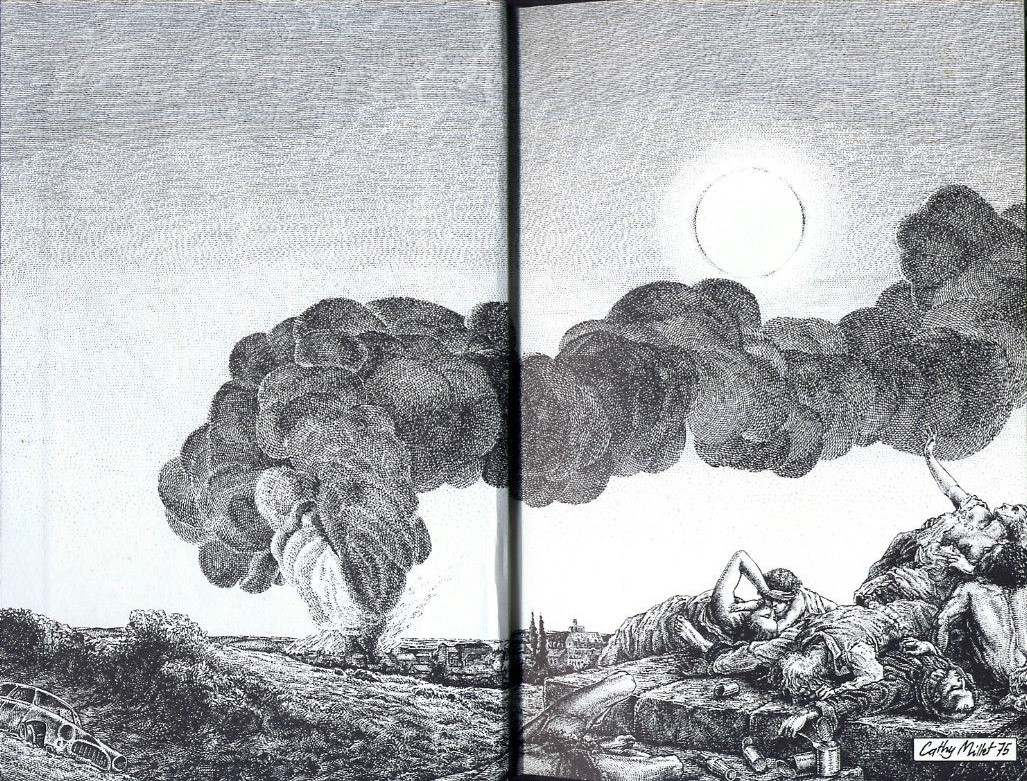
Adventures in Science Fiction Cover Art: Cathy Millet illustrates Michael Moorcock, Bob Shaw, and John Cristopher

(Interior art for the 1975 French OPTA edition of The Death of Grass (1956) and The Long Winter (1962), John Christopher)

I cannot ascertain the identity of Cathy Millet. There is a well known Catherine Millet—a French writer, art critic, curator, etc. However, I do not think they are the same. If you know more information about who she might be, please please please let me know! (French articles are fine — I can read them easily).

Cathy Millet created a handful of covers and larger number of interior illustrations for the French publisher OPTA. Here’s her incomplete isfdb.org listing which I used as a jumping off point. The ones which caught my eye are her spectacular interior illustrations for two John Christopher post-apocalyptic Continue reading

Updates: Recent Science Fiction Acquisitions No. CCXL (Melissa Scott, Ignácio de Loyola Brandão, Sheila MacLeod, and Albert J. Guerard)

1. I have yet to read anything by Melissa Scott — as is my habit, I start with a lesser known novel (in this case, her first one).

2. SF in translation from Brazil! Looks terrifying.

3. And I’m yet again the owner of another one of the worst SF covers. That said, Sheila MacLeod’s Xanthe and the Robots  (1977) seems to be an intriguing take on androids and the the nature of humanity.

4. A complete unknown author (wrote more mainstream lit than SF) and novel… According to SF encyclopedia, Albert Joseph Guerard’s only SF novel Night Journey (1950) “depicts an idealistic soldier against the background of a useless Near-Future European Future War. The loss of his illusions is rendered with psychological acuity, though the narrative itself is dithery.”

Count me intrigued.

Let me know what you think of the books and covers in the comments!

~

1. The Game Beyond, Melissa Scott (1984)

(Alan Gutierrez’s cover for the 1st edition) Continue reading

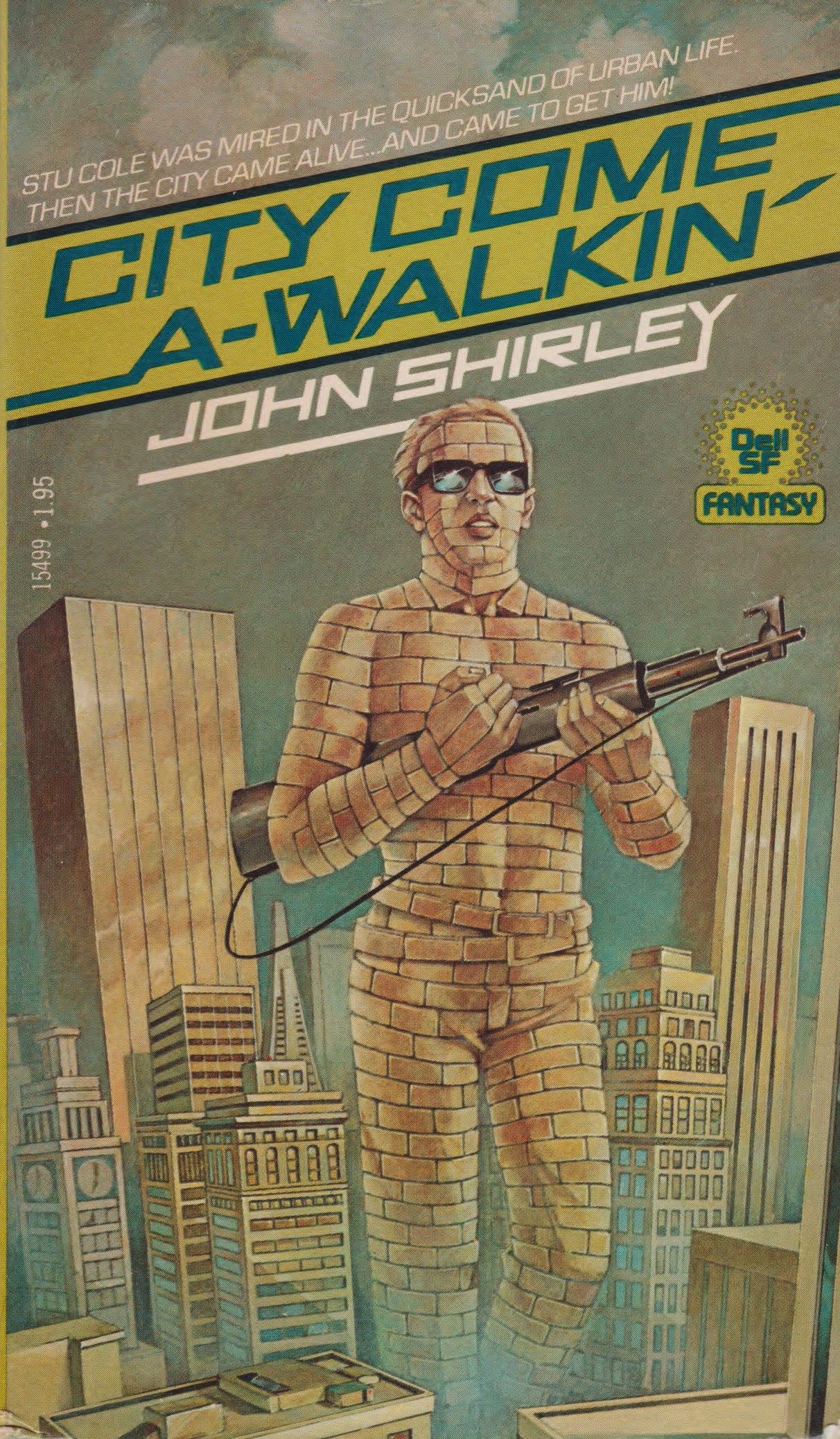
Updates: Recent Science Fiction Acquisitions No. CCXXXIX (Jack Dann, Judith Merril, Anne McCaffrey, John Shirley)

1. I have yet to read any of Jack Dann’s SF — this surreal (?) post-apocalyptical novel looks promising! And a strange Jim Burns cover to boot…

2. I recently reviewed Judith Merril’s “Wish Upon a Star” (1958) for my generation ship short story read-through (i’ll have a new installment soon). I decided to track down another one of her short fiction collections….

I’ve reviewed the following collections so far:

3. The title of Anne McCaffrey’s collection Get Off the Unicorn (1977) was derived from a humorous misprint. According to the collection’s introduction: “The title was derived by accident: McCaffrey’s working title had been “Get of the Unicorn” but this was misprinted as “Get Off the Unicorn” in Ballantine’s roster of unfilled contracts. After McCaffrey’s editor, Judy-Lynn del Rey, was repeatedly asked what “Get Off the Unicorn” was, del Rey asked McCaffrey what she could do about that theme.”

The collection itself contains a wide-range of her short fictions—from the Pern sequence (a childhood favorite) to the earliest story in the Catteni Sequence. I DEVOURED Freedom’s Landing (1995), Freedom’s Choice (1997), Freedom’s Challenge (1998), and Freedom’s Randsom (2002) as a kid! How to survive and thrive on an alien planet was my “go-to” SF device.

4. I’ve only read a handful of John Shirley’s short stories. It’s time for a novel. Eclipse (1985), set in a future a cyberpunk dystopia, tells the tale of anti-fascist resistance. We shall see!

Let me know what you think of the books and covers in the comments!

1. The Man Who Melted, Jack Dann (1984)

(Jim Burns’ cover for the 1986 edition) Continue reading

Adventures in Science Fiction Cover Art: The Spectral Visions of Terry James, Part I

(The 1967 edition of Mindswap (1966), Robert Sheckley)

A few weeks ago I reviewed Clifford D. Simak’s The Werewolf Principle (1967) and came across Terry James’ cover (below) for the 1969 Science Fiction Book Club (UK) edition. The spectral shedding/transforming of the human figure matched the uncanny vibe of the novel. And I headed immediately to isfdb.org to browse his ouvre (note: a few volumes in the pub. series are clearly his but remain uncredited)! And I decided to put together a series of posts showcasing his work.

His art, the entire catalog of SFBC editions between 1968 and the mid-way point of 1971, works with little Continue reading

Book Review: The Bleeding Man and Other Science Fiction Stories, Craig Strete (1977)

(Karl Stuecklen’s cover for the 1st edition)

4/5 (collated rating: Good)

In 2015, I read and reviewed Craig Strete’s collection If All Else Fails…. (1980) and found it to be a spectacular vision “filled with gorgeous lines, evocative images” and palpable “despair at the loss of Native-American culture.” Strete, one of the few Native-American SF authors I know of, picked up three Nebula Award nominations for short SF over the 70s and early 80s (“Time Deer” in 1976, “The Bleeding Man” in 1976, and “A Sunday Visit With Great-Grandfather” in 1981 although it was withdrawn). The latter two are in this collection. The former two can be found in If All Else Fails….

Recommended for fans of experimental 70s Continue reading

Updates: Recent Science Fiction Acquisition No. CCXXXV (M. A. Foster, Garry Kilworth, Cary Neeper, and Anthology)

1. A fascinating, and disturbing, themed anthology edited by Thomas M. Disch. Of the stories in the anthology (see contents below), I look forward to Gene Wolfe’s “Three Million Square Miles” (1971) the most.

Richard Powers’ cover is gorgeous.

2. I recently read and enjoyed Garry Kilworth’s The Night of Kadar (1978) so I pulled the trigger and purchased a handful of his other early SF works. I’m also for ambivalent takes on revolutions…. In Solitary (1977) is Kilworth’s first published novel. According to  SF Encyclopedia, the novel “is set on an Earth whose few remaining humans have for over 400 years been dominated by birdlike Aliens, and deals with a human rebellion whose moral impact is ambiguous; the novel is the first of several combining generic adventurousness – indeed opportunism, for Kilworth seldom accords his full attention to the raw sf elements in his tales – and an identifiably English dubiety about the roots of human action. Consequences of such action in a Kilworth novel are seldom simple, rarely flattering, usually ironized.”

Will read this one soon.

3. I know little about M. A. Foster’s SF other than a few articles I’ve read here and there–The Gameplayers of Zan (1977) included. In 2009 Jo Walton wrote a positive article about the novel on tor.com.

4. A completely unknown author (Cary Neeper) and novel (A Place Beyond Man)…. I don’t have a lot to go on for this one!

Let me know what you think of the books and covers in the comments!

~

1. The Ruins of Earth: An Anthology of the Immediate Future, ed. Thomas M. Disch (1971)

(Richard Powers’ cover for the edition) Continue reading

Updates: My 2019 in Review (Best SF Novels, Best SF Short Fiction, and Bonus Categories)

(Chis Foss’ cover for the 1976 French edition of The Inverted World (1974), Christopher Priest)

2019, the tenth year of my site, proved to be a renaissance of sorts. While I managed to read a lot in 2018, I wrote few posts—mostly acquisition and art posts (which take the least effort and time). I have returned, almost, to my earlier levels of productivity and I hope that continues into 2020. Thank you all for reading and commenting be it on the site or on twitter.  It’s greatly appreciated.

And here are my favorite novels and short stories I read in 2019 Continue reading