Updates: Recent Science Fiction Acquisitions No. XXV (Silverberg + Dickson + Bester + et al.)

I have a substantial backlog of purchases from my “productive” book hunting Spring Break in Texas….

I’ve read Alfred Bester’s The Demolished Man (1952), which I loved, and The Stars My Destination (1956), which I mostly enjoyed, however I’ve rarely seen his short story collections in used book stores.  I snatched up the gorgeous covered The Dark Side of the Earth (1956).  I suspect Bester is even better at short stories than his novel length works….

The Time of the Great Freeze (1964) is considered one of Robert Silverberg’s best pulp works.  On indirect advise of my friend Michael Dalke at Potpourri of Science Fiction Literature, I’ve procured more of Gordon R. Dickson’s short works…  Thankfully, he hasn’t reviewed the collection The Star Road (1973) yet (I think) — we have a “rivalry.”  Haha.

I’ve already reviewed the short story collection edited by Donald Wollheim, The End of the World (1956) (MY REVIEW), and highly recommend it. A few of the stories are duds but two are in my top 5 short work list.  Philip K. Dick’s ‘Impostor’ (1953) alone is reason enough to track down the volume.

1. The Dark Side of the Earth (1964), Alfred Bester (MY REVIEW)

(Uncredited cover for the 1964 edition) Continue reading

Adventures in Science Fiction Art: Doomed Cities Part III (the attack of the metal missile casings, monks among ruins)

(Rod Turner’s cover for the 1952 edition of The G-Bomb (1952), Vargo Statten (i.e. John Russell Fearn)

Make sure to check out Part I and Part II if you haven’t.  Some of the doomed cities are stunning!

Of all the 50s pulp covers, Rod Turner’s series for Vargo Statten’s novels (John Russell Fearn) has become one of my favorites (above).  Although they adhere to every possible cliché, the pure exuberance of delivery is addicting — the books themselves are supposed to be pure drivel.

Enjoy monks among ruins, spaceships hovering above the fragments of past cities, hordes emerging from the wrecked husks of our august metropolises, the attack Continue reading

Adventures in Science Fiction Cover Art: The Art of Robert Foster, Part II

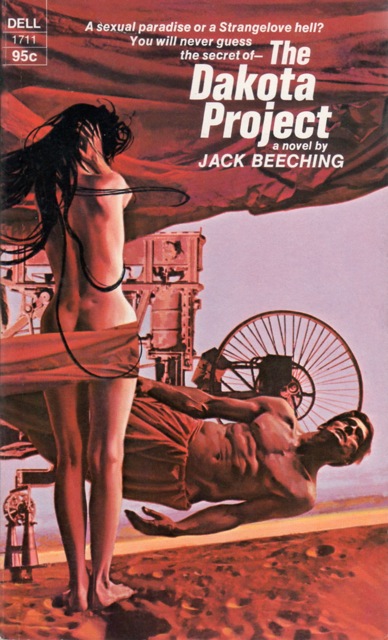
(Robert Foster’s cover for the 1971 edition of The Dakota Project (1968), Jack Beeching)

Unfortunately, science fiction covers from the 60s/70s are not always credited — Robert Foster’s covers are no exception.  Originally I assumed that Foster had only produced a handful (see my first post on his work, Part I), but after searching under Bob Foster and identifying covers by sight I’ve cobbled together another varied/intriguing/unusual collection of his work.

His work are often characterized by fascinating collaged, geared, industrial machinery paired with nudes and semi-nudes Continue reading

Updates: Recent Science Fiction Acquisitions N. XXIII (Farmer, Malzberg + et al.)

A while back I slogged through Philip José Farmer’s dismal To Your Scattered Bodies Go (1971) (the worst novel ever to win the Hugo Award?) and all the increasingly terrible sequels and made a solemn vow to wait a few years before I returned to his extensive oeuvre — so, against my better judgement I picked up a copy of  Traitor to the Living (1973).  I don’t have high hopes (but I love the cover!).  I hope my two dollars were well spent.

Malzberg is shaping into my “under read/unjustly forgotten author of the year” whom I’ll showcase.  Last year’s winner was the brilliant D. G. Compton (see INDEX for reviews).  Fresh off Conversations (1975) and In The Enclosure (1973) I picked up a copy of Guernica Night (1975).  I can’t wait!

Harold Mead’s The Bright Phoenix (1955) is yet another against the oppressive state à la Orwell’s 1984… But, I’ve found that the premise generally holds up despite frequent re-interpretations…

Greenfield’s Waters of Death (1967) should be avoided — at all cost.  I’ve already written a scathing review (rant).

1. Traitor to the Living (1973), Philip José Farmer (MY REVIEW)

(Hans Ulrich Osterwalder and Ute Continue reading

Book Review: In The Enclosure, Barry N. Malzberg (1973)

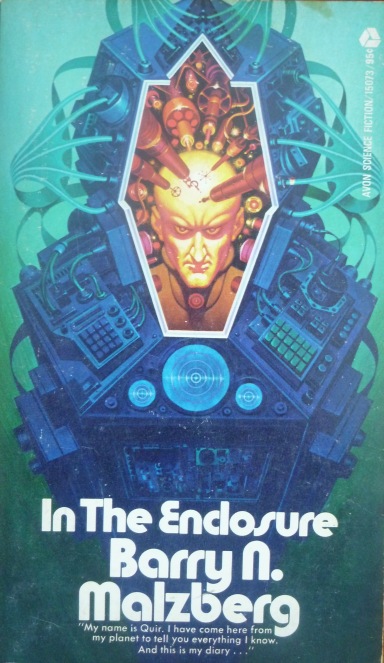
(Davis Meltzer’s cover for the 1973 edition)

4.5/5 (Very Good)

Fresh off Malzberg’s intriguing young adult novel, Conversations (1975), I picked up a copy of the altogether more disturbing, transfixing, unnervingly prescient, and at moments, brilliant In The Enclosure (1972).  As with many of Malzberg’s oeuvre, the work is infused with a steady dose of metafiction — our hero laments (and we writhe along with him in a malaise of unease), “I will never really know” (189).  Just as Quir is unsure of his own reality, his diaristic words — which the reader is desperate to hold on to — are admittedly, “an impression, a conception, nothing more” (190).

Combining the science fiction trope of implanted memories with the literary narrative mode of the unreliable narrator creates an overwhelmingly uncomfortable gulf between reality and constructed reality.  The result, the overpowering desire to pick up a piece of pulp science fiction where the future is rosy, technology = happiness, the kids smart, where rockets Continue reading

Updates: Recent Science Fiction Acquisitions N. XXI (Silverberg + Compton + Malzberg + Anderson)

A few more Christmas gift card purchases…

Dying Inside (1972) is often considered one of Silverberg’s best works and I can’t wait to read it (I will after my soon to be hellish weekend grading ~60 undergrad history papers).  Despite a painfully negative review on Amazon slamming Compton’s The Silent Multitude (1967) as a dull imitation of J. G. Ballard, it is high on my to read list — almost any experimental (allegorical) work exploring a crumbling city intrigues me.  Malzberg’s Conversations (1975) was a shot in the dark — it might be the least read of any of his novels — hence, my interest.

Pohl Anderson is almost always worth reading — even his middling short stories are fun.

Enjoy!

1. Dying Inside, Robert Silverberg (1972)

(Jerry Thorp’s cover for Continue reading

Updates: Recent Science Fiction Acquisitions N. XX (Clifton + Aldiss + et al.)

Christmas giftcard expenditures continue…

An interesting collection of acquisitions — Clifton’s Eight Keys to Eden (1960) is considered, at least by the reviews I’ve found online, to be a little read classic — i.e. my kind of sci-fi novel.  Aldiss always has wonderful ideas and The Long Afternoon of Earth (variant title: Hothouse) is generally proclaimed one of his best — I’m still waiting for work which garners the same magic as his masterpiece Non-stop (variant title: Starship) (1958).

After reading Kornbluth’s masterful short story collection The Explorers (1953) I felt obligated to pick up a copy of one of the more famous Pohl + Kornbluth collaborations, Gladiator-In-Law (1954).

A few intriguing Malzberg stories in Future City (1973) compelled me to snatch one of his lesser known novels off of the shelf — In The Enclosure (1973) tells the story of an alien tortured by his human captives.  I find Malzberg’s relentlessly dark visions very appealing…  He has a HUGE catalog I’ve yet to read.

1. The Long Afternoon of Earth (variant title: Hothouse), Brian Aldiss (1962)

(Uncredited cover for the 1962 edition) Continue reading

Updates: Recent Science Fiction Acquisitions N. XIX (Herbert + Aldiss + et al.)

Christmas = gift cards = more science fiction books, and a few my dad had procured for himself appeared miraculously in my pile — I’ve decided to break down the clump into manageable four book posts.

And of course, I wish you all a good sci-fi book hunting/reading year!

Enjoy!

1. The Santaroga Barrier, Frank Herbert (1968)

(Paul Lehr’s cover for the 1968 edition)

I’ve read a substantial number of Frank Herbert’s non-Dune Continue reading

Book Review: Magellan, Colin Anderson (1970)

(Uncredited cover for the 1970 first edition)

3.5/5 (Good)

Magellan (1970), Colin Anderson’s only science fiction publication, is an inventive but emotionally hollow novel, overly brief, and lacking in sufficient prose to adequately convey the lengthy allegorical sequences.  It is a shame that Colin Anderson didn’t write other science fiction works because this one holds great potential.  The future evolution of mankind — waiting to be subsumed into a computer of their own making — is a fascinating premise.  The tepid  and unadventurous prose conflicts with the grand and audacious subject matter.

Brief Plot Summary (limited Continue reading