Book Review: The Bright Phoenix, Harold Mead (1955)

(Richard Powers’ cover for the 1956 edition)

3/5 (Average)

Harold Mead’s The Bright Phoenix is a readable future ultra-regulated “perfect” State themed science fiction novel with a time-worn but proven plot. Unfortunately, the end product, despite moments of intriguing characterization and oppressive gloom, sinks into forgettable melodrama and the conclusion resorts to frustratingly obvious references to a “second coming” (of sorts).  Mead is less interested in describing the mechanisms of the “perfect” state and more interested in the slow evolution of a character coming to grips with the deficiencies of the system.  This is an admirable program that falls woefully short in part due to the paltry descriptions of the before mentioned system.  This causes our hero’s evolution to occasionally ring hollow.  The primitive but somehow “truer” pseudo-Christian civilization contacted by our hero, the fulcrum of his transformation, lacks any seductive qualities that would facilitate Continue reading

Adventures in Science Fiction Cover Art: The Art of Robert Foster, Part II

(Robert Foster’s cover for the 1971 edition of The Dakota Project (1968), Jack Beeching)

Unfortunately, science fiction covers from the 60s/70s are not always credited — Robert Foster’s covers are no exception.  Originally I assumed that Foster had only produced a handful (see my first post on his work, Part I), but after searching under Bob Foster and identifying covers by sight I’ve cobbled together another varied/intriguing/unusual collection of his work.

His work are often characterized by fascinating collaged, geared, industrial machinery paired with nudes and semi-nudes Continue reading

Updates: Recent Science Fiction Acquisitions N. XXIII (Farmer, Malzberg + et al.)

A while back I slogged through Philip José Farmer’s dismal To Your Scattered Bodies Go (1971) (the worst novel ever to win the Hugo Award?) and all the increasingly terrible sequels and made a solemn vow to wait a few years before I returned to his extensive oeuvre — so, against my better judgement I picked up a copy of  Traitor to the Living (1973).  I don’t have high hopes (but I love the cover!).  I hope my two dollars were well spent.

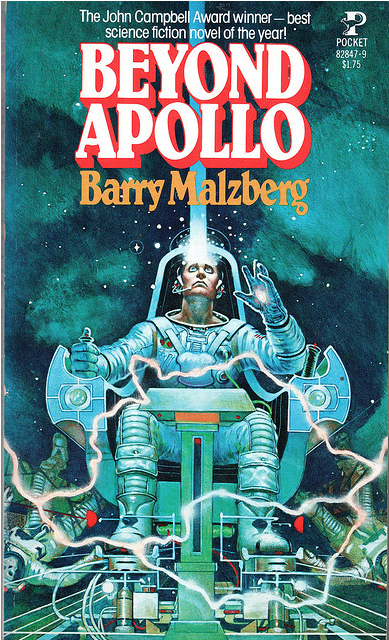
Malzberg is shaping into my “under read/unjustly forgotten author of the year” whom I’ll showcase.  Last year’s winner was the brilliant D. G. Compton (see INDEX for reviews).  Fresh off Conversations (1975) and In The Enclosure (1973) I picked up a copy of Guernica Night (1975).  I can’t wait!

Harold Mead’s The Bright Phoenix (1955) is yet another against the oppressive state à la Orwell’s 1984… But, I’ve found that the premise generally holds up despite frequent re-interpretations…

Greenfield’s Waters of Death (1967) should be avoided — at all cost.  I’ve already written a scathing review (rant).

1. Traitor to the Living (1973), Philip José Farmer (MY REVIEW)

(Hans Ulrich Osterwalder and Ute Continue reading

Book Review: In The Enclosure, Barry N. Malzberg (1973)

(Davis Meltzer’s cover for the 1973 edition)

4.5/5 (Very Good)

Fresh off Malzberg’s intriguing young adult novel, Conversations (1975), I picked up a copy of the altogether more disturbing, transfixing, unnervingly prescient, and at moments, brilliant In The Enclosure (1972).  As with many of Malzberg’s oeuvre, the work is infused with a steady dose of metafiction — our hero laments (and we writhe along with him in a malaise of unease), “I will never really know” (189).  Just as Quir is unsure of his own reality, his diaristic words — which the reader is desperate to hold on to — are admittedly, “an impression, a conception, nothing more” (190).

Combining the science fiction trope of implanted memories with the literary narrative mode of the unreliable narrator creates an overwhelmingly uncomfortable gulf between reality and constructed reality.  The result, the overpowering desire to pick up a piece of pulp science fiction where the future is rosy, technology = happiness, the kids smart, where rockets Continue reading

Book Review: Eight Keys to Eden, Mark Clifton (1960)

(Ralph Brillhart’s cover for the 1962 edition)

3.25/5 (Average)

Mark Clifton’s readable and thought-provoking Eight Keys to Eden (1960) has been unfortunately overshadowed by his dismal failure, They’d Rather Be Right (1955) (co-written with Frank Riley), which is generally considered the worst novel ever to win the Hugo Award.  Although I wouldn’t classify Eight Keys to Eden as a masterpiece, the novel does contains an original premise, good plotting, and sufficiently thought out “pseudo-intellectual” content that is only overbearing at the work’s climax.  The serious nature of the premise is weakened by a forced strain of unfunny “humor” that creeps in at the wrong moments.  Also, a complete lack of character development makes us care little for the challenges Continue reading

Book Review: The Man in the Maze, Robert Silverberg (1969)

(Ron Walotsky’s cover for the 1978 edition)

4.5/5 (Very Good)

The Man in the Maze (1969) is yet another glorious novel from Silverberg’s best period (1967-1975).  Silverberg adeptly recasts Sophocles’ play Philoctetes (perhaps more of a loose inspiration) in an inventive and fully realized science fiction future where man has newly come into contact with interstellar beings.  As with some of his more serious works (The World Inside, Downward to the EarthHawksbill Station, etc.) the tone is that of a dark and brooding rumination.  The setting, a massive and unexplained ancient maze/city on the planet of Lemnos, is the perfect backdrop for the thought-provoking human drama that unfolds.

Plot Summary

Our hero, Richard Muller, is a one-time diplomat famous Continue reading

Updates: Recent Science Fiction Acquisitions N. XXI (Silverberg + Compton + Malzberg + Anderson)

A few more Christmas gift card purchases…

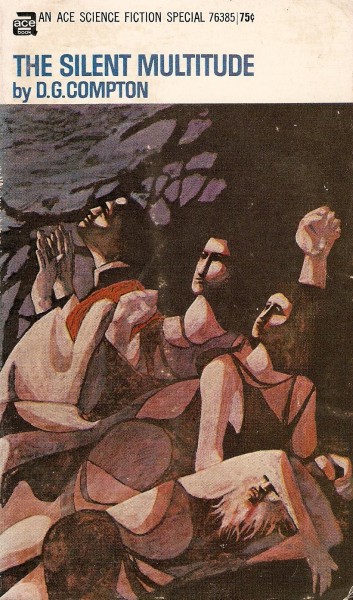
Dying Inside (1972) is often considered one of Silverberg’s best works and I can’t wait to read it (I will after my soon to be hellish weekend grading ~60 undergrad history papers).  Despite a painfully negative review on Amazon slamming Compton’s The Silent Multitude (1967) as a dull imitation of J. G. Ballard, it is high on my to read list — almost any experimental (allegorical) work exploring a crumbling city intrigues me.  Malzberg’s Conversations (1975) was a shot in the dark — it might be the least read of any of his novels — hence, my interest.

Pohl Anderson is almost always worth reading — even his middling short stories are fun.

Enjoy!

1. Dying Inside, Robert Silverberg (1972)

(Jerry Thorp’s cover for Continue reading

Updates: Visit + Submit to the BSFA Award Nominated Review Site SF Mistressworks


Hello all,  Ian Sales’ wonderful SF Mistressworks (link), a review collating blog, has recently been nominated for the BSFA award (British Science Fiction Association) in the non-fiction category (link for the list).  I’ve submitted nine of my reviews of sci-fi works written by women over the last few months.  It was created in direct response to the absence of sci-fi masterpieces by women on a list by The Guardian, a lack of general knowledge in the sci-fi community about early female pioneers in the genre, and general lack of readership for their many award-winning works.

If you’ve written reviews of science fiction works by women (the novels/short story collections need to be written before 2000) please submit them as well (500 words or so is preferred)!  So, gather up any Russ, Norton, Cherryh, C. L. Moore, Merril, Brackett, Piserchia, Le Guin, MacLean, Butler, etc etc etc reviews you might have on your blog or anywhere else.  It’s a great resource for finding seldom read works/authors which deserve a greater readership. Continue reading

Adventures in (Bad) Science Fiction Cover Art: Miserable Monday No. III (Through the Purple Haze)

(Uncredited cover for the 1971 edition of Paradise is Not Enough (1970), Michael Elder)

My third Miserable Monday installment! (part I, part II)

Evil lurks behind purple clouds — a mascara-eyed man be-speckled with sparkling stars leers from the purple haze (the aphrodisiacal gases of paradise?), a goggled hero clutches his chest due to the horrific color palette sheeting towards them (a purple god’s purple tears?)(“O no! Run! Shall we run from the purple and green atomic rays?”), and real humans aren’t purple, so, the androids must be — to blend in with the real humans? or, are all humans purple but only androids see the purple spectrum?  Serious questions.

No wonder the cover artists aren’t credited!

Enjoy, and try not to Continue reading