Book Review: Future Without Future, Jacques Sternberg (1971, trans. 1973)

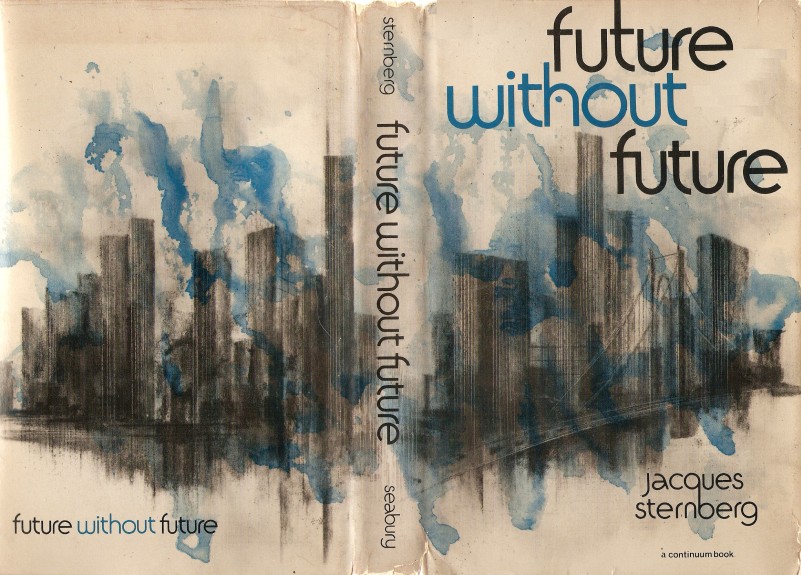
(Rus Anderson’s cover for the 1973 edition)

3.75/5 (collated rating: Good)

Jacques Sternberg (1923-2006) was a Belgian author who occasionally published SF, especially early in his career. Future Without Future (1971, trans. by Frank Zero 1973) contains a nearly novel-length novella “Fin de siècle” and four other bleak satirical works published between 1958 and 1971.

A worthwhile acquisition for “Fin de siècle” (1971) alone. The other stories are still worth a read. If you’re interested in SF in translation, this collection is a must have. I plan on tracking down Sternberg’s only SF novel in translation, Sexualis ’95 (1956, trans. Lowell Blair 1965). It’s a shame La sortie est au fond de l’espace (“The Way Out is at the Bottom of Space”) (1956), “a black comedy set in space and featuring the last human survivors of a bacterial Holocaust” doesn’t exist (yet!) in translation…. (See SF Encyclopedia for a rundown of his works).

Like Stanislaw Lem, Sternberg creates planetary environments and otherworldly denizens that feel truly alien. In the more dystopic works, Sternberg’s bleak outlook on humanity’s increasing inability to connect with each other and our pasts Continue reading

Book Review: The 1977 Annual World’s Best SF, ed. Arthur W. Saha and Donald A. Wollheim (1977)

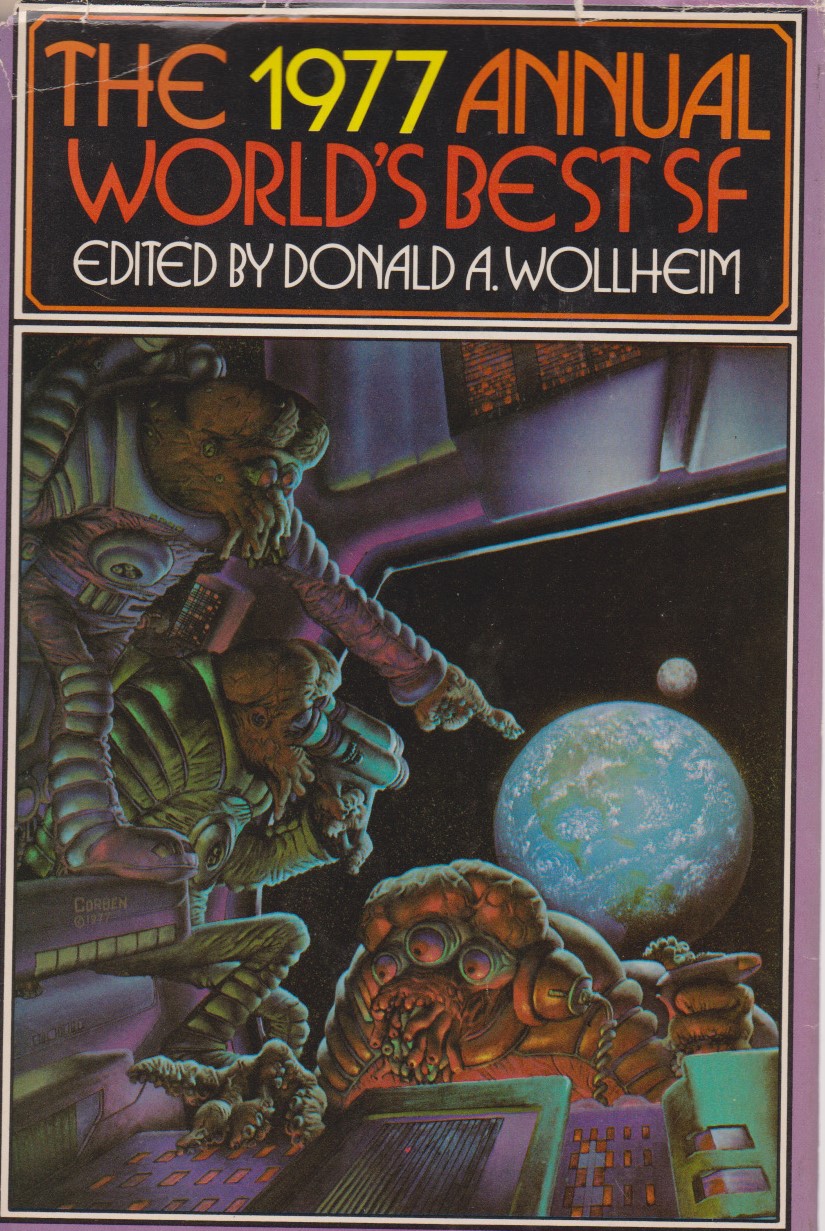
(Richard Corben’s cover for the 1977 edition)

4.25/5 (collated rating: Very Good)

The 1977 Annual World’s Best SF, ed. Donald A. Wolheim and Arthur S. Saha (1977) is a glorious anthology of SF published from the year before containing rousing works by the established masters (Isaac Asimov and Brian W. Aldiss), philosophical gems from New Wave icons (Barrington J. Bayley), and gritty and disturbing commentaries on masculinity by the newer voices (James Tiptree, Jr.). While Richard Cowper and Lester del Rey misfire, the overall quality is high for a large Continue reading

Book Review: Dark December, Alfred Coppel (1960)

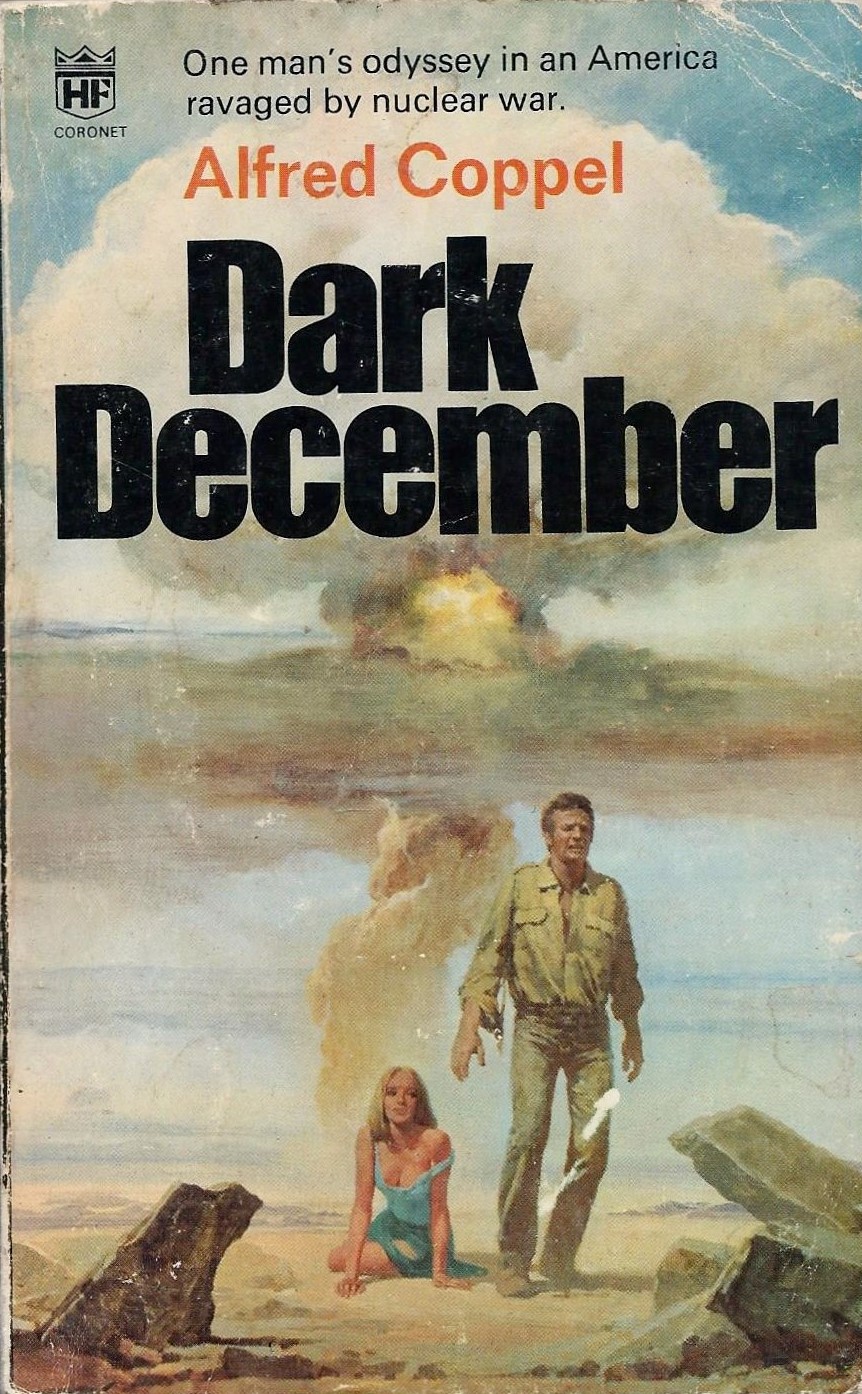
(Uncredited cover for the 1971 edition)

4.25/5 (Very Good)

“In my holster I carried a pistol that had never been fired. Yet I was master of ten thousand graves” (72).

Occasionally my childhood love of survival tales—whether post-apocalyptic nightmares or sailors stranded on Pacific islands—rears its head and I am forced to track down a book, languishing in some forgotten corner, that satiates the craving. Alfred Coppel’s Dark December (1960), an unknown gem, successfully distills in ultra-realistic strokes the basic post-nuclear war survival formula: man traverses a bombed landscape, pockmarked with the vestiges of human habitation, on a quest to find his family. Dark December is a careful study of trauma and survival in the face of forces willing to plunge the world back into Continue reading

Updates: Recent Science Fiction/Fantasy Acquisitions No. CCXVIII (Wolfe + Saxton + Tilley + New Worlds Anthology)

1. This looks like a splendid New Worlds Quarterly anthology replete with book reviews, articles, and interior art by John Clute and James Cawthorn. When I review it (hopefully soon), I’ll include a few examples of the art. The quantity of authors I’ve not read in this anthology is high—for example, A.A. Attanasio, Harvey Jacobs, Rachel Pollack, among many others. See content lists below.

For more fantastic Mati Klarwein covers check out my recent art post.

2. Gene Wolfe’s novels are a major hole in my SFF knowledge. Here is an early fantasy work that I might in the near future. I tend to take perambulatory paths before tackling an author’s great works. Thoughts on this lesser known one?

I’ve read quite a few of his 60s and 70s short stories. For example, the spectacular “Silhouette” (1975) and “The Changeling” (1968).

3. It’s been a while since I raved about Josephine Saxton’s delightful The Hieros Gamos of Sam and An Smith (1969). An author I must return to….

4. Silly early 80s post-apocalyptical adventure anyone? Sometimes you need a break from Christopher Priest and J. G. Ballard! hah.

Let me know what books/covers intrigue you. Which have you read? Enjoyed? Hated?

~

1. New Worlds #6 (variant title: New Worlds #7), ed. Charles Platt and Hilary Bailey (1974)

(Mati Klarwein’s cover for the 1975 edition) Continue reading

Adventures in Science Fiction Interior Art: Monday Maps and Diagrams (Science Fiction) 7/15/19: Greg Bear’s Hegira (1979)

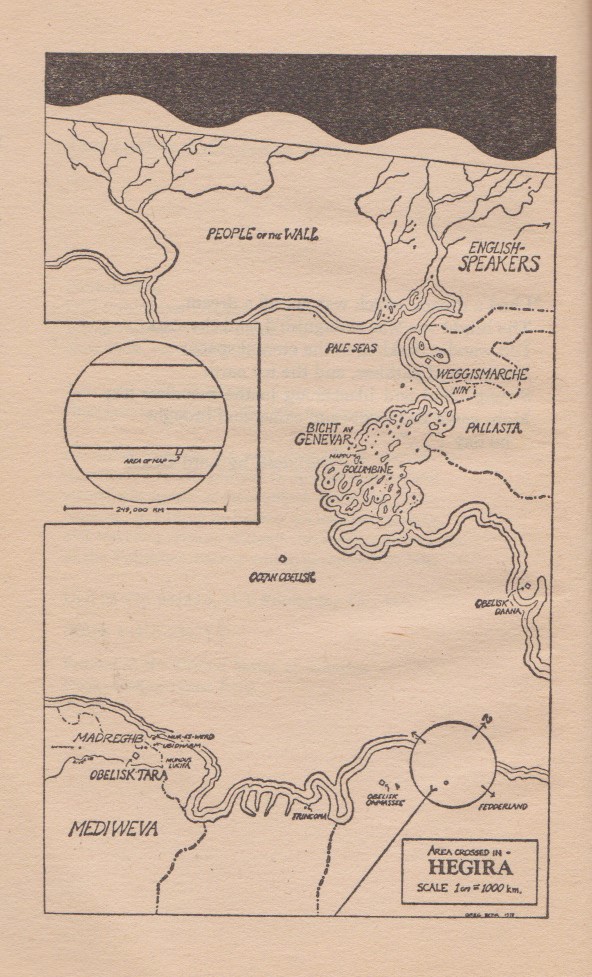
Today’s installment of Monday Maps and Diagrams returns to a recent acquisition of mine—a signed copy of Greg Bear’s first published novel Hegira (1979), which seems to be a Riverworld and Ringworld inspired read involving the discovery of the nature of an unusual world…

I’m impressed with the simple effectiveness of Greg Bear’s map—created by his own hand (citation bottom right corner). The ocean is nicely indicated as are the rivers and regions (and of course, the unusual wall in the far north–one of the story’s many mysteries).

Enjoy! And, as always, comments are welcome and appreciated!

For my recent acquisition post which included novel’s plot blurb and discussion in comment section about the Greg Bear’s early works, click here.

Citation: Greg Bear’s own map for the Dell 1st edition of Hegira (1979), Greg Bear. Continue reading

Updates: Recent Science Fiction Acquisitions No. CCXVII (Bear + Elgin + Lee + Clingerman)

1. Years ago I read and reviewed Suzette Haden Elgin’s provocative At the Seventh Level (1972)–I praised the use of linguistics, the formulation of societal ideologies, and critiqued the ramshackle plot and Orientalism. Native Tongue (1984) is supposedly her strongest work. I look forward to reading it.

2. I have yet to ready any of Greg Bear’s work. This late 70s novel was signed so I snatched it up. I don’t track down signed copies–all the ones I owned were accidentally mislabeled or inexpensive volumes I wanted anyway. Bear’s signature joins the ranks of Christopher Priest, D. G. Compton, Karen Joy Fowler, and Norman Spinrad.

Hegira itself draws inspiration from the Ringworld and Riverworld-style SF novel.

3. My Tanith Lee collection grows and grows. This one more fantasy than SF (although SF elements crop up at the end). In case you missed it, I reviewed Don’t Bite the Sun (1976) recently and procured a copy of Electric Forest (1979).

4. Mildred Clingerman was regularly featured in The Magazine of Fantasy and Science Fiction in the 50s and early 60s. I have finally found an inexpensive copy of her only collection published during her life (an omnibus edition with never before seen stories was recently self-published by her descendants). As it’s a Ballantine Books volume, it has a wonderful Powers cover.

Let me know what books/covers intrigue you. Which have you read? Enjoyed? Hated?

1. Native Tongue, Suzette Haden Elgin (1984)

(Jill Bauman’s cover for the 1st edition) Continue reading

Updates: Recent Science Fiction Acquisitions No. CCXVI (Le Guin + Leiber + Laumer + Martin)

1. Keith Laumer is an author I’ve only dabbled in—a few short stories in an anthology here and there. Another (one of twenty?) Laumer volume joins my collection. With a solid Richard Powers’ cover!

2. I finally picked up a copy of Ursula Le Guin’s The Lathe of Heaven (1971)—one of her few early works lacking from my collection. I recently read and enjoyed The Word for World is Forest (1972).

3. According to a goodreads review, Justin Leiber’s novel “a hard sci-fi take on gender dysphoria.” SF Encyclopedia emphasizes how Justin Leiber, Fritz Leiber’s son, “used sf as a medium  for speculation in his field of interest, the philosophy of the mind.” Call me intrigued about Beyond Rejection (1980)….. and suspicious.

4. The unknown quantity of this post. Have you read any of his work? Or heard of his most “famous” novel Time-Slip (1986)? Joachim Boaz, taking risks since the birth of this abomination (website).

1. Nine by Laumer, Keith Laumer (1967)

(Richard Powers’ cover for the 1969 edition) Continue reading

Book Review: Seeklight, K. W. Jeter (1975)

(Kelly Freas’ cover for the 1975 edition)

3.5/5 (Good)

K.W. Jeter’s first published novel is a promising one (*). On a nameless colony world, entropic forces influence all. Humankind speaks less and less and resorts to animistic grunts. Robotic priests go mad. Speculation abounds of a “Dark Seed” (52) implanted by the eugenicists on Earth in the colonist gene pool creating an increasingly crude and lazy population, “wretched and fearful of any change or effort” (46). The landscape itself  is inscribed with the entropic effects: most of the population seems to be engage in quarrying, hillsides are covered with the Continue reading

Updates: Recent Science Fiction Acquisitions No. CCXIII (Sheffield + Lessing + Callenbach + Ford)

1. Body modification + new definitions of humanity + a mystery! What is there not to like? I’ve not read any of Charles Sheffield’s SF. I look forward to exploring his oeuvre.

2. A proto-cyberpunk novel? I wonder if Ford’s novel, Web of Angels (1980), doesn’t receive the readership it should due to the lack of noir imagery and Asian culture that forms the “cyberpunk” archetype…. thoughts?

3. I need to complete Doris Lessing’s sequence! When I might get around to reading it is another matter…

4. I always see Ernest Callenbach’s environmental utopia novel on the shelves of my local Half Price Books. While wandering around Mexico City I saw this one for a few pesos… and grabbed it.

Note: I am currently in Mexico City, far away from my scanner, and will be for almost another week. In two instances I own different editions of the books than the cover might indicate. I have noted in the back cover blurb which I own.

Let me know what books/covers intrigue you. Which have you read? Enjoyed? Hated?

~

1. Sight of Proteus, Charles Sheffield (1978) (MY REVIEW)

(Clyde Caldwell’s cover for the 1978 edition) Continue reading