Book Review: The Wall Around the World, Theodore R. Cogswell (1962)

(John Schoenherr’s cover for the 1962 edition)

collated rating: 2.25/5 (Bad)

In my quest to bring to light the esoteric, the worthwhile yet forgotten, and to re-examine unjustly maligned works of science fiction I’m unfortunately more likely find incredibly average works than if I were to stick to the more well-trod path.  Theodore Cogswell’s short stories attempt unsuccessfully to wed clichéd fantasy + horror elements — à la vampires, werewolves, broomsticks and all that drek — with science fiction staples, including alien invasions and alien visitations.  I suspect there was, and still is, a market for such hybridity.  I don’t have to mention the conveyor belt chunking out vampire/zombie excreta all over our modern bookstore shelves… (I apologize to anyone who’s offended or implicated by that statement).  Almost all of Cogswell’s stories are lighthearted (besides ‘The Burning’), replete with heavy doses of whimsy, and in the few readable stories, some vibrancy.

Not my type of science fiction or fantasy.

Continue reading →

Updates: Recent Science Fiction Acquisitions N. XXXIX (Priest + Brunner + Crowley + Wallace + Duncan)

Ah, what a delightful group! A few from my father, a few from Marx books which I hadn’t posted yet….  Priest and Crowley’s novels involve fascinating worldscapes — a world winched across the horizon, a world at the top of a pillar…  Both are considered among the better stylists in science fiction and fantasy.

And, my 22nd (?) Brunner novel!  The Stone That Never Came Down (1973) — from his glory period of the late 60s-early 70s (this period produced Stand on Zanzibar, The Sheep Look Up, Shockwave Rider, The Jagged Orbit).

And two more impulsive finds — Ian Wallace’s Croyd (1967) — a reader claimed it was one of the best sci-fi novels of the 60s, and thus due to my intense curiosity, I had to find a copy.  And Dark Dominion (1954), I know little about David Duncan — he wrote only three sci-fi novels in the 50s.  His work is described by SF encyclopedia as “quietly eloquent, inherently memorable, worth remarking upon.”

And the covers!

1. The Inverted World, Christopher Priest (1974)

(Jack Fargasso’s cover for the 1975 edition) Continue reading →

Updates: Recent Acquisitions N. XXXVII (del Rey + Geston + Saxton + Gunn)

A wonderful selection of Marx Book purchases….  All of them are high on my to read list!  I hadn’t heard of Josephine Saxton — she’s considered an inventive sf fabulist — until I read a review of her novel Vector for Seven (1970) on SF Mistressworks, a review collating blog which I highly recommend for any fan of science fiction.  There are so many great works by female sci-fi authors out there waiting to be rediscovered on dusty used bookstore shelves….

I enjoyed James Gunn’s Station in Space (1958), a thematically linked short story collection depicting mankind’s first steps into space, so I picked up a copy of one of his better known fix-up novels, The Joy Makers (1961).

I adore sci-fi novels on overpopulation so Lester del Rey’s The Eleventh Commandment (1962) was a given…

And, well, the incredibly alluring description on the back cover of Mark S. Geston’s Lords of the Starship (1967) speaks for itself…

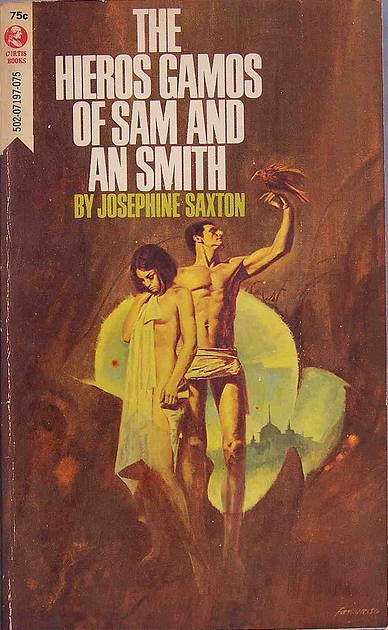
1. The Hieros Gamos of Sam And An Smith, Josephine Saxton (1969) (MY REVIEW)

(Jack Fargasso’s cover for the 1969 edition) Continue reading →

Updates: Recent Science Fiction Acquisitions XXXIII (Delany + Wyndham + Sturgeon + Knight + Ellison)

My last batch of the summer from Austin, TX — as always a nice haul.  Unfortunately, I’m back home in a rather lackluster state for acquiring sci-fi.  Henceforth, amazon/abebooks it shall be!

Still haven’t tackled a Sturgeon collection yet — now I have three unread ones sitting in my to read stack.  I also added Delany’s first published novel, The Jewels of Aptor (1962), to my collection.  And some Ellison stories…  And three short novels (in one collection) by Damon Knight of whom I have a rather dubious opinion (see Beyond the Barrier).

Most importantly, another Wyndham novel (still haven’t read The Day of the Triffids which I’ve had for years and years and years).

1.  A Way Home, Theodore Sturgeon (1956) (MY REVIEW)

(Mel Hunter’s cover for the 1956 edition)

Continue reading →

Updates: Recent Science Fiction Acquisitions No. XXXI (Dick + Zelazny + Tucker + Smith)

Another wonderful assortment (some from Central Texas bookstores, some from my father as presents, some semi-forgotten works from a few months ago that I forgot to post about)…  Regardless, I’m almost finished Zelazny’s Jack of Shadows (1971) and am quite impressed (I loved This Immortal and Lord of Light).  Another PKD, Dr. Bloodmoney or How We Got Along After the Bomb (1965),  swells my already extensive collection of his novels and short story collections — again, the premise is vintage PKD surrealism (girl with twin brother growing inside of her in a post-apocalyptical wasteland).  I bought the Wilson Tucker novel, Tomorrow Plus X (1956), because of the gorgeous Richard Powers cover…  A few of his works are supposedly readable, but this one is probably justly forgotten.  The Cordwainer Smith collection, Space Lords (1965), will be my first exposure to his work — very excited!  Now that I think about it, I do have a copy of Norstrilia (1975) languishing somewhere.

Enjoy!

1. Jack of Shadows, Roger Zelazny (1971)

(Robert Pepper’s cover for the 1972 Continue reading →

Adventures in Science Fiction Cover Art: Underwater Expeditions (futuristic submarines, unusual sea life, underwater cities) Part I

(Paul Lehr’s cover for the 1968 edition of Conquerors from the Darkness (1965), Robert Silverberg)

A cornucopia of underwater sci-fi cover art images!  As always, Paul Lehr’s covers are among my favorite for he masterfully renders the green-blue depths and textures of water inundated worlds (especially above, Conquerers from the Darkness).  Watery worlds evoke unusual underwater life, a place fraught with danger where humans and aliens meet, unusual cityscapes (domes, water impervious shields, a plethora of transport craft) and of course, the vehicles for transportation (for example below, the futuristic submarine in Treasure of the Black Flacon and 21st Century Submarine, etc)  evoke the same giddy sense of adventure as when first reading Jules Verne’s Twenty Thousand Leagues Under the Sea (1870) or watching Richard Fleischer’s surprisingly good 1954 film adaptation of the novel.

There are countless films, sci-fi TV shows, novels, short stories Continue reading →

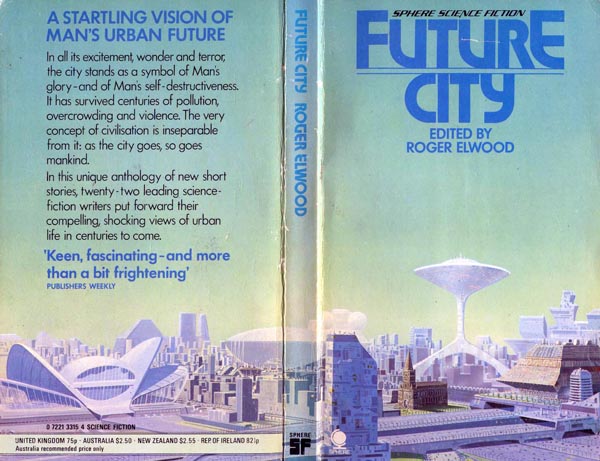
Book Review: Future City, ed. Roger Elwood (1973)

3.25/5 (Average)

According to Future City, the cities of the future are to be avoided at all costs.  There are no utopias here — only overpopulation, pollution, racial warfare, natural disasters, robot takeovers, and eventual reversion to primitivism!  But there’s a trajectory!  In fact, Roger Elwood, the editor of the volume, asked for new stories that fit along this arc.  Elwood claims that there are twenty-two leading science-fiction writers who contributed to the volume.  Unfortunately, three of these leading authors don’t submit stories: Tom Disch contributes a one page poem, Clifford D. Simak a brief introduction, and Frederick Pohl a short afterword.  Also, two of the twenty-two are monikers for Barry N. Malzberg.  Famous authors like Frank Herbert and Ellison contribute substandard short stories.  Many of the other leading figures are not “leading figures” in any sense of the word!

As with most collections there are gems AND complete blunders.  Robert Silverberg, R. A. Lafferty, Ben Bova (and others) all contribute thought-provoking stories making this collection Continue reading →

Adventures in Science Fiction Cover Art: Infernal Machines

(Uncredited cover for the 1974 edition of The Stars Will Judge (1974), Irving A. Greenfield)

There are manifold possibilities for the infernal machine unraveling beneath the streets or inhabiting entire planets — it could construct simulacra, infiltrate spaceships with insinuating metal tentacles, conduct experiments, terraform the soil, create new life, manipulate politicians, cause natural disasters — technology gone mad, endlessly proliferating…  The dangers of technology, or technology in the hands of nefarious individuals is by far one of the most popular themes of science fiction.  I cannot count how many Star Trek episodes, novels, movies, and other television shows examine these scenarios — innumerable, it goes without saying.

I’ve chosen a wonderful collection of science fiction cover Continue reading →