Which books/covers/authors intrigue you? Which have you read? Disliked? Enjoyed?
1. Karin Boye’s Kallocain (1940, trans. David McDuff, 2019)
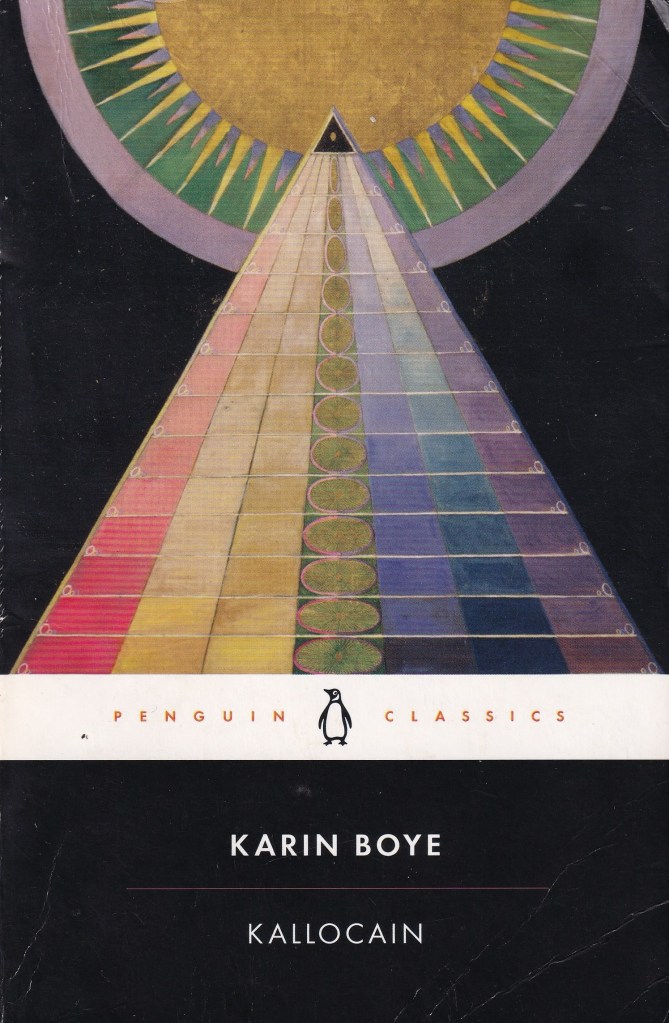
Hilma of Klint’s art used for the 2019 edition
From the back cover: “Written midway between Brave New World and Nineteen Eighty-Four, as the terrible events of the Second World War were unfolding, Kallocain depicts a totalitarian ‘World State’ which seeks to crush the individual entirely. In this desolate, paranoid landscape of ‘police eyes’ and ‘police ears’, the obedient citizen and middle-ranking scientist Leo Kall discovers a drug that will force anyone who takes it to tell the truth. But can private thought really be obliterated? Karin Boye’s chilling novel of creeping alienation shows the dangers of acquiescence and the power of resistance, no matter how futile.”
Initial Thoughts: This is one of those famous dystopias I’ve yet to read. I look forward to it!
2. Russell M. Griffin’s The Time-Servers (1985)
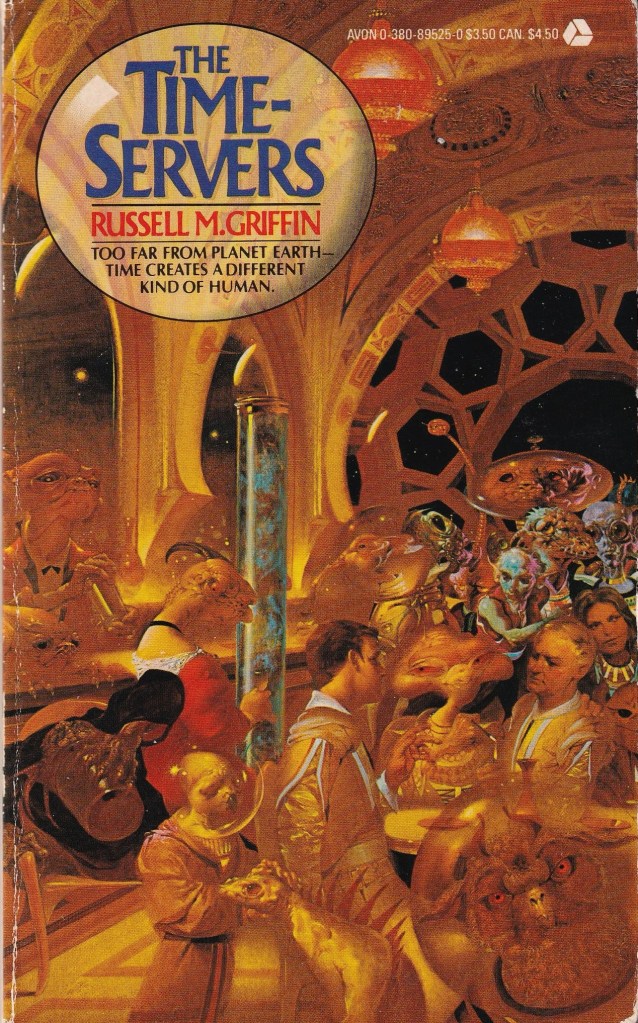
Uncredited cover art for the 1st edition
From the back cover: “HUMANS FROM EARTH. They serve their time on a planet at the far reaches of the galaxy. One a battlefield erupting under the watchful control of all-knowing minds. A world careening toward cataclysm.
Officer Calvin Troy, new boy at Earth embassy, faces a first mission against alien minds that kill in alien ways. But facing death is his duty. Even if his co-officer is a totally dangerous woman. Who might no longer be totally human.
In a war across a time zone when humanoids and clones have infiltrated the race, Calvin Troy will have to battle a terrifying possibility: He is not the only Calvin troy. And if that is so, then just how human are the rest of his fellow timeservers?”
Initial Thoughts: I know little about Griffin’s SF. I’ve acquired The Makeshift God (1979) and The Blind Men and the Elephant (1982) but have not read them yet. SF Encyclopedia has kind words for his fiction — cut short by an early death at 43.
3. C. J. Cherryh’s Visible Light (1986)
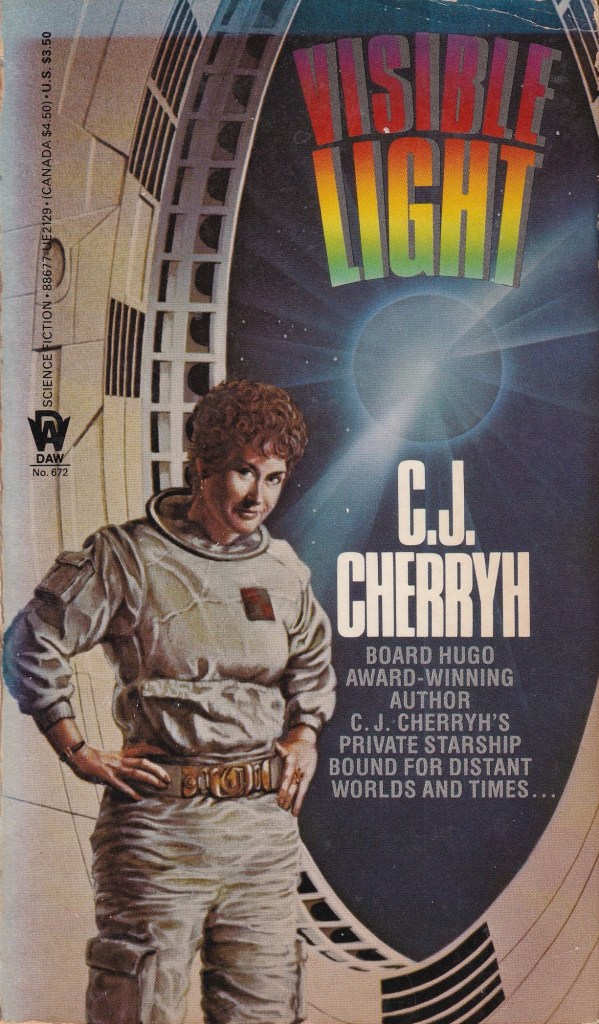
David A. Cherry’s cover for the 1st edition
From the back cover: “IMAGES OUT OF TIME AND SPACE—
The terrifying, prophetic vision of a not-too-distant future here on Earth…. An ever-changing journey through Gates in time with countless beginnings but only one End… A world where man and machine define life–and death–in contrary terms… A realm where magical intervention can prove both blessing and curse…
From Earth the day after tomorrow to light-years distant worlds, here is your ticket for an unforgettable expedition abroad a starship fueled by the powerful imagination of Hugo Award-winning author C. J. Cherryh.”
Contents: “Casandra” (1978), “Threads of Time” (1981), “Companions” (1984), “A Thief in Korianth” (1981), “The Last Tower” (1982), “The Brothers” (1986).
Initial Thoughts: I’ve read many Cherryh novels. I’ve never read one of her handful of short fictions. I might tackle this collection next month as I’ve read very little short fiction (strangely) this year.
4. Abram Tertz’s The Makepeace Experiment (1963, trans. Manya Harari, 1965)
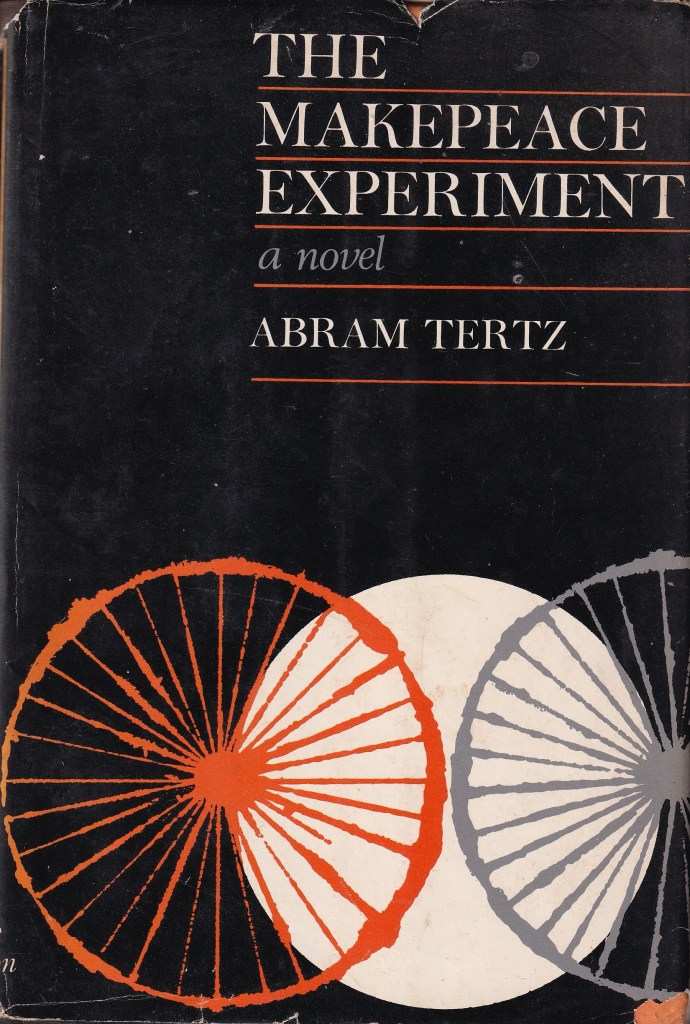
Uncredited cover for the 1st English language edition
From the inside flap: “Terz’s newest novel may well be the most important Russian book of this decade,” wrote Andrew Field in discussing Abram Tertz, the anonymous writer whose works are smuggled out of Russia, in an article on recent Soviet literature in The New York Times Book Review. In The Makepeace Experiment, a novel of great wit and power, we encounter again the unique language and acute imaginative mind that have characterized Tertz’s earlier work.
Leonard Makepeace, a mechanic, learns the secret of “psychic magnetism” and, armed with this extraordinary power to influence people’s minds, gets himself proclaimed rule of Lyubimov, a town somewhere in Central Russia. Hiding his town from the central authorities, Makepeace keeps the townspeople happy by making them believe they have everything they want, and plans to seize world government and establish universal peace and happiness.
Initial Thoughts: Andrei Sinyavsky, aka Abram Tertz, was a Russian author and Soviet dissident who published his works under a pseudonym to avoid censorship. However, in a 1965 show trial he was sentenced to six years in a labor camp. Eventually moving to France in 1973, he taught Russian and continued to publish. The Makepeace Experiment appears to be a fantasy-adjacent novel with fantastical elements. I acquired it for my series of reviews for Rachel Cordasco’s new Small Planet: The SFT Magazine. We’ll see if I end up covering it. Appeared first in a Polish translation in France. This is a translation of the original Russian.
For book reviews consult the INDEX
For cover art posts consult the INDEX
For TV and film reviews consult the INDEX


For some reason, I thought you already owned the Kallocain novel. It’s very good. I found the writing and characterization better than 1984, and at least as high-quality as Huxley. Maybe not at the poetic level of WE though, as far as classic, formative dystopias.
Oh yes, that’s Griffin. I knew I recognized the name. I came across a copy of The Blind Man and the Elephant at the used book store recently. I didn’t know of Griffin, but saw the trusty SFE compared the novel to Sladek (one of my favourites), so I had to acquire it. It went deep into my ever-growing TBR pile, so who knows when I’ll get to it.
It’s certainly a book that I’ve known about and read scholarship on but never acquired a copy. I searched through my purchase posts and glanced at my shelves. I have repeated books by accident in the past. Not this time! But yes, I’ve only heard good things — and I’ve had a really great run with Scandinavian SF on the site so far.
As for Griffin, I’m very intrigued. I read a review somewhere that really suggested he’s an underrated voice who never really made an impact in sales but should have… I look forward to finding out.
I read Kallocain some time back and was impressed – I think it definitely deserves more mainstream attention than it seems to have got until recently. And I’ve read Tertz and found him fun, though not this one (I believe I do have a copy lurking somewhere…)
Hello Kaggsy, thanks for stopping by. Did you review Kallocain?
I did indeed – on Shiny New Books, here: https://shinynewbooks.co.uk/kallocain-by-karin-boye
Ah, that’s maybe why I didn’t remember it. Thank you.
I’d recommend Cherryh’s The Collected Short Fiction of C.J. Cherryh over Visible Light… because Collected includes all of Visible as a subset.
I found this in a used book store. I also already own her Sunfall collection. As I know I’ve mentioned before, if I’m intrigued I’m perfectly happy tracking down fictions — and frequently do so — in their original magazines or anthologies that I might not own. And I’m not interested in her later SF short fictions anyway (my pre-1985 range of historical interest).
I reviewed Kallocain last year. It’s as good as better-known examples of its type. See https://iansales.com/2025/06/11/kallocain-karin-boye/
I’m a big fan of Cherryh’s fiction – but you probably already knew that. I actually have the signed slipcased Phantasia Press edition of Visible Light, although I’d already read its contents in The Collected Short Fiction of CJ Cherryh. I have two of her collections here in Sweden: Glass and Amber (a NESFA limited edition) and Sunfall.