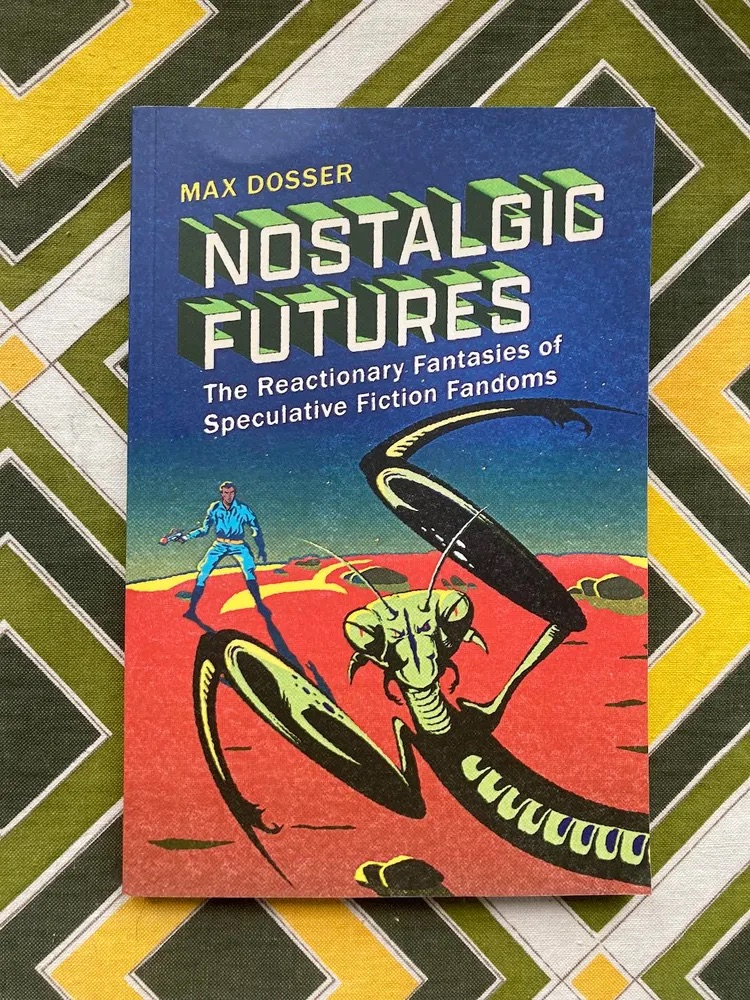
Over the last few years, I have curated a few pieces of science fiction scholarship in my Exploration Log series that I’ve found memorable, historically important, and worth sharing.1 Today I have an interview with Max Dosser, author of the recent book Nostalgic Futures: The Reactionary Fantasies of Speculative Fiction Fandoms (2026). As his book centers on more recent history of science fiction, I’ve focused my discussion on his larger conceptual frameworks that are applicable to the pre-1985 focus of the site. I’m fascinated by his multi-faceted approach to nostalgia as both a formative and destructive emotion.
You can acquire Nostalgic Futures (2026) via the press or Amazon. Let’s get to the questions.

Graphic created by my father
1. Thank you so much for agreeing to this interview. Please introduce yourself and your interest in the intersection of science fiction fandoms and far-right reactionary politics.
Thank you for the questions! I’m Max Dosser, a visiting assistant professor of communication and digital media at Wittenberg University and the co-founder and editor of Flash Point Science Fiction. I’m a pretty avid science fiction reader and watcher. I write and edit it as well. But PuppyGate is what really got me into this research.
Back in 2015, my roommate and future co-editor at Flash Point SF told me about PuppyGate as it was happening, but I didn’t look too much into it beyond that for years. Half a decade later, in my Ph.D. program, I had to take a proseminar, where we would read work by the faculty then pose questions for others to respond to in a short essay. One of my cohort members asked about the role of anger, melancholy, and mourning in social movements. That immediately brought the Sad and Rabid Puppies to mind, so I read through blog posts by Correia, Torgersen, Vox Day, and others, really trying to understand the emotions involved in the controversy. I then wrote a seven-page paper, and while I really liked it, it wasn’t my main academic focus at the time, so I placed it in the digital drawer.
When the January 6th insurrection happened, I noticed that there was a similarity between the rhetoric surrounding the Trump supporters and the Puppy groups. I wanted to probe that connection more, so I shifted my dissertation from examining the communicative role of film and television music to one that asked: What is the relationship between fans’ affective attachments to speculative fiction media and the logics of violence and exclusion that motivates reactionary groups? I considered a wide swath of fan history, examining controversies from the 1930s to the 2020s, with PuppyGate being a centerpiece of the argument. Ultimately, pieces of that short paper made it into the final version of Nostalgic Futures.
2. Your book explores the tension between “the liberatory potential of speculative fiction” (4) and the nostalgic desires of reactionary fans. Why is nostalgia such a powerful force? And how does it function in fandom?
To start, I want to bring in the various manifestations of nostalgia I discuss. I draw and expand on Svetlana Boym’s distinctions between restorative and reflective nostalgia. Restorative nostalgia is likely what many people think of when they think of the more “damaging” kind of nostalgia, though it certainly doesn’t have to be that. Restorative nostalgia is a longing to return to a lost time, a time that is seen as better than what we have now. It’s melancholic and refuses to let go of the past, instead wanting to reinstate it in the present. Reflective nostalgia, on the other hand, is more in line with mourning, where it acknowledges that what once was is gone. It misses that time, but it acknowledges that things have changed and uses the past as a way to understand the present. My book proposes a third variant: Revanchist Nostalgia. It’s a modality of restorative nostalgia, but while restorative nostalgia may imply violence is involved with the restoration of the past in the present, revanchist nostalgia is explicit about it. It is about revenge, where it does not only want to retake and reinstate an imagined past but to punish all those who caused the loss of that (imaginary) time and place.
Not all fandoms are driven by revanchist nostalgia or even nostalgia in general, but you can already see that when a longing for a supposedly lost past translates into violence against those who are deemed responsible for that loss, things can get bad. Nostalgia is important to think about with fandom, because it can lead to a sense that one’s personal experience with a text or genre represents its authentic history when that’s not the case. We have a memory of what something was like, but we experienced it at a certain time or in a certain way or with a certain person and that influenced how we took it in. My childhood neighbor and I would laugh harder than was likely healthy at adult comedies when we were kids, but watching them now, I might chuckle. That’s normal, but nostalgia (particularly the restorative or revanchist kind) wants to be able to return to that time. Or, in many cases, to a version of the thing that it no longer is (and never actually was).
While reflective nostalgia is often associated with the individual, restorative is about movements. Nostalgia can transform personal loss into collective loss, creating community and bonding those together who may want to turn back the clock. That’s what I’m most interested in throughout my book—how nostalgia for an imagined past of speculative fiction is used to mobilize so much vitriol and violence against the relatively small gains of diversity in professional and fan spaces in the SF community.
3. I am struck by nostalgia’s interaction and reinforcement of the concept of “archeofuturism” explored in Jordan Carroll’s Speculative Whiteness: Science Fiction and the Alt-Right (2024) – I interviewed Jordan in 2025. According to this idea the alt-right sees science fiction as manifesting “some preexisting racial potential.” By introducing the power of nostalgia, your analysis narrows into the affective power of the thinking about and getting attached to the past. Why do we need to consider “strong affective attachments” when analyzing fandoms?
My simplest answer is: because fandom is an affective practice. I should probably say what I mean by “affective” and “affect” before I go any further. If you asked thirty scholars what affect is, you’d likely get thirty definitions, many of which contradict each other. There’s a school of affect where it is completely separated from emotion, but I don’t subscribe to that school. I follow Sara Ahmed in saying that while we can distinguish between bodily sensations and the feelings of fear, they’re not experienced as separate in everyday life. Because of that, I often use emotion and affect interchangeably, and I define affect as the possibilities for emotional investments as they are expressed in communicative acts and the contexts that give rise to them.
So what do I mean when I say fandom is an affective practice? We feel deeply about the things we are fans of. During awards season, we root for the things we’re fans of to win—which often causes us to root against the things that might win instead (people often feel yucky about this, but if we swapped out “awards” for “football,” then few would find it odd that a person is rooting for their team’s rival to lose, even when they aren’t directly competing against each other). Fandom is all about feeling strongly attached to an object, usually positively attached through affects of love or joy (though, spoilers for #10, sometimes through anger or hatred).
An affective approach to fandom allows us to gain an insight into what fans say about speculative fiction and their other fan objects, but also why those beliefs matter so much to them. Analyzing affective attachments gets to why fans are so attached to a particular version of the genre or a particular interpretation of a text, and how those attachments motivate action to preserve what they deem to be the “correct” version of their fan object.
4. Before we get into a deeper look at the specific fan controversies you cover, I can’t help but ask a methodological question. This monographs relies on extrapolating patterns in social media, online forums, and fanzines. What sources did you use? What were the primary challenges?
I was fortunate enough that during my Ph.D., I was awarded the Rachel McMasters Miller Hunt Scholarship from the University of Pittsburgh’s Nationality Rooms Program. This allowed me to travel to England for a month, doing research at both the Science Fiction Foundation Collection at the University of Liverpool and in the Bodleian Library at Oxford University. While there, I read through twenty-five different fanzines (multiple issues of each), nine boxes of fan correspondence to authors, and then a slew of issues from six professional magazines (including Amazing Stories). These all came from a period between 1926 and 1996. I then used the snowball method along with some lucky hits on archive.org and fanac.org to find additional fanzines and magazines referenced in the ones I read. I also read a lot of speech transcripts from and accounts of the early days of fandoms, such as Sam Moskowitz’s The Immortal Storm, Harry Warner Jr.’s All Our Yesterdays, and Frederik Pohl’s The Way the Future Was.
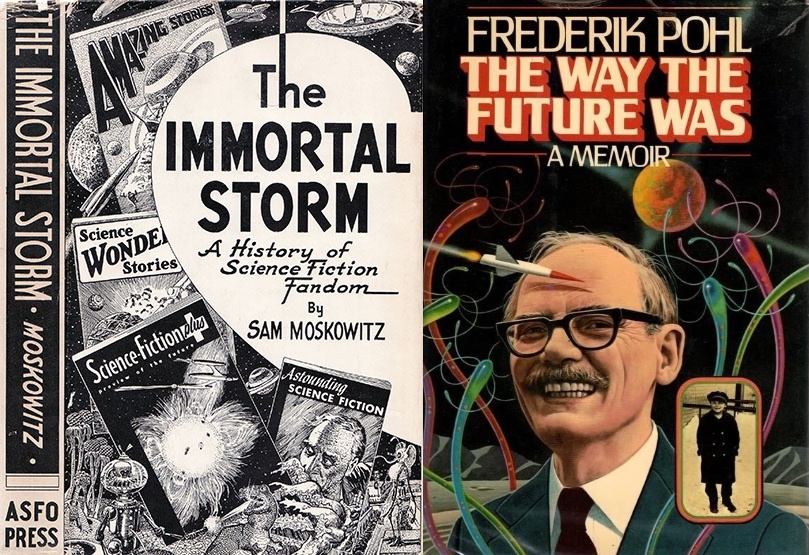
L to R: Frank R. Paul’s cover for the 1954 edition of Sam Moskowitz’s The Immortal Storm: A History of Science Fiction Fandom (1951); Joseph Lombardero’s cover for the 1st edition of Frederik Pohl’s The Way the Future Was: A Memoir (1978)
The challenges abounded. One example is that I almost wrote “I was lucky they were so prolific at documenting what happened,” but then I stopped because I don’t know how useful that actually is, given that the accounts I saw of some events were particularly one-sided or only represented one identity when many others were present and I couldn’t access them, because they were not available digitally or in print. I think often of Moskowitz offhandedly mentioning that one of the club leaders was a Black man then saying but he’s not important to the rest of this narrative, so I won’t mention him again. I worked hard to try to discuss what I found in a way that didn’t cast it as “this is what the whole fandom was doing” while also going beyond “Here’s one guy saying one thing.” Finding enough evidence where I felt comfortable using the representative anecdotes I did was tough, but ultimately made the work stronger, I hope. Beyond that, there were so many times, I found references to what I thought could be perfect for an argument, then there was no way to read it. Some zines with issues that just seemed to disappear from everywhere, only their dates preserved. So I learned early with the archival work not to get my hopes up but to always check, because I was surprised more than twice about a seemingly obscure piece I found immediately.
I realize I spent so long thinking about the historical aspect that I forgot to mention social media or online discussions at all. That part was not glamorous. To borrow a phrase from my advisor, Calum Matheson, I considered myself “an intellectual raccoon,” where I picked through the various internet trashcans and touched everything so I could find what I considered the best bits. I searched using key terms and hashtags, then snowballed on profiles, likes, comments, etc. on Twitter, Reddit, Tumblr, YouTube, Instagram, Facebook, and IMDb. I specifically chose those as I found that they were seen, at the time at least, as less “fringe,” so more mainstream fan discourse existed beside the reactionary content, whereas if I looked at 8chan, Gab.ai, Parler, or Telegram exclusively (and I did look at these, likely more than was healthy), I would be getting almost exclusively reactionary content. I was more interested in how fans in general reacted to controversies and how fans that may not explicitly consider themselves part of the far right could be drawn into various reactionary ideologies through these controversies.
5. In my discussion with Loïg J. F. Pascual who publishes on feminist fandoms, he brought up the idea that fandom is a “labor of memory” where “fan memory cements the fandom, consolidates the specificity of the fan experience […], builds common interpretations of cultural products, and generates a proper vocabulary for that fandom.” Chapter 1 charts a series of fan debates in fanzines and at conventions. What is the importance of fan activism?
There’s a distinction between activism within fandom and activism through fandom. For the former, it’s what a lot of early fan studies scholarship used to show that fans were active and critical producers, not passive consumers. It’s fans organizing conventions, launching campaigns to save shows, producing fanzines and fancasts, etc. And thinking through what you quote from Loïg J. F. Pascual, I agree. Fans don’t simply inherit a collective memory. They actively produce it. They decide what texts, people, debates, and experiences deserve attention and what gets remembered and preserved. I do this in my book too. I chose certain case studies, and because of that, these debates are preserved, for better or worse. Because fandom has the ability to decide what is given attention, they can preserve marginalized histories and challenge dominant narratives, but it can also produce exclusionary accounts of what fandom is or what it used to/should be. Fans can unearth evidence later that pushes back on these calcified accounts, but this fan activism generates our understanding of fandom.
The latter version of fan activism is when fans use their identities, communities, and shared attachments to organize around broader social and political concerns. An example I love is when K-pop fans started flooding racist hashtags with memes so all the actual racist content became nearly impossible to find. They used their community to change how a hashtag was utilized and prevent hate from being spread. Importantly, though, not all fan activism is progressive. I would classify a significant portion of what I talk about in my book as fan activism, and I’m largely focused on reactionary politics. Even so, fans can use their shared affective attachments to media to mobilize in ways that go beyond the object and instead create larger change in the world.
6. Your analysis begins with the 1939 1st annual World Science Fiction Convention — and the split between the Futurians and the Greater New York Science Fiction Club. You highlight that even at that early juncture in SF genre history nostalgia played a role! What do historical events like this one illustrate about the political nature of genre and fandom?
Even though the fandom was still so young during the Great Exclusion Act of 1939, a lot of the controversy came down to a forward-looking version of fandom versus a nostalgic one. New Fandom claimed the Futurians were forcing their communist stances on a genre and fandom that had been and should remain escapist, while the Futurians pushed against New Fandom for wanting to keep the genre and fandom from playing a role in creating a more Utopian existence. I pulled in a quote from Harry Warner Jr. that I thought really got to the impact of the groups, where he claims that their feud ultimately created a dividing line for speculative fiction fans not as “a little liberal or a little conservative, but as an adherent of the Taurasi-Sykora faction [New Fandom] or the Wollheim-Michel faction [the Futurians].”
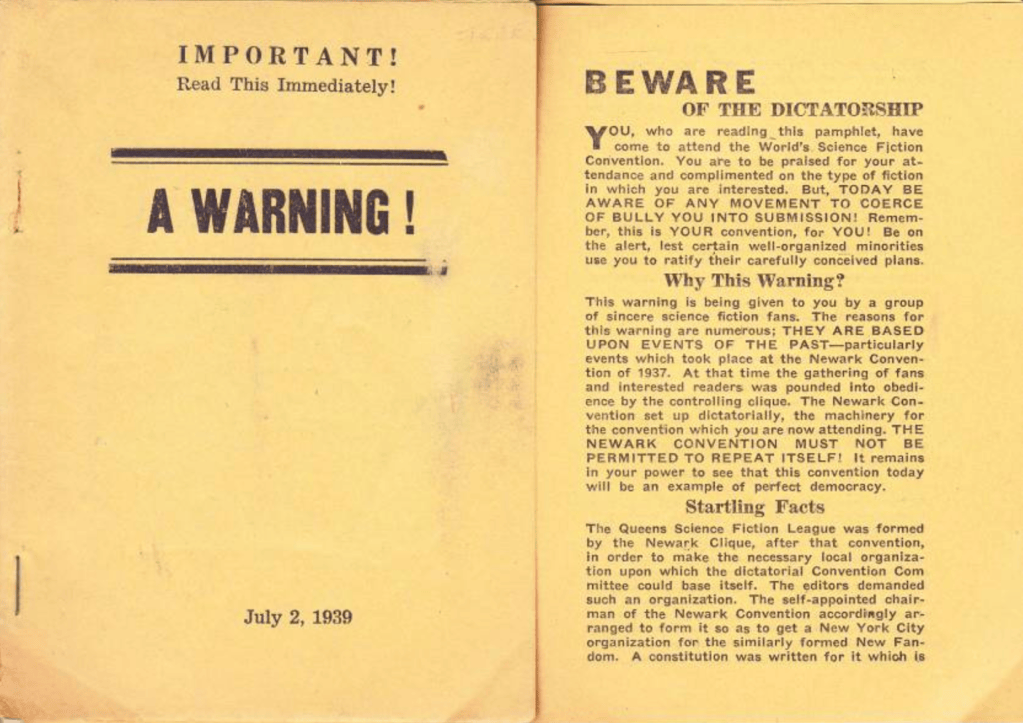
David Kyle’s 1939 pamphlet, known as The Yellow Pamphlet, A Warning, that caused the Futurians to be banned from the first WorldCon.
I bring this up because it’s a controversy from nearly a century ago that clearly mirrors issues we see in the fandom now. In a way, it reminds me of how a lot of my students assume that anti-immigrant rhetoric is new, when it’s been a part of the US from the beginning, it’s just the target of the rhetoric has shifted over time. And that’s the same with the controversies I discuss in the book. We can see how as early as the 1930s then repeatedly up to the contemporary controversies in the 2010s-2020s, that one group’s nostalgia for a previous version of the fandom or SF butts up against another group who is considering how SF and fandom can grow and change. Henry Jenkins has written that fans often chose what to be fans of because it reinforces their ideological standing, and a lot of people embrace SF because it has the ability to be so many things to so many different people. I argue that speculative fiction has no inherent ideological position, because it can be and has been used by people of drastically different ideologies. That’s what these historical events really illustrate. That this isn’t new. This polysemy is part of the genre. The fandom that emerges around it—a fandom that is fractured in being drawn to a myriad of texts with profoundly different interpretations—is a terrific way to understand how our affective attachments to how we see something can motivate action, just as it does outside traditional fan spaces.
7. In part because of the inherent “polysemy” (strategic ambiguity) and “hermeneutic depth” of a text and our interaction with it, you argue that whether or not authors consider their work escapist or political, you consider “speculative fiction to always have the potential to be political.” Can you unpack that argument?
A big part of what I’m discussing with polysemy is that there are multiple interpretations of texts. Sometimes, that’s intentionally done by the author in a way that can help a text appeal to a wider audience. Other times it’s less intentional and audiences read things in a way the author may not have intended. I use a few examples to illustrate this, like how in The Matrix the red pill is intended to be an allegory for the transgender experience, but “the red pill” is now something men’s rights activists have embraced. While that one was explicitly political on both sides, the ending scene of A New Hope similarly provides material enabling an interpretation that the men are the ones being honored for their work while the woman is relegated to awarding them, that the woman is demonstrating her power over what amount to her soldiers, or something else entirely.
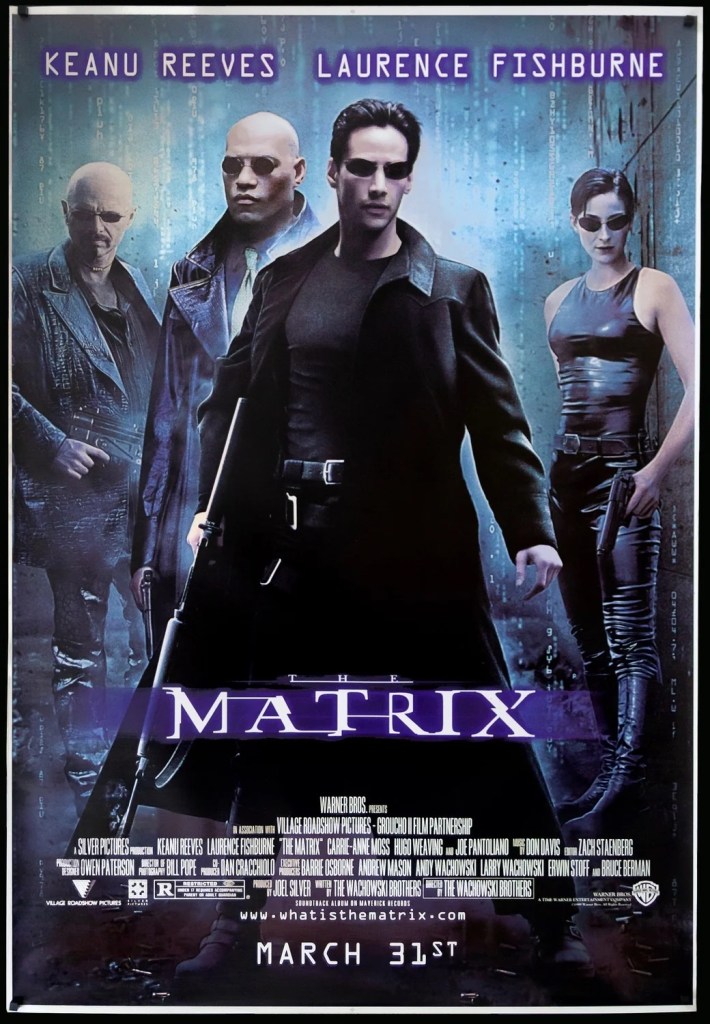
Original poster for The Matrix (1999)
In essence, I’m not saying that a person who writes a story about a man finding money on the street and keeping it has to believe their story is political. They may have had no political intention when they crafted that story. But that doesn’t mean people won’t read into the person’s actions as being positive, negative, selfish, justified, etc. Maybe the author wrote the character as a particular identity. That alone could cause the audience to interpret the scene differently, even if the author meant nothing by that choice. Alternatively, they may have a very specific political objective in their story, but that doesn’t mean the audience will always interpret it that way. All media is created with a specific point of view, just as all readers come to texts with their own points of view.
And really, to get to the part of the question about escapism and politics, I think escapism is political. My favorite endnote (what a nerdy thing to write) is about just that. It includes J.R.R. Tolkien and Ursula K. Le Guin describing the political nature of escapism. Beyond that, the authors who are writing “escapist” fiction or the readers who want “escapism” will still equate certain things with politics and others not. In chapter four, I talk about how the mere presence of a queer character causes some fans to cry out that games should be escapist, not political. A queer person existing becomes a disruption for those fans, while others may not notice at all. That’s what the polysemy argument is about. Speculative fiction is a genre that allows authors to create new worlds, new species, new ways of breaking the laws of our universe, yet the presence (or absence) of certain identities can cause entirely different reactions and motivate people to (re)act.
8. While you focus primarily on more contemporary debates like PuppyGate and the recent Star Wars films, you touch on right-wing fan reaction to pre-1985 movements such as the Vietnam War and New Wave science fiction. Can you explain how nostalgia worked in these debates? I am reminded of Isaac Asimov’s scathing anti-New Wave editorial “S.F. as a Stepping Stone” in Galaxy (August 1967) that evokes a similar brant of restorative nostalgia: “science fiction tends to be lacking in science these days” and “I hope that when the New Wave has deposited its froth and receded, the vast and solid shore of science fiction will appear once more and continue to serve the good of humanity.”
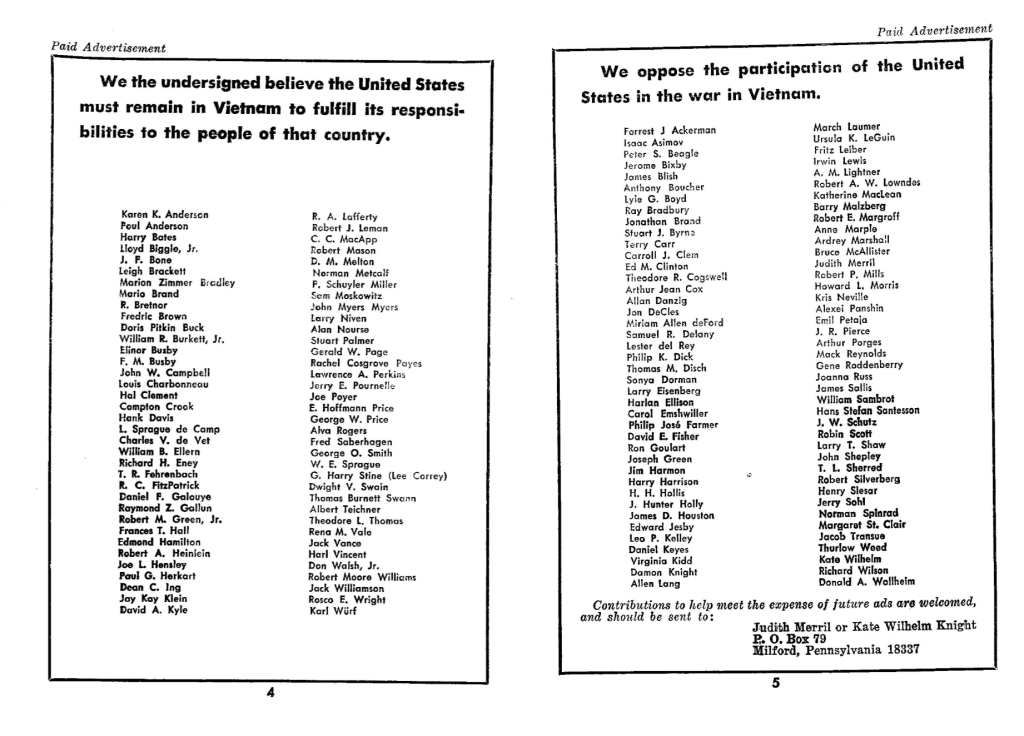
From the June 1968 issue of Galaxy
The advertisements in Galaxy and F&SF about the Vietnam War are illustrative of a tension in speculative fiction that goes back at least as far as the Futurians and New Fandom’s. Kate Wilhelm and Judith Merril assumed that most authors would sign an ad against the war, because the genre had a global and anti-racist view. Authors like Robert A. Heinlein, however, said no, that we must stay in the war, and an ad for the continued participation in the war appeared beside the one against it. While there’s a lot to unpack about the fiction of the two sides—one that reveled in manly, military virtue while the other (filled with New Wave authors) was anti-imperialist and anti-militarist—a particularly interesting manifestation of nostalgia came from Frederik Pohl, then editor of Galaxy. He claimed that despite the ads indicating different ideologies, “there’s not a pennyworth of difference between [the authors].” He even argued that if the two sides constructed ideal worlds, those worlds would be the same. That is clearly rooted in a nostalgia for an imagined past of speculative fiction where everyone was writing the same stuff. I say imagined past, because that’s never been the case. Pohl was a Futurian during the 1939 WorldCon, so he knows there’s a difference in how fans approach SF just as he knows there’s a difference in how people write SF. I do not believe he truly saw no difference between Samuel R. Delany and Heinlein’s work. Instead, he sought to return to an imagined, utopic time where the division between these authors may not be as noticeable. Sometimes we turn to nostalgia to protect ourselves from an uncomfortable present, and seeing clear lines between authors he respected, likely made a fantasy of the past a welcoming place.
I really like the Isaac Asimov quotes about the New Wave that you mentioned to me: “science fiction tends to be lacking in science these days” and “I hope that when the New Wave has deposited its froth and receded, the vast and solid shore of science fiction will appear once more and continue to serve the good of humanity.” They ring very true with other comments and editorials I cite in the book. Fandom has a tendency to develop us-versus-them/ingroup-outgroup divisions, and when “us” seems to be losing ground to “them,” “we” will push back, wanting to restore the time when “we” were on top. I discuss fans wanting to return to the “Good Old Days” before the New Wave during the 60s, then how other fans blamed each new popular series (from Star Trek to Doctor Who to Star Wars) as ruining science fiction for the fans. These are not isolated comments from one period. They stretched throughout my archival work, and I see them still today, with people lamenting about the current state of SF and wanting to return to a previous version of it.
Nostalgia acts as a shield against what threatens our preferred version of a text or genre. It was pure and great, but now it’s bad, so the newness must be what has harmed it. This can lead to us attributing the changes to progress. For the New Wave just as in many controversies today, that newness can be seen as more progressive and diverse authors, characters, and narratives. This causes fans upset by the new reality to lash out at what they deem the “bad object.” We see this in the many fanzines that wanted to return to the past when the New Wave started, when “science” became less important in mainstream science fiction, when the genre started attracting younger fans and its public profile changed, when authors that previously could be on the same page together were now physically separated by advertisements that made their ideological commitments known. Nostalgia can drive those who long for that past version to bond together, but it can also lead to exclusionary practices that cause those who are not in the in-group to be shunned just for not fitting into a version of what the genre “should” be.
9. I first became aware of science fiction fandom when I started my website in 2011. While I had read science fiction as an older teen in the early 2000s, I did not subscribe to any magazines or follow any fanzines. I created my Twitter account (long since deleted) around when the PuppyGate started to gain steam. How are the concepts of revanchist and reconstructive nostalgia a helpful lens to view the evolution of the controversy?
PuppyGate was an event where the coordinators made their desires to turn back the clock pretty explicit. They were unhappy with how “popular literature” was no longer winning awards and wanted to bring back an environment where it would win again. So much of their rhetoric calls on the past, a past they want to return to, a past they want to remake in the present. I developed the idea of revanchist nostalgia while analyzing PuppyGate—it was the seed for the entire book.
The coordinators from the three-year period I focus on, largely Larry Correia, Brad Torgersen, and Vox Day, utilize this nostalgia for older SF to justify their actions against diversity. The Sad Puppies developed a mission patch for their movement that featured three puppies named Ray, Isaac, and Frank. I couldn’t help but notice how that aligns with Ray Bradbury, Isaac Asimov, and Frank Herbert, showing how they are appealing to the 1950s and 1960s rather than the origins of SF, where the puppies may be Mary, Jules, and Herbert. And that’s a key part of restorative and revanchist nostalgia—it doesn’t have to appeal to the actual history, but a version of it that aligns with one’s ideals.
Revanchist nostalgia reveals how Vox Day, the Rabid Puppies, and the Sad Puppies draw on this fantasy for a past of speculative fiction, a past where the only values awarded aligned with a politically homogeneous version of speculative fiction. They then mobilized their desire for that past to hurt others in the present. Revanchist nostalgia allows us to consider what aspects of the (real or imagined) past they’re appealing to, how they aim to restore the past in the present, and who they seek to punish for disallowing that past to continue. Through this lens, we can observe how PuppyGate evolves from one guy complaining that “popular” literature (which, we should read as “conservative” literature) didn’t get awarded the way it did when Heinlein and Orson Scott Card were big winners, to one where the goal is not even to get certain types of literature on the ballot but to “blow up” the Hugo Awards and “leave a big smoking hole” where they once stood because they dared to award anyone other than white, cishet men. Revanchist nostalgia allows us to track the emotions of the controversy, shifting from melancholy and anger to hatred and disgust as the coordinators shift and the campaigns grow larger and more influential. And it can help understand other controversies like PuppyGate as well, controversies where a group longs for a past that is much more exclusionary and attempts to bring that back in the present through violence against diversity.
10. While reading your chapter on Star Wars: The Last Jedi, you introduce the category of the “anti-fan” who strongly dislikes a text or genre and bond over that hatred. How is this a helpful methodological category of “fan”?
Anti-fan is an incredibly useful way for thinking through how fandom manifests. I mentioned this earlier, but anti-fandom is a key part of fandom and not necessarily in insidious ways. Think sports. If you’re a fan of Ronaldo, you’re likely much less of a fan of Messi. Messi’s achievements seem to undercut those of your fan object. So you may reject and belittle, focus on some stats and not others. Zooming out from players to teams. If you support Duke basketball, it makes sense that you root for UNC to fail, right? UNC doing well, even when they’re not playing Duke, is bad, because they’re your rival. In this way, anti-fandom is normal for sports and other venues of fandom. If it should be is another question. I use anti-fandom more to discuss media, and in media, it’s rarely one thing against another, which makes the dynamics of anti-fandom different.
In particular, when I talk about anti-fandom, I’m often focused on a “bad object” anti-fandom. In this, the anti-fan rejects a text for a particular reason, often after they previously embraced it. This could be fans who love a certain run of a novels or films, then at a certain point they start hating it. Has the writing decreased in quality? Has there been an addition or narrative decision they disagree with? What about the text changed to cause a shift from fan-to-anti-fan? That’s what I’m really interested in when I talk about anti-fans in this book. And the reason I find this so fascinating and useful as a methodological category is because they don’t have to agree! One person may hate The Last Jedi because they think the dialogue is wooden, another may think the message is too obvious, another may hate the diversity on screen, and another may hate how Johnson represents the Force and Leia, but all that hatred and dislike can bond these anti-fans together. It’s a coalition of hate, where you are against the object, and being against it, you may be less discerning about why others are against it, as long as you’re on the same team.
That’s really where my analysis uses the anti-fan, thinking through the radicalization of these once-fans into reactionary anti-fans, those who attack the increasing diversity in SF because they view it as disrupting or “bad.” Not all anti-fans are reactionary, but it is a manifestation of fandom that is eminently hospitable to reactionary activity because hate is so welcome. Again, in a lot of venues, anti-fandom is seen as normal and I had a student write a paper about how some social media influencers cultivate anti-fandom in order to get more attention on their posts and thus make more money, so it’s complicated. But, like revanchist nostalgia, it really allows us to think through how the emotions involved (love and joy, hate and disgust, anger and sadism, etc.) influence how we are relating to real and imagined versions of texts, past, present, and future.
11. Returning to my discussion with Loïg J. F. Pascual and my interest feminist fandoms, can you say a few words about how the role of nostalgia and the past differs between fandoms?
I’d love to take this as an opportunity to clarify a point I may have been dancing around but haven’t said explicitly. Nostalgia is not inherently reactionary or negative. Like I said, nostalgia can bond communities together. It can lead communities to work to preserve the past or engage in efforts to increase the accessibility of their beloved texts. The nostalgia for the studio BioWare during the 2000s, for example, has led thousands (myself included) to sign a petition to #SaveMassEffect following the studio’s closure by Electronic Arts. The attachment to BioWare’s earlier identity has motivated collective action online and in real life, action that is meant to demonstrate the fan desire to preserve the game studio, largely because of nostalgia for the kind of quality the studio has not shown in over a decade.
Nostalgia is a really powerful resource for building communities and motivating action. While the #SaveMassEffect campaign may be seen as more politically ambivalent (though I wouldn’t say that for reasons that I don’t have space to get into here), nostalgia doesn’t determine the politics of the actions it motivates. Reactionary fans might use nostalgia to defend an imagined past in which BIPOC, queer, and gender-marginalized individuals are excluded from their stories and their publishing houses. Feminist fans, however, might use nostalgia to recover overlooked histories, challenge the canon, and make space for people who were written out of it previously. Both involve attachments to the past, either real or imagined, but they have very different relationships to the present and the future. Like you’ve said to me, nostalgia in this sense encourages activism but it also is woven through this tension within fandom of remembering what something was versus destroying what it is not. And I don’t want that “destruction” to sound uniformly negative, as feminist fans and critics successfully mobilized their nostalgia for SF storytelling to push back against male-centric storytelling in a variety of sub-genres, like cyberpunk and military SF. While some of that continues, the sub-genres have grown, have been pushed by this nostalgia-motivated action to be more inclusive. So, in short, nostalgia differs greatly between fandoms, because it (like speculative fiction) is politically ambivalent—it’s able to be utilized to bond and motivate communities without requiring a specific political slant.
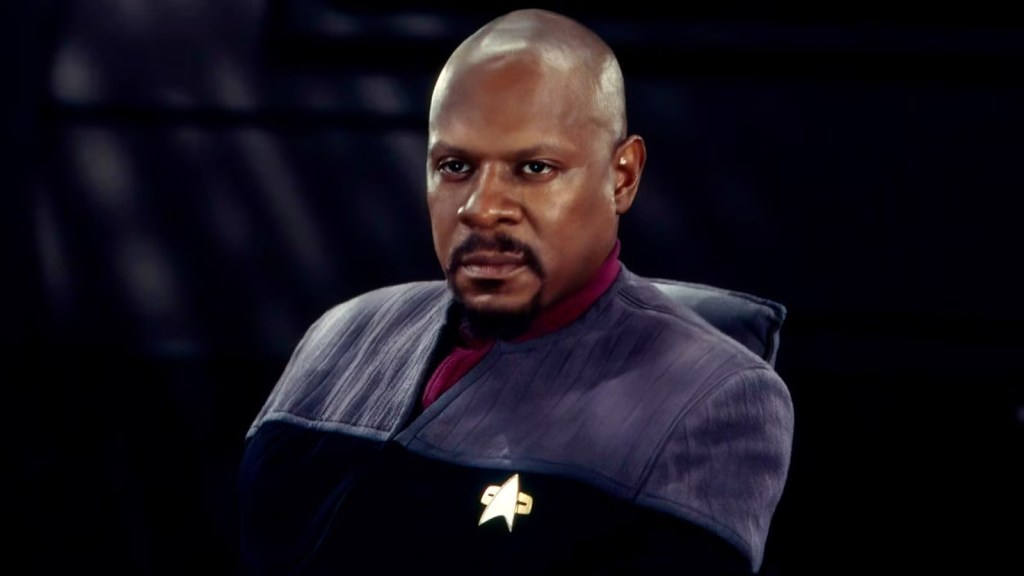
Avery Brooks as Captain Sisko in Star Trek: Deep Space Nine (1993-1999)
12. My final question connects to my own profound nostalgia for Star Trek: Deep Space Nine (1993-1999). I grew up without a television until I was around nine. And even then, my parents never paid for cable. Almost all the TV I watched came from my friend’s VHS and DVD collection — and the focus of our obsessions was Deep Space Nine. I remain utterly unaware of fan debates that existed in the late 90s. Was there the similar outrage over the casting of Avery Brooks as Captain Benjamin Sisko? Or the frequent bisexual implications of Jadzia Dax’s character?
This is a really interesting question. I talked to my friend and Star Trek expert, Don Holmes, about it, and he said people hated Deep Space Nine when it premiered. Part of that is because it wasn’t on the Enterprise, instead being on a station. I think there was some outrage about Sisko being a Black man, but he was also a Commander instead of a Captain (at least for a while), so he could be seen as beneath Kirk and Picard. While I’m not sure if that was intentionally done to make the casting more palatable for certain audiences or if it was solely a creative decision to depart from the traditional Star Trek formula, I’ve also read how the studio did not let Avery Brooks shave his head or grow facial hair for the first three seasons because it was too “street.” I recently found a Reddit thread where people raved about Sisko and Janeway for representing identities that weren’t regularly seen in science fiction or wider television. Clearly, many fans appreciated them, but I have to imagine there was discontent as well.
But, as I talk about in the book, a lot of the backlash may have gone unnoticed because it’s so much easier to make your opinions known with the internet. Following the episode “Rejoined,” Paramount was flooded with calls and letters about the kiss between Jadzia Dax and Lenara Kahn. While some sources say the calls were positive and the letters were negative, it’s hard to verify this since ultimately, the only people who know about the content of the correspondence are their authors and the people at Paramount. With social media, those complaints are much more visible. What is particularly interesting to me is how the reactions might shift today. In the 1990s, the studio seemed more concerned about a Black lead than audiences were (though, again, that backlash may have just been less visible), whereas today, there are more diverse leads in projects put out by studios and they are being greeted with vitriol from a reactionary subset of the fanbase. Based on the reception to Sonequa Martin-Green’s casting in Star Trek: Discovery, if Brooks were cast as the lead of a Star Trek series today, I imagine the response would be much louder and negative. A kiss between two women would likely still provoke a reactionary response, but given everything else that Star Trek does, I have to think it would be swept into the umbrella of offenses for a “woke” series like Star Trek.
13. What are your next projects?
Coming out next month is a piece I wrote for Feminist Media Studies about romantasy and anti-fans. It argues that some anti-fans make criticisms in bad faith, but in the process of trying to defend the genre, many critics then overlook its hegemonic investments. It’s a very short piece, but I see it as a way to talk more about something I mentioned with The Last Jedi but never had time to really unpack. It examines how once reactionary fans start latching onto a text, non-reactionary fans can become uncritical champions of it. My argument is that we can defend against reactionary trolls while still being critical and pushing for better. Additionally, I’m writing a piece for Speculative Insight that’s all about the politics of keeping politics out of SF. It engages with the claims of authors who say there are no political messages in their works. What is deemed as “political” is often charged in a particular way (just how fan fictions written by Black women were tagged as anti-racist just because they were Black-authored) while other political ideas go unmarked, so I’m excited to get more into that.
In terms of a larger project, I would really like to do a companion book to Nostalgic Futures that I’m tentatively calling Worlds Otherwise: Speculative Fiction and the Politics of Possibility. I want to focus on those fans who creatively engage with speculative fiction to imagine better tomorrows. One chapter could be on game mods that allow for more inclusive play possibilities, another on fan writers and professional magazines that create spaces for marginalized voices, another on fan practices like cosplay and roleplay games that allow people to explore facets of their identities, and another that looks to things like Octavia’s Brood, afrofuturist authors, and fan activists. It’s in the brainstorming stages now, but I would like for it to be much more interview-focused than Nostalgic Futures was, get me out of dark places on the internet and into rooms with people who are using this wonderful genre to try to make our todays and tomorrows better.
14. Thank you so much for your answers. I look forward to your future work on science fiction.
Notes
- Relevant previous posts: Interview with Loïg J. F. Pascual on 1970s-1980s Feminist Science Fiction Fandoms; Interview with Matthew I. Thompson, author of On Life Support: Eco-Dystopian Cinema in the Long 1970s (2026); Interview with Chukwunonso Ezeiyoke, author of Nigerian Speculative Fiction: The Evolution (2025); Interview with Jaroslav Olša, Jr., author of Dreaming of Autonomous Vehicles: Miles (Miroslav) J. Breuer: Czech-American Writer and the Birth of Science Fiction (2025); Interview with Jordan S. Carroll, author of Speculative Whiteness: Science Fiction and the Alt-Right (2024); Interview with Adam Rowe, author of Worlds Beyond Time: Sci-Fi Art of the 70s (2023); Al Thomas’ “Sex in Space: A Brief Survey of Gay Themes in Science Fiction” (1976); and Sonja Fritzsche’s “Publishing Ursula K. Le Guin in East Germany” (2006). ↩︎
For book reviews consult the INDEX
For cover art posts consult the INDEX
For TV and film reviews consult the INDEX


Thanks! I need to read this book.
No problem. As I mention in the beginning, his look at nostalgia as a multi-faceted concept is what I found most interesting.