Graphic created by my father
Here’s to happy reading in 2026! I hope you had a successful reading year. Whether you are a lurker, occasional visitor, a regular commenter, a follower on Bluesky or Mastodon, thank you for your continued support. As I say year after year, It’s hard to express how important (and encouraging) the discussions that occur in the comments, social media, and via email are to me. I’m so thankful for the lovely and supportive community of readers, writers, and discussion partners that stop by.
What were your favorite vintage SF reads–published pre-1985–of 2025? Let me know in the comments.
Throughout the later part of the year I’ve dropped hints about a research project. Perceptive readers might have parsed together the contours of the research: late 19th/early 20th century, utopian, African American, the American South, radical politics… It’s taking longer than expected. I’ve read a good ten monographs, five dissertations, countless articles. I’ve written twenty pages. I hoped to have it posted by early in this year. Alas. It’s coming together–slowly. Stay tuned.
Without further ado, here are my favorite novels (I only read a few) and short stories (I read a ton of those) I read in 2025 with bonus categories. I made sure to link my longer reviews where applicable if you want a deeper dive.
Check out my 2024, 2023, 2022, and 2021 rundowns if you haven’t already. I have archived all my annual rundowns on my article index page if you wanted to peruse earlier years.
My Top 5 Science Fiction Novels of 2025

Alan Gutierrez’s cover for the 1985 edition
1. Octavia E. Butler’s Clay’s Ark (1984), 4.5/5 (Very Good). Full review.
Octavia E. Butler’s Clay’s Ark is the final published volume of her Patternist sequence (1976-1984). It is the third novel according to the internal chronology of the series. Clay’s Ark is, without doubt, the most horrifyingly bleak science fiction novel I have ever read. It’s stark. It’s sinister. It’s at turns deeply affective before descending into extreme violence and displaced morality. The moral conundrum that underpins the central problem, the spread of an extraterrestrial disease, unfurls with an unnerving alien logic. Butler’s characters are trapped by the demands of the alien microbes, scarred by the pervasive sense that their humanity is slipping away, and consumed by the fear of starting an epidemic. A true confrontation of the moment cannot lead to anything other than suicide or the first steps towards an apocalyptic transformation.
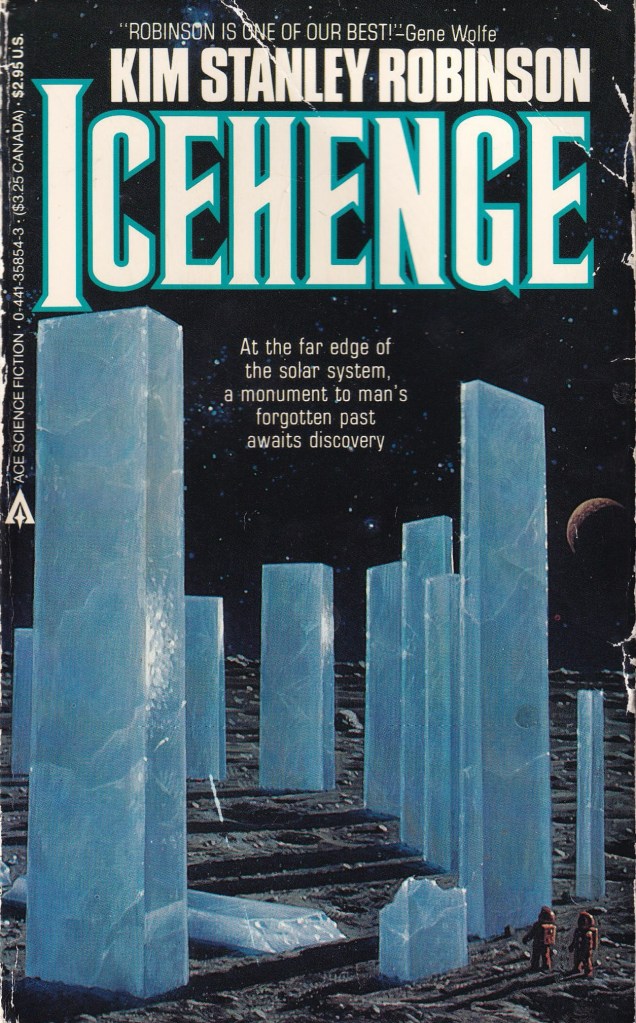
Mark Weber’s cover for the 1st edition
2. Kim Stanley Robinson’s Icehenge (1984), 4.5/5 (Very Good). Full review.
Kim Stanley Robinson’s Icehenge, a fix-up from two previously published stories “To Leave a Mark” (1982) and “On the North Pole of Pluto” (1980), tells three interconnected tales that all connect to a mysterious monolith left on Pluto (the titular Icehenge). By design Icehenge instead follows the action after the action: men and women attempting to figure out their own place in a world characterizes by lifespans that stretch hundreds and hundreds of years. And its this brilliant interconnection between self-conception and the operations of history that Robinson succeeds and casts his spell. The story is well-told, polished, and filled with fascinating details (technological and sociological).

Peter Jones’ cover for the 1978 UK edition
3. Joe Haldeman’s All My Sins Remembered (1977), 4/5 (Good). Full review.
The vast Confederación is comprised of radically distinct worlds ruled by the entire spectrum of political systems with both alien and non-alien inhabitants. There are few rules: don’t take advantage of indigenous populations and don’t wage wars on neighboring planets. At 22, the naive Otto McGavin, an Anglo-Buddhist, joins the Confederación as an agent to protect the rights of humans and non-humans. But there’s a twist. Under deep hypnosis a construct of Otto McGavin will be created for each mission. He’ll take on the identity–under a sheath of plasticine flesh–of whatever person he needs to be depending on the task. The story follows Otto on three missions over many years. The interlocking segments convey the deep trauma Otto must confront before he’s immersed in another persona and sent on another mission. His idealism clashes with the violence he must perpetuate. His sense of self conflicts with the violent actions of his “constructs.” The looming sense of dread and despair must finally have its reckoning.

Uncredited cover for the 1983 edition
4. Zoë Fairbairns’ Benefits (1979), 3.75/5 (Good). Full review.
Zoë Fairbairns charts the struggles of the British women’s liberation movement in a dystopic near future. An anti-feminist fringe political party called FAMILY comes to power, simultaneously proclaiming family values while systematically dismantling the welfare state. Benefits effectively eviscerates governmental doublespeak and champions the need to organize and educate in order to fight against patriarchal forces and messianic movements that promise to solve all our ills.

Colin Hay’s cover for the 1976 edition
5. Edgar Pangborn’s The Company of Glory (1975), 3.5/5 (Good). Full review.
Edgar Pangborn is an unsung SF hero in my book. At his best, he’s a deeply humanistic writer interested in moments of effective metafictional play on the nature of narrative. The Company of Glory (serialized 1974, 1975) is the third novel in the Tales of Darkening World sequence. It forms a prequel to Pangborn’s masterpiece Davy (1964). As with Davy, The Company of Glory attempts to create multiple interlocking layers of narrative, stories within the stories, quotations from various diaries, and the interjections of the overarching narrator of the entire collection of texts who remains anonymous until the final pages. Unfortunately, The Company of Glory is a deeply flawed novel. Recommended only for Pangborn’s fans. Read Davy first if you’re new to his work.
My Top 20 Science Fiction Short Stories Reads of 2025 (click titles for my full review)
1. Philip K. Dick’s “Foster, You’re Dead” (1955), 5/5 (Masterpiece): I featured on a podcast about this story. When the episode is posted, I’ll make sure to link it. Mike Foster spends his school days practicing survival skills–digging, making knives, weaving baskets–in case of a nuclear attack. The kids snicker at him as he walks past. They don’t own a fallout shelter at home. His father refuses to pay into the NATS (National Security fund). If a bomb hit, Mike wouldn’t even be granted access to the school shelter. He’s possessed by a deep, perpetual, encompassing trauma.
2. Fritz Leiber’s “Coming Attraction” (1950), 5/5 (Masterpiece): A rare reread! Leiber imagines an America transformed after a limited nuclear war with the Soviet Union. The physical landscape mirrors the psychological scars of New York’s inhabitants. Perverse new forms of TV entertainment, in particular male wrestlers pitted against masked women, transfix all audiences.
3. Jack Dann’s “A Quiet Revolution for Death” (1978), 5/5 (Masterpiece): Roger and his family head out of the city for a picnic in a vast cemetery. Roger dreams that he is an angel of God guiding mankind through the realm. Visiting the cemetery is an act of devotion. While other kids plug themselves into feelies, Bennie is a fanatic disciple of his father’s pseudo-philosophy of embracing the macabre. Sandra, Roger’s wife, plays along. The kids see through her dislike of the cemetery and the burial rituals happening around them.
4. Izumi Suzuki’s“Terminal Boredom” (1984, trans. by Daniel Joseph 2021), 4.5/5 (Very Good): A nameless young female main character recounts her interactions her one-time boyfriend. HE wants to reconnect with his mother, who abandoned his family. HE joins a staged show called The Psychoanalysis Room in an attempt to convince his mother to take “pity and come and find” him. She also has a dysfunctional family. Her mother, a TV executive, struggles/refuses to connect to her daughter. Like some manifestation of the modern hikikomori, they often refuse to communicate with others, eat as a group or eat at all for days on end, or leave their dwellings for the sun and vista of the aboveground. Both find solace and escape in the vacuities and artifice of television.
5. Philip K. Dick’s “Explorers We” (1959), 4.5/5 (Very Good): Six astronauts return to earth from a voyage to Mars. But they are not treated as heroes. Instead people flee. I found “Explorers We” a well-crafted existential terror. The story plays with narrative expectation and hints at a cosmic enormity that will, at least in this iteration, remain unknown.
6. James Tiptree, Jr.’s “Painwise” (1972), 4.5/5 (Very Good): An explorer who feels no pain is hurled mercilessly from planet to plant where is he tortured, experimented upon, and broken again, and again, and again. His sense of time dissipates. Space becomes a hellscape that he cannot escape. And each time he’s lifted back to his scout ship where a mechanical boditech stitches him back together.
7. Jack Dann’s “The Dybbuk Dolls” (1975), 4.5/5 (Very Good): Chaim Lewis works at a sex shop down below in the Undercity, one of many identical spheres, one mile in diameter, buried one thousand feet below the ground. As Chaim finishes up his shift in the dingy shop, a group of visitors ask about his hook-ins and 21st century pornos. Eventually one of them asks him about his alien sex doll collection. And when he returns to the room with the dolls, he discovers they’ve all been unpacked and they imprint themselves on his mind! Cue a descent into the bizarre…
8. Jack Williamson’s “Guinevere for Everybody” (1955), 4.5/5 (Very Good): An artificially created Guinevere stands “chained” in a “vending machine” tempting sleepy passengers in an airport with her plaintive calls. I did not know Williamson had this type of vision in him! The surprise of the year!
9. George H. Smith’s “The Last Days of L. A.” (1959), 4/5 (Good): A nameless character (“you”) wakes from a recurring dream: “the dream that has haunted the whole world since that day in 1945.” A dream of apocalyptic annihilation, in infinite variations. A narrative repetition takes form: Nuclear nightmare. The waking moment. The aimless quest for understanding. Communing with other lost souls. The retreat to the bottle. Fragments of the news suggest a world unraveling.
10. Theodore Sturgeon’s “The Stars Are the Styx” (1950), 4/5 (Good): The premise: Humans created Curbstone, an artificial satellite around Earth, to facilitate the ultimate scientific achievement–near instantaneous transportation across the galaxy. How? Individual spaceships, with a solitary crew person or couple, will be hurled out from Curbstone at various points across the space time continuum. The story revolves around the aging (and rotund) Senior Release Officer on Curbstone, who certifies, counsels, and guides the strange collection of humans who gather at the station willing to take such a risk.
11. Richard Matheson’s “Dance of the Dead” (1955), 4/5 (Good): In a drug and alcohol drenched near-future, a group of young adults take a break-neck road drip and stray from the path set out by parents and small town community. Manifesting the SPEED of the car, Matheson’s prose resonates with pulse and hum, snippets of song and signage, slang and youthful lust. It’s frantic. It’s zappy. It’s vibrant. Recommended for fans of the more linguistically experimental (and bleak) of 50s visions.
12. Jack Dann’s “Rags” (1973), 4/5 (Good): Joanna wanders the streets without seeing a single person. Everything she sees—from garbage cans to parked cars–seem in be various states of decay (“dented, rusted, and discolored”). She teaches herself a new way to walk to avoid the “invisible beings” that flit around her (6). She remembers a past sickness. Deaths in the family. She makes new rules of movement and perception as an act of preservation. And suddenly she sees The Purple Cat.
13. Jack Dann’s “Fragmentary Blue” (variant title: “There are no Bannisters”) (1973), 4/5 (Good): he elderly dwell underground in large domed cities. It’s a commercial and media-inundated world — tiny machines grant “feeling” as you watch commercials. Professor Fleitman, who “could not rationalize having an orgasm over a cigarette advertisement,” presents a new idea to galvanize the elderly to Entertainment Committee. Rather than a feelie or a movie he wants to put on a circus.
14. Arkady and Boris Strugatsky’s “Wanderers and Travellers” (1963, trans. 1966), 4/5 (Good): Stanisław Ivanovich spends his days submerged in lakes and rivers tagging septopods, a new octopus-like species discovered on Earth. His daughter, Marsha, assists from above. When he emerges from a lake, Marsha is deep in conversation with Leonid Andreevich Gorbovsky, an astroarchaeologist implied to be on leave from an expedition. The two scientists–IIvanovich, with his eyes on earthly mystery, and Gorbovsky, untangling the traces of potential intelligences across the cosmos–and Marsha engage in a series of discussions about the nature of the universe.
15. John Wyndham’s “The Man From Beyond” (variant title: “The Man from Earth”) (1934), 3.5/5 (Good): Somewhere on the Venusian surface the Valley of Dur, with its amalgamation of gasses, traps unsuspecting denizens who wander into its depths. In the city of Takon, Venusians, six-limbed creatures with silvery hair, ogle the strange beasts extricated and caged and exhibited from the Valley. The child, transfixed by the man’s noises and scrawls, pushes his stylus and pad under the bars. And Morgan Gratz, stranded astronaut and self-confessed murderer, draws for the child the respective locations of their planets.
16. Katherine MacLean’s “Contagion” (1950), 3.5/5 (Good) is a contact with an alien planet tale that’s legitimately odd. A hunting party looking for specimens of alien life in order to dissect, sets off from the spaceship Explorer across an alien planet called Minos. Reasonably, the crew is obsessed with a minute medical analysis of flora and fauna. The hunting party encounters a majestically shaped human who spins a crazy tale of adaptation and disease.
17. Cherry Wilder’s “The Ark of James Carlyle” (1974), 3.5/5 (Good): Carlyle spends his tour of duty in a hut with a wood platform on small landmass surrounded by an “oily purple sea” on an alien planet. A crisis hits — and he suddenly learns the reason for the singular trees that grow in the center of each island.
18. E. C. Tubb’s“Without Bugles” (1952), 3.5/5 (Good): A naive journalist struggles to confront her heroic idealism, regurgitated through the media, in her attempt to save the Mars colony afflicted with a futuristic case of the black lung.
19. Frank K. Kelly’s “Famine on Mars” (1934), 3.5/5 (Good): President Herbert Hoover infamously proclaimed on the eve of the Great Depression that “given the chance to go forward with the policies of the last eight years, we shall soon with the help of God, be in sight of the day when poverty will be banished from this nation.” “Famine on Mars,” published five years into the Great Depression, evokes similar paradigmatic shifts between propagandistic proclamation and harsh reality. Kelly spins a nightmare account of a famine on Mars and a plan to save the starving legions.
20. Gerald Kersh’s “Whatever Happened to Corporal Cuckoo?” (1953), 3.5/5 (Good): Kersh imagines a literary version of himself returning to New York City from WWII interacting with a fantastical manifestation of a Wound Man on board the Cunard White Star liner Queen Mary. Corporal Cuckoo, the “Wound Man” in question, regals the narrator (Kersh) with the history of his scarred and mutilated form that mysteriously heals from every injury.
Reading Initiatives
I have continued, resurrected, and created new science fiction short story reading series over the course of the year. Most of the stories I’ve picked for the series are available in some fashion online via links to Internet Archive in each review. I’ve included installments from 2024 in each series below. Feel free to read along with me! And thanks for all the great conversation.
Galaxy Science Fiction Read-through (started 2025)
- Galaxy Science Fiction, ed. H. L. Gold (October 1950)
- Galaxy Science Fiction, ed. H. L. Gold (November 1950)
Organized Labor and Unions in Science Fiction (started in 2024)
- Mack Reynolds’ The Earth War (1964)
- Zoë Fairbairns’ Benefits (1979)
The First Three Published Short Fictions by Female Authors (continued from 2021)
Translated Short Stories in Translation (with Rachel S. Cordasco) (started in 2024)
- Arkady and Boris Strugatsky’s “Wanderers and Travellers” (1963, trans. 1966)
- Izumi Suzuki’s “Terminal Boredom” (1984, trans. by Daniel Joseph 2021)
The Media Landscape of the Future (started in 2022)
- George H. Smith’s “In the Imagicon” (1966)
- Izumi Suzuki’s “Terminal Boredom” (1984)
- Jack Dann’s “Fragmentary Blue” (variant title: “There are no Bannisters”) (1973)
The Search for the Depressed Astronaut (continued from 2020)
- Philip K. Dick’s “Explorers We” (1959)
- James Tiptree, Jr.’s “Painwise” (1972)
- E. C. Tubb’s “Without Bugles” (1952)
- E. C. Tubb’s “Home is the Hero” (1952)
- E. C. Tubb’s “Pistol Point” (1953)
- John Wyndham’s “The Man From Beyond” (variant title: “The Man from Earth”) (1934)
Generation Ship Short Stories (continued from 2019)
Exploration Logs (continued from 2022)
- Exploration Log 7: Interview with Jordan S. Carroll, author of Speculative Whiteness: Science Fiction and the Alt-Right (2024)
- Exploration Log 8: Pat M. Kuras and Rob Schmieder’s “When It Changed: Lesbians, Gay Men, and Science Fiction Fandom” (1980)
- Exploration Log 9: Three More Interviews with Clifford D. Simak (1904-1988)
- Exploration Log 10: Interview with Jaroslav Olša, Jr., author of Dreaming of Autonomous Vehicles: Miloslav (Miles) J. Breuer: Czech-American Writer and the Birth of Science Fiction (2025)
- Exploration Log 11: Interview with Chukwunonso Ezeiyoke, author of Nigerian Speculative Fiction: The Evolution (2025)
My Top 4 History Reads of 2025
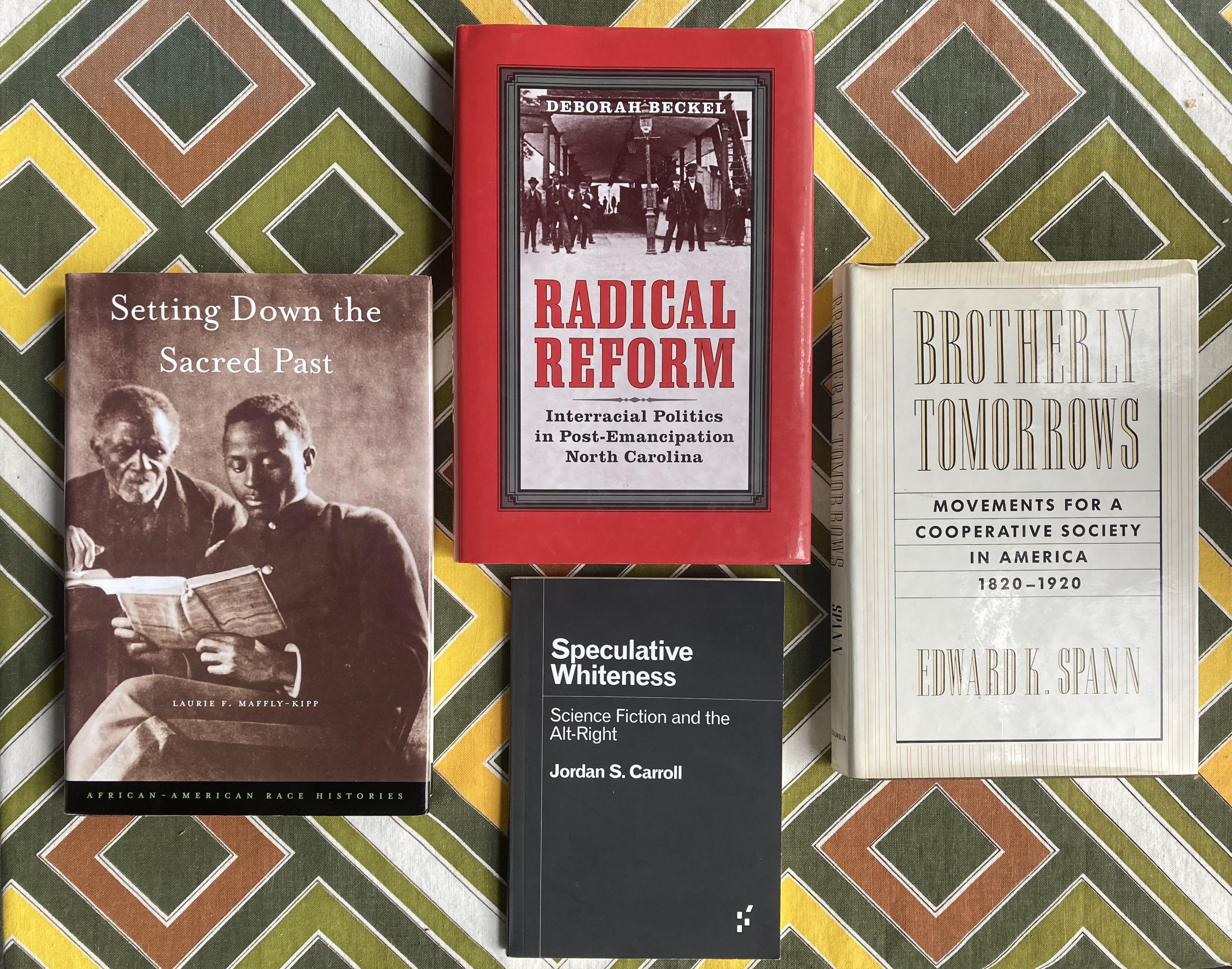
A large portion of my history reading this year pushed my general interest in labor history and leftist politics backwards into the 19th century. Unusual for me I know! Often I write about what I can write about not what I plan on writing about. A brief caveat worth repeating: I’m a PhD-wielding historian and have a high tolerance for academic texts. That said, I’d classify everything in my list as on the approachable side of things if you know the broad strokes of American history.
1. Laurie F. Maffly-Kipp’s Setting Down the Sacred Past: African-American Race Histories (2010): This filled a complete hole in my knowledge. While I had encountered history-centric militant abolitionist texts written by black authors, I did not know how they fitted into the larger historiographic project of the era. As my PhD looked at universal histories in the medieval period, I’m a sucker for all kinds of histories of historiography! This is a good one.
2. Deborah Beckel’s Radical Reform: Interracial Politics in Post-Emancipation North Carolina (2011): I read this one for my research project on a black utopian author. Beckel’s brilliant monograph looks at the race and politics in North Carolina after the end of Reconstruction–a “fusion” government of Republicans and Populists managed to take power (temporarily) from the white supremacist Democratic status quo in the 1890s. Depressing. Fascinating. I’m waiting for an alt-history that uses the 1898 election in North Carolina as a jonbar hinge — hah!
3. Edward K. Spann’s Brotherly Tomorrows: Movements for A Cooperative Society in America (1989): While an older monograph, Spann’s work is a fantastic survey of the fascinating range of radical social idealism-inspired communities that proliferated across America. I’m obsessed by left-wing ideologies that permeate the rural world and movements for working-class utopianism. Spann will inspire you to track down newer monographs on the social movements he surveys.
4. Jordan S. Carroll’s Speculative Whiteness: Science Fiction and the Alt-Right (2025): Rightly won the Hugo! I interviewed Carroll in January. In the book, he examines the ways the alt-right uses classic science fiction imagery and authors to mainstream fascism and advocate for the overthrow of the state. This is a short monograph designed to encourage thought. Highly recommended.
Goals for 2026
1. Keep reading and writing.
2. Read more reviews by other bloggers.
3. Cover more SF in translation.
For cover art posts consult the INDEX
For book reviews consult the INDEX
For TV and film reviews consult the INDEX
 Science Fiction and Other Suspect Ruminations
Aw shit. Your new format doesn’t work for me.
Hello John, I don’t understand. I have no new format. I’ve posted this style of year-in-review post for 11 of the 15 years I’ve had my site. I provided links to the last few years’ installments. Nor have I changed the site theme in a few years. I assume you mean something else.
What were your favorite pre-1985 SF reads of the year?
It says “choose a block” to comment. It never has said that before. I have no idea how to choose a block.
Ah, it still seems like you successfully left two comments. I think all you need to select is “paragraph” from the “choose a block.” WordPress a few years ago added “blocks” to the post formatting to allow more customization. It’s a bit clunky but I got used to it.
Sorry. It’s not something I can change on my end.
Happy New Year Joachim! Much appreciated with the recommendations this past year, including Leigh Brackett’s The Long Tomorrow. Your others are on the TBR (incl. Roshwald’s Level 7 and Holm’s Termush). I also need to check out Carroll’s Speculative Whiteness. I’ve heard nothing but good things of that recent offering. Finally, I would be right there with you on the alt-history of that 1898 jonbar hinge — admittedly, I had to look that term up. Great secondary source material from Zucchino’s Wilmington’s Lie (saw that in your photos the other day).
John
Hello John,
Thanks for stopping by. Yeah, the Zucchino is an interesting book but only part of the much larger picture that Beckel covers. I also recommend John Beeby’s Revolt of the Tar Heels: THe North Carolina Populist Movement, 1890-1901 (2008) and Matthew Hild’s Greenbackers, Knights of Labor, and Populists: Farmer-Labor Insurgency in the Late-Nineteenth-Century South (2007) for the larger picture of the era.
Level 7 is really good (I enjoyed it more than Termush although I read it many years earlier, so, who knows). Let me know your thoughts when you get to it!
Beneath the Shattered Moons by Michael Bishop was fantastic!
Hello, I enjoyed Beneath the Shattered Moons. Here’s my review: And Strange at Ecbatan the Trees (variant title: Beneath the Shattered Moons) (1976)
Have you read other Bishop works? I found the following even better (he’s a favorite of mine): A Funeral for the Eyes of Fire (1975), Stolen Faces (1977), and Transfigurations (1979).
My most recent Bishop review was his masterpiece “The Windows in Dante’s Hell” (1973), which was one of the stories in Catacomb Years (1979).
Thanks for the link to the review! I haven’t read Funeral or Transfigurations yet, although I own both. Will have to make sure I get to them this year.
Happy New Year, Joachim! I treasure your blog, it has led me to so many interesting books.
There’s a complex publication history related to Funeral. He completely rewrote it later, then published it under a different name, then the same name… I think it’s probably best to read the VERY first version (the Nebula-nominated one published in 1975) first. It’s the one I reviewed (I explain all the pub. stuff at the top of the review).
Thank you for the kind words!
Great overview & enjoyed reading your top picks. I really value your focus on short stories (which can often be overlooked in comparison with novels).
Likewise thoroughly enjoyed ‘Foster – you’re Dead!’ (what a great title) and Lieber’s ‘Coming Attraction’, both of which I read for the first time this year. Haven’t come across the others as yet, but will certainly keep them in mind for future reading.
I was hard pressed to think about my own top 5 short stories this year, but something along the following lines is probably a good match. In no particular order:
Jerome Bixby – It’s a GOOD life (brilliantly utilises a focused ‘show not tell’ approach. Although we quickly surmise that something is *very* wrong indeed in the story’s pastoral setting, the way in which the tension is held until the unnerving climax is just masterful).
David Masson – Traveller’s Rest (such a beautifully constructed tale, it’s conciseness arguably amplifying the impact of the time dilation theme at the heart of the story).
Frederik Pohl – The Gold at the Starbow’s End (loved the dual narrative here – in one of which our understanding of the plight of the spaceship crew is gleaned at one remove (via reports received by our main character). The ending is such a satisfyingly effective pay-off.
Philip K. Dick – The Days of Perky Pat (this was fascinating – ostensibly lightweight at the outset, but such a dark theme underpinning it all, which is brought into sharp relief in the closing paragraphs).
J. G. Ballard – The Last World of Mr Goddard (hard choice, simply because *everything* I’ve completed by Ballard has been a hoy to read. However, I’ve opted for what is probably a lesser known piece, because just when I think I have the ‘measure’ of Ballard, I come across another tale which prompts me to think again – and this particular story is one of the most haunting tales I’ve read in years.
Lots of honourable mentions of course to other short stories, but it would become a *very* long list! (‘Coming Attraction’ would certainly feature here too…)
Thank you for sharing your insightful reviews – always of great interest.
Thanks for stopping by and for your kind words! As you already know, I’ve covered a few on your list: the Pohl, Masson (not a favorite of mine, alas), and I’ve read but never reviewed the PKD (most of my PKD reading happened before I started my site).
If you get to any others on my list, let me know your thoughts.
I used to read far more novels. However, the reality is that due to the stress of my job I find it more challenging to review them.
My best pre 1985 read was undoubtedly the novella The Mask by Lem. Will need to read that Butler title, and maybe finally get me a collection of shorts by PKD.
Ah, I have not read that Lem novella. I read a TON of his novels (and some short fiction) before I started my site.
I look forward to any PKD reviews that you might post. But yes, I am partial to his short fiction. I’ll link my interview/discussion about “Foster, You’re Dead” when it’s posted. It’s the story of his I picked to cover. One of the best commentaries on nuclear war out there.
I love the short story recommendations. I’ve read stories by some of those authors, but none of these sound familiar. I need to look them up.
For pre-’85 science fiction, I read Kornbluth & Pohl’s THE SPACE MERCHANTS, which I thought was funny and not quite as mean as I expected. I also reread some fantasy: Le Guin’s THE TOMBS OF ATUAN and THE FARTHEST SHORE, still very good.
I’m also working my way through the Bujold’s Miles Vorkosigan books, but the one I read this year, Borders of Infinity, is from the late 80s.
Hello Hestia, thanks for stopping by! Which stories intrigued you the most? I remember enjoing The Space Merchants — I read it before my site. Same thing goes with the Le Guin, although it was so long ago…
I’ve read quite a few stories by Tiptree, but Painwise doesn’t sound familiar. The ones by Jack Dann sound good, too. I feel like I’ve read a couple of his stories (probably in best-of collections or anthologies) but I have no idea which ones.
Dann was my discovery of the year. Reminds me a lot of 70s Silverberg combined with a more overt Jewish mysticism and a willingness to engage in the metaphysical.
Hestia: I read Kornbluth & Pohl’s THE SPACE MERCHANTS, which I thought was funny and not quite as mean as I expected
Gladiator-At-Law is the Pohl & Kornbluth outing I slightly prefer over The Space Merchants.
That may be because of purely personal taste. Or because I feel it doesn’t get enough love compared to the other book, given that Gladiator goes more over the top in terms of black comedy and science-fictional out-there-ness — it feels, in fact, like a 1950s-era PKD novel like Solar Lottery and The World Jones Made, and presumably was a model in PKD’s mind when he wrote those books–and also because the targets Pohl and Kornbluth went after in it are the ones that now dominate the world in 2025, rather than Madison Avenue etc.
It’s meaner and more savage than Space Merchants, too, if that’s what you want.
Honestly, that sounds pretty great. I’ll have to look out for a copy.
I reviewed Gladiator-At-Law back in the day (2013) on the site: https://sciencefictionruminations.com/2013/09/16/book-review-gladiator-at-law-frederik-pohl-and-c-m-kornbluth-1955/
The review index: https://sciencefictionruminations.com/science-fiction-book-reviews-by-author/
Hello Mark,
I reviewed Gladiator-At-Law back in 2013. I must admit, it’s faded completely from memory — and I even wrote a review.
What were your favorite pre-1985 reads of 2025?
Synthajoy by Compton, The Years of the City by Pohl, and the short story ‘Baby, You Were Great’ by Wilhelm.
While I haven’t read the Pohl, the other two are topnotch.
I didn’t read that much SF in 2025. Izumi Suzukis Terminal Boredom collection and Angela Carters Infernal Desire Machines of Doctor Hoffmann were the SF high points for me, both of them really good.
I also liked a couple of old ones a lot – Perkins Gilmans Herland and Alexander Belyaevs Professor Dowells Head – despite both of them containing some badly dated elements.
Angela Carter’s The Infernal Desire Machines of Doctor Hoffmann is one of my SF favorite novels of the 70s. Never managed to review it. Definitely a good one!
Maybe 2026 will include more! Any SF reading plans for the new year? Thanks again for the Izumi recommendation.
I haven’t a lot concrete reading plans, my TBR pile is almost gone so I look forward to some rereading, where I’ll probably also return to SF favorites like Lem, Ballard, and PKD. I recently found a free copy of Aldiss’ Non Stop, and its a long time ago I read that one, so that’s also tempting.
Otherwise, I think there’s only one SF book in my collection that I haven’t read yet (a Soviet collection, including one or two stories I’ve read before), so it all depends on what I can find with danish second hand sellers. There’s some Ian Watson and Christopher Priest around right now, as well as Angela Carters Heores and Villains, so I’ll probably get some of those.
Only one…. omg. hah. As you could probably ascertain, I have close to 2k unread volumes.
Yes, I think you’ve mentioned this wild accumulation of yours before… impressive and somewhat scary!
A few years ago I did buy many more books than I had time for, but now I’m trying to keep it more balanced. I do probably still have around 20-30 unread books (not counting art books, which I seldom read), it’s just that only one of them is SF as far as I recall.
Joachim,
I read 73 SF (of 198 books). Most enjoyable for me, oddly enough, were four collections: Galactic Cluster (Blish), Billenium (Ballard), The Infinite Moment (Wyndham) and Another Kind (Oliver).
Continuing older novels I found “2894” or The Fossil Man (Browne) most amusing while The Republic of the Future (Dodd) was worth a reread. Omega: The Last Days of the World (Flammarion), The British Barbarians (G. Allen), The Star Rover (London), The Crystal Button (C. Thomas) and The Messiah of the Cylinder (Emanuel) were all flawed in some way.
In eight SF magazines of the ’50s, J.T. McIntosh was most notable.
Special mention should be made of Islandia (Wright, A): It was essentially a verbose record of failed romantic pursuits, ad nauseum.
Andrew
Happy New Year, Joachim!
Thank you for the review of Clay’s Ark, an excellent reminder to me to get busy with Mind of My Mind (I read Wild Seed in 2023).
Keep up the good work!
Hello Chad,
Thanks for stopping by. What were your thoughts on Wild Seed? I have not read that one yet — or rather, I read part of it and set it down (for whatever reason).
Wild Seed was a terrific book with an incredible scope. I enjoyed it very much but not quite as much as the Lilith’s Brood trilogy, which knocked my socks off.
Thanks Chad. If you get to Clay’s Ark this year, let me know.
I would have commented sooner but I’m still recovering from a fairly nasty virus we both caught at the end of the year…
I’ve read very little older sf&f this last year – a short but enjoyable Margaret St.Clair collection (The MStC Science Fiction Megapack) and a 1948 William Tenn novelette called The Ionian Cycle, which was also quite fun. Other older novels I read weren’t particularly genre – Another Roadside Attraction by Tom Robbins (a counter culture conspiracy romp from the early 1970s) and Lolly Willows (1926) by Sylvia Townsend Warner, which apparently helped inspire a pre-War English witchcraft revival!
Also two Strugatsky stories – not only Wanderers and Travellers, which you discussed, but also An Emergency Case, both from the Path into the Unknown anthology. Thinking back I think I preferred An Emergency Case… Sorry I never made time to comment earlier.
I/we did, however, get into the habit of listening to a couple of chapters of various audio books before bed most evenings. Not all of them fit the time period but we worked our way through Vance’s Demon Prince set, Miller’s Earth Abides, and Simak’s Mastodonia, which focused heavily on big game hunting of dinosaurs as the obvious way to make money from time travel. I hadn’t remembered that it played such a major role in the book.
I think we’re eying up Helliconia Spring next!
Hello Mike,
No worries. I am about to read another Tenn collection. He’s one of my 50s favorites. I should 100% read more St. Clair… alas.
Leftist politics + historians + SF? Try 1988’s “The Sykaos Papers”, a hilarious satire by Marxist political historian E.P. Thompson. Alien academics reconstruct the journey of culture-shocked scout/poet Oi Paz from journal entries, interviews, and poetry as he engages in anthropological exchange with the local Sykotics (AKA Earthlings). Wild narrative structure and even typography, the text sometimes breaks into verse or flips upside down, but somehow it all makes some sense…
My 2025 blind pick surprise: “The Year of the Last Eagle” by Leona Train Rienow, 1970. In an Idiocracy-esque 1980s hyper-America, an astronaut-ornithologist is tasked with protecting the last endangered bald eagles. An international bidding war erupts over a hole in the ground, noise-dampening surgical deafness is trendy, barbecue napkins spark an economic crisis, and the most powerful conservation lobby in America combats deadly hovercars – primarily to prevent them from crashing into endangered plastic lawn umbrellas. References to 1960s ecological hot-button issues were interesting to spot.
Hello Trent, thanks for stopping by. The latter of the two sounds far more interesting. Not only are the 70s far more interesting historically than the later 80s (I get tired of Thatcher and Reagan) but I’m always interested in SF that touches on ecological themes. I struggle with a lot of science fiction that’s madcap and “hilarious.” I’ve heard of both but do not yet own copies.
As for the “History PhD. [..] History of Leftist thought.” Bluesky blurb I asumme you’re referencing, here’s an example of the stuff I like analyzing if given the time to really dive in: “We Must Start Over Again and Find Some Other Way of Life”: The Role of Organized Labor in the 1940s and ’50s Science Fiction of Clifford D. Simak
I am currently writing an even more intense (with a lot of original research) article on a turn of the 19th century African American utopian author/politician.