What pre-1985 science fiction adventures have you finished this summer? Any great reads? Disappointing ones? Intriguing discoveries? Here’s the June installment of this column. I know, it’s been a while…
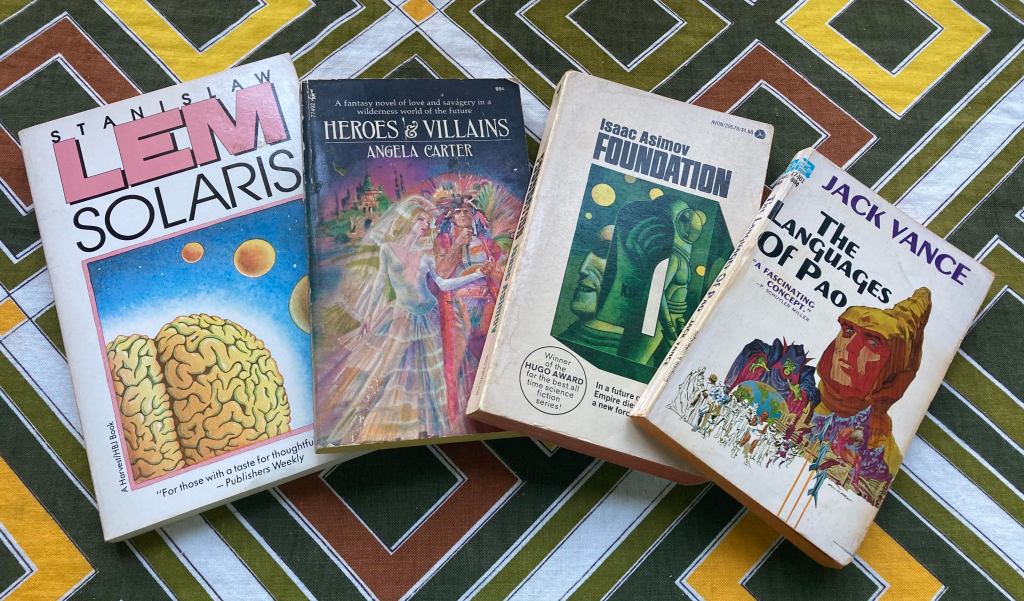
A selection of read volumes from my shelves
On Bluesky, a Youtube channel that I follow sought to collate a list influential cyberpunk novels for a future video or review series from the first generation of the subgenre’s practitioners. Other than Pat Cadigan’s multiple contributions, the list was entirely male. Knowing me, I suggested a few works by female authors that engaged with similar ideas that might be considered either important predecessors–for example Joan Vinge’s “Fireship” (1978) and Chelsea Quinn Yarbro’s Hyacinths (1983) (I think the proto-internet isn’t that central so it tends to be dismissed)–or works by the second generation right around the original poster’s cutoff date of 1990: Lisa Mason’s Arachne (1990), late 80s short fiction by Candas Jane Dorsey, Melissa Scott’s Trouble and Her Friends (1994), Gwyneth Jones’ Escape Plans (1986) and White Queen (1991), Misha’s Red Spider White Web (1990), and Nisi Shaw’s “I Was a Teenage Genetic Engineer” (1989).
Intrigued about why so many female authors started writing cyberpunk in the 90s, I tracked down Carlen Lavigne’s book Cyberpunk, Feminism, and Science Fiction (2013) which charts feminist interpretations of the genre between 1981 and 2003. She admits that before 1990, other than Pat Cadigan, cyberpunk was primarily white and male. Unfortunately, as cyberpunk lost its steam and cultural cache in the 90s, female authors increasingly offered their unique critiques on the genre and larger contemporary movements. My takeaway, if you read newer SF, is not to ignore the slightly later takes by feminist authors–they tend to be given short shift in the established canon of the subgenre. Other than the few I mentioned above, the following caught my eye: Marge Piercy’s He, She and It (1991), Emma Bull’s Bone Dance (1991), and Raphael Carter’s The Fortunate Fall (1996).
Also, before we get to the photograph above and the curated birthdays, let me know what pre-1985 (or after if it’s cyberpunk by women!) SF you’re currently reading or planning to read.
The Photograph (with links to reviews and brief thoughts)
- Stanislaw Lem’s Solaris (1960, trans. 1970): One of those novels on my shortlist to reread. I remember how transfixed I was by Lem’s heady combination of critique of humanity’s urge to explore outward and the personal of memory and trauma. A look at Wikipedia revealed a Soviet TV adaptation earlier than Tarkovsky’s 1972 masterpiece: Boris Nirenburg and Lidiya Ishimbayeva’s TV play Solaris (1968).
- Angela Carter’s Heroes & Villains (1969): Carter’s prose tears and rends with unnatural power. Recommended for fans of experimental, feminist, and well-written 60s New Wave science fiction. I suggest tracking down The Infernal Desire Machines of Doctor Hoffman (1972) first.
- Isaac Asimov’s Foundation (fix-up 1951): I impulsively started watching the recent TV adaptation (through episode five). Solid. My memory of my original read-through back in my teens remains mostly lost to time so I wasn’t fixated on show’s changes.
- Jack Vance’s The Languages of Pao (1958): I found the ideas in The Languages of Pao elevate the story above its banal plot and muddled action. Recommended for fans of early social SF.
What am I writing about?
I’m currently working on a review of a rare reread — John Brunner’s fascinating The Shockwave Rider (1975). Stay tuned. I’m also working on an article for issue three of Rachel S. Cordasco’s magazine The SF in Translation Magazine. I plan on contributing one review of pre-1985 SFF in translation for each issue. If you haven’t tracked down the magazine (or taken a look at my review in each) then you’re in for a treat! Here’s the link to free PDFs of each issue. The next issue will be published at the end of November.
If you missed any of my articles and review from the past few months, here are links to some of my favorites.
- Exploration Log 17: Interview with Loïg J. F. Pascual on 1970s-1980s Feminist Science Fiction Fandoms
- Luděk Pešek’s Trap for Perseus (1976, trans. Anthea Bell, 1980)
- Exploration Log 16: Clifford D. Simak’s speech “The Face of Science Fiction” (1953)
- Exploration Log 15: Clifford D. Simak’s fanzine article “The Future of Science Fiction” (1941)
- George Alec Effinger’s The Wolves of Memory (1981)
What am I reading?
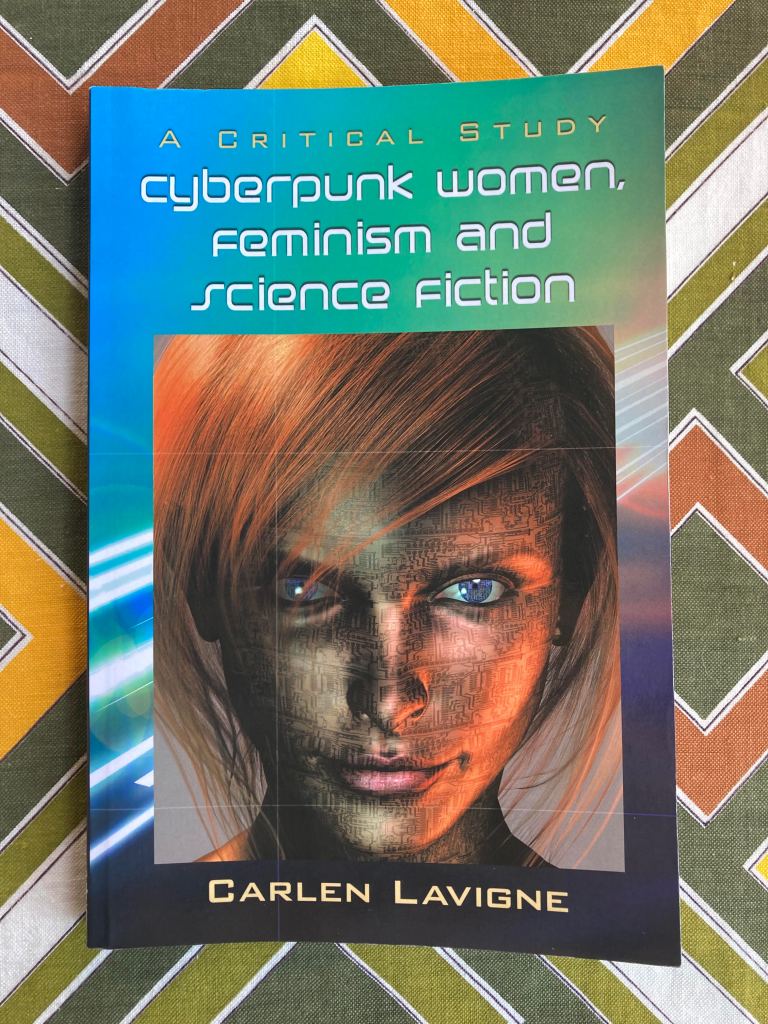
Uncredited cover for the 2013 edition
I read Carlen Lavigne’s entire book Cyberpunk, Feminism, and Science Fiction (2013) a few days back while waiting for vet updates on my cat — we had to visit the pet emergency room. He’s on the long road to recovery but we had quite the scare. See comments above for my thoughts on this monograph! Thought provoking for sure!
A Curated List of SF Birthdays from the Last Two Weeks [names link to The Internet Speculative Fiction Database for bibliographical info]
September 12th: Henry Slesar (1927-2002)
September 12th: Frank K. Kelly (1914-2010).
September 14th: Martin Caidin (1927-1997). In addition to his slick best-selling SF thrillers, he claimed to posses the power of telekinesis.
September 14th: Martin Caidin (1927-1997). In addition to his slick best-selling SF thrillers, he claimed to posses the power of telekinesis.
September 14th: Artist Rowena Morrill (1944-2021). Can’t say I’m much of a fan of her work.

Charles Moll’s cover for the 1st edition of Norman Spinrad’s No Direction Home (1975)
September 15th: Norman Spinrad (1940-). My most recent Spinrad review: “The Weed of Time” (1970).
September 15th: Chelsea Quinn Yarbro (1942-). I’ve reviewed her post-apocalyptic novel False Dawn (1978) and Hyacinths (1983), an unsettling dystopian tale of a future where even the unregulated creative world of dreams is harnessed and controlled.
September 15th: Howard Waldrop (1946-2024). I thoroughly enjoyed Waldrop’s “Mary Margaret Road-Grade” (1976).
September 16th: Lisa Tuttle (1952-). I can’t dispel the disquiet caused by her story “Stone Circle” (1976).
September 18th: Francis Stevens (1883-1948). Best known for her SF satire The Heads of Cerberus (1919).
September 19th: Hilary Bailey (1936-2017). I’ve covered a few of her short stories. I remain most impressed with her novel co-written with her then-husband Michael Moorcock The Black Corridor (1969).
September 19th: Damon Knight (1922-2002). My most recent Knight review: Far Out (1961).
September 19th: Tanith Lee (1947-2015). If you haven’t read any of her science fiction yet, check out her brilliant and moody Electric Forest (1979).

Chris Foss’ cover for the 1977 edition
September 20th: Keith Roberts (1935-2000). Check out his wonderful collection The Grain Kings (1976).
September 20th: George R. R. Martin (1948-). I’ve only covered his early short story “The Second Kind of Loneliness” (1972) on my site. I should read more of his early SF.
September 20th: James P. Blaylock (1950-). Remains a complete unknown to me. I always see his name on the shelves of my local Half Price Book store.
September 20th: A. A. Attanasio (1951-). His monolithic looking Radix (1981) judges me, unread, from the shelves (for years). I have yet to explore his work.
September 23rd: Wilmar H. Shiras (1908-1990). is best known for her short stories in the Children of the Atom sequence–starting with “In Hiding” (1948)–about hyper-intelligent mutant children and a well-meaning psychiatrist who brings them together. I reviewed the majority of her early work here.
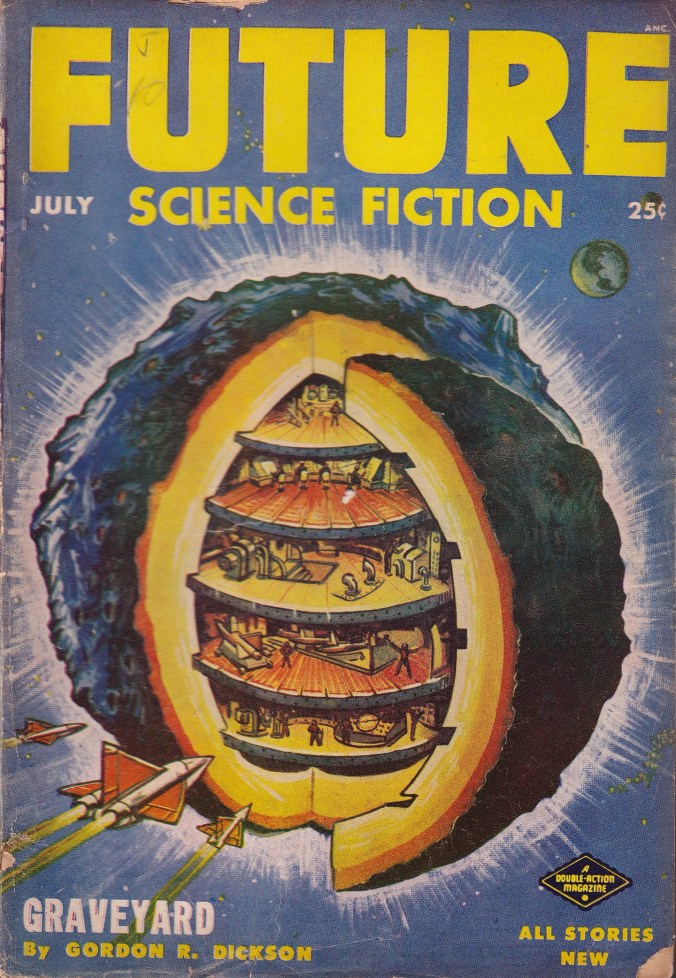
Chris Foss’ cover for the 1977 edition
September 23rd: Richard Wilson (1920-1987). I’ve only reviewed Wilson’s controversial “Mother of the World” (1968). I reviewed his short story “Strike” (1953) for my ongoing series on labor issues in SF.
September 24th: Artist Jack Gaughan (1930-1985). While he’s never been one of my favorite big name artist of the era, I find an occasional cover or interior art appealing. His cover for the 1969 edition of Ursula Le Guin’s The Left Hand of Darkness (1969) is a great example.
September 24th: John Brunner (1934-1995). The author of my favorite SF novel: Stand on Zanzibar (1968). As I mentioned earlier in the post, I’m working on a rare reread review of one of his best works.
September 24th: David Drake (1945-2023).
September 24th: John Kessel (1950-).
September 25th: J. Hunter Holly (1932-1982).
September 26th: Douglas R. Mason (1918-2013). An incredibly prolific British SF author… I’ve not enjoyed what I’ve read of his so far.
For book reviews consult the INDEX
For cover art posts consult the INDEX
For TV and film reviews consult the INDEX


I revisited Shockwave Rider a couple of years ago. Still a very prescient look at the poorly-distributed-access-to-information age. I’ve read Foundation so many times that I can bring most of it to memory without much effort – it was (shall we say) foundational to my SF reading.
Recently read Vinge’s “The Witling” (1976) which has some very nice worldbuilding and prefigures some of his later concepts as well.
As you probably know, I’m not much of a rereader. Maybe that will change as a get older. That said, I was very pleased when I reread The Shockwave Rider. As I hope my review makes clear whenever I find a minute to finish it, I enjoyed it far more than when I read it back in my late teens.
I acquired a copy of Vinge’s The Witling a while back. I don’t know much about it.
Looking forward to your thoughts on Shockwave Rider. I read it (relatively) recently, and though it had a lot of interesting stuff in it, I wasn’t super impressed, perhaps – as with Stand on Zanzibar – because I had read The Sheep Look Up earlier, which I think is kind of in a different league.
As I have perhaps mentioned before, Solaris is my all time favorite book. I have read it maybe three times (though it’s some time ago), and I’d still like to reread it again soon.
My summer SF reads were, as mentioned last time, Kate Wilhelms Infinity Box, Christopher Priests The Glamour and a reread of Ballards The Drowned World. The latter also among my all time faves, and as good as I remembered. The stories in Infinity Box were mostly brilliant, though one or two didn’t really do it for me. The Glamour was great almost all the way through, but I found the ending to be a big letdown.
Since then I’ve also read Keith Roberts Pavane, on behalf of all the people saying it’s one of the greatest alternative history novels. It could well be – I’m not really a fan of alternative history and it didn’t change that, but I enjoyd the writing and really liked several of the stories. Didn’t find the resolution particularly convincing though.
The Glamour was spectacular. I was a bit overwhelmed by Priest’s vision that I didn’t write a full-length review. There’s a short one on the site.
I also was frustrated–for, what I suspect, are quite different reasons–by some elements of Pavane. I have returned to short stories like “The White Boat” from the sequence (albeit added to UK editions much later) and found them quite spectacular.
Wilhelm is a favorite of mine. I’ve only read a few of the stories from that collection.
So is the Ballard you mention — never managed to review it… that seems to be the theme of this selection of summer reads. I’ve read them but never managed to review them.
I’m not sure why you’d recommend Dr Hoffman before Heroes & Villains; I would say the latter is far more accessible to most sf readers. I absolutely love all Angela Carter’s works. For those asking which to start with, I usually recommend The Magic Toyshop.
Of those in your opening photo, I liked all but the Asimov. But then, I frequently find myself at odds with popular opinion, especially in sf.
Why? Because it’s one of my absolute favorite SF novels of the 70s! And yes, I certainly would not call it accessible but I assume readers of my site know my penchant for the oblique and experimental.
I don’t have firm memories of Foundation. I read it as an older teen — half my life ago — and have not returned.
I read The Big Book of Cyberpunk anthology when it was published. It does a good job filling in writers post-1990 of the Cyberpunk sub-genre who are females or non-white/English language, although only short fiction. It was a high-quality book, as I think I only found two or three stories not worth reading. There was a story from Bulgaria and one from South Korea which stood out as my favourites. That would be a nice place to go to find some of the more recent names in Cyberpunk, if one had read Gibson, Sterling, Cadigan, etc.
There’s also James Tiptree Jr.’s “The Girl Who was Plugged In” as far as proto-Cyberpunk by a woman.
I have always considered Steven Barnes’ “Streetlethal” trilogy as a neglected work of early Cyberpunk, with the first novel (1983) predating Neuromancer.
As far as The Shockwave Rider, I enjoyed it until the damp ending. After all that promise, it ends with the decision that they can now do a better job of collecting progressive income tax? Brunner couldn’t stretch his imagination a bit more than that? I am in agreement that the writing and plot doesn’t hold up as well as Stand on Zanzibar or The Sheep Look Up, even if it’s not as dated as large parts of Stand on Zanzibar. It’s the writing style that makes Stand on Zanzibar work so well rather than the plot.