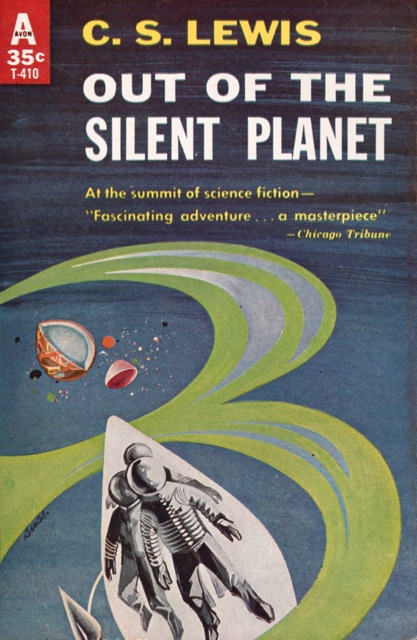
(Cover for the 1960 edition of Out of Silent Planet (1938), C. S. Lewis)
Art Sussman produced a remarkable corpus of SF and other pulp covers (mysteries, crime, etc). He could easily shift gears between Richard Powers-esque surrealism—although distinctly his own take—to covers that suited an Agatha Christie mystery (browse the range here). I would be wary comparing him to Powers until you skim through the latter’s late 50s early 60s art (definitely an enjoyable activity!). Although Powers is still far superior, both were part of the SF art movement increasingly experimented with surreal/metaphoric and experimental art (there are still spaceships lurking around the edges, and futuristic cities, and other pulpy moments).
There is a precision of vision with Sussman’s art—his cover for the 1960 edition of Out of Silent Planet (1938), C. S. Lewis places the astronauts in an outline of a vessel with strange hints at alien planets and experiences scattered gem-like in the distance. Sussman’s focus on the human form — often surrounded by surreal forms and humanlike membranes — showcases agony and despair. A great example (and my favorite of the bunch) pairs jagged black fields with a bloodied man, the 1960 edition of Beyond (1960), Theodore Sturgeon.
Thoughts and comments are welcome! Do you have a favorite cover? Have you read any of the books?
I read and reviewed Judith Merril’s collection Out of Bounds (1960). I read and somewhat enjoyed C. S. Lewis’ Out of Silent Planet (1938) but did not continue with the sequels in the Cosmic Trilogy….
You all know my opinions of A. E. van Vogt….
For more explorations of cover art consult the INDEX

(Cover for the 1958 edition of The Mind Cage (1957), A. E. van Vogt)
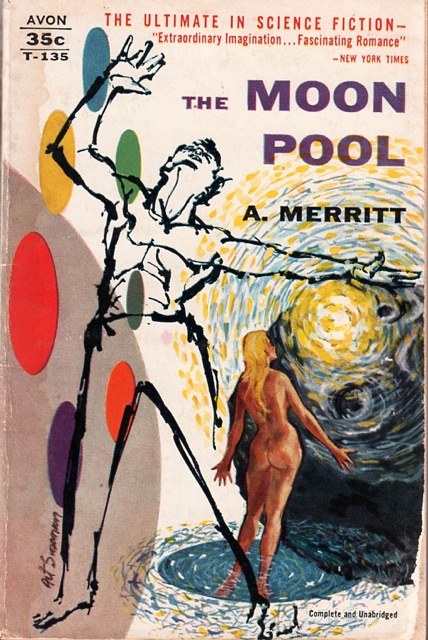
(Cover for the 1956 edition of The Moon Pool (serialized 1919), A. Merritt)

(Cover for the 1957 edition of The Planet Explorer (variant title: Colonial Survey) (1956), Murray Leinster)

(Cover for the 1959 edition of Wasp (1957), Eric Frank Russell)
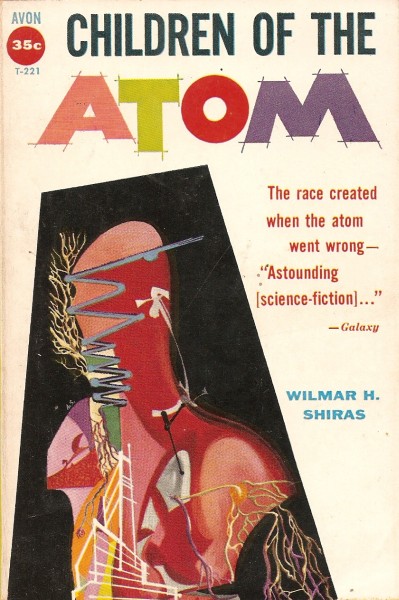
(Cover for the 1958 edition of Children of the Atom (1953), Wilmar H. Shiras)
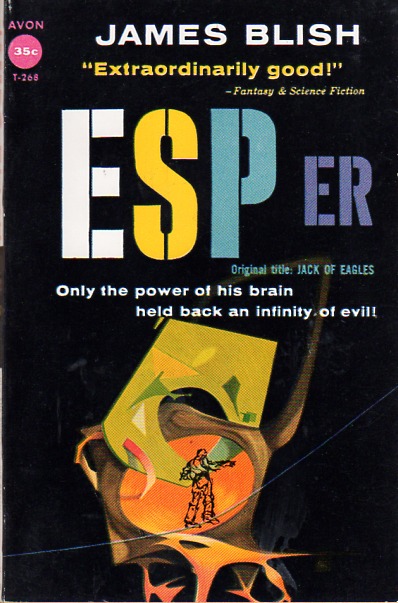
(Cover for the 1958 edition of ESPer (variant title: Jack of Eagles) (1952), James Blish)

(Cover for the 1959 edition of Aliens 4 (1959), Theodore Sturgeon)

(Cover for the 1962 edition of The Fantastic Universe Omnibus (1960), ed. Hans Stefan Santesson)

(Cover for the 1960 edition of Beyond (1960), Theodore Sturgeon) 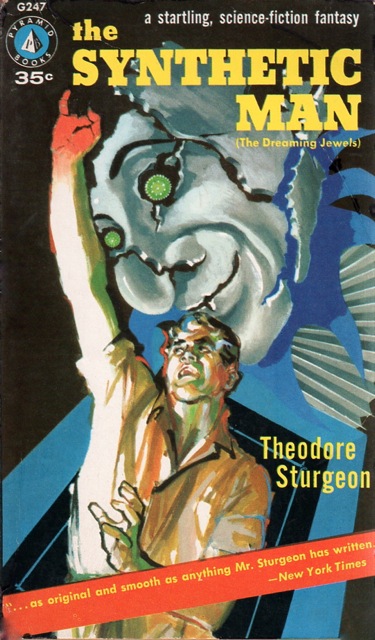
(Cover for the 1957 edition of The Synthetic Man (variant title: THe Dreaming Jewels) (195), Theodore Sturgeon)
(Cover for the 1960 edition of Out of Bounds (1960), Judith Merril)
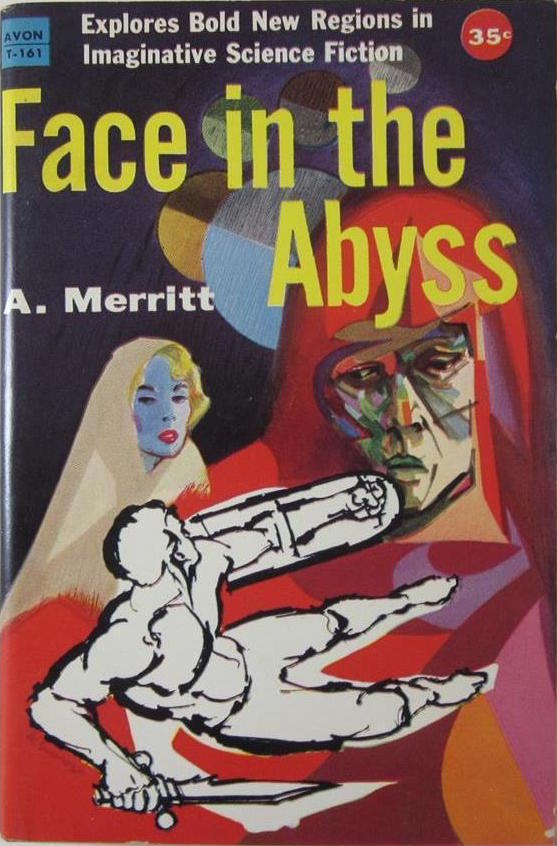
(Cover for the 1957 edition of Face in the Abyss (1931), A. Merritt)
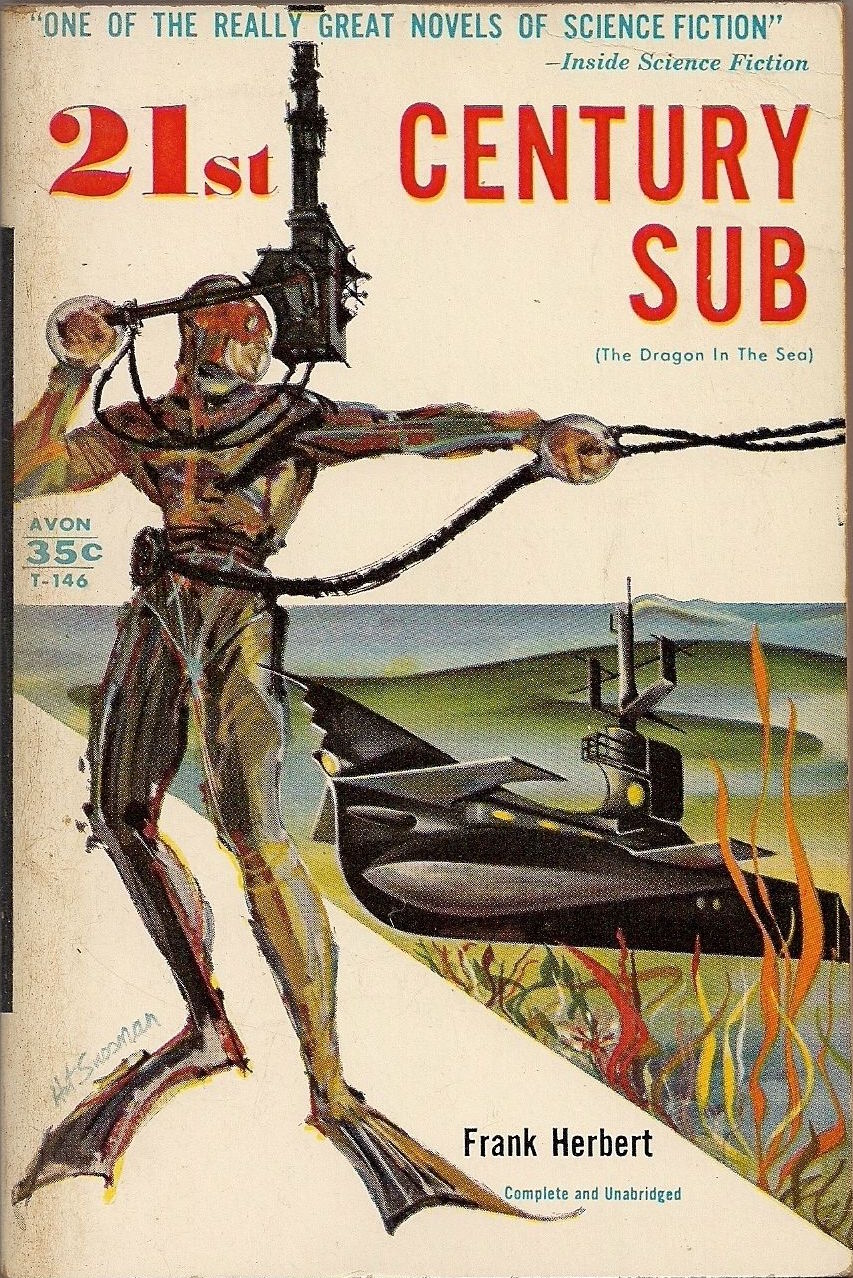
(Cover for the 1956 edition of 21st Century Sub (variant title: Under Pressure), Frank Herbert)
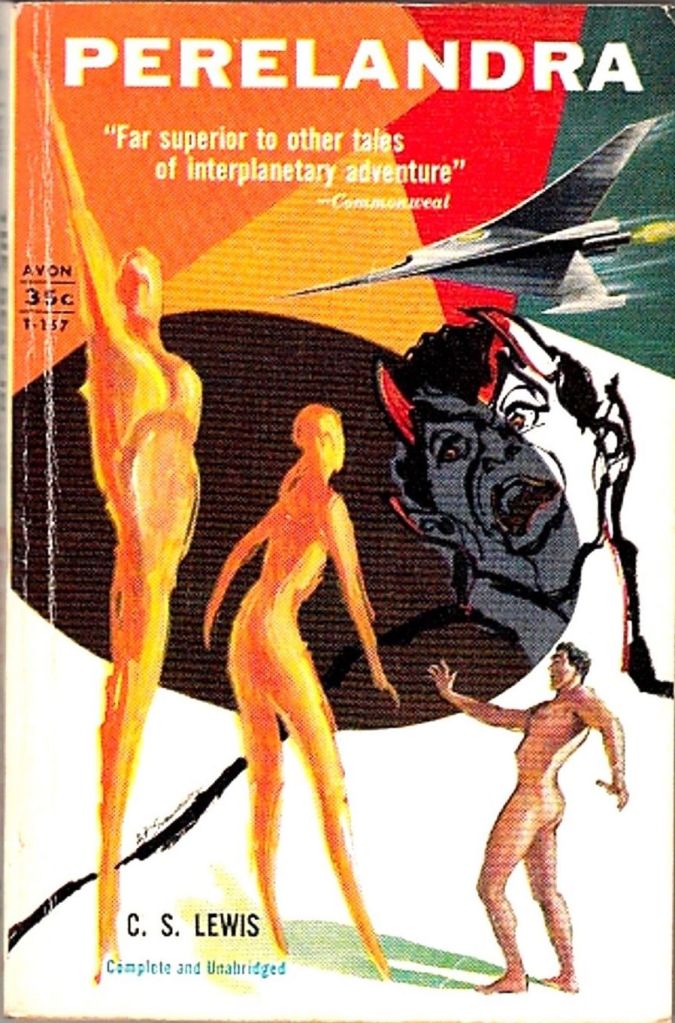
(Cover for the 1957 edition of Perelandra (1943), C. S. Lewis)
 Science Fiction and Other Suspect Ruminations
I don’t remember seeing any of these back then. Usually, your exhibit of covers has mostly books I remember seeing, if not owning.
I’m surprised as they are from the major presses – Avon, Permabook, Pyramid Books, etc. Do you enjoy them? Favorites?
I own the Permabook 1958 edition of Eric Frank Russell’s The Wasp (1957).
Those are stunning and very much of their time. Love Out of the Silent Planet – I really should re-read it!
I read it soon after I read The Lion, the Witch and the Wardrobe (and its various sequels and prequels) and I’m not sure I really understood what he was doing as I was quite young….
Hi
If you had mentioned his name it would not have rung a bell but I remember his distinctive style. I have a number of them including Wasp, Under Pressure, The Planet Explorer and Aliens 4. I probably have some of the Merritt as I collect him. As far as reading them I read all three Lewis, Out of the Silent Planet is the best in my mind, Wasp was a strong work, I read Children of the Atom, but I preferred the original short story by Shiras called In Hiding it made a big impression on me as a kid. I suspect I have read some of the Leinster but I will have to check. I have always loved the 21st Century Sub cover but you have collected lots of great images. Wasp is anther great one I love the city in the distance.
Thanks for this.
Guy
I identified a few of these covers on style as they are not always credited in The Internet Speculative Fiction Database — goes to show how distinctive his art is though!
That said, Powers’ Merritt covers are superior. Here, Richard Powers’ cover for the 1956 edition of The Ship of Ishtar (!924)
Hi
The Powers is great I will have to keep my eyes open.
Thanks
Guy
Won’t lie, in that single image he evokes so much more than the Sussman one. As I look at more and more art it’s hard to escape my initial assessment of Powers — i.e. he’s brilliant.
Great collection of covers — I have several of those (ESPer for sure), and always enjoyed Sussman’s surrealistic style. Not as much as Powers, but still vivid and cool at his best.
Actually, most of the Sussman covers I own are for crime novels, like this one…
Or this one…
And I think those really just highlight that he was not very good at illustrating realistic people. His covers for MOON POOL and PLANET EXPLORER I think work because of how stylized the characters are. The dude on THE SYNTHETIC MAN just does not work for me, haha!
ugh, apparently the comment ate my images, so here are the links instead:
I love the two people on the bottom of the Case of the Dark Wanton — his dark black lines, the red blot, stirring stuff!
Yes! I love his use of dark, stylized lines to illustrate people. Very evocative and somewhat primal.
“Vivid and cool” are good descriptors — especially when they have more crime novel visual elements, for example his cover for the 1957 edition of Face in the Abyss (1931) (similar to The Caste of the Dark Wanton below).
And yes, The Synthetic Man covers doesn’t work….
On the whole I enjoy his work — and one can see how he reframes other pulp styles as he was so prolific for the SF audience (and sometimes it’s just a spaceship in the distance, haha).
Thanks for the comment!
While I have most of these books, and while I find most of the cover artwork interesting, to be honest, I find myself reacting indifferently to the artist. With some of these covers being downright ugly. A couple are fairly good though, but the rest look like they were done on the artist’s lunchbreak, and seem to represent everything that is wrong with interpretive cover art. I know that I speak blasphemy, but some of favorite surrealist cover artists were Ron Walotsky, Karel Thole, and Paul Lehr.
I’ve read a number of these books, but then, I like pulp fiction, and I just reviewed the Leinster book for Amazon. Twice.
One reason I selected Sussman was the fact that he was a contemporary of Powers when Powers was creating his early 50s surreal covers while Ron Walotsky, Karel Thole (a few late 50s covers), and Paul Lehr were mostly creating their art in the 60s… And yes, I enjoy Powers, Thole, Lehr, and recent artists I’ve featured like Anita Siegel far more.
The other reason I chose him were the clear connections (and deviations) from more standard pulp genre art — crime/mystery fiction (a few which Admiral_Ironbombs posted above). You can see how he repurposes those conventions for SF.
Point taken. Still, if you more good surrealism check out some of Ebel’s artwork, check out http://www.isfdb.org/cgi-bin/pl.cgi?182265 for an example of his work. Also, some of Ed Emshwiller’s art http://www.isfdb.org/wiki/images/4/4d/KLLRTCMNZL1954.jpg from the fifties is work checking out.
Thanks! I know them well — I’ve looked through both of their catalogues.
And by Ebel I suspect you mean Alex Ebel? I’ve noticed in the past that a lot of his 50s covers are not credited on isfdb.org… Alas.
http://www.isfdb.org/cgi-bin/ea.cgi?25577
Well, as somebody who edits for isfdb I know that the rules are to credit artwork only if the artwork A) has been credited in or on the book, B) signed, and signatures have to match from book to book, or C) credited by a reliable source. (website, collection, relative, etc.). Sadly, Ebel is not necessary a popular enough artist to have had an extensive fan following, and as such, no real effort has been made to ID or study his work. Also, a lot of artists either don’t sign their work, or the signature is cropped off the published work. Artists get no respect.
Ah, you’re the one who identified a cover for one of my art posts way back in 2012 as Ebel? i.e. you commented under “MLB”?
***Blush*** Yup, MLB is me.
I did not know you were a fan of the site for so long! Glad you decided to join in on the discussion after years of lurking (haha). I appreciate all your comments and insights.
I have only discovered your blog now. I love the work of Richard Powers, Robert Forest and Art Sussman. What I find shocking is how sure I was that many of Sussman’s works were NOT done by Powers. I am having to re-think many covers. Thank you for clarifying this. I will look forward to future posts.
Sorry, I meant that I was sure that many of Sussman’s covers were Powers’. Surprised they were actually Sussman’s.
Thanks for visiting! While I track down better images (many from my own collection) for these posts, I also utilize The Internet Speculative Fiction Database for the publication dates, artist citations, and other bibliographical info. You can search by artist, author, publisher, etc. It’s a great resource: http://www.isfdb.org/cgi-bin/index.cgi
This was the Wasp cover my father / older brother had, and the cover is part of what drew me in (I thought from the pose, he was going to be some kind of alien/superhero like Spiderman): https://pangobooks.com/books/2c1c033d-1493-470f-be40-a4475791fb52-rc5mEAIxF9UVaZsz3dQRMpC9Zgx1 But despite it not at all being what I thought it was going to be, I liked this Eric Frank Russell enough that I read it again, once I’d gotten the hang of it my first time through.
Gene Szafran, the artist of that gauzy cover, is perhaps my least favorite of the main artists of the day. Airbrush. Fuzz. No thanks! haha.